
Pivot points have been part of professional trading for decades, yet they remain one of the most misunderstood tools among retail traders.
Most traders believe a pivot level is supposed to reverse the price.
So they buy every support pivot and sell every resistance pivot.
After a few losing trades, they conclude that pivot points no longer work.
The problem is rarely the pivot.
The problem is the way it’s being used.
A pivot level is not a trading signal. It is simply a location where market participants may react.
The real edge comes from understanding when that location has enough supporting evidence to justify risking capital.
After looking at years of charts on the forex and indices one lesson stands out. We very rarely see high grade pivot trades because of the pivot. They occur when numerous independent considerations point to the same decision.
That is why many experienced traders only take pivot trades when three specific conditions align.
This article explains those three conditions, why they matter, how to recognize them in real time, and why filtering pivot trades dramatically improves consistency compared to treating every pivot level as an automatic entry.
Why Pivot Points Still Matter
Algorithmic trading has grown, yet pivot points remain popular with discretionary traders, institutions and quantitative systems.
Daily pivot levels are non subjective. Every trader using the same calculation sees identical levels.
That shared visibility creates self-fulfilling behavior.
Price frequently pauses, accelerates, or reverses around these areas because thousands of market participants are watching them simultaneously.
The mistake is assuming every reaction deserves a trade.
Markets react to many levels.
Only a small percentage create meaningful opportunities.
Research Supports the Importance of Key Price Levels
The CME Group explains that price often respond to widely observed reference levels because they influence order placement and liquidity concentration across futures markets.
The Bank for International Settlements (BIS) continues to emphasize that liquidity and order flow play a major role in short-term price discovery, particularly during active market sessions.
Research published by the Corporate Finance Institute (CFI) also highlights that pivot points are best viewed as potential support and resistance zones rather than standalone buy or sell signals.
For active traders, the takeaway is simple.
A pivot level matters because traders pay attention to it.
Whether it becomes a profitable trade depends entirely on the surrounding market context.
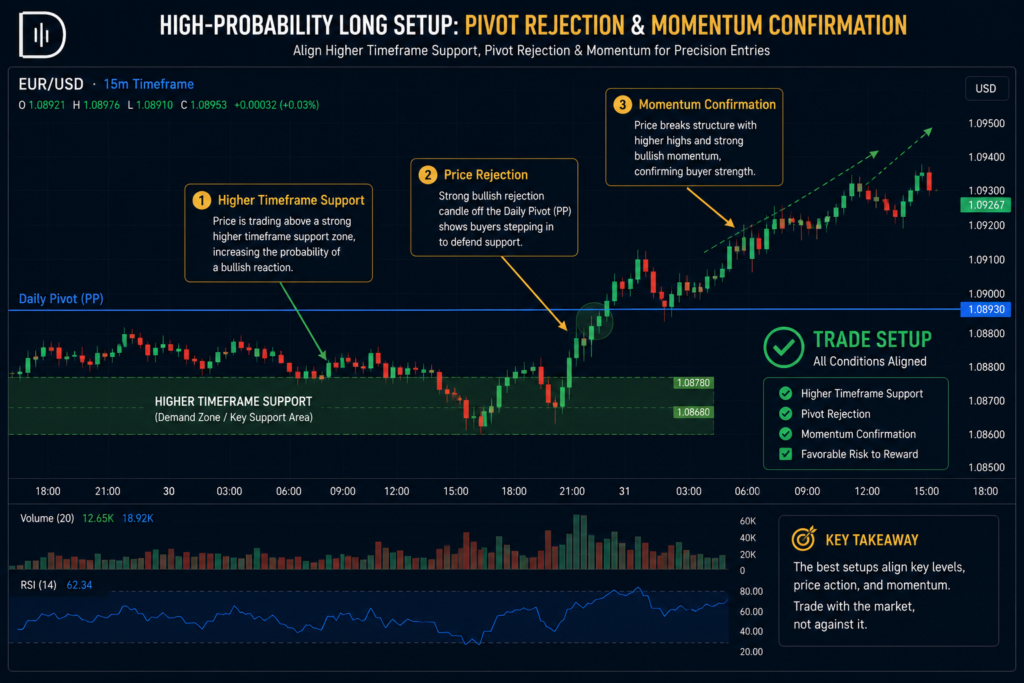
Condition One: The Pivot Must Align With Higher Timeframe Structure
This is the filter that eliminates the majority of poor setups.
Suppose today’s central pivot sits directly inside a major daily support zone.
That immediately gives the level more importance.
Now imagine the same pivot sits in the middle of yesterday’s trading range with no significant structure nearby.
Technically, both are pivot levels.
Practically, they are completely different trades.
Professional traders rarely allow an indicator to override market structure.
Instead, they ask whether the pivot reinforces what higher timeframes are already suggesting.
For example, if the daily trend remains bullish and price pulls back into a pivot that overlaps with previous resistance turned support, the probability of a meaningful reaction generally improves.
This idea builds naturally on our article What Does Liquidity Sweep Look Like on a Chart, where structural context determines whether a reaction is worth trading.
Condition Two: Price Must Show Clear Rejection
A pivot level is not a confirmation in itself.
Price activity gives you confirmation.
Many traders set limit orders right at the pivot levels and don’t wait for the market to react, falling into the trap.
That approach often produces unnecessary losses because markets regularly trade through pivots before choosing direction.
Instead, observe what happens after the price reaches the level.
Does momentum slow?
Is the price rejecting the level quickly?
Buyers: Absorbing Selling Pressure?
Are buyers swamped by sellers?
The rejection candle, failed breakout, liquidity sweep or market structure shift tells you so much more than the pivot itself.
The pivot tells us where to concentrate attention.
Price action tells you what you should do.
Condition Three: Momentum Must Support the Trade
The last condition is often forgotten.
Even the best pivot and structure might go wrong if the momentum is wrong.
Let’s say the price has dropped sharply and is at a daily support pivot.
The arrangement is visually pleasing at first sight.
But volume is growing.
There is still aggressive bearish momentum.
No buying pressure.
Taking that long trade simply because the price reached support ignores the market’s current behavior.
Now imagine another scenario.
Price reaches the same pivot.
Selling pressure weakens.
Volatility contracts.
Buyers are slowly regaining control.
The rejection takes place over a couple of candles before price starts to create higher highs.
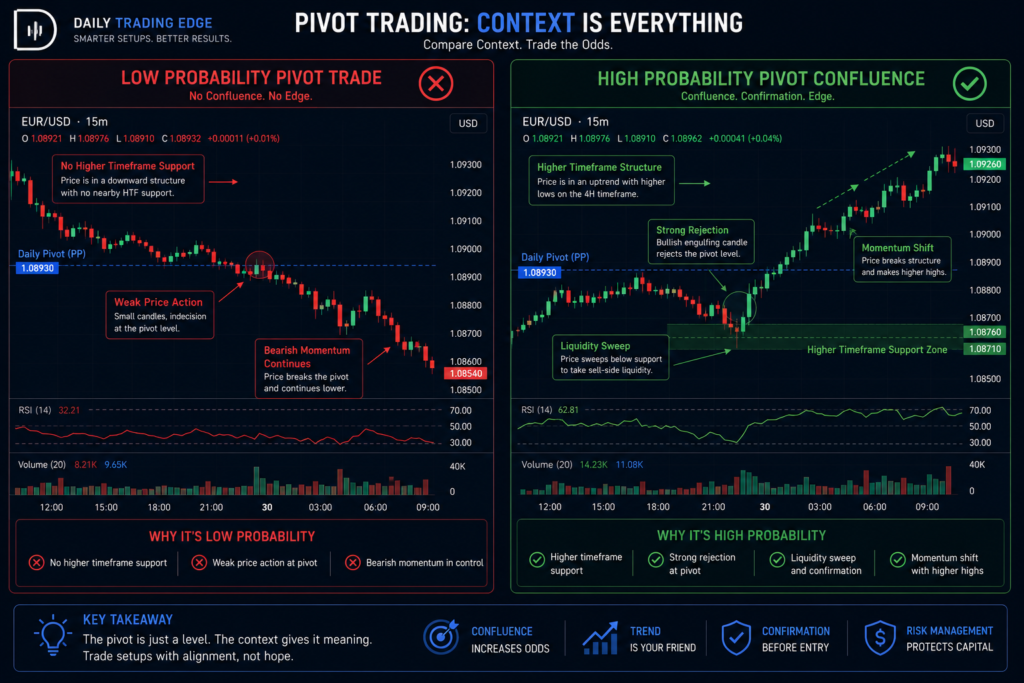
Both charts share the same pivot.
Only one did all three.
Momentum is often the factor that distinguishes a reaction that is a temporary bounce from the start of a sustained move.
Why Three Conditions Improve Decision Quality
The purpose of adding conditions is not to create complexity.
It is to remove unnecessary trades.
Every additional filter reduces frequency.
Ideally, it increases quality.
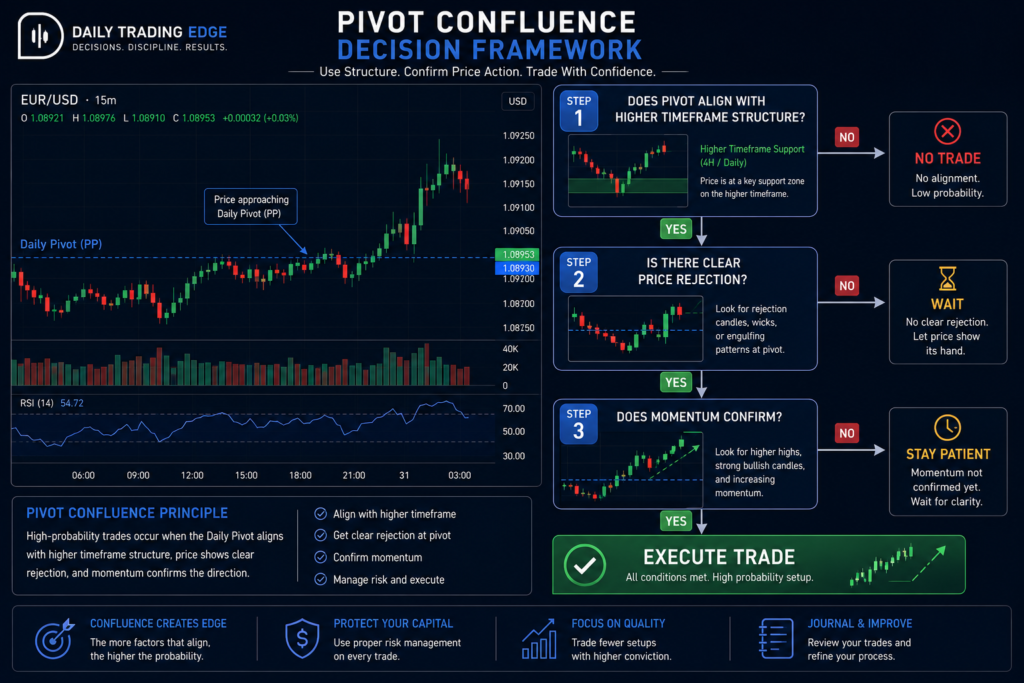
Ask three questions instead of whether a pivot is being touched.
Is the pivot in line with a higher time frame structure?
Is the level obviously rejected by the price?
Is the trade supported by present momentum?
If the answer to any question is no, patience usually becomes the better decision.
Many experienced traders find that eliminating average setups improves long-term profitability more than finding additional entries.
Does This Improve the Pivot Point Strategy Win Rate?
Many traders search for the pivot point strategy win rate as if there is a universal percentage.
There is not.
A strategy that buys every pivot level may perform poorly in trending markets.
The same pivot calculation may perform much better when combined with market structure, momentum, and disciplined execution.
The win rate depends far more on trade selection than on the indicator itself.
Ironically, some profitable traders intentionally accept fewer trades because their filters improve average trade quality.
Win rate matters.
Expectancy matters even more.
A lower win rate combined with larger average winners often outperforms a higher win rate with poor risk-to-reward.
A Practical Trading Framework
You have to get ready before the market opens.
Mark the Daily Pivot Levels
Look for support and resistance on the higher timeframes.
Use recent price action to gauge current market volatility.
Identify scheduled economic events.
Once trading begins, wait for the price to approach one of the major pivot levels.
Do not predict the reaction.
Observe it.
Look for rejection.
Evaluate momentum.
Only then decide whether all three conditions exist.
If any one requirement is not there go on.
In the market, there is always another chance.
This framework builds upon themes introduced in How Many Pips Do London Session Breakouts Average where patience before execution is typically the defining factor in quality of trade.
Common Pivot Trading Mistakes
The first mistake is to treat all pivots as equally essential.
Markets don’t usually work that way.
Another mistake is to enter before confirmation just because the price reached a calculated amount.
Some traders also ignore the broader trend entirely.
Buying every support pivot during a strong bearish trend usually produces disappointing results.
Finally, many traders widen stop losses after entering because they believe the pivot “must” hold.
Markets have no obligation to respect any technical level.
Discipline matters more than confidence.
Risk Management Around Pivot Confluence
Even excellent setups fail.
That is why position sizing deserves just as much attention as market analysis.
Many traders risk inconsistent amounts because stop-loss distances vary from one pivot setup to another.
This is where most traders miscalculate risk. Using the Position Size Calculator removes guesswork by automatically adjusting position size according to your planned stop-loss distance rather than your preferred lot size.
Consistent position sizing protects your trading account while allowing high-quality pivot confluence setups to play out over a large sample of trades.
Measuring Your Pivot Performance
Most traders never discover whether their pivot strategy actually works because they fail to separate different setup types.
Treat each pivot trade like a research project.
Record whether all three conditions were present.
Track the market session.
Measure the higher-timeframe trend.
Record the quality of the rejection.
Evaluate the strength of momentum after entry.
After fifty or one hundred trades, meaningful patterns begin to appear.
You may discover that your best setups occur only during the London session.
You may notice that pivots combined with liquidity sweeps outperform simple pullbacks.
These observations become personal evidence rather than opinions.
Our downloadable Trade Journal Template helps organize this information so your improvements come from measurable data instead of selective memory.
Scaling a Proven Trading Process
After a trader has proven consistency over hundreds of trades, the next limitation is usually not the quality of the strategy but rather available capital.
That is why disciplined traders are looking at evaluation programs by companies such as The5ers, FTMO and FundedNext.
The purpose is not to trade larger immediately.
It is to demonstrate that your process remains profitable while respecting predefined risk limits.
A trader who consistently follows the same three-condition framework becomes a much stronger candidate for professional capital than someone chasing every pivot that appears on the chart.
If you have a trading diary with a proven positive anticipation and disciplined execution, a The5ers evaluation account can be a sensible approach to increase your buying power without needing to keep adding your own personal funds.
Final Thoughts
Pivot points are still valuable because they identify levels where there is often increased market participation.
They are only potent when they are supported by the evidence.
The three-condition framework is not meant to predict markets.
It’s supposed to make better choices.”
More than one timeframe’s structure, price rejection and momentum aligning at the same pivot increases the probability of a meaningful move.
When they do not, patience typically protects both capital and confidence.
For the next twenty trading sessions, challenge yourself to ignore every pivot setup that fails one of these conditions.
You may take fewer trades.
You will likely take better ones.
For your next read, continue with What Does Liquidity Sweep Look Like on a Chart to understand how liquidity events frequently create the strongest pivot confluence opportunities.
Frequently Asked Questions
What is Pivot Confluence?
Pivot confluence happens when a pivot point lines up with other technical criteria such as higher-timeframe support or resistance, market structure, liquidity zones, or price action confirmation.
What are the three conditions for trading pivot confluence?
For a high quality set up you need 3 things: an alignment of a higher time frame structure, a clear rejection of price at the level of the pivot and momentum confirming the expected direction.
Does pivot confluence improve trading performance?
By filtering out low-probability entries, it often enhances the quality of the choice, rather than boosting the frequency of transactions.
What is the pivot point strategy win rate?
There is no guaranteed win rate. It depends on the market, risk management and trade selection. Traders that use pivot points with structure and confirmation tend to be more successful than those who only use pivots.
Which trading session works best for pivot point strategies?
The London and New York sessions are usually more volatile as a large proportion of active traders think that a larger level of liquidity and more institutional participation will make true price action more probable.
Should beginners trade every pivot level?
No. Pivot points are levels of reference, not automatic trading signals. Waiting for confirmation and using the larger market view with pivots results in better decision making than reacting to every level.