
Most traders spend years learning how to trade trends.
Very few take the time to learn how to survive when trends disappear.
That’s a problem because markets spend a surprising amount of time moving sideways.
If you’ve ever watched price bounce between the same support and resistance levels for hours, only to stop out breakout attempts in both directions, you’ve experienced a flat market firsthand.
This is where many traders quietly damage their accounts.
Trend traders still purchase resistance on a breakout. Momentum traders are still chasing non-existent moves. The market is busy looking but without any real directional conviction. Scalpers are overtrading.
The result is often a series of small losses that accumulate into significant drawdowns.
Learning how to trade flat markets is not just a useful skill; it’s essential. It’s a survival skill.
The traders who remain profitable year after year understand that different market conditions require different approaches. A strategy that performs brilliantly during strong trends can struggle badly during consolidation.
This guide explains how professional traders identify flat markets, adapt their execution, manage expectations, and sometimes make the most profitable decision of all: not trading.
What Is a Flat Market?
A flat market is a period in which prices lack a clear directional trend and trade within a relatively defined range.
Instead of making consistent higher highs and higher lows, or lower highs and lower lows, the price repeatedly oscillates between support and resistance.
Flat markets usually have:
Lower volatility
False outbreaks are prone to
Negative directional movement
compressed price range
Market sentiment mixed
In forex they often happen ahead of important economic releases, around holiday times or when market participants are waiting for new information.
The challenge is that many traders continue to apply trending market strategies in non-trending conditions.
That’s where problems begin.
Why Flat Markets Exist
Research from the Bank for International Settlements (BIS) highlights that liquidity conditions, institutional positioning, and information uncertainty often contribute to periods of market consolidation.
Similarly, studies published by the CME Group show that markets frequently alternate between expansion phases and contraction phases rather than moving continuously in one direction.
For traders, this means flat markets are not abnormalities.
They are normal market behavior.
In fact, many strong trends begin with extended periods of consolidation.
Professional traders understand that market conditions constantly rotate between:
Trending environments
Range-bound environments
Transition phases
Volatility expansions
Volatility contractions
Recognizing these shifts often matters more than identifying individual trade setups.
The Biggest Mistake Traders Make in Flat Markets
Most traders don’t lose money because flat markets are impossible to trade.
They lose money because they refuse to acknowledge that the market has changed.
Imagine EUR/USD has been trending strongly higher for several weeks.
Eventually, momentum slows.
Price begins moving sideways between support and resistance.
Trend traders continue buying every pullback because the previous strategy worked so well.
The market repeatedly reverses.
Losses accumulate.
Frustration grows.
The issue isn’t execution.
The issue is adaptation.
Professional traders understand that market conditions dictate strategy selection.
Not the other way around.
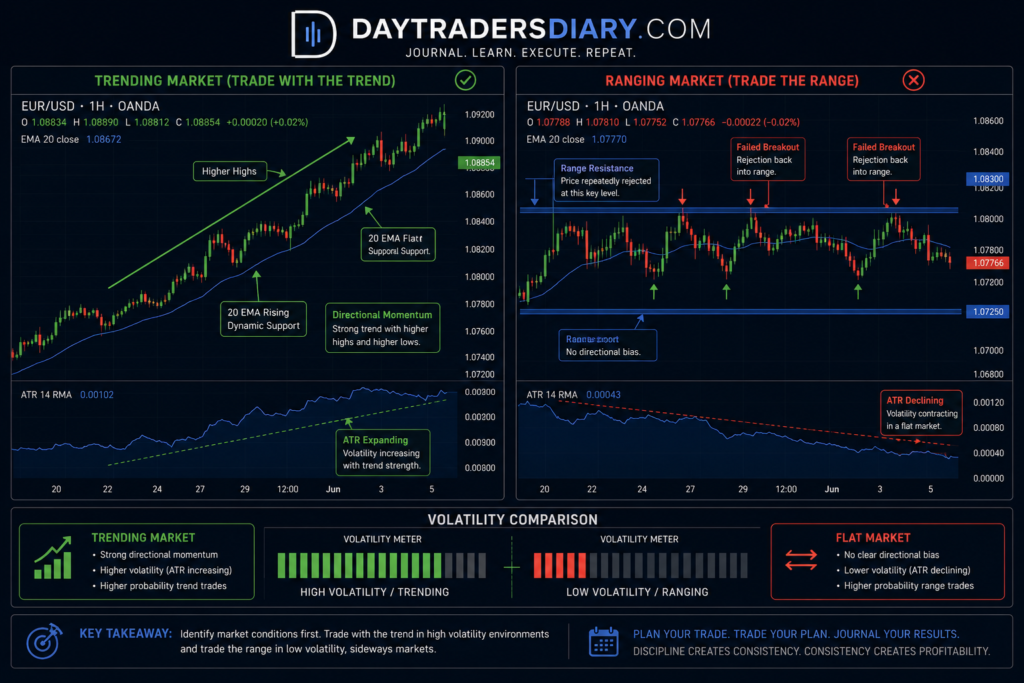
How to Identify a Flat Market
The first step is recognizing when trend conditions no longer exist.
Several clues typically appear together.
Price repeatedly rejects both highs and lows.
Moving averages flatten.
Breakouts fail more frequently.
Average True Range begins declining.
Momentum becomes inconsistent.
The key observation is structure.
In a healthy trend, price continues creating directional progress.
In a flat market, progress disappears.
Price moves, but it goes nowhere.
This distinction sounds simple, yet many traders ignore it because they are emotionally committed to a directional bias.
The Professional Framework for Trading Flat Markets
Successful range traders think differently from trend traders.
Their objective is not to capture massive directional moves.
Their objective is to exploit predictable behavior within established boundaries.
The process begins with identifying the range.
Where has price repeatedly found support?
Where has price repeatedly encountered resistance?
Once these levels become obvious, the next step is to wait for the price to approach one of them.
This is where patience becomes an edge.
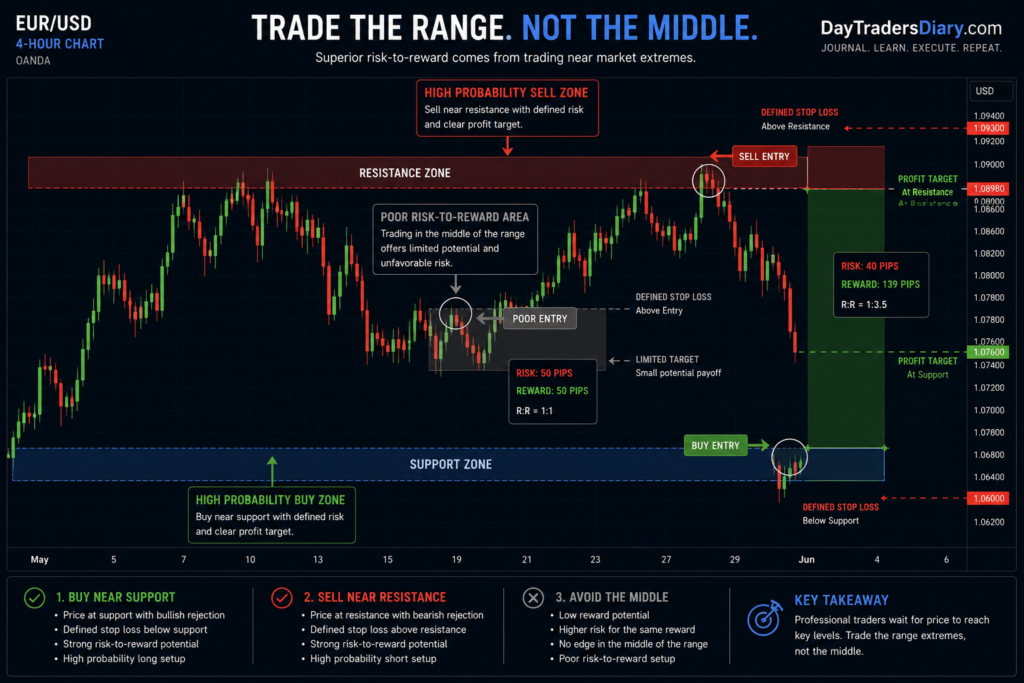
Rather than trading the middle of the range, professional traders focus on extremes.
Buying near support.
Selling near resistance.
Avoid low-quality entries between those levels.
This simple adjustment dramatically improves risk-to-reward potential.
Why Range Extremes Matter
Imagine a market trading between 1.1000 and 1.1050.
A trader entering near the center has limited upside and downside protection.
A trader entering near support has a clearly defined invalidation point while maintaining substantial room for price to move back toward resistance.
The difference is not in the prediction.
It’s positioning.
Price action traders often refer to this concept as trading locations rather than patterns.
If you’ve already read our guide on How to Use Price Action Only Trading, you’ll recognize that location frequently matters more than candlestick formations.
Trading False Breakouts in Flat Markets
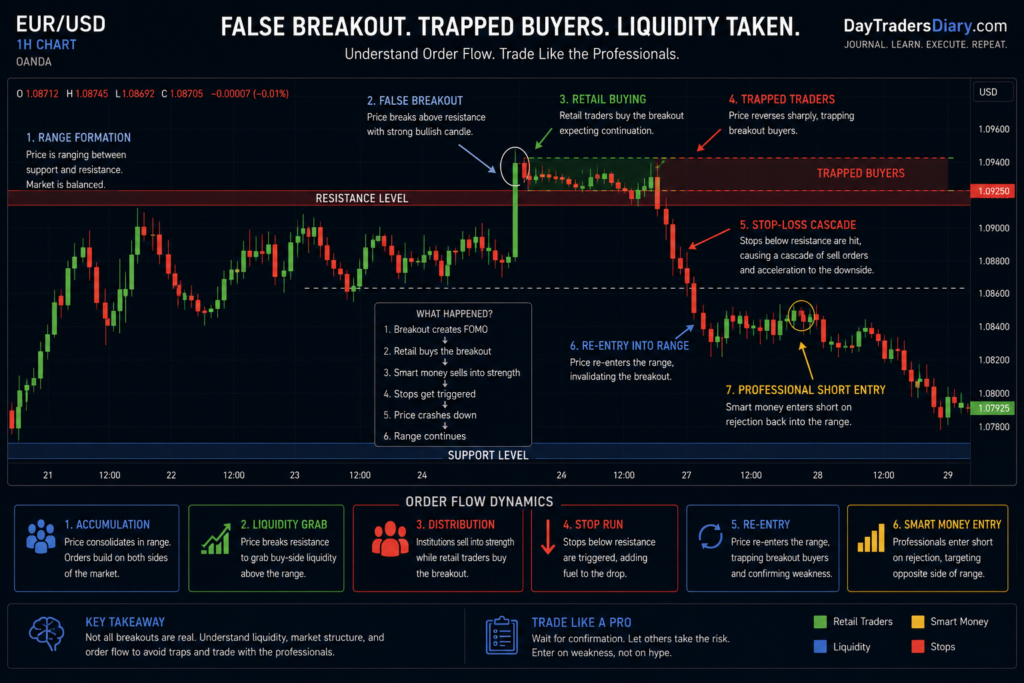
One of the most profitable opportunities during consolidation often comes from failed breakouts.
Most retail traders are conditioned to chase breakouts.
In flat markets, that behavior frequently becomes expensive.
Imagine price breaks above resistance.
Momentum traders rush in.
A few minutes later, the price falls back into the range.
Those breakout buyers are now trapped.
As they exit positions, their orders can accelerate movement back toward the opposite side of the range.
Experienced traders monitor these situations closely.
The failed breakout itself often becomes the trade setup.
Not because every breakout fails.
But flat markets naturally produce more failed moves than trending environments.
When Not to Trade a Flat Market
One of the most overlooked skills in trading is recognizing when conditions offer little opportunity.
Some flat markets are highly tradable.
Others are simply noise.
If the range becomes extremely narrow, spreads consume a larger percentage of potential profits.
Risk-to-reward deteriorates.
Execution quality declines.
At that point, preserving capital becomes more important than finding trades.
Many professional traders significantly reduce their activity during these periods.
This is not inactivity.
It is strategic patience.
Flat Markets and Trading Psychology
Flat markets expose emotional weaknesses more than almost any other market condition.
The lack of movement creates boredom.
Boredom creates temptation.
Temptation creates overtrading.
Overtrading creates losses.
Many traders convince themselves they need constant market participation.
Professional traders understand something different.
Their goal is not action.
Their goal is opportunity.
Flat markets often reward patience far more than aggression.
This concept aligns closely with the ideas discussed in our article, “What Is a Trading Edge and How to Build One.”
Sometimes protecting an edge means trading less.
Risk Management During Consolidation
Risk management becomes even more important during sideways conditions.
False breakouts occur more frequently.
Momentum is less reliable.
Targets are often smaller than those seen in trending markets.
This is where most traders miscalculate risk.
Using the Position Size Calculator removes guesswork by ensuring position size remains aligned with stop-loss placement and overall account risk.
A common mistake is increasing position size simply because stop-loss distances become smaller.
Professional traders focus on maintaining consistency regardless of market conditions.
Using a Trade Journal to Improve Flat Market Performance
Many traders never discover how their strategies perform during consolidation because they fail to track market conditions.
A high-quality journal should record:
Market type
Volatility conditions
Range size
Entry location
Outcome
Execution quality
Over time, patterns emerge.
You may discover your strategy performs exceptionally well during trends but struggles badly during ranges.
Or your best trades occur specifically after failed breakouts.
The Trade Journal Template helps organize this information into actionable insights rather than vague observations.
Eventually, your journal reveals which market environments truly fit your edge.
Building a Range Trading Playbook
Every experienced trader benefits from having a separate plan for flat markets.
That plan may include:
Conditions that define a valid range.
Rules for identifying support and resistance.
Criteria for failed breakout entries.
Profit-taking guidelines.
Risk management rules.
The objective is not predicting market direction.
The objective is to adapt intelligently to current conditions.
Markets change.
Your approach must change with them.
Scaling a Proven Edge
Once traders learn to perform across multiple market environments, consistency often improves dramatically.
The next challenge becomes capital efficiency.
A trader capable of navigating both trending and range-bound conditions possesses a more adaptable skill set than someone who relies on a single market regime.
This is one reason experienced traders often explore proprietary trading firms such as The5ers, FTMO, and FundedNext.
Evaluation programs provide an opportunity to demonstrate disciplined execution under structured risk parameters before gaining access to larger capital allocations.
The goal isn’t finding a shortcut.
It’s proving that your edge works consistently across different market conditions.
If your journal and backtesting demonstrate reliable performance in both trending and flat markets, a The5ers evaluation account may be a logical step toward scaling that edge.
Final Thoughts
Flat markets frustrate traders because they challenge assumptions.
Most people enter trading believing markets should always move.
The reality is that markets spend a significant amount of time waiting.
Professional traders learn to wait with them.
The next time you find yourself staring at a sideways market, resist the urge to force trades.
Instead, ask a different question.
Is this environment actually offering opportunity, or am I simply uncomfortable doing nothing?
That single question can prevent countless unnecessary losses.
For your next read, explore our guide on What Is a Probabilistic Trading Model to understand better how professional traders adapt their expectations to changing market conditions.
Frequently Asked Questions
What is a flat market in forex?
A flat market is a period in which prices move sideways within a defined range, without establishing a sustained uptrend or downtrend.
Can you trade flat markets profitably?
Yes. Many traders use range trading strategies, support and resistance levels, and failed breakout setups to profit during sideways conditions.
How do I identify a flat market?
Look for repeated support and resistance reactions, declining volatility, failed breakouts, and the absence of higher highs or lower lows.
Are breakout strategies effective in flat markets?
Breakout strategies often perform worse during consolidation because false breakouts occur more frequently. Additional confirmation is usually required.
Should I avoid trading flat markets?
Not necessarily. Some flat markets offer excellent range-trading opportunities. Others become too narrow and inefficient to justify participation.
What is the best risk management approach for flat markets?
Maintain consistent position sizing, use clearly defined stop losses, and avoid increasing risk simply because price movement appears limited.