
One of the most common patterns I see among struggling traders isn’t poor analysis.
It’s information overload.
They start with a clean chart. Then they add RSI, MACD, moving averages, Bollinger Bands, volume indicators, trend indicators, and custom tools downloaded from social media. Eventually, the chart becomes so crowded that the price itself becomes the hardest thing to see.
Ironically, the one thing that actually moves the market gets buried beneath layers of confirmation.
Many traders arrive at price action trading after years of frustration with indicators. They realize indicators are simply mathematical calculations derived from price. If price is the source, why not learn to read the source directly?
That question often marks a turning point.
Price-action-only trading is not about removing indicators because they are bad. It is about developing the ability to understand market behavior through structure, momentum, liquidity, and participant behavior without relying on lagging signals.
The challenge is that most price action education stops at candlestick patterns.
Real price action trading goes much deeper.
This guide explains how experienced traders use price action in forex and day trading, how to learn it properly, and how to build a repeatable price action strategy that withstands real market conditions.
What Is Price Action Only Trading?
Price action-only trading is the process of making trading decisions based on raw market price movement rather than indicator-based signals.
The focus shifts toward:
Market structure
Support and resistance
Liquidity behavior
Momentum shifts
Trend development
Breakout and rejection behavior
Order flow clues are visible through price movement
Price action traders analyze how buyers and sellers interact at important locations rather than waiting for indicators to generate signals.
This distinction is important.
Indicators tell you what has happened.
Price action helps you understand what is happening now.
The best price action traders are not predicting the future. They are interpreting the current battle between buyers and sellers.
Why Professional Traders Focus on Price First
The CFA Institute research consistently emphasizes that when too many factors are included in the decision-making process, market participants are often overwhelmed by information and paralyzed in decision-making.
Similarly, studies from the Bank for International Settlements (BIS) show that liquidity, order flow, and market structure heavily influence short-term price movement.
For traders, this has practical implications.
Price reflects every available market opinion.
Economic data, institutional positioning, sentiment, and news expectations all become visible through price movement.
This does not mean indicators are useless.
It means price should remain the primary source of information.
Many experienced traders eventually discover that most indicators simply confirm what the price has already revealed.
The Biggest Misunderstanding About Price Action
Most educational content treats price action as a collection of candlestick patterns.
Pin bars.
Engulfing candles.
Inside bars.
While these patterns can be useful, they are rarely enough on their own.
A bullish engulfing candle at random chart locations means very little.
The same candle forming at a major higher timeframe support level after a liquidity sweep carries a completely different meaning.
Context creates the edge.
The candle itself is only part of the story.
Professional traders focus less on individual candles and more on why those candles formed.
How to Learn Price Action Trading Properly
Most traders learn price action backward.
They memorize patterns first and attempt to understand context later.
A more effective approach starts with market structure.
Before looking at any candlestick pattern, ask:
Is the market trending?
Is the market ranging?
Where are the major support and resistance levels?
Where is liquidity likely resting?
Who currently appears in control?
Only after answering these questions should you evaluate entry opportunities.
Without structure, patterns become random.
With structure, patterns become meaningful.
The Four Layers of Price Action Analysis
Price action becomes significantly easier to analyze when viewed in layers.
The first layer is trend.
Every trade should begin with identifying whether the price is making higher highs and higher lows or lower highs and lower lows.
The second layer is location.
Price behaves differently at important levels.
A rejection at major resistance carries more significance than the same rejection in the middle of a range.
The third layer is momentum.
Strong, impulsive moves reveal aggressive participation.
Weak moves suggest hesitation.
Momentum often provides clues about trend continuation or exhaustion.
The fourth layer is confirmation.
This is where candlestick behavior becomes useful.
Instead of trading every pin bar, you trade pin bars appearing within a favorable context.
This sequence dramatically improves decision quality.
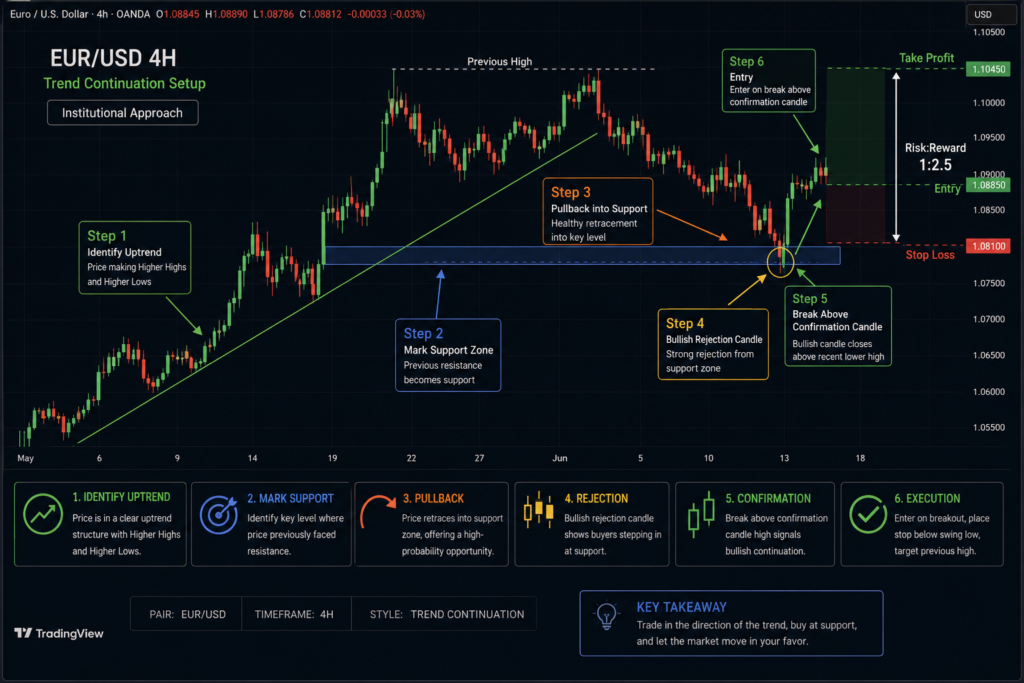
A Practical Price Action Strategy
Let’s look at a simple framework many experienced traders use.
Start on the higher timeframe.
Identify the dominant trend.
Mark key support and resistance zones.
Wait for the price to retrace into an important area.
Observe how the price behaves when it reaches that zone.
Imagine EUR/USD is trending higher on the four-hour chart.
Price pulls back toward a previous breakout area.
As the price reaches support, selling momentum begins to slow.
A bullish rejection candle forms.
The next candle breaks above the rejection candle’s high.
This sequence creates a higher-probability setup than simply buying because the RSI has become oversold.
The market is communicating information through structure and behavior.
Your job is to interpret it.
Why Most Price Action Traders Struggle
The biggest challenge with price action trading is subjectivity.
Two traders can examine the same chart and see completely different stories.
One sees a breakout.
Another sees a fake break out.
Found is support.
Another sees a median.
Hence the importance of objective rules.
Price activity does NOT mean discretionary madness.
Your rules should be:
Trend criterion
Support and resistance identification
Entry triggers
Stop placement
Profit targets
Risk parameters
The more objective your framework becomes, the more repeatable your results become.
Liquidity Is the Missing Piece Most Traders Ignore
One area rarely discussed in beginner price action education is liquidity.
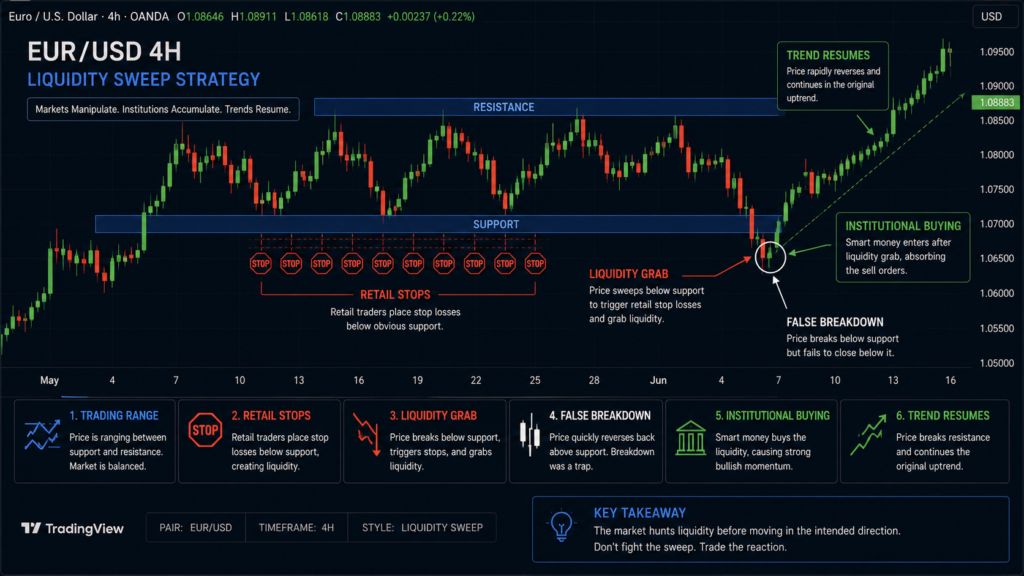
Markets often move toward areas where stop-loss orders accumulate.
This explains why obvious support and resistance levels frequently experience brief violations before reversing.
Many traders call this manipulation.
In reality, it is often liquidity-seeking behavior.
Imagine a range where thousands of traders place stops below the support level.
Price briefly dips below the level, triggers stops, attracts sellers, and then reverses higher rapidly.
Price action traders who understand liquidity often view these moves as opportunities rather than surprises.
This concept connects closely with our article on What Is a Probabilistic Trading Model, where context matters more than individual signals.
The Role of Multi-Timeframe Analysis
Price action becomes more effective when viewed through multiple timeframes.
Higher timeframes provide context.
Lower timeframes provide execution.
A five-minute chart may show a bearish move.
The four-hour chart may reveal that the move is simply a pullback within a strong uptrend.
Without awareness of the higher timeframe, traders often enter the market directly against larger market forces.
The best price action traders constantly ask:
What is the larger market narrative?
Then they use lower timeframes to find precise entries.
Risk Management Matters More Than Entries
Many traders obsess over finding perfect entries.
The reality is that long-term profitability depends more on risk management than entry precision.
A strong price action setup can still fail.
Unexpected news, institutional flows, and volatility shifts can invalidate any analysis.
This is where most traders miscalculate risk.
Using the Position Size Calculator removes guesswork by ensuring every trade risks a consistent percentage of capital regardless of stop-loss distance.
Without disciplined sizing, even excellent price action analysis eventually breaks down.
Using a Trade Journal to Improve Price Action Skills
Price action mastery develops through observation.
One of the fastest ways to improve is reviewing screenshots rather than focusing solely on profit and loss.
After each trade, record:
The market structure
The key level
The entry trigger
The outcome
What price did you pay after your exit
Patterns begin emerging surprisingly quickly.
You may discover that your best trades occur after liquidity sweeps.
You may notice that range breakouts underperform compared to trend pullbacks.
The Trade Journal Template helps organize these observations into actionable improvements.
Over time, your journal becomes your personal playbook for price action.
Scaling a Price Action Edge
A trader who develops a repeatable price action strategy eventually encounters a familiar challenge.
Capital.
Even a strong edge produces limited income when applied to a very small account.
This is one reason many experienced traders explore proprietary trading firms.
Programs offered by The5ers, FTMO, and FundedNext allow traders to demonstrate consistency before gaining access to larger capital allocations.
The point is not to find an easy way out.
It’s about using an established process.
Price action trading is generally very well suited for evaluation accounts because the method focuses on focused execution, limited risk and repeatable decision making.
If your backtesting and live results regularly show a real edge, a The5ers evaluation account can be a sensible next step to scale up without risking a lot more personal capital.
Common Price Action Mistakes
The reason that most traders fail with price action is not because the strategy doesn’t work, but because they don’t grasp it.
Typical mistakes are:
Trading candlestick patterns with no context.
Ignoring higher time frame structure.
Entering the middle of the ranges.
Moving stop losses emotionally.
Taking every setup instead of waiting for quality opportunities.
Over time, patience becomes a bigger edge than pattern recognition.
The best price-action traders often take fewer trades than others.
Final Thoughts
Price-action-only trading isn’t about getting rid of indicators.
It’s about learning to speak the market’s own language, directly.
The chart already provides you information on trend, momentum, liquidity and participant behavior.
Your edge comes from consistently interpreting that information.
If you want to improve your price action skills this week, don’t search for another pattern.
Instead, spend time studying market structure.
Mark key levels.
Observe how the price reacts around them.
Focus on context before confirmation.
That single adjustment often produces more progress than months spent chasing new indicators.
For your next read, explore our guide on What Is a Trading Edge and How to Build One to understand how price action becomes a repeatable advantage rather than just another strategy.
Frequently Asked Questions
What is price action only trading?
Price Action Only Trading is a method that employs raw price movement, market structure and support and resistance levels for making trading choices without the usage of indicators.
How do I learn price action trading?
Before analyzing candlestick patterns, examine market structure, trends, support and resistance, liquidity behavior and momentum. Context, not individual candles, is the thing.
Is price-action trading effective in forex?
Yes, price action trading is widely used in forex because it helps traders analyze market behavior directly without relying on lagging indicators.
What is the best price action strategy?
There is no single best strategy. Many traders focus on trend pullbacks, support and resistance reactions, liquidity sweeps, and breakout retests within a strong market structure.
Can price action trading work without indicators?
Yes. Many professional traders use little or no indicators and rely primarily on price structure, momentum, liquidity, and risk management.
How long does it take to become good at price action trading?
Most traders require several months of chart study, backtesting, journaling, and live execution before consistently recognizing high-probability price action setups.