
One of the most frustrating moments in trading happens after a setup moves perfectly in your favor.
Price breaks out.
Momentum confirms.
The trade finally starts working.
Then fear quietly takes over.
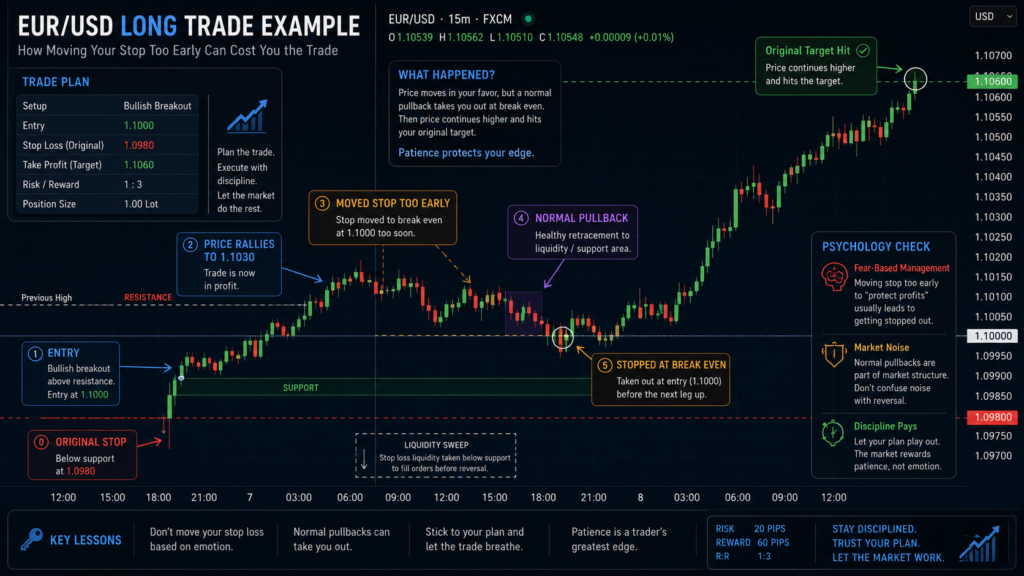
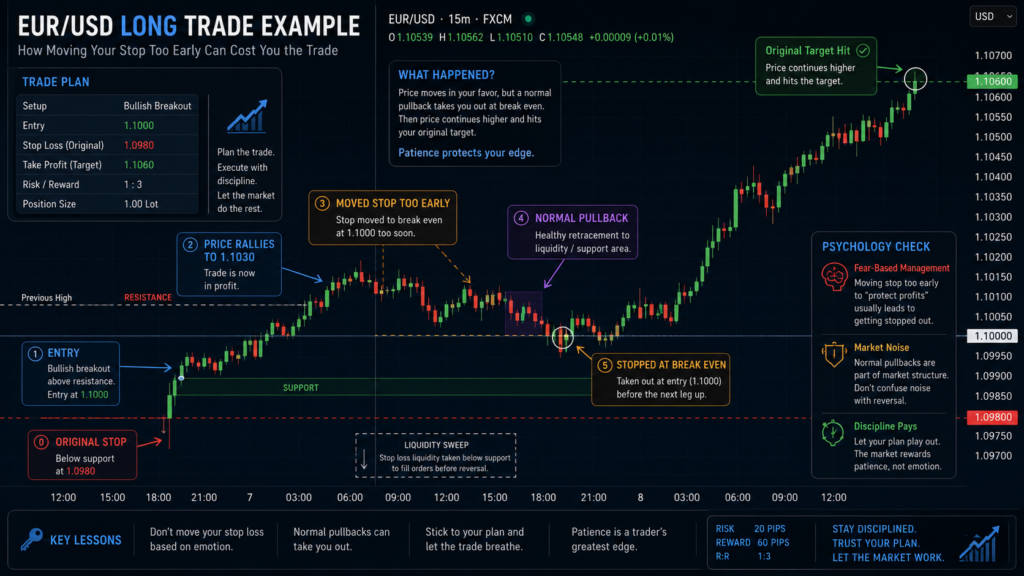
The trader moves the stop loss to break even too early, price retraces normally, the position closes for nothing, and minutes later the market runs exactly where the original target was sitting.
Almost every active trader has experienced this.
At first, moving to break even feels smart. It feels responsible. It feels like “protecting capital.”
But after enough screen time, traders realize break-even stops are not automatically good or bad.
They are put in context.
Used appropriately a break even stop can relieve the emotional burden and save capital amid unpredictable market circumstances.
In the wrong hands it quietly ruins good deals, reduces reward-to-risk performance, and educates traders to exit impulsively rather than rationally.
That distinction significant because many traders move stops based on fear rather than actual market structure.
After seeing traders grow over years, one thing is clear:
Break-even mistakes are psychological before they are technical.
In this post you’ll learn what a break-even stop really means in trading, when skilled traders use it, when they don’t, and how to think about break-even management in a way that enhances consistency instead of destroying strong setups.
What Is Break Even in Trading?
A break-even stop means moving your stop loss to the original entry price after a trade moves into profit.
The idea is simple:
If price reverses, the trade closes without a loss.
For example:
A forex trader buys EUR/USD at 1.1000 with a stop loss of 1.0980.
Price increases up to 1.1030
So the trader moves the stop from 1.0980 to 1.1000.
If the market turns around now, the trade closes at the initial entry level, not the full intended loss.
This is what traders mean when they talk about “moving stops to break even.”
At a surface level, it sounds like a perfect solution.
Remove downside risk while still keeping upside potential.
But trading is rarely that simple.
Why Traders Become Obsessed With Break-Even Stops
Most traders become emotionally attached to break-even stops after painful losing experiences.
They finally see a trade move into profit.
Then the market reverses.
A winning trade becomes a loss.
That emotional pain sticks.
Eventually the trader decides:
“Next time I’ll protect the trade immediately.”
The problem is that markets naturally retrace during trends.
A normal pullback is not automatically a failed trade.
The CFA Institute’s research on behavioral finance has long shown that traders feel the agony of losses more than the joy of profits. This type of emotional imbalance normally prompts traders to take overly defensive decisions in trade management.
Meanwhile, market structure research from CME Group Education consistently points out how swings in volatility and liquidity cause natural price retracements even amid healthy directional movement.
NASDAQ Market Research educational material also highlights that short-term price movement is dictated more by liquidity, order flow and transient volatility spikes than pure directional purpose.
Experienced traders eventually understand something important:
A trade can retrace deeply and still remain technically valid.
That realization changes how break-even stops are used completely.
Why Moving to Break Even Too Early Becomes a Hidden Trading Problem
One of the biggest mistakes traders make is treating break-even stops like automatic rules instead of strategic decisions.
Some traders move stops to break even after:
5 pips.
10 pips.
The first green candle.
Any small profit at all.
That usually comes from emotional discomfort rather than structured trade management.
The market often needs room to breathe.
Especially in forex day trading.
A breakout setup may retest the breakout zone before continuation.
Momentum expansion can pull back ahead of a liquidity grab.
A trend downturn might retest support and then continue.
When they move stops too aggressively traders often get knocked out of potentially good trades right before the big move starts.
What follows is a frustrating loop of:
Scratch trading.
No runners present.
Reduced reward-to-risk performance.
Greater emotional frustration.
Traders eventually get the feeling that the market is “hunting” their stops.
In reality, they are often placing stops inside normal market noise.
When Break-Even Stops Actually Make Sense
Break-even stops are not bad.
They just need context.
Experienced traders usually move to break even for specific reasons, not emotional comfort.
When is break-even management worthwhile? Break-even management is worth it in the following situations:
Large directional confirmation after.
Before important news releases.
As price bursts through important liquidity zones.
Some profit taken later.
When the original trade premise no longer applies.
For instance:
A trader goes long after a break out during the London session. When price breaks structure cleanly and takes out surrounding liquidity, it may make sense to move your stop closer to entry since the market has already proven directional strength.
That is completely different than going to BE when the trade turned green temporarily.
What do professional traders ask:
“Has the market hit the tighter stop?”
That question is important.
The Relationship Between Break-Even Stops and Market Conditions
This is where many developing traders struggle.
The same break-even strategy does not work equally well across all environments.
Trending markets often tolerate wider management.
Choppy conditions punish aggressive stop movement constantly.
Highly volatile news settings tend to cause deep retracements before continuation.
Break-even rationale is different for experienced traders:
Volatility.
Session time.
Liquidity circumstances.
Pair behaviour.
Market structure.
For example, GBP/JPY during London open behaves very differently from EUR/USD during quiet Asian session trading.
Treating both markets identically usually creates problems.
This idea connects directly with many related DayTradersDiary.com articles covering volatility, forex risk management, and execution psychology.
Why Break-Even Stops Are Mostly Psychological
Most traders think break-even management is purely technical.
It is heavily emotional too.
Moving to break even often provides psychological relief.
The trader feels safer.
Fear decreases temporarily.
The emotional pressure softens.
But there is a dangerous side to this.
Sometimes traders move stops not because the market justifies it, but because they personally cannot tolerate uncertainty anymore.
That is an important distinction.
Good trade management should come from market structure, not emotional discomfort.
After enough experience, traders realize:
Protecting yourself emotionally and protecting the trade technically are not always the same thing.
Why Professional Traders Focus More on Expected Value
Many developing traders obsess over avoiding losses entirely.
Experienced traders focus more on long-term expected value.
Sometimes allowing normal pullbacks creates much larger winning trades over time.
Sometimes moving aggressively to break even protects performance during unstable conditions.
There is no universal answer.
The key is consistency.
A trader who randomly changes stop behavior emotionally usually creates inconsistent results.
Professional traders create management rules around:
Conditions of volatility.
Trade pattern .
Liquidity behaviour.
Reward and risk expectations
That consistency is considerably more important than avoiding every single bad trade.
Why Risk Management Still Matters at Break Even
A typical mistake is to think that risk management is not important after a trade is at break even.
That’s not right.
Performance can still be affected by poor break-even management through:
Reducing average winners.
Creating overtrading behavior.
Encouraging emotional micromanagement.
This is where many traders miscalculate exposure completely. Using a structured Position Size Calculator helps traders maintain consistent risk before the trade even begins, reducing the emotional urge to interfere with positions too aggressively later.
Stable risk sizing often improves patience naturally.
Because traders stop feeling emotionally overexposed.
Why Journaling Break-Even Decisions Improves Trading
One of the fastest ways traders improve trade management is by journaling break-even behavior specifically.
Most traders only follow:
Victories.
Loses.
Profit figures.
More experienced dealers go further.
They observe:
When the stops changed.
Why They Were Taken Out.
Whether it was emotional or structural.
How many trades did after.
Over time, patterns become obvious.
Some traders realize they move stops too aggressively after recent losses.
Others discover they perform better giving trades more room during trending conditions.
Without documentation, these patterns stay hidden.
Using a structured Trade Journal Template helps traders review execution quality objectively instead of emotionally reacting to isolated outcomes.
The traders who improve fastest are usually the ones willing to study their own behavior honestly.
Why Serious Traders Eventually Prioritize Consistency Over Comfort
Most traders in development trade on emotion.
Finally, professional traders trade in a systematic way.
That change is everything.
They stop chasing emotional comfort through constant stop adjustments.
They focus more on:
Probability.
Expected value.
Risk consistency.
Structured execution.
This is one reason many disciplined traders eventually explore evaluation programs from firms like The5ers, FTMO, and TradeThePool.
These firms reward stable execution, disciplined risk management, and emotional consistency rather than impulsive trade management.
A trader who understands when to use break-even stops strategically usually adapts far better to funded trading environments than traders constantly reacting emotionally to every price fluctuation.
For disciplined traders looking to scale responsibly, a The5ers evaluation account can become a logical next step because it rewards process stability instead of emotional overtrading.
The Real Purpose of a Break-Even Stop
There is no break-even halt to remove all emotional distress.
Its purpose is to manage risk wisely in the context of market structure and volatility.
Sometimes, to go out, to break even, it preserves the capital very well.
Sometimes it gets traders out of great setups too early.
The trick lies in knowing the difference.
This week, take a hard look at your previous trading.
Did you move stops because of market structure change?
Or because you became uncomfortable holding the position?
That single question often reveals more about a trader’s psychology than the outcome of the trade itself.
For your next read, explore related DayTradersDiary.com content on forex risk management, trading psychology, and volatility-based trade management. Those subjects connect directly with long-term trading consistency.
FAQs
What is a break-even stop in trading?
A break-even stop is when you increase the stop loss to the original entry price once a trade has gone into profit reducing the initial downside risk.
When should traders move stops to break even?
Experienced traders usually move to break even after meaningful market confirmation, structural shifts, or partial profit-taking rather than immediately after small profits.
Why do traders get stopped out at break even so often?
Many traders move stops too aggressively inside normal market retracements and volatility noise.
Is moving to break even always a good idea?
No. Moving stops too early can reduce reward-to-risk performance and remove traders from valid setups prematurely.
What is break even meaning in trading with an example?
If a trader buys EUR/USD at 1.1000 and then lifts the stop loss to 1.1000 after price rallies, the trade will close at break-even if the market reverses.
How do funded trader programs evaluate risk management?
Programs like The5ers and FTMO focus on focused execution, exposure control and emotionally calm trade management.