
A lot of traders think they understand risk because they use stop losses.
Then one day they trade GBP/JPY the same way they trade EUR/USD and suddenly a normal losing trade feels much bigger than expected.
That moment usually exposes a problem most traders ignore for far too long:
They know where they want to enter, but they do not actually know how much each pip is worth.
It sounds like a small detail until inconsistent position sizing starts affecting emotions, decision-making, and account performance.
And one trade feels good.
The next looks stressful.
A sudden one feels tough to hold even though the setup itself seems acceptable.
The quality of the strategy is rarely the problem.
It’s the inconsistent exposure.
That is where a pip value calculator is one of the most crucial tools for forex trading, especially for busy day traders dealing with several pairings, varying volatility situations and fast-moving intraday setups.
Not because the calculation itself is complicated.
Because traders become emotionally unstable when they stop understanding their actual risk clearly.
After enough time in the markets, most experienced traders eventually realize something important:
Good trading is usually less about prediction and more about controlling exposure consistently.
And that process starts with understanding pip value properly.
This guide breaks down what a pip value calculator actually does, why so many traders misuse it, how professional traders think about pip exposure, and why accurate position sizing often improves psychology more than traders expect.
Why So Many Traders Misunderstand Pip Value
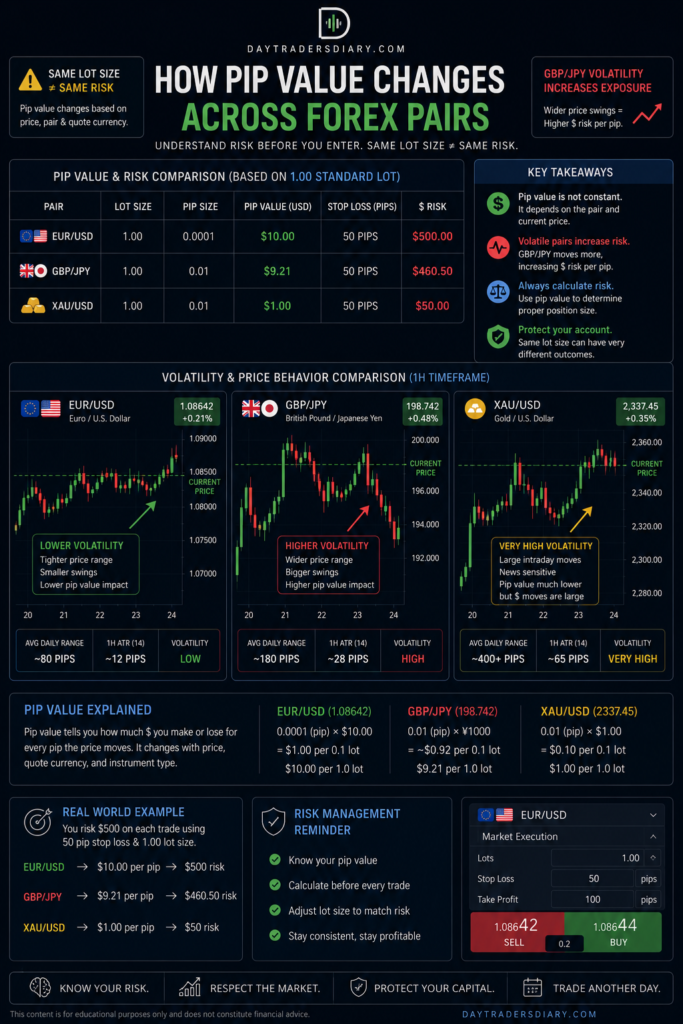
One of the biggest misconceptions new traders make is to assume that every pip shift is worth the same amount for every trade.
No.
Pip value changes depending on:
The currency pair.
The lot size.
The account currency.
The current exchange rate.
That creates problems quickly for traders who never slow down long enough to calculate actual exposure.
For example, a 20-pip stop on EUR/USD behaves very differently from a 20-pip stop on GBP/JPY or gold. Yet many traders still use identical lot sizes across completely different instruments.
The result is inconsistent risk.
Research from CME Group Education continues to emphasize that understanding contract value and leverage exposure is one of the foundations of long-term trading survival.
Investopedia’s educational material also shows how leveraged markets can amplify even minor pricing fluctuations when traders misjudge the true pip value.
CFA Institute behavioral finance research regularly demonstrates that whenever volatility is high or there is emotional strain, traders underestimate risk.
That matters more than most people realize.
Because once exposure becomes unpredictable, emotions usually follow.
What a Pip Value Calculator Actually Does
At its simplest level, a pip value calculator tells you how much money each pip movement is worth on a specific trade.
It considers:
The pair of currencies.
Size of trade.
Unit of account.
Current market value.
That’s rather basic information, yet it totally affects the way traders handle risk.
Without accurate pip calculations, traders often:
Oversized positions without knowing it.
Get the stop-loss exposure wrong.
Don’t trade volatile pairs too hard.
Create wild swings on your account.
Active market sessions rarely reveal professional traders guessing exposure in their mind.
They make it normal.
For example, a seasoned trader may decide:
“I just want to put at risk $50 in this setup.
The pip value calculator automatically translates that selection into suitable position sizing.
That consistency matters because emotional stability usually improves once traders know exactly what they are risking before entering the trade.
Why Pip Value Matters More for Day Traders
Swing traders sometimes have more room for positioning mistakes because they operate on larger timeframes.
Day traders usually do not.
Intraday trading involves:
Tighter stops.
Faster execution.
Higher frequency decision-making.
Greater sensitivity to volatility changes.
Small sizing mistakes become amplified very quickly.
For example, a trader scalping EUR/USD during normal London session conditions may feel comfortable risking 10 pips.
Then they switch to GBP/JPY using the same lot size without recalculating pip value.
Suddenly the emotional pressure feels completely different.
The trader thinks the setup failed.
In reality, the exposure changed.
This is one reason many active traders struggle emotionally during volatile sessions without fully understanding why.
Experienced traders know that a consistent risk exposure is more important than always seeking the perfect entry.
This topic is strongly related to many of the other articles on DayTradersDiary.com about forex risk management, scalping mentality and discipline of execution.
The Psychological Side of Pip Value Most Traders Ignore
Most traders think pip value is merely a math thing.
It isn’t.
This immediately influences psychology.
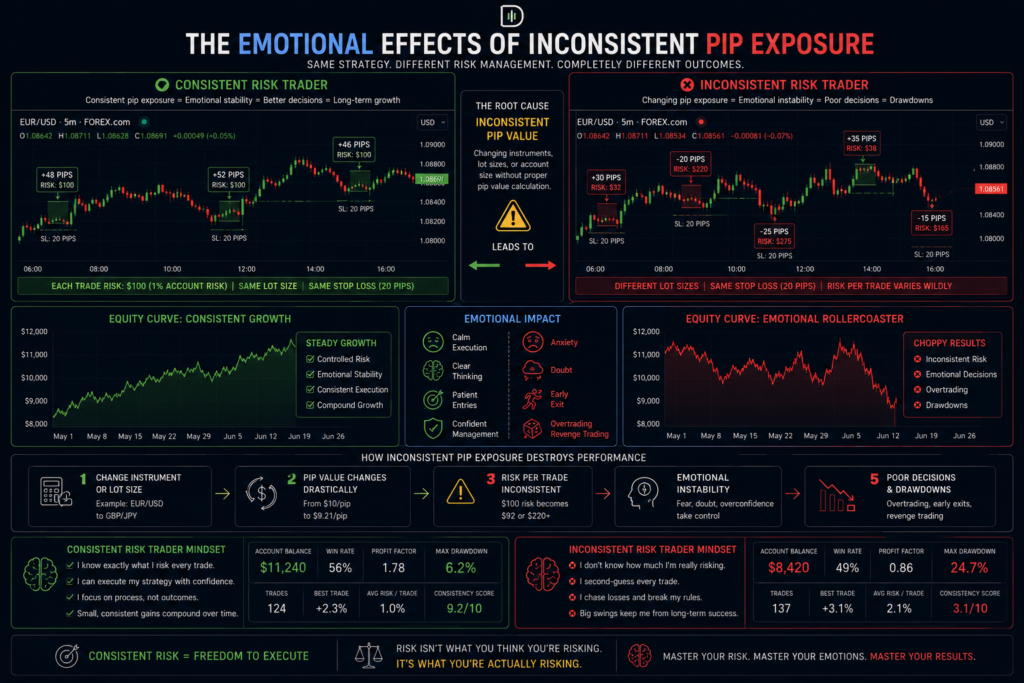
When exposure fluctuates unpredictably, emotions also become inconsistent.
One trade seems straightforward to handle.
Another becomes anxious suddenly.
Another one leaves early; the job is too emotionally huge.
Many traders blame these reactions on strategy failure.
The common problem is often inconsistent risk estimates.
After enough experience, most professional traders realize confidence does not come from predicting markets perfectly.
It comes from understanding exactly what can happen financially before the trade even begins.
That kind of clarity dramatically reduces emotional decision making.
Good traders are seldom courageous.
“They’re just ready.
Why Traders Still Misuse Pip Calculators
Even traders who understand pip value basics often misuse calculators later.
Usually because they focus only on maximizing position size instead of controlling overall exposure.
For example, a trader sees a small stop-loss distance and increases lot size aggressively.
Then volatility expands suddenly during New York open or a major news release.
Currently the trade feels emotionally overpowering even though the original stop seemed logical. Experienced traders know that assessments of pip value must always relate to market conditions and not just technical stop placement.
A 15-pip stop during quiet Asian session trading behaves very differently from a 15-pip stop during high-volatility news conditions.
The numbers matter.
But context matters too.
Why Position Sizing Changes Everything
This is where many traders finally start becoming more consistent.
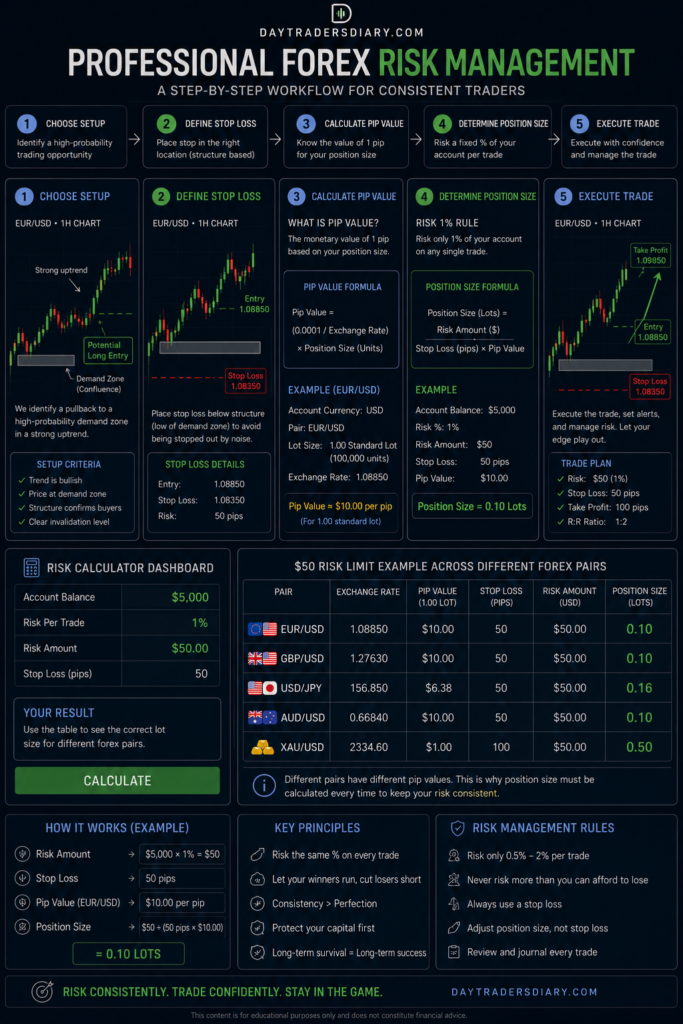
Once traders understand pip value properly, position sizing becomes more logical and less emotional.
Instead of thinking:
“How many lots should I trade?”
The experienced traders believe:
“Just how much exposure of my account am I willing to risk on this idea?”
That shift fundamentally impacts how we trade.
This is where a lot of traders totally miscalculate exposure. A structured Position Size Calculator takes the uncertainty out of the equation and allows traders to normalize risk across multiple forex pairings, volatility circumstances and stop-loss distances.
That consistency becomes incredibly valuable over time.
Because stable exposure usually creates more stable psychology.
Why Experienced Traders Think in Risk First
Newer traders often obsess over:
Pips won.
Trade frequency.
Daily profit goals.
Experienced traders focus more on controlled exposure and execution quality.
For example, a trader risking 1% per trade understands every setup in terms of manageable account exposure rather than emotional excitement around individual trades.
That framework promotes emotional balance.
The losses appear tolerable.
The winning streaks don’t look so scary.
Decision-making is more transparent.
The finest traders are not gamblers always chasing the outcomes.
They begin to think like risk managers, maintaining consistency.
They start thinking like risk managers protecting consistency.
Why Journaling Exposure Improves Trading
One of the fastest ways traders improve is by reviewing their exposure patterns honestly.
Most traders follow only:
Sign In.
“Exit.
Gain or loss.
More experienced traders follow far more:
Risk percent.
Pip values consistency.
Conditions of volatility.
Emotional activity in the act of performing.
Over time, patterns will emerge.
Some traders know that they become impulsive on volatile pairs.
Some believe that large exposure creates hesitancy or emotional departures.
Without documentation, those patterns remain unseen.
Using a structured Trade Journal Template helps traders analyze execution quality objectively instead of emotionally reacting to outcomes alone.
The traders who improve fastest are usually the ones willing to study themselves honestly.
Why Serious Traders Eventually Focus on Capital Efficiency
At some point, disciplined traders learn that long-term growth isn’t about taking big risks, it’s about growing reliable execution.
And that transforms the way they think about capital.
Most experienced traders eventually go into assessment programs since these programs allow them to get access to bigger capital while setting up systematic risk-management guidelines.
The5ers, FTMO, and TradeThePool are all companies that promote consistency, regulated exposure, and disciplined execution.
That structure matters.
A trader who already understands pip value and position sizing usually adapts much better to funded trading environments than traders still operating emotionally.
For disciplined traders looking to scale responsibly, a The5ers evaluation account can become a logical next step because it rewards consistency instead of reckless risk-taking.
The Real Purpose of a Pip Value Calculator
A pip value calculator is not just a convenience tool.
It is a consistency tool.
Its real purpose is helping traders maintain stable exposure regardless of:
Currency pair.
Stop distance.
Trading conditions.
That consistency improves much more than risk management alone.
It improves emotional control too.
This week, go back and review your last ten trades carefully.
was your exposure the same in each setup?
Or did your risk shift silently based on confidence, volatility, or emotion?
Once traders start looking at exposure honestly, most of them will see critical trends.
If you are searching for your next read, take a look at similar DayTradersDiary.com information on forex risk management, trading psychology and position sizing discipline. The issues directly relate to long-term trading consistency.
FAQs
What is a pip value calculator in forex trading?
A pip value calculator allows traders to assess how much money each pip movement is worth based on the size of the trade, the currency pair being traded, and the account currency.
Why is pip value important in day trading?
Pip value is actual trade exposure. Without proper estimates, dealers can unwittingly put inconsistent amounts at risk on different trades.
Does pip value change between forex pairs?
Yes . Pip values change for different currency pairs and lot sizes. Especially for volatile or non-USD pairs.
How does a pip calculator help risk management?
It helps traders standardize exposure by calculating proper position size relative to stop-loss distance and acceptable account risk.
Why do traders become emotional with inconsistent position sizing?
And when the exposure shifts unpredictably, the emotional responses tend to shift. Stable risk generally means stable decisions.
How do funded trader programs use risk management?
Programs like The5ers and FTMO emphasize disciplined exposure control, consistency, and professional risk-management standards.