
Most traders that lose don’t have an issue with execution first. They have a problem with choice.
They trade setups that are ordinary, late, emotional, revenge, and random, which seemed excellent for ten seconds. They blame psychology, indicators, or brokers when the true problem was that they were making trades with bad odds.
High-probability setups are not patterns on charts that work every time. They are times when a number of things come together to make you more likely to get what you want. That doesn’t mean you can be sure. It means better bets, less risk, and fewer trades that don’t need to be made.
One thing that hasn’t changed after years of watching traders get better is this. More deals are not the quickest way to becoming consistent. It is better at filtering trades.
This article will teach you how to spot high-probability setups in real time, how to avoid phoney confluence, and how to create a framework that works in forex, indices, and other liquid markets.
What High Probability Actually Means
Many traders misuse the term high probability.
They think it means a setup that wins often. That is incomplete.
A true high-probability trade includes three layers:
A favorable chance of working
Controlled downside if wrong
Enough upside to justify the risk
A trade that wins 80 percent of the time but makes 0.3R while losing 1R can still fail long term. A trade that wins 45 percent of the time at 2.5R may outperform it.
This is why expert traders don’t only look at their win rate; they also look at their expectancy.
Studies from CME Group education, the CMT Association, and broker performance reveal that disciplined risk management and a methodology that can be repeated are more important than being able to make accurate predictions.
Stop going after “sure thing” trades if you’re a day trader. Start making maths that works for you.
Why Most Traders Miss the Best Setups
Before they move, the best setups are usually boring.
They come together around levels that have already been defined. They go off at session windows that are known. They fit with the logic of a trend or an obvious reversal. They don’t need ten signs that say “green.”
A lot of traders don’t pay attention to these because they care more about movement than context.
They buy when a candle goes off. They short after people sell in a panic. They mix up edge and momentum.
Traders that have been around for a while recognise this difference:
People pay attention to movement.
Positioning opens up possibilities.
The High-Probability Setup Framework
When I review trades with struggling traders, I ask five questions. If three or more are weak, the trade is usually low quality.
Market Structure
Where is price relative to key levels?
Is the market trending with higher highs and higher lows? Is it compressing into breakout pressure? Is it rejecting a weekly level?
A long trade into major resistance is weaker than a long trade above reclaimed resistance.
Structure is the first filter because direction without context is noise.
If you need help with this concept, read your internal guide on Best Forex Chart Patterns for Day Traders.
Location
Where did the setup occur?
A breakout in the middle of nowhere is weaker than a breakout from range highs. A reversal at a random price is less strong than one at the bottom of the previous session.
Location is very important to good traders since it makes risk clearer.
The setup is usually better if your halt can hide behind a logical level.
Timing
When did it happen?
EURUSD at London open behaves differently than midday drift. GBPUSD around major UK data behaves differently than late US afternoon.
A lot of setups don’t work out not because the pattern was bad, but because the time was off.
The same chart pattern may work great when there is a lot of liquidity, but not so well when there isn’t.
Trigger
What specifically confirms entry?
This is where many traders get lazy.
“Price looked strong” is not a trigger.
A proper trigger could be:
Break and hold above range high
Retest of breakout level with rejection
Pin bar from support with momentum follow-through
Inside bar break aligned with trend
You already cover some of these ideas in your articles on How to Trade Pin Bars in Forex and How to Trade Inside Bars in Forex.
Risk to Reward
Can the trade pay enough?
Even clean setups fail if target is too close and stop is too wide.
If resistance is six pips away and your stop needs ten pips, the chart may be pretty but the trade is poor.
This is why professionals pass many valid setups. They are valid, but not profitable enough.
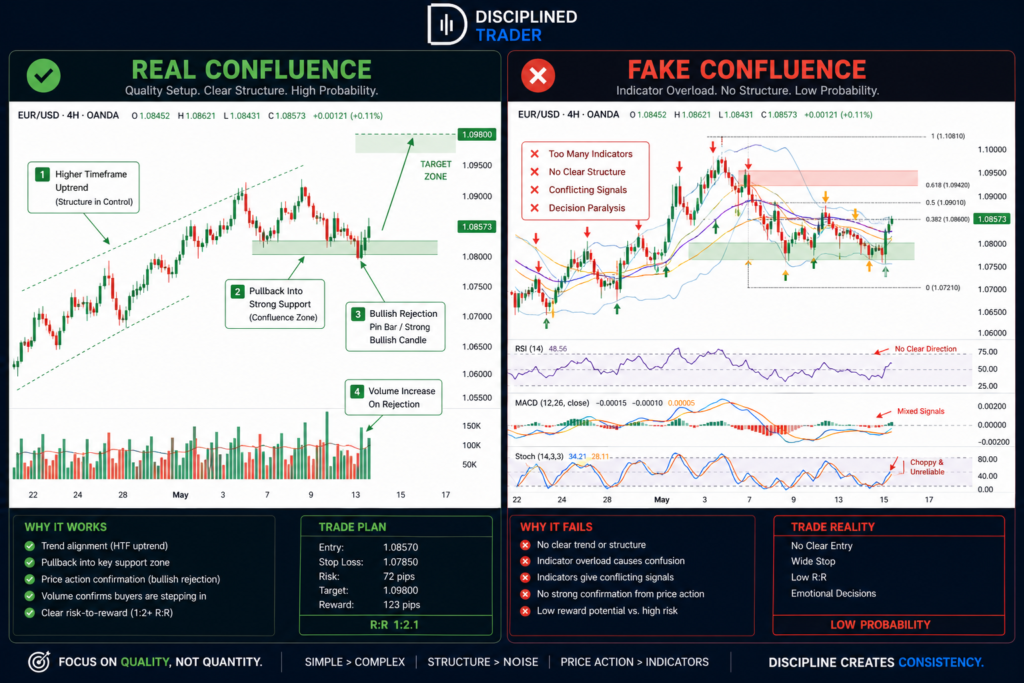
What Real Confluence Looks Like
Confluence is another abused word.
Real confluence means independent reasons aligning. Fake confluence means five indicators derived from price saying the same thing.
Useful confluence might be:
Trend direction up on higher timeframe
Pullback into intraday support
London open liquidity entering
Bullish rejection candle
Room to next resistance for 2R+
That is meaningful.
RSI up, MACD up, stochastic up, moving average up on same candle is often just duplicated information.
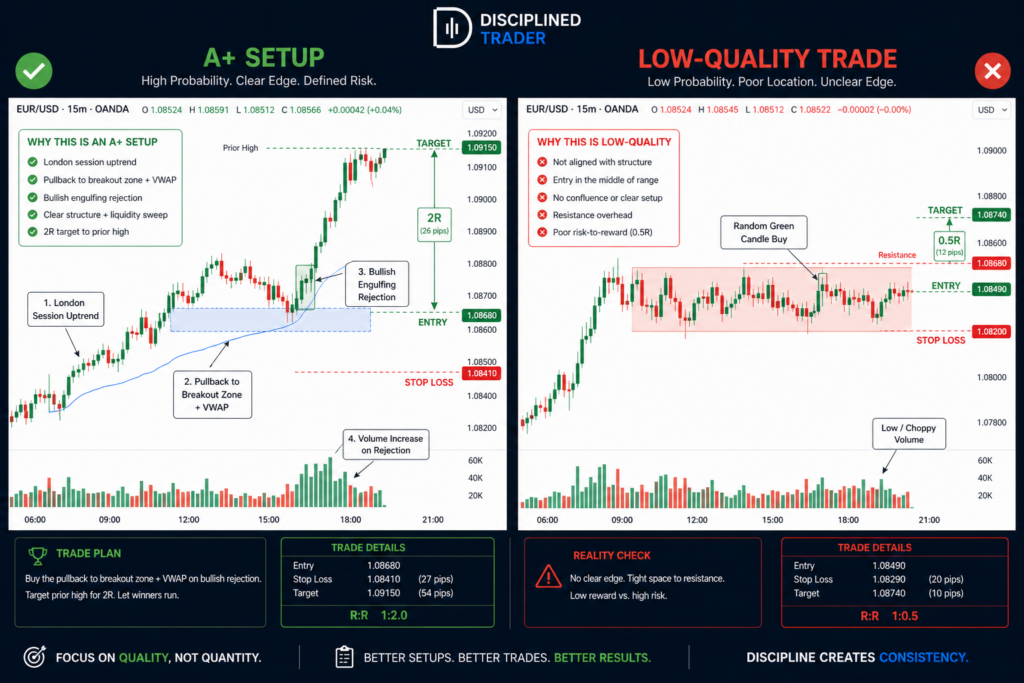
Example of a High-Probability Intraday Setup
During the London session, the EURUSD goes higher. Price goes back to the previous breakout zone and VWAP area. ATR contracts when the price goes down. When the volume comes back, a bullish engulfing candle forms.
Why this is important:
Trend backs up direction.
Location helps with stop placement.
Timing helps with liquidity.
Trigger confirms that buyers are coming in.
Reward for previous high offers 2R+.
That is a trade worth attention.
Now compare that to buying a random green candle in the middle of range after a move already extended. Same pair, same day, lower quality.
How to Identify High Probability Reversals
Reversals are harder because traders love calling tops and bottoms early.
A real reversal often includes:
Exhaustion into key level
Failure to continue after breakout
Shift in structure
Strong rejection candle
Follow-through on next candle
Without those elements, many reversals are just pullbacks.
If this is your style, your article on How to Identify Trend Reversals Intraday should be required reading.
Risk Management Separates Good Setups from Good Results
Even A+ setups lose.
That sentence saves accounts.
If a trader sizes too big on one good setup, they could ruin a whole week of hard work. A trader who takes risks all the time can handle changes and let their edge play out.
Most traders get the risk wrong here. The Position Size Calculator takes the uncertainty out of lot size and helps make sure that it matches the stop distance, pair volatility, and account size.
High probability does not justify oversized risk. It just justifies attention.
Journaling High-Probability Trades Properly
Most journals track P&L and nothing else.
That misses the point.
Use your Trade Journal Template to grade every trade on:
Structure quality
Location quality
Timing quality
Trigger quality
Risk to reward quality
Execution quality
Emotional state
After 50 trades, compare setups that got an A grade to setups that got a C grade.
Most traders learn something difficult and useful: bad luck doesn’t cause most losses; ordinary setups do.
That one piece of information could change your career.
How to Build a Personal Setup Playbook
You do not need twenty setups. You need two or three that match your temperament.
If you are patient, trade pullbacks.
If you react fast, trade breakouts.
If you read price action well, trade reversals selectively.
Build screenshots of your best trades. Label the conditions. Study them weekly.
The market rewards specialization more than variety.
Scaling the Edge Beyond Personal Capital
Once a trader can identify quality setups and execute with discipline, another issue appears: capital limits.
A trader making 4 percent monthly on a small account may have skill but limited upside. That is why many serious traders explore evaluation programs from firms like The5ers, FTMO, and similar prop models.
Used correctly, these are not shortcuts. They are capital access models.
If your journal shows real consistency, low drawdown, and rule-based execution, a The5ers evaluation account can be a rational next step to scale proven performance rather than overleverage personal funds.
The wrong reason to seek funding is desperation. The right reason is readiness.
Common Mistakes When Searching for High-Probability Trades
Waiting for perfection and never trading.
Calling every confluence setup high probability.
Ignoring session timing.
Taking setups with poor reward profile.
Forcing trades after missing one good move.
Changing strategy weekly before collecting data.
Confusing confidence with edge.
SEO Questions Traders Commonly Ask
How do I identify high probability trades?
Make a list of things to do based on structure, location, timing, trigger, and reward potential. The chances of anything happening go up if a number of things happen at the same time.
What is the best high probability setup for day trading?
There is no universal best setup. Pullbacks in trend, range breakouts with confirmation, and level-based reversals are common strong candidates.
Are high win-rate setups always better?
No. A lower win-rate setup with larger average winners can outperform a high win-rate setup with poor reward ratios.
Final Takeaway
High-probability setups are rarely flashy. They are usually obvious in hindsight because they were logical in real time.
Your challenge this week is simple: stop asking whether a trade “looks good.” Start scoring it.
This week, your task is easy: stop asking if a trade “looks good.” Start giving it points.
Use structure. Use timing. Use math to figure out rewards. Be disciplined.
One trade that has been sorted out often trumps five that were made on a whim.
Next read: Best Risk/Reward Ratios for Day Trading or Best Day Trading Mistakes Checklist.
FAQs
How many setups should a day trader focus on?
Usually two or three repeatable setups are enough. Depth beats variety.
Can beginners find high-probability setups?
Yes, but they should make it easier and focus on one market and one session at a time.
Do indicators create high probability trades?
Indicators can support decisions, but structure, timing, and execution usually matter more.
How long should I test a setup?
Track at least 30 to 50 trades before making major conclusions.
Why do good setups still lose?
Because probability is never certainty. Even strong edges experience losing streaks.