
Most day traders do not lose because they cannot spot direction. They lose because normal candlesticks tempt them into reacting to every small pullback, fake breakout, and random spike.
A trend starts, they enter late. Price pauses, they panic. One red candle appears, they exit. Then the move continues without them.
This is where Heiken Ashi charts can make a big difference.
Heiken Ashi candles smooth out price changes and cut down on visual noise. They assist traders stick with trends longer, avoid making decisions based on their feelings, and better understand momentum. I’ve seen traders with good systems get better just by not overreacting to every candle.
This guide explains how to trade with Heiken Ashi charts in a professional way, where they help most, where they can mislead you, and how serious day traders use them for cleaner execution.
What Are Heiken Ashi Charts?
Heiken Ashi means “average bar” in Japanese. Heiken Ashi candles use averaged data from current and prior candles, while regular candlesticks show raw open, high, low, and close prices.
That makes trends smoother and the structure of the candles more stable.
This means in real life:
Strong uptrends often have a series of green candles with little or no lower wicks.
Strong downtrends often show consecutive red candles with small or no upper wicks.
Choppy markets become easier to identify because candles alternate more often.
Instead of reacting to every price twitch, you focus on momentum quality.
Heikin Ashi Candles Calculation Explained
Many traders use the chart without understanding what it is plotting. That creates confusion when comparing broker prices to candle values.
The simplified formula is:
Heikin Ashi Close = (Open + High + Low + Close) ÷ 4
Heikin Ashi Open = Previous Heikin Ashi Open + Previous Heikin Ashi Close ÷ 2
High = Highest of current high, Heikin Ashi open, or Heikin Ashi close
Low = Lowest of current low, Heikin Ashi open, or Heikin Ashi close
What matters for traders is this:
The chart is derived from price, not raw price itself. It is a filtered version of price action.
That is why it looks cleaner and trends appear smoother.
Why Heiken Ashi Helps Day Traders
Most intraday mistakes come from poor emotional timing, not bad ideas.
A trader correctly identifies bullish EURUSD bias but exits on the first small pullback. Another person sells GBPUSD during a trend because one candle goes red. Heiken Ashi cuts down on these hasty choices.
Some of the benefits are:
Recognising cleaner trends
Less emotional response to noise
Longer hold times for strong moves
More patient pullbacks
Easier to make visual decisions during quick sessions
That psychological edge is more important to scalpers and intraday traders than most indicators.
Research-Backed Insight Traders Should Understand
Research from CME Group and exchange education resources regularly indicates that volatility tends to cluster around session openings, closings, and economic events. Standard candles often become noisy and unsteady at these times.
Technical analysis research from broker education desks and market structure studies also shows traders frequently underperform due to early exits and overtrading during volatility spikes.
Heiken Ashi helps because it slows your reaction speed just enough to improve judgment.
That is valuable in trading. Faster decisions are not always better decisions.
How to Use Heiken Ashi for Day Trading
Trend Continuation Framework
To figure out which way to go, start with a higher period chart, such the 15-minute or 1-hour chart.
If the market is going up and the Heiken Ashi candles are still green with only a few lower shadows, only look for long setups.
After that, go to your execution window and enter on little pullbacks.
For example:
The EURUSD is above the London session VWAP.
The Heiken Ashi candles are green for 15 minutes.
A pullback happens around support.
The first bright green continuation candle is your trigger.
This stops people from making random trades that go against the trend.
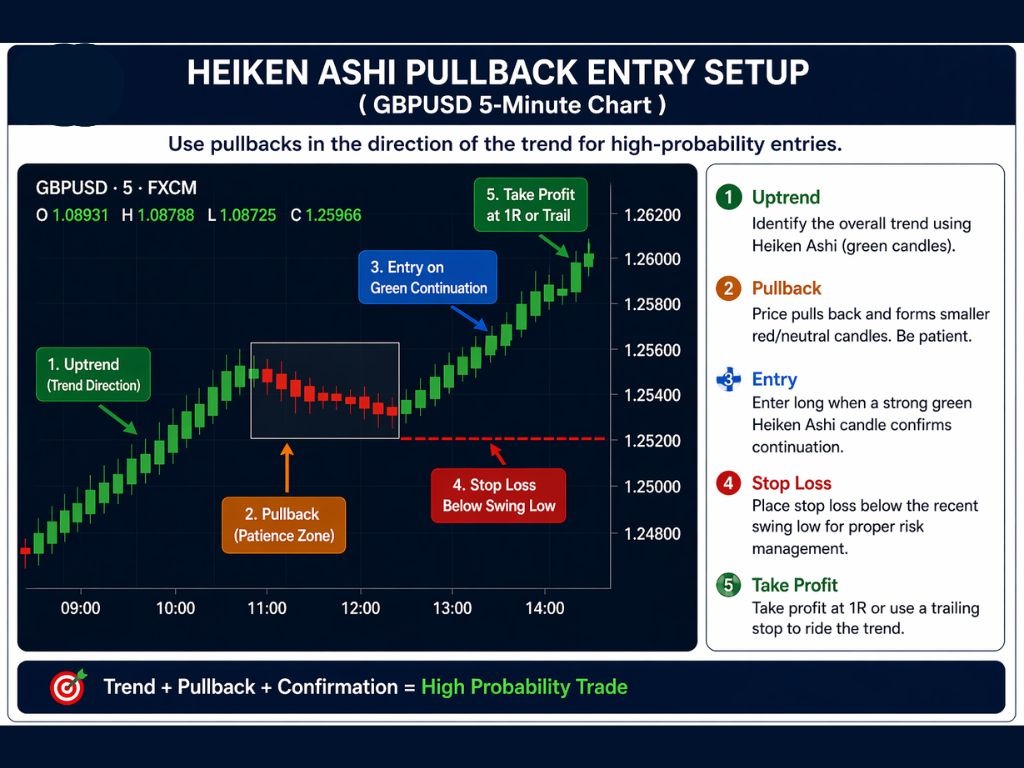
Pullback Entry Logic
Many traders chase the first breakout candle and get trapped.
Instead, let price extend, wait for a pause, then use Heiken Ashi color resumption as confirmation.
If three green candles trend upward, then two smaller indecisive candles form, a fresh strong green candle often signals continuation.
This works well with our guide on How to Trade the EURUSD Daily Range where session levels matter.
Exit Management with Heiken Ashi
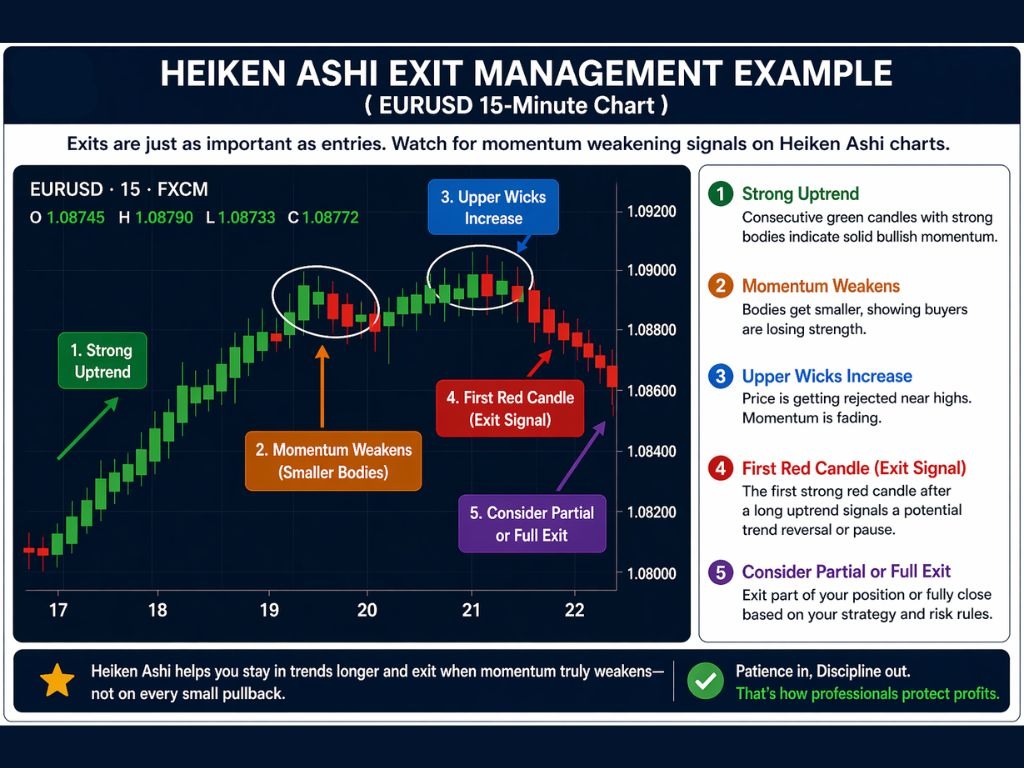
One of the best uses of Heiken Ashi is exits.
Instead of grabbing tiny profits, hold until momentum weakens.
Examples:
All of a sudden, consecutive green candles print smaller bodies.
The upper movement stops.
After a strong trend expansion, a red candle closes.
That often means taking some profits or leaving completely, depending on the structure.
A lot of traders improve their expectation not by getting in better, but by getting out better.
Heikin Ashi Strategy for Forex Day Traders
A practical forex setup:
For directional bias, look at the 15-minute chart.
Use the Heiken Ashi chart for 5 minutes to enter.
Only trade during the London or New York sessions.
Take long positions above the session VWAP and short positions below it.
Enter after the pullback and the candle colour stays the same.
Put the stop beyond the most recent swing.
At 1R, scale out and follow the rest of the position.
This structure brings together discipline, time, and trend.
Read How to Trade GBPUSD Intraday if you focus on faster-moving pairs.
Best Indicators to Combine with Heiken Ashi
Heiken Ashi works best with technologies that give you more information instead of additional noise.
Some strong combos are:
VWAP for the average value of a session and ATR for stops dependent on how volatile the market is
200 EMA to sort out patterns
Daily highs and lows
Tools for session or volume activity
Don’t put five lagging indicators on a smoothed chart. That makes decisions take longer.
Where Heiken Ashi Can Mislead You
This chart type is useful, but not magical.
It can create problems when traders forget it is a derived chart.
Common issues:
Late reversal signals in sharp turns
Late entries after big price moves
Fake confidence when trends are crushing down
Ignoring real bid and ask levels
Putting stops in place just based on the colour of the candle
Always check the raw pricing levels to be sure the trade goes through.
Risk Management and Execution Discipline
Because Heiken Ashi looks smoother, traders sometimes assume trades are safer than they are.
That is dangerous.
You still need to base your risk on how the market really works, not on attractive candles.
Place your stops based on swing highs, lows, the ATR distance, or session levels. Then get the size right.
This is where most traders get the risk wrong. The Position Size Calculator takes the uncertainty out of trading and makes sure that every trade is the same.
A clean chart doesn’t mean you can take too big of a position.
Journaling Heiken Ashi Performance
Don’t think that the chart will help you do better. Take a measurement.
Keep an eye on the next 30 deals and compare:
Did you keep the winners longer?
Did you cut down on revenge trades?
Did the entries get better?
Did delayed signals hurt performance?
Which pairs did the best?
Did certain sessions work better?
Use the Trade Journal Template to compare Heiken Ashi trades against normal candlestick trades. Let data decide.
Scaling Edge Into Capital Growth
Many traders eventually discover they can execute well on small accounts but returns remain capped by account size.
That is where funded evaluations become relevant.
Disciplined traders can get more money through firms like The5ers, FTMO, and other prop businesses if they can show that they are consistent.
Heiken Ashi traders often do well since sponsored models reward being patient, sticking to a trend, and keeping drawdowns under control.
If your process is stable but you don’t have enough money to move on, looking into a The5ers assessment account could be a good next step, not a quick fix.
Common Mistakes Traders Make
The biggest mistake is treating Heiken Ashi as a signal generator.
It is a charting method, not a guaranteed strategy.
Other errors include:
Trading every candle color change
Ignoring session context
Going in after long runs
Using no stop since the trend appears good
Changing systems after five trades
Don’t use technology to make decisions; instead, use it to help you make decisions.
FAQs
Is Heiken Ashi good for day trading?
Yes, especially for trend-following traders who overreact to normal candlestick noise.
What is the best timeframe for Heiken Ashi?
A lot of day traders use 5-minute charts to make trades and 15-minute charts to figure out which way the market is going.
Is Heiken Ashi better than candlesticks?
Not better in all cases. It is better for smoothing trends, while standard candles are better for exact price detail.
Can I scalp with Heiken Ashi?
Yes, but combine it with session levels, spreads, and fast execution. It works best in liquid markets.
Does Heiken Ashi repaint?
It does not repaint like some indicators, but because values are averaged, candles differ from raw price candles.
Final Thoughts
Heiken Ashi charts help traders do something most systems fail to teach: stay calm during movement.
That alone can improve results.
If you always leave early, chase noise, or change your mind too often, try Heiken Ashi for the following 30 trades and keep a strict diary.
You might learn that your strategy was never the problem. You were looking at price in a certain way.
You should read How to Use ATR Stops in Forex next. Smoother entrances don’t matter much if you don’t know how to get out of trades.