
Most traders don’t place bad trades.
They place bad stops.
You enter at the right level, your analysis is solid, the market moves slightly against you, stops you out, and then runs exactly in your direction.
After a while, it feels personal.
So you widen stops. Then losses get bigger. Or you tighten them. Then you get chopped out even more.
This cycle has nothing to do with your entries.
It has everything to do with ignoring volatility.
ATR stops fix that problem, but only if you understand how to use them as a dynamic tool, not a formula.
What the Data Says About Volatility-Based Stops
ATR, or Average True Range, measures how much a market typically moves over a given period.
That sounds simple, but it solves one of the biggest issues in trading.
Markets don’t move in fixed pip distances.
Research from the Bank for International Settlements shows that forex volatility shifts based on liquidity, macro flows, and session timing.
CME Group volatility data highlights clustering behavior. Quiet periods lead to expansion, and expansion leads to unpredictable spikes.
J. Welles Wilder, who developed ATR, designed it specifically to adapt to changing market conditions.
For a day trader, this means one thing.
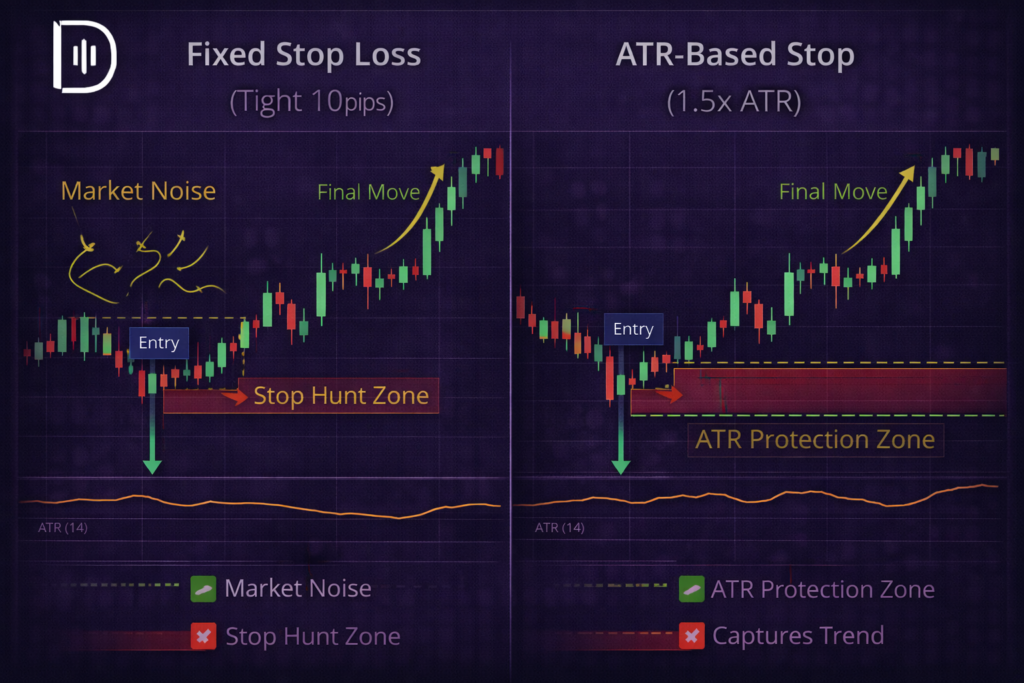
A fixed 10 pip stop might be perfect in one environment and completely useless in another.
ATR adjusts your stop to the current market reality.
What ATR Stops Actually Do
Most traders think ATR is just a number.
It is more than that.
It tells you how much room the market needs to breathe.
If your stop is smaller than the current ATR, you are trading inside normal noise. You are likely to get stopped out even if your idea is correct.
If your stop is significantly larger than ATR, you may survive noise but destroy your risk to reward.
The goal is balance.
ATR stops place your invalidation point outside normal volatility but still within a logical risk framework.
A Practical Framework for Using ATR Stops Intraday
Start by identifying the current volatility environment.
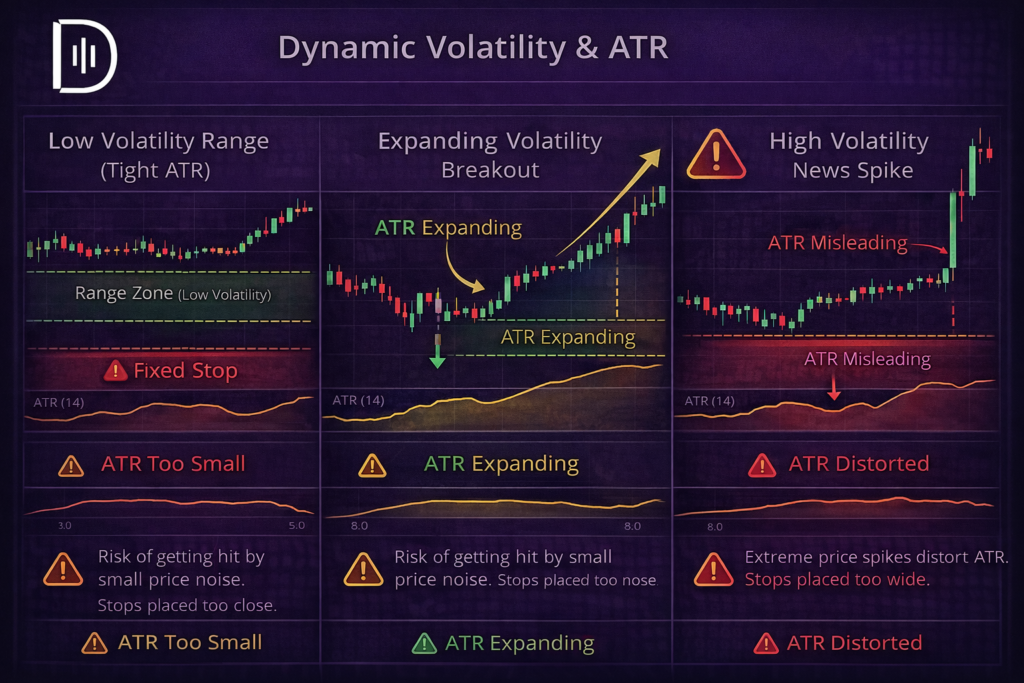
If ATR is low, the market is quiet. Breakouts are more likely to fail, and tight stops may work better.
If ATR is expanding, volatility is increasing. This is where most traders get stopped out because they don’t adjust.
Now apply a multiplier.
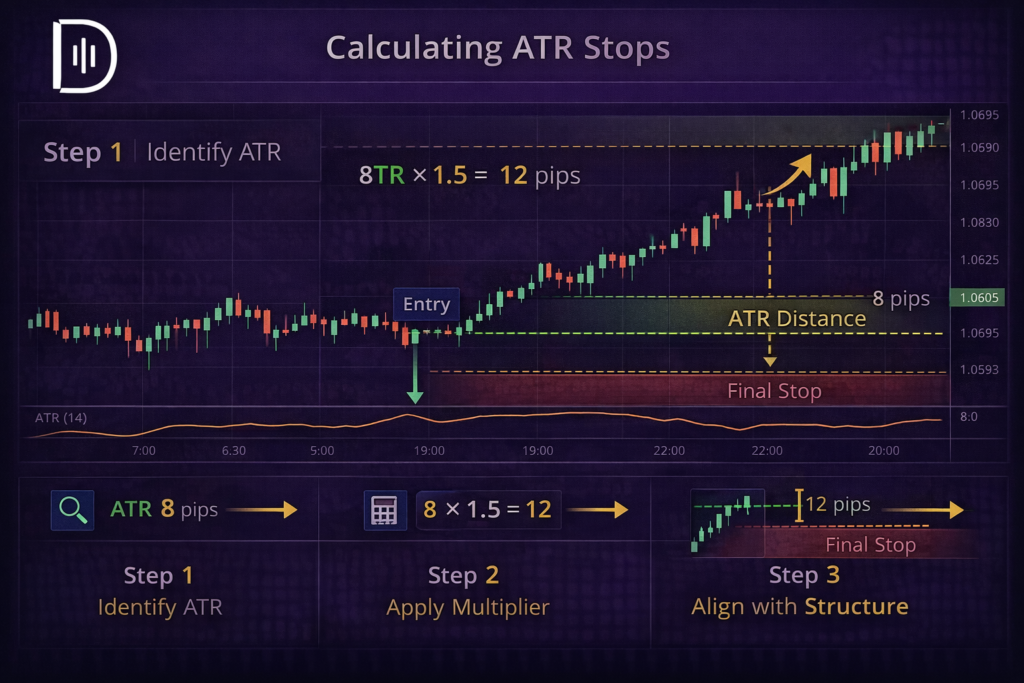
Instead of using raw ATR, experienced traders use a multiple such as 1.2x, 1.5x, or 2x ATR depending on the setup.
For example, if ATR on your timeframe is 8 pips and you use a 1.5x multiplier, your stop distance becomes 12 pips.
Now here is where most traders miss the real edge.
You do not place the stop blindly at that distance.
You align it with structure.
If you are buying a pullback in an uptrend, your stop should sit beyond both the structure level and the ATR-based distance. This ensures your trade is only invalidated if both price structure and volatility logic break.
Now consider a scalping scenario.
If you are trading quick intraday moves, using a smaller ATR multiplier can make sense, but only in stable conditions. In volatile sessions, tight ATR stops become a liability.
This is why understanding session timing is critical. If you have studied how to trade London or New York sessions, you already know volatility behaves very differently across them.
When ATR Stops Fail
ATR is not a magical shield.
It stops working when traders take it out of context.
ATR rises quickly during news events, which can change where stops are set. A stop based on the present ATR can be too wide or too quick to react.
In markets that are going up and down, ATR may get so small that stops get excessively tight, which can cause modest losses over and over.
Using the same ATR settings for all pairs is another typical mistake.
EURUSD, GBPJPY, and XAUUSD have completely different volatility profiles. ATR must be adapted accordingly.
The biggest failure point is mechanical use.
If you treat ATR as a fixed rule instead of a dynamic guide, you lose its advantage.
Risk and Execution: Where ATR Becomes a Real Edge
ATR stops improve survival, but they also impact position sizing.
Wider stops mean smaller position sizes. Tighter stops allow larger positions.
This is where most traders miscalculate risk.
They adjust stops but forget to adjust size.
Using a position size calculator removes that inconsistency and keeps your risk per trade stable regardless of volatility.
Execution also improves with ATR because it reduces emotional decision-making.
Instead of guessing where to place your stop, you follow a structured approach based on market conditions.
Journaling ATR Performance
If you want to truly benefit from ATR stops, you need to track how they perform in different environments.
Look beyond whether a trade wins or loses.
Track the relationship between ATR and your stop.
Was your stop inside normal volatility?
Did ATR expand after entry?
Did your stop align with structure?
Were you trading during high or low volatility sessions?
Over time, patterns will emerge.
You will start to see which ATR multipliers work best for your style and which conditions lead to better outcomes.
This is where a structured Trade Journal Template becomes powerful. It helps you refine your approach based on actual data, not assumptions.
Scaling an ATR-Based Strategy
Once you build consistency using ATR stops, the next step is scaling.
Volatility-based risk management is exactly what professional trading environments require.
The5ers, FTMO, and FundedNext are examples of prop firms that value managed risk and consistency over big rewards.
ATR-based strategies work well with these models since they change based on market conditions instead than forcing a set amount of risk.
If your journaling demonstrates consistent performance, the next step is to look into a The5ers evaluation account. It helps you take benefit of higher sums of money without placing yourself at more risk.
FAQs
What is the best ATR setting for forex day trading?
A 14-period ATR is normal, but the advantage comes from how you use multipliers and the situation, not the setting itself.
What multiplier should I use for ATR stops?
Most day traders use between 1.2x and 2x ATR depending on volatility and setup type.
Can ATR be used for scalping?
Yes, but it needs stricter multipliers and close monitoring of volatility circumstances.
Is ATR better than fixed stops?
In most cases, yes. ATR adapts to market conditions, while fixed stops do not.
Closing: The Shift That Fixes Your Stop Loss Problem
ATR does not just change where you place your stop.
It changes how you think about risk.
Instead of asking “how many pips should I risk,” you start asking “how much movement is normal for this market right now.”
That shift alone can eliminate a huge percentage of unnecessary losses.
For your next week of trading, focus on one thing.
Before placing any stop, check the current ATR and ask if your stop is inside or outside normal volatility.
Track the difference.
You will quickly see how much of your previous stop-outs were avoidable.
As a next step, combine this with your understanding of volatility and session timing to build a more complete, adaptive trading system.