
Most day traders obsess over win rate and ignore the number that actually decides whether they survive long term: risk/reward.
I have seen traders win 70 percent of their trades and still lose money because they take tiny profits and oversized losses.
This guide explains the best risk/reward ratios for day trading, when each ratio makes sense, where traders misuse the concept, and how to build a framework that actually improves performance.
What Is Risk/Reward Ratio in Trading?
Risk/reward ratio compares how much you are willing to lose versus how much you expect to gain on a trade.
If you risk $100 to make $200, that is a 1:2 ratio.
That means you have a 1:3 chance of making $300 if you risk $100.
You are risking $100 to make $100.
Easy to write down. Difficult in real markets.
Many traders take profits too soon and let losses breathe too long when money is on the line. The ratio they planned never becomes the true one.
That is why doing things is more important than thinking about them.
Why Risk/Reward Matters More Than Win Rate
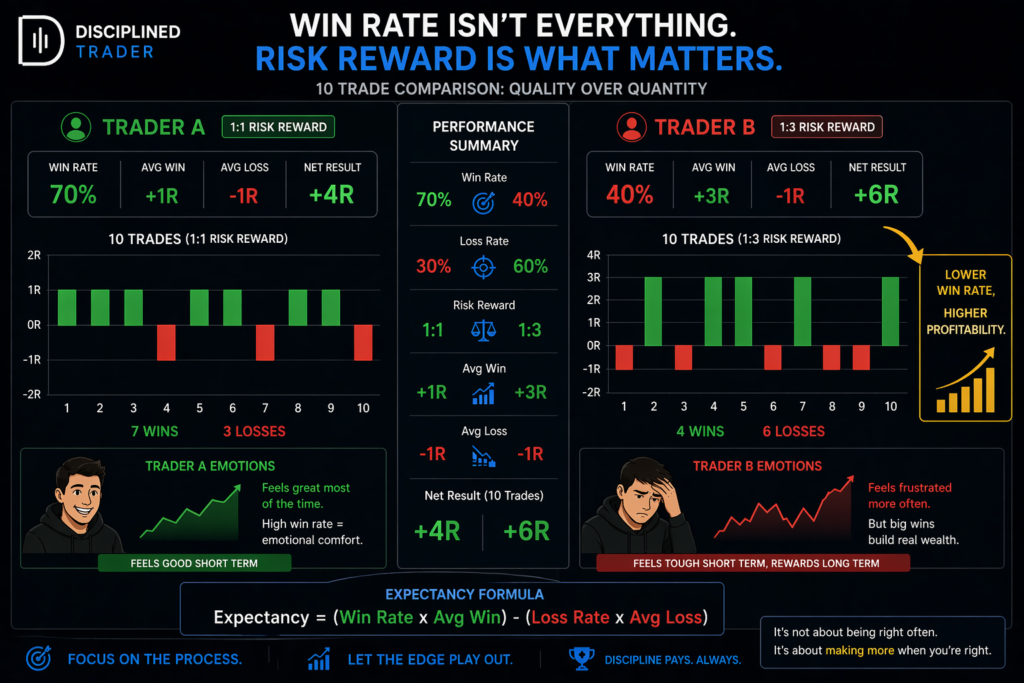
A trader who wins 40% of the time with 1:3 setups can do better than a trader who wins 70% of the time but has bad exits.
For example:
At a 1:1 ratio, Trader A wins 7 of 10 deals and loses 3.
The final result is +4R.
Trader B wins 4 out of 10 transactions at a 1:3 ratio and loses 6.
The end outcome is +6R.
Trader B is feeling terrible emotionally. Trader B usually makes more money.
Many traders quit profitable systems because they cannot tolerate lower win rates.
Research-Backed Insight Traders Should Understand
Studies from brokerage performance reports and behavioral finance research frequently show retail traders tend to cut winners early and hold losers longer. This is tied to loss aversion, a concept studied by Daniel Kahneman and Amos Tversky.
CME Group educational material on expectancy and risk also emphasizes that trade outcomes must be evaluated across a sample, not one result.
What this means in practice:
You do not need to be right often.
You need positive expectancy over enough trades.
Risk/reward is one of the clearest ways to create that expectancy.
The Best Risk/Reward Ratio Depends on Trade Type
There is no one-size-fits-all optimal ratio. The right percentage relies on how the market is doing, what kind of plan you use, and how well you carry it out.
1:1 Risk/Reward
Useful in fast scalping environments where hit rate is high and trade duration is short.
Works best when:
You have exact entries
Markets with a lot of liquidity
Good at reading tapes
Instruments with a tight spread
Doesn’t work when:
You think twice about entries.
Costs take away profits
The win rate falls below the required level.
For some traders who use tick charts or make quick momentum entries, this technique works well. If you like that kind of thing, read What Is a Tick Chart and How to Use It.
1:2 Risk/Reward
For day traders, this is often the best ratio.
It lets you set realistic goals while still keeping the win rate requirement modest.
Works best when:
Pullbacks in trends for trading
Breakouts during sessions
Expansions of ranges
Setups for forex intraday
One baseline ratio that I would choose for developing traders would be about 1:2.
1:3 Risk/Reward
Great for high-quality A+ setups when the market structure allows for long-term movement.
Works best when:
Days with strong trends
News keeps coming after a pullback
Breakout from important levels
Alignment on a higher time frame
Fails when:
The market is moving around.
Goals are not realistic
You can’t hold winners emotionally
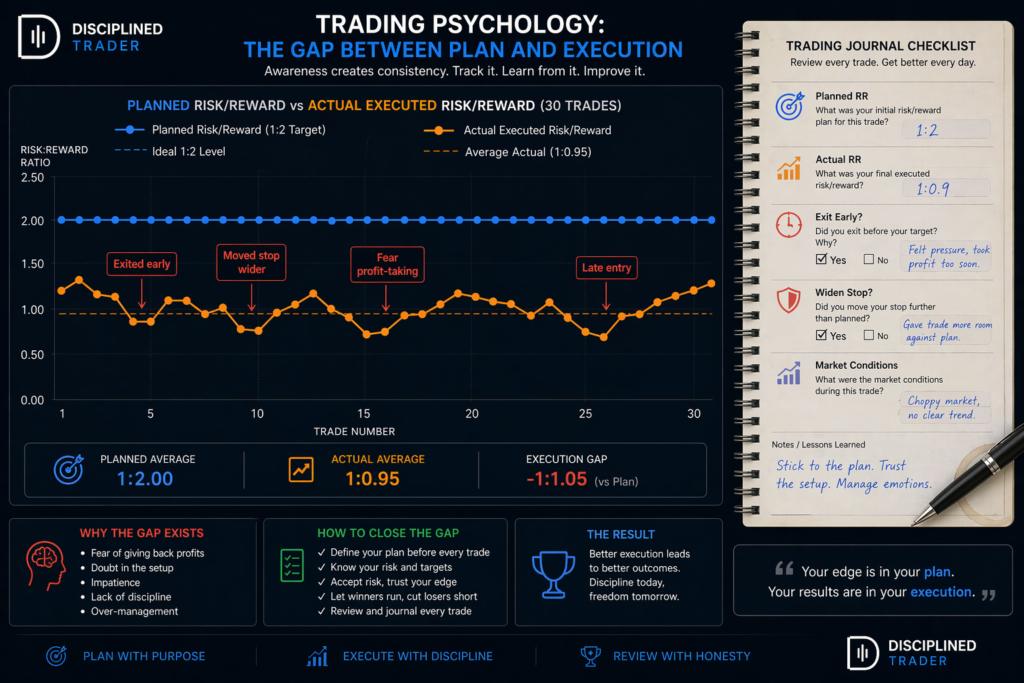
A lot of traders want to make 1:3 deals, but they leave around 0.8R because they are scared.
How to Use Risk Reward Ratio in Trading Properly
The mistake is starting with reward first.
Professionals start with structure.
Ask:
Where is my stop logically invalidated?
Where is the next realistic target?
Does reward justify risk after spreads and slippage?
If stop must be 20 pips and clean target is only 15 pips, skip it.
No setup is mandatory.
The market offers endless trades. Your capital does not.
A Practical Day Trading Framework
Trend Pullback Trade
EURUSD trending higher on 15-minute chart.
You buy retracement near VWAP.
Stop below swing low = 10 pips.
Next resistance = 22 pips.
That is roughly 1:2.2
Valid setup.
Breakout Chase Trade
GBPUSD breaks out of its range.
You get in late after the spike.
Stop still requires 15 pips to work.
There may only be 8 pips left before resistance.
Bad ratio. Forget it.
Late entries ruin the chance to win a prize.
Reversal Attempt
USDJPY looks exhausted.
Countertrend short setup.
Need wider stop due to volatility.
Possible reward exists, but probability lower.
This may need 1:3 potential to justify taking it.
Read How to Identify Trend Reversals Intraday for reversal logic.
Why Traders Misuse Risk/Reward
Many traders force trades because the ratio looks good on a chart.
A random setup with 1:5 target is still random.
High reward does not equal high expectancy.
Other mistakes:
Moving stops wider after entry
Taking profits early
Not paying attention to how much spread there is on scalps
Using fixed goals when things get unstable
Getting measurements from wrong entries
The ratio ought to be useful, not merely for show.
Dynamic Targets Beat Static Targets
Markets change by session and volatility.
A 1:3 target during dead Asian session may be unrealistic.
A 1:1 target during New York breakout may be too conservative.
Use the context:
ATR ranges
Increase in session range
Liquidity pools close by
How strong the trend is
Things that make news
This is why regulations that don’t change often let people down.
Risk Management and Position Sizing
Even the best ratio fails if position sizing is reckless.
If you risk too much on each trade, you’ll make lousy exits because of stress.
Most traders who are still learning do better when they take little, steady risks and allow the sample size do its job.
A lot of traders get the risk wrong here. The Position Size Calculator takes the uncertainty out of the equation and makes sure that your lot size matches your real stop distance.
Consistency, not big trades, is what makes a professional trader.
Journaling Risk/Reward Performance
Keep an eye on the planned ratio and the actual ratio.
That one number rapidly shows the truth.
Write down the next 30 trades:
R:R planned
Actual R:R reached
Did you leave early?
Did you make the stop bigger?
Did the market support the target?
What settings gave the best multiples?
A lot of traders find out that their problem isn’t with the quality of their strategy. It can’t hold on to winners.
Use the Trade Journal Template to identify patterns objectively.
Scaling Edge Into Bigger Capital
A trader who always makes money with disciplined risk/reward has something valuable: procedure.
But modest personal accounts sometimes limit how much you can make.
That’s why professional traders look into paid appraisals from companies like The5ers, FTMO, and others. These models value consistency, controlling drawdowns, and managing risk in a way that can be repeated more than fortuitous home runs.
A The5ers evaluation account might be a good approach to grow your edge professionally if you can show that you can consistently follow through and set reasonable reward goals.
Best Risk/Reward Ratios by Trader Type
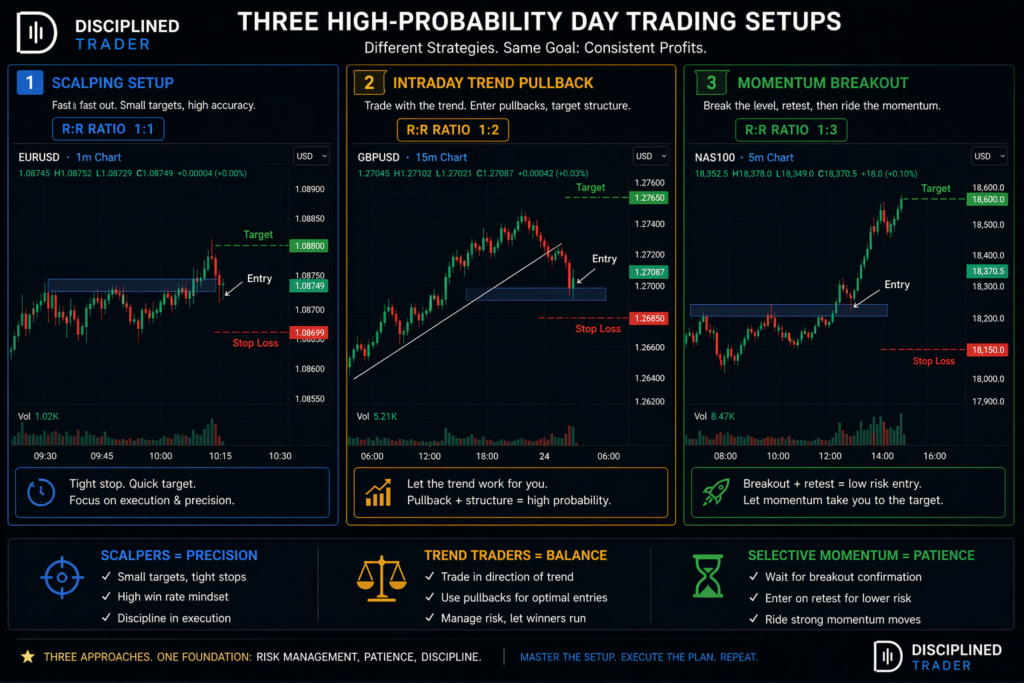
Scalpers commonly work at a rate of 1:1 to 1:1.5 with more frequency and accuracy.
Around 1:2, intraday trend traders do quite well.
Selective momentum traders could aim for 1:3 or more on premium setups.
Learning 1:2 is typically the best way for new traders to learn since it strikes a mix between being patient and being practical.
FAQs
What is the best risk to reward ratio in trading?
There isn’t one best ratio. A lot of day traders think that 1:2 is a good starting point since it strikes a good balance between realistic goals and high expectations.
Is 1:3 better than 1:2?
Only if the market structure supports it and you can hold winners. Unrealistic targets reduce actual profitability.
Can you be profitable with 1:1 risk reward?
Yes, as long as your win rate is high enough and your costs stay modest.
Should every trade have the same risk reward ratio?
No. Markets change. Use structure and volatility to guide realistic targets.
Why do traders fail with good risk reward?
Because intended ratios don’t always work out. Early exits and wider stops hurt your chances of winning.
Final Thoughts
The optimal risk/reward ratio is the one you can use in actual markets all the time, not the one that looks good on social media.
For most traders, that means fewer forced trades, cleaner entries, and keeping winnings for a little longer than they would want.
This week, keep an eye on how your planned R:R compares to your actual R:R on each deal. That gap might say more than any other sign ever could.
Your next read should be Best Day Trading Mistakes Checklist because poor risk/reward habits are usually hidden inside everyday execution errors.