
Most traders gaze at 1-minute and 5-minute charts for years without understanding this basic fact: orders, not time, move price.
That mistake makes people operate slowly, come in late, and feel like they know what they’re doing. A one-minute candle could look active when there isn’t much going on, or it might hide big order flow when things are moving quickly. You think you are reading price action, but often you are reading a clock.
This is where tick charts become valuable.
A tick chart builds candles based on a set number of transactions instead of elapsed time. That means the chart speeds up when markets become active and slows down when participation dries up. This can help day traders, especially scalpers and intraday momentum traders, see a clearer structure, better timing, and a more honest market rhythm.
I’ve seen traders transform the way they trade merely by changing the way they think about price. Not because tick charts are magical, but because they reflect how the market is truly moving.
This guide explains what tick charts are, how to use them properly, where they fail, and how serious day traders can build an edge with them.
What Is a Tick Chart?
A tick chart creates a new candle after a certain number of transactions occur.
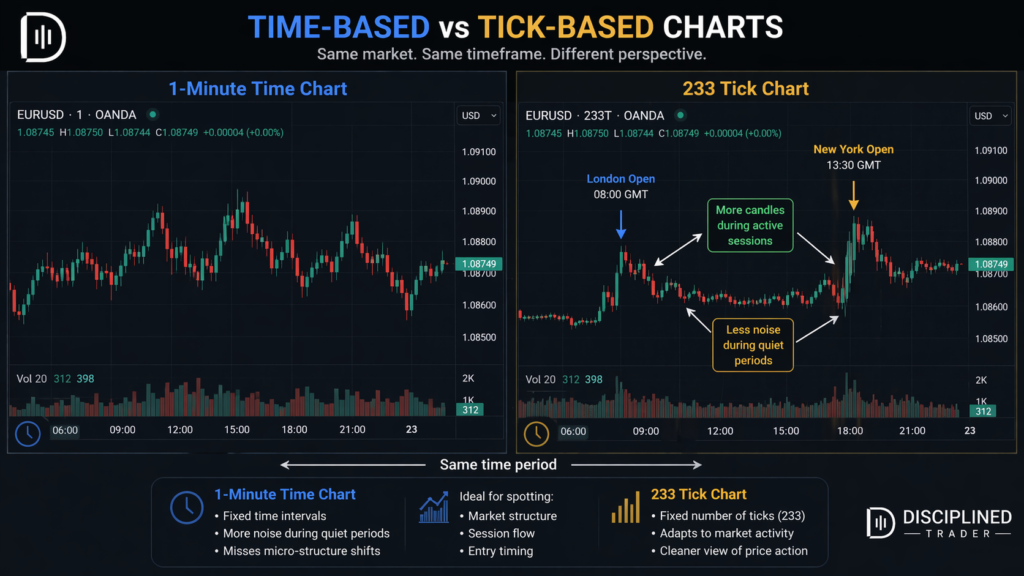
If you use a 200-tick chart, each candle forms after 200 trades are processed. During heavy activity, candles print quickly. During quiet periods, candles may take longer.
That differs from a 1-minute chart, where a new candle appears every minute no matter how active or inactive the market is.
This matters because active markets create opportunity. Tick charts naturally emphasize those moments.
For example:
When the London or New York market is open, a 200-tick chart may print candles quickly and reveal changes in momentum sooner than a 5-minute chart.
The same chart may slow down during the Asian session, which might help you avoid making trades when there isn’t much liquidity.
Why Tick Charts Matter for Day Traders
A lot of retail traders have trouble because they utilise charts that are easy to read but not very accurate.
Time charts are helpful for getting the big picture. Tick charts are typically superior for doing things.
Some benefits are:
Cleaner patterns throughout active sessions throughout the day
Less visual noise during quiet times
Better time for breakouts
Pullback entries that are more responsive
Better at reading when momentum is running out
If you trade fast markets like EURUSD, GBPUSD, Nasdaq, S&P futures, gold, or major stocks, tick charts can help you see what the crowd is doing in real time.
Research-Backed Insight Traders Should Understand
The CME Group and other futures exchanges routinely put out research on market microstructure that indicate how volume, order flow, and transaction activity tend to cluster around major session beginnings, closes, and data releases. That means that the odds may not be evenly spread out throughout the day. NASDAQ market structure studies also show liquidity and spread behavior change significantly during opening and closing periods.
For traders, this means one important thing:
A fixed time chart treats all minutes equally. Markets do not.
Tick charts adapt to participation. When activity rises, they provide more information. When activity falls, they provide less noise.
That does not guarantee profits, but it gives a more realistic lens.
How Tick Charts Actually Help Entries
Most traders lose their edge when they enter a trade.
They know which way to go, but they enter too late, chase breakouts, or buy when they are tired. Candles show true participation, thus tick charts can help with this.
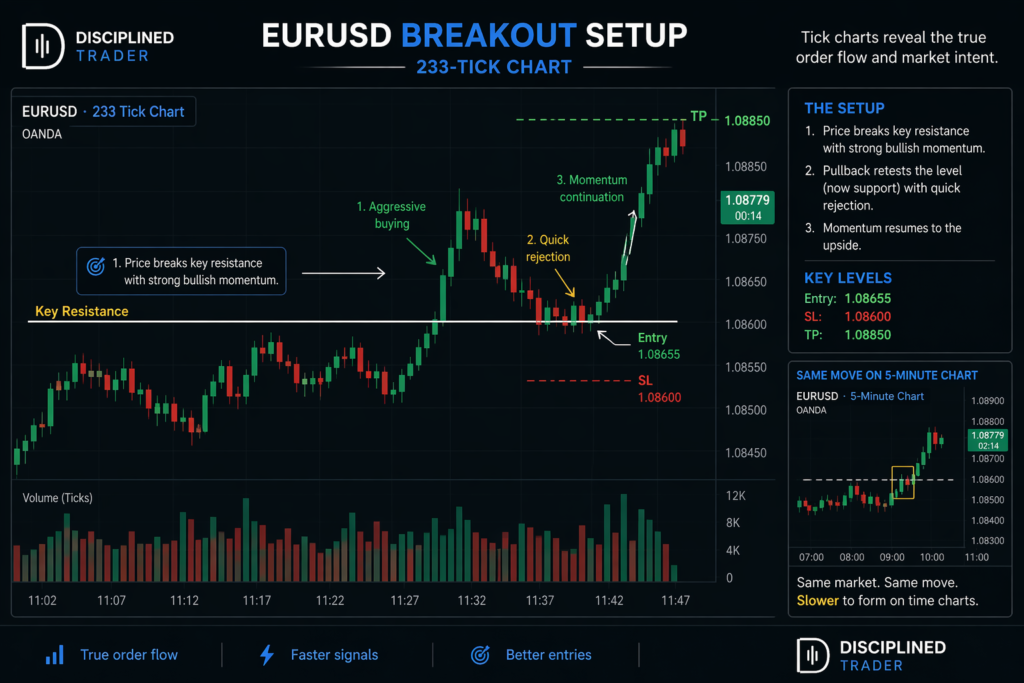
What do you think would happen if EURUSD broke through the resistance before London?
The breakout candle might still be building on a 5-minute chart. You are unsure.
On a chart with 233 ticks, a few candles may already show:
Buying aggressively at the breakout
Quick rejection of a pullback
Bids for continuation
That helps traders who are ready act sooner with known risk. If you trade momentum setups, read our guide on How to Trade the EURUSD Daily Range for session-based context.
Best Tick Chart Settings for Day Trading
There is no one optimal environment for everyone. It depends on how fast the market is and how you trade.
Traders commonly try these things for Forex day trading:
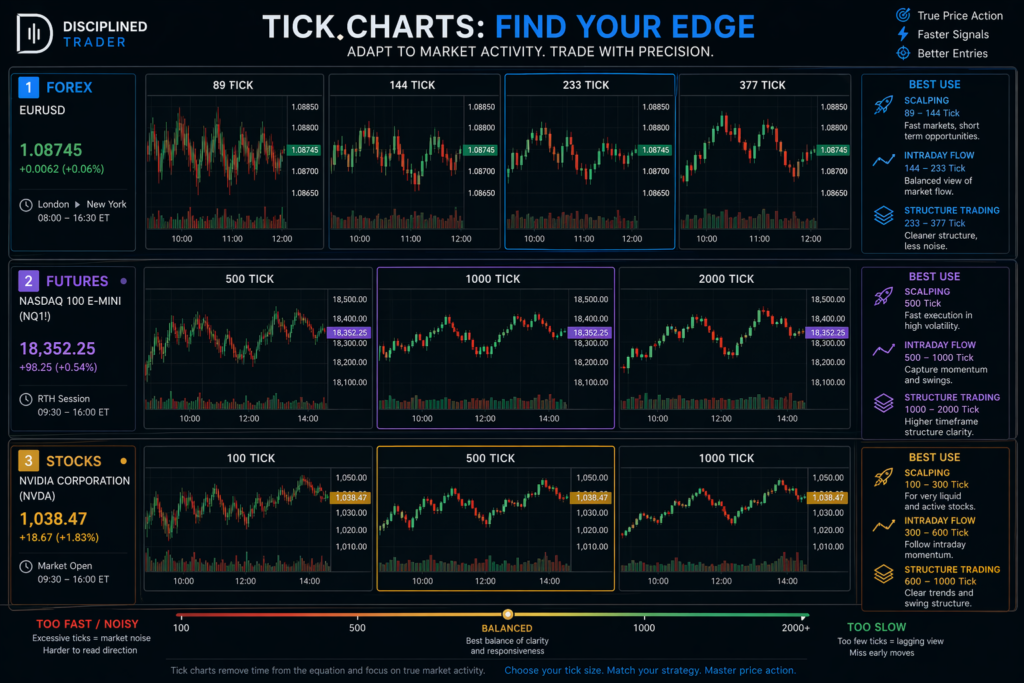
89 tick for aggressive scalping and 144 ticks for fast intraday flow
233 tick for an even execution
377 tick for a slower structure
For index futures:
500, 1000, and 2000 ticks
For stocks that are active:
100 to 1000 tick, depending on how much money is available
The error is duplicating someone else’s number. Instead, pick a place where candles may be seen, not one that is too busy or too cold.
A excellent test:
If candles print too quickly for you to think, make the tick size bigger. If candles barely move during active sessions, reduce tick size.
Tick Chart Trading Strategy That Actually Makes Sense
Trend Pullback Continuation
Use a higher timeframe time chart to define bias. Then use a tick chart for entry.
Example:
EURUSD trending higher on 15-minute chart.
Switch to 233 tick chart.
Wait for pullback into VWAP, moving average, or prior breakout zone.
Only enter when buyers get back on track with powerful candle closures.
This works because the greater timeframe shows the way and the tick chart helps with timing.
Breakout Retest Setup
A lot of breakouts fail because traders follow the first move.
Instead:
Wait for the range to break.
Check the tick chart for a retest.
If candles soon reject the original range limit and momentum returns, enter continuation. This often gives tighter stops than chasing a time-based breakout candle.
Exhaustion Fade Setup
Only useful for traders who have been doing it for a while.
When tick candles rise up quickly after a long trend and then move down again with smaller follow-through and frequent rejection, momentum may be slowing down.
That can create scalp reversals.
Read our guide on How to Identify Trend Reversals Intraday if this style interests you.
Where Tick Charts Fail
Tick charts are not always better than other types of charts.
They may have trouble when:
Markets are driven by news and are often turbulent.
Instruments with low liquidity print transactions that don’t make sense.
The input from your broker is not very good.
You don’t pay attention to the bigger picture.
You trade too much because candles come up faster.
That last point is fairly common. Having more candles can make you want to do more. well charting won’t make someone who is mentally sick well.
Tick Charts vs Time Charts
The smartest traders use both.
Use time charts for:
Session bias
Important support and resistance
Context of the trend
Windows for news
Use tick charts for:
Exact entries
Confirmation of momentum
When to pull back
Taking care of the scalp
Time charts are like maps, while tick charts are like street views.
Risk Management on Tick Charts
Because tick charts move faster when things are happening, stops might feel tighter and emotions can be greater.
This makes it easy to become stuck: by making positions too big.
A cleaner entry does not make taking big risks okay.
Set a predetermined percentage risk for each transaction and figure out the lot size based on the actual stop distance. This is where a lot of traders get their risk wrong. The Position Size Calculator takes the guesswork out of sizing and keeps it the same.
If volatility rises quickly, only widen stops if the amount of your position goes down.
Journaling Tick Chart Performance
Most traders don’t bother to see if tick charts are helpful to them. For 30 trades, keep track of the following:
Did the tick chart help you get a better price?
Did it make the stop smaller?
Did it make people trade too much?
Which session was the most fun?
Which tick setting was the most clear?
Did the win rate go up, or just the confidence?
Use the Trade Journal Template to compare tick-chart trades versus normal time-chart trades. Real data beats opinions every time.
Tick Charts and Capital Growth
A lot of competent traders reach their limit.
They become consistent with tiny personal accounts, but their revenues are still restricted by the size of their capital. That is where funded evaluation models become relevant.
Traders can get more buying power through structured programs like The5ers, FTMO, and other prop businesses if they can show that they are disciplined.
Tick chart traders frequently fare better since these accounts encourage accuracy, risk management, and consistent execution instead of just random gambling.
If your strategy works but account size is the bottleneck, it may be worth exploring a The5ers evaluation account as a professional next step, not a shortcut.
Common Mistakes With Tick Charts
Most of the time, new traders make the same mistakes.
They stop paying attention to the context and merely trade small candles.
They use settings that are too small and get lost in the noise.
They change numbers every day in their quest for perfection.
They don’t know the difference between speed and edge.
They trade more because the chart is interesting.
The answer is simple: don’t use tick charts for pleasure; use them to get things done.
FAQs
Are tick charts better for day trading?
In active markets, they can be superior for entry and timing momentum. They don’t inherently work better in trend context.
What is the best tick chart for day trading?
There isn’t one optimum setting for everyone. A lot of traders start with 144 or 233 for forex and then change it based on how volatile the market is.
Can I use tick charts for forex?
Yes, if your platform gives you good tick data. Many forex traders utilise tick charts to make quick trades and trades during the day.
Are tick charts good for beginners?
Only if paired with structure and discipline. Without context, beginners often overtrade.
Do professional traders use tick charts?
Many futures, scalping, and intraday traders use tick charts or similar activity-based charts for execution.
Final Thoughts
Tick charts don’t make edges. They show activity more honestly than time charts do.
Testing tick charts could be a good idea if your entries are always late, your stops are excessively broad, or momentum swings are hard to catch.
Take an actual 30-trade sample. Change the chart type, but keep everything else the same. Let the results do the talking.
Your next read should be Best Forex Chart Patterns for Day Traders because chart structure and tick execution work best together.