
Many traders assume USDJPY should be easy.
It is one of the most liquid forex pairs in the world, spreads are often tight, and price can trend cleanly. Then they trade it the same way they trade GBPUSD or EURUSD and wonder why they keep getting chopped up.
USDJPY has a different engine.
It reacts a lot to bond yields, risk mood, expectations for Bank of Japan policy, and the schedule of the session. Some days it looks great. It grinds in a small band on some days until New York wakes it up. You won’t see what truly moves it if you consider it like any other chart pattern pair.
This article is for day traders who wish to get ahead in USDJPY. Not guesses. A practical framework for reading the pair, timing entries, and managing risk like a professional.
Why USDJPY Behaves Differently
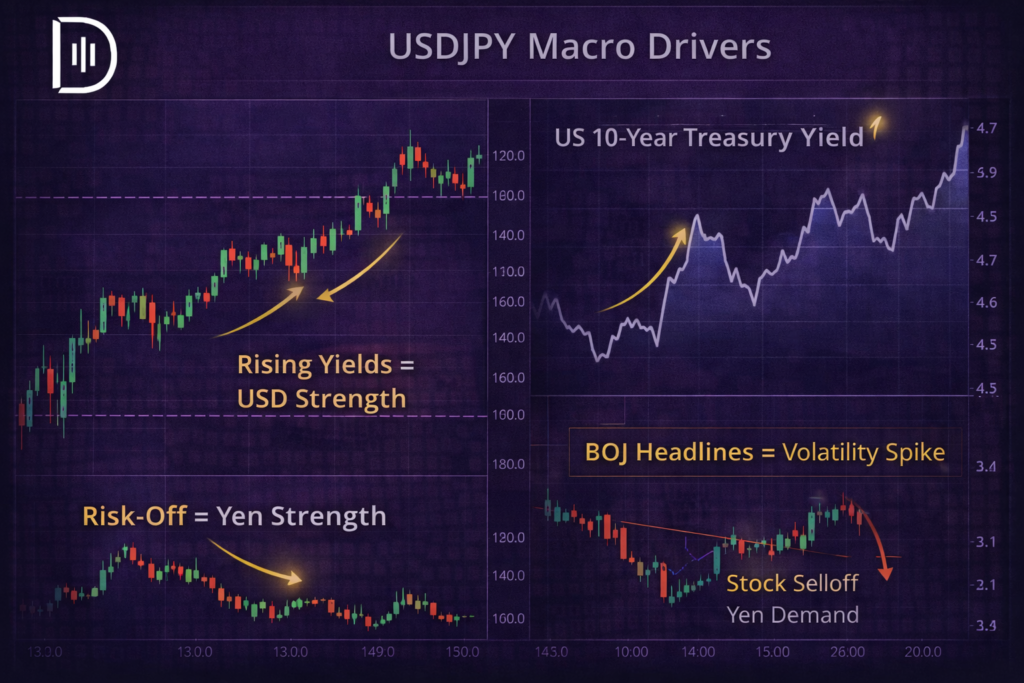
USDJPY is one of the clearest examples of macro influence in retail forex.
The U.S. dollar side reacts to Federal Reserve expectations, economic data, and Treasury yields. The Japanese yen side often reacts to risk aversion, Bank of Japan policy shifts, and repatriation flows.
That means USDJPY can move because of chart structure, but it often accelerates because of fundamentals.
Data from the Bank for International Settlements continues to rank USDJPY among the most traded global currency pairs. CME Group futures flows and U.S. Treasury market moves also regularly correlate with intraday USDJPY momentum.
For traders, this means one thing.
If U.S. yields rise sharply, USDJPY often finds buyers. If yields fall and markets move risk-off, yen strength can appear quickly.
Ignoring this relationship is one of the most common reasons traders get blindsided.
The Biggest Mistake Traders Make on USDJPY
They focus only on candles and ignore context.
You may see a clean bullish breakout, but if Treasury yields are rolling over and equities are weak, follow-through may fail.
Or you may see a bearish move during Asia, then New York opens with stronger U.S. data and the entire session reverses.
Traders that ask why the price is changing, not just where it changed, will make money with USDJPY.
Best Sessions for USDJPY Day Trading
USDJPY offers opportunity across multiple sessions, but the quality changes depending on timing.
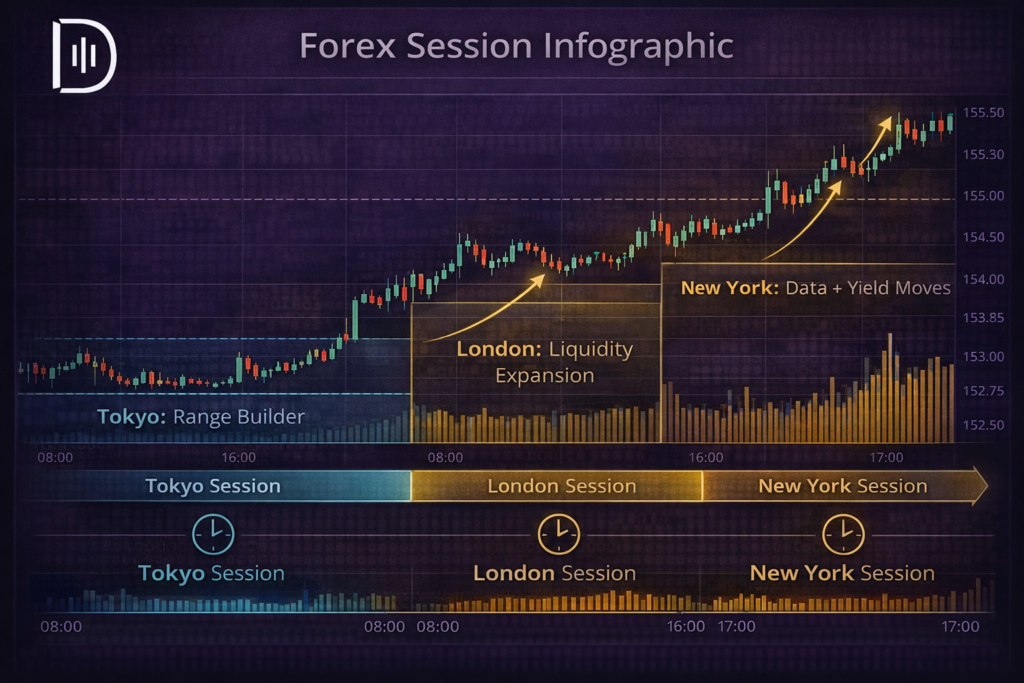
The Asian session matters more here than with many other pairs because Japan-based participation is active. Tokyo can establish early direction or defend major levels.
London often adds liquidity and can extend moves already in progress.
New York becomes critical when U.S. data releases hit or yields move aggressively.
This gives USDJPY a unique advantage. It can be tradable in more than one session, but you still need to know what environment you are in.
Quiet Asia range trading is different from New York breakout trading.
A Practical USDJPY Intraday Framework
Start each day with three checks.
Where are U.S. Treasury yields trending?
What did Asia session establish?
Is price trending or rotating around a range?
If yields are rising, Asia held support, and London starts pushing higher highs, long setups become more attractive.
If yields are going down, stocks are weak, and prices keep failing at resistance, shorts may be a better idea.
Now add range logic to the mix.
If USDJPY has already moved most of the way through its usual daily move before New York, chasing continuation becomes less useful. If the pair is still stuck before a big U.S. data release, setups for growth become more appealing. This is how professionals think. They do not trade isolated candles.
High Probability USDJPY Setups
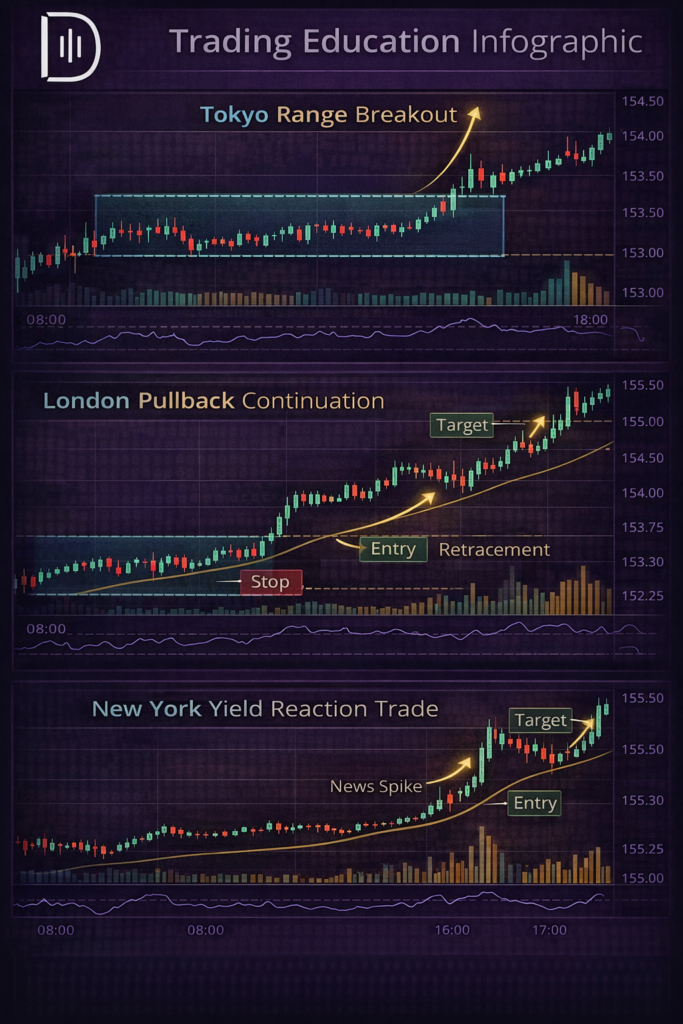
Tokyo Range Breakout
Asia generally makes clear ranges. If the volume in Tokyo goes up and the price breaks with momentum, continuation trades can work nicely.
Best when it fits with the trend on a higher time frame.
London Pullback Continuation
If Asia trends and London pulls back into structure, continuation entry can be a good way to make money with little risk.
Most of the time, this is better than chasing the first move.
New York Yield Reaction Trade
U.S. CPI, jobs data, or Fed headlines move yields quickly. USDJPY often responds fast.
Wait for the first reaction, then assess whether the move is accepted or fading. The second move is often cleaner than the first spike.
Understanding the USDJPY Trend
Many search for “USD/JPY trend” as if it is static. It is not.
There is higher timeframe trend and intraday trend.
The daily chart may be bullish while intraday price pulls back 70 pips. If you confuse timeframe trends, you create emotional conflict.
A better process is this:
Use the trend on a higher time frame to find the direction.
Use the framework of the day for entries.
Use the momentum of the session to time things.
That keeps your choices in line.
Risk Management on USDJPY
Because spreads are often efficient, traders get overconfident and oversize positions.
Tight spread does not mean low risk.
When news about data releases or interventions comes out, USDJPY might fluctuate quickly. When the yen suddenly gets strong, it can be violent.
Most traders get the risk wrong here. They pay attention to spread cost but not volatility risk.
Use a Position Size Calculator before every trade to make sure that your lot size is based on stop distance and account risk, not how convinced you are.
Good traders can deal with surprises since they knew how big their trades would be before the surprise happened.
Execution Psychology on USDJPY
USDJPY exposes impatience.
Because it often moves in phases, traders enter too early in ranges and exit too early in trends.
You need to know whether the market is in compression or expansion.
Compression demands patience.
Expansion demands decisiveness.
A lot of traders do the opposite of these things.
You should write down whether you were early, late, or on time in your journal.
That one number can make a big difference in how well you do.
Journaling USDJPY the Right Way
Track more than P&L.
Record:
Session traded
Yield direction at entry
Setup type
Range completed before trade
Whether move came from data release
Emotional state during hold
After 30 trades, patterns emerge.
You may find your Tokyo trades outperform New York trades. Or you may discover you do well in trends but lose in ranges.
Use the Trade Journal Template to turn frustration into useful data.
Scaling a USDJPY Edge
Once you build consistency, capital becomes the next bottleneck.
A trader who makes 1 to 2 percent a month with discipline has something valuable. But it feels like development is slow on a small account.
Many traders look at evaluation systems for this reason.
Companies like The5ers, FTMO, and others let disciplined traders get more money after they show they can keep their losses under control and stay consistent. USDJPY fits these models well because it has organised session activity and a lot of chances to trade.
If your edge is real and your discipline is repeatable, a The5ers evaluation account may be a logical next step. Not a shortcut. A scaling mechanism.
A Daily USDJPY Routine
Check the economic calendar, the direction of yields, the high and low from the previous day, and the Asia range before the session starts.
While you are trading, ask yourself if the price is going up or down.
After the session is over, think about whether your trade fit with the situation or if you did it out of boredom.
That honest review is what makes things better.
Final Thoughts
USDJPY day trading is not about memorizing patterns. It is about understanding the relationship between price, yields, sentiment, and timing.
A lot of traders fail because they look at the chart but not the motor that makes it work.
Do one thing different for the following week.
Before you trade USDJPY, check to see if yields are going up, down, or staying the same.
That one habit can help you time your transactions better right away and get rid of bad ones.
If you want to know when USDJPY makes its most significant intraday decisions, see our article on how to trade the New York session next.
FAQs
Is USDJPY good for day trading?
Yes. USDJPY is one of the best day trading pairs due to strong liquidity, tight spreads, and clean reactions to macro catalysts.
What moves USDJPY the most intraday?
U.S. yields, important economic data, headlines from the Bank of Japan, and the general mood of the market about risk.
What is the best session to trade USDJPY?
Tokyo can be productive, while New York is often strongest during U.S. data releases and yield-driven moves.
Is USDJPY easier than GBPUSD?
Often it is smoother than GBPUSD, but it requires stronger awareness of macro drivers.
Can beginners trade USDJPY?
Yes, but they should learn session behavior and risk control first instead of trading every small move.