
Have you ever analyzed a chart, identified a perfect support or resistance zone, and entered a trade, only to watch the market hit your stop loss before moving in your expected direction?
It is frustrating, especially when your overall market analysis turns out to be correct.
But there is something worth considering. Maybe your analysis was not the problem. Maybe you entered before the market gave you a genuine reason to take the trade.
This happens to both new and experienced day traders. You see price approaching an important level, anticipate a reaction, and enter because everything looks promising. Sometimes it works. Other times, the market does something completely different.
The problem is often a lack of clearly defined trade trigger events.
A good trading opportunity does not mean you should immediately enter the market. You need a specific event that tells you buyers or sellers are actually stepping in.
In this guide, we will look at how to identify those events, use them in forex and day trading, and develop an entry process that removes unnecessary guesswork.
What you will learn:
- What trade trigger events are and how they work.
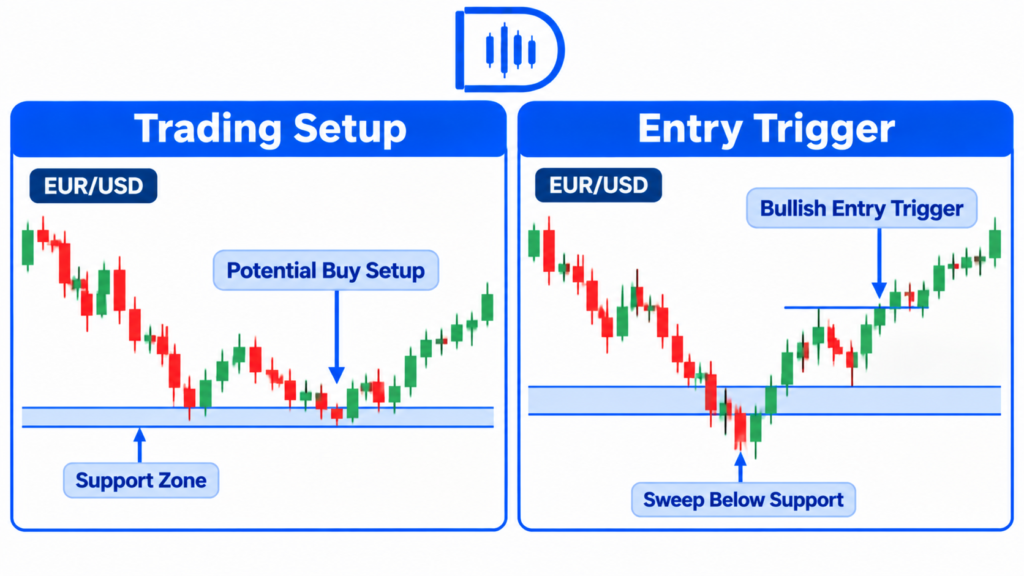
- The difference between a trading setup and an entry trigger.
- Five practical triggers used by day traders.
- How to build clear entry and invalidation rules.
- How to improve execution through risk management and journaling.
What Are Trade Trigger Events in Trading?
A trade trigger event is something specific that happens on the chart and tells you it may be time to execute your trading setup.
Think of it this way. Your market analysis tells you where you want to trade, but your trigger tells you when to pull the trigger.
For example, imagine EUR/USD is approaching a support zone during the London session. The higher timeframe structure is bullish, and you are looking for a buying opportunity.
You could simply buy when price touches support. But what if the market is actually preparing to break below it?
Instead, you wait. Perhaps price takes out the previous swing low, quickly moves back above support, and then breaks a minor lower high. That change in short-term structure gives you a more objective reason to consider buying.
This is what makes a trigger useful. It gives you something observable to act on rather than relying entirely on what you think the market should do.
CME Group’s guidance on developing a trading plan also emphasizes planning trading strategies and entry conditions in advance.
Why Your Trading Setup Needs a Clear Trigger
One thing that separates a planned trade from an impulsive trade is the entry decision.
Consider a bullish engulfing candle. You might see one forming at a major support level and immediately think about buying.
But would you take the same candle if it appeared directly below a strong resistance zone? Probably not.
The candle itself has not changed. The surrounding market conditions have.
This is why it helps to separate your trading decisions into three parts.
First, look at the market context. Is price trending, ranging, or showing signs of a reversal?
Next, identify your setup. This could be a pullback into support, a breakout, or a liquidity sweep.
Finally, wait for your trigger. This is the actual price movement or candle behavior that confirms your entry conditions have been met.
Without this final step, you are often trading an expectation rather than a confirmed opportunity.
Five Trade Trigger Events You Can Use in Day Trading
There is no need to use every available indicator or price action signal. The best trigger is one that fits your strategy and can be repeated consistently.
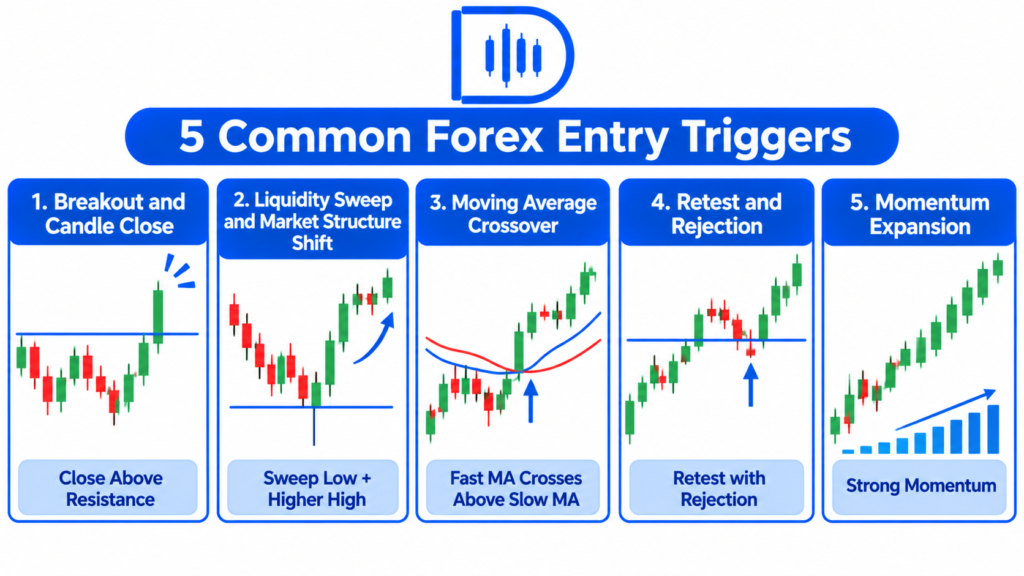
1. Breakout and Candle Close
A breakout happens when price moves beyond an important support or resistance level.
However, experienced traders know that not every breakout is worth trading. Sometimes price moves above resistance, attracts buyers, and then immediately falls back below the level.
This is why waiting for a candle close can help.
For example, GBP/USD breaks above the Asian session high. Instead of buying as soon as price crosses the level, you wait for a 5-minute candle to close above it.
If price holds above the breakout area, your entry condition may be satisfied.
You will occasionally miss fast-moving breakouts this way. That is part of the trade-off. Missing an opportunity is usually better than repeatedly entering false breakouts without a clear plan.
2. Liquidity Sweep and Market Structure Shift
This is a popular approach among traders who use Smart Money Concepts.
Suppose EUR/USD is moving towards a previous swing low. Price briefly breaks below that low, triggering orders around the level, but quickly moves back upwards.
You notice that buying pressure is increasing. Shortly afterward, price breaks above a minor lower high.
That market structure shift becomes your potential bullish trigger.
The important part is not simply spotting the liquidity sweep. Many traders make the mistake of buying immediately after price takes out a previous low.
A sweep can lead to a reversal, but it can also be the beginning of a genuine bearish continuation. Waiting for additional price action helps you avoid treating every sweep as a reversal signal.
3. Moving Average Crossover
Moving average crossovers are useful for traders who prefer straightforward, rules-based strategies.
For example, a 9-period moving average crossing above a 21-period moving average may provide a bullish entry trigger.
However, there is a catch. During sideways market conditions, moving averages can cross repeatedly without producing meaningful price movement.
I would avoid relying on crossovers alone. Check the overall market direction and look for a suitable entry location before acting on the signal.
4. Retest and Rejection
Some traders prefer not to enter immediately after a breakout. They wait for price to return to the broken level.
Imagine price breaks above resistance and then pulls back towards it. Instead of falling below the level, buyers step in and produce a bullish rejection candle.
That rejection can become your entry trigger.
One advantage of this approach is that it can offer a clearer stop-loss location. The downside is that some breakouts never retest, meaning you may miss the move completely.
Do not chase price just because the retest never happened. Your trading plan should determine which opportunities you take, not the fear of missing out.
5. Momentum Expansion
Sometimes the market gives you a clear indication that buying or selling pressure is increasing.
For example, price may suddenly produce a strong bullish candle that closes above a recent short-term high. The candle range is noticeably larger than the previous candles, suggesting increased momentum.
This can be useful during the London or New York session when market activity increases.
However, be careful around major economic announcements. Sudden price expansion can be caused by temporary volatility rather than sustainable buying or selling pressure.
The key is to understand why momentum is increasing before treating it as an entry signal.
How to Build a Trade Trigger System That Actually Works
You do not need a complicated entry strategy. In fact, making your rules too complicated can create more hesitation when it is time to trade.
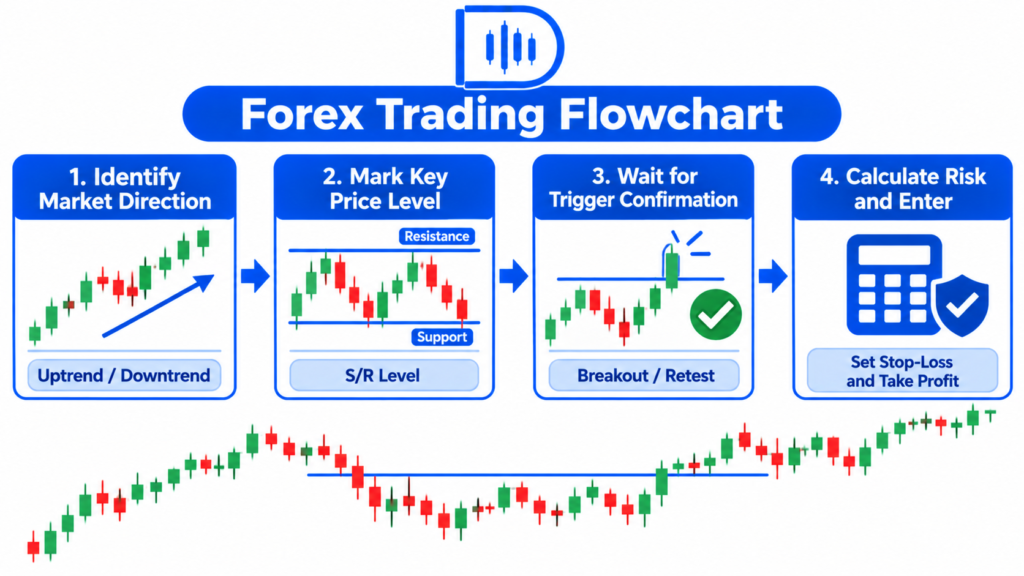
Start with the market conditions you understand best. For example, if you prefer bullish trades, you might decide to look for buying opportunities only when the higher timeframe structure is bullish.
Then mark the price area where you want to enter. It could be a demand zone, previous support, or a liquidity level.
Now comes the important part: decide exactly what needs to happen before you enter.
For example, your rule might be:
“I will consider a buy after price sweeps below a previous swing low and a 5-minute candle closes above the most recent lower high.”
That is much clearer than saying you will buy when price looks bullish.
You should also decide when the setup becomes invalid. If price breaks significantly below your identified demand zone before the trigger appears, there may no longer be a reason to take the original trade.
Write these conditions down and follow them. Do not keep changing your entry rules simply because you want to participate in a particular market move.
What Research Tells Us About Trading Decisions
There is an important difference between finding profitable opportunities and executing them consistently.
A study by Brad Barber, Yi-Tsung Lee, Yu-Jane Liu, and Terrance Odean, published in the Journal of Financial Markets, examined day traders in Taiwan between 1992 and 2006.
The research found that fewer than 1% of the overall day trader population consistently earned positive abnormal returns after fees.
You can read the study here: The Cross-Section of Speculator Skill.
What does this mean for someone trading forex or other intraday markets?
It highlights why having a strategy is only part of the process. You also need to execute it properly, control costs, and avoid unnecessary trades.
Execution matters even when your analysis is correct. FINRA discusses execution-system limitations and trading risks in its Day-Trading Risk Disclosure.
For example, a breakout signal during normal market conditions may offer a reasonable entry. The same signal during a major news release could result in slippage and a much worse fill.
A good trigger needs to work alongside an execution plan.
Managing Risk After Your Trigger Appears
Getting the entry right does not automatically make it a good trade.
Suppose you have a $10,000 account and risk 0.5% on each position. That gives you $50 of planned risk.
You identify a bullish trigger, but hesitate. By the time you enter, price has already moved 10 pips above your original entry.
Your stop-loss distance is now larger, and your potential reward may be smaller.
Would you still take the trade?
This is where many traders make mistakes. They become so focused on getting into the market that they forget to recalculate the risk.
Use a Position Size Calculator to work out the appropriate position size based on your actual entry and stop-loss distance.
And remember, sometimes the best decision is to skip the trade. If the original entry is gone and the risk-to-reward no longer makes sense, there is no reason to chase it.
Use Your Trading Journal to Improve Entry Timing
Here is something worth paying attention to: not every losing trade means your trigger is bad.
Sometimes the trigger was perfectly valid, but you entered too early. Other times, you followed your rules correctly, but the market simply failed to continue.
These are two very different situations.
This is why keeping a trading journal is so important.
Record which trigger you used, when it appeared, your actual entry, stop loss, market session, and final result. Also make a note of whether you followed your rules or entered based on emotion.
After 20 to 30 trades using the same trigger, review the results.
You may discover that your breakout entries work well during the London session but perform poorly during quiet market hours. Or perhaps your liquidity sweep strategy produces better results when you wait for a structure shift.
These are the kinds of observations that can help improve a trading strategy.
You can use the Trade Journal Template to organize your records and make your reviews more useful.
Scaling Your Trading Capital With Consistent Execution
Once you have a strategy that you can follow consistently, you may eventually start thinking about trading larger capital.
This is where proprietary trading evaluations can become an option worth considering.
Firms such as The5ers, FTMO, and TradeThePool offer different evaluation structures and trading opportunities. Their programs have different markets, account rules, profit targets, and drawdown requirements.
For forex traders, The5ers High Stakes program is one option to explore. It uses a two-step evaluation process with defined profit targets and loss limits.
But do not make the mistake of treating a funded trading evaluation as a way to fix an inconsistent strategy.
If you cannot follow your entry rules on a smaller account, trading under additional drawdown restrictions will not magically solve that problem.
Build your edge first. Learn to control your risk, follow your triggers, and maintain consistency. Then consider whether an evaluation account fits your trading approach.
Frequently Asked Questions
What is an example of a trade trigger?
A bullish candle closing above a recent lower high after price sweeps below support is one example. It gives the trader a specific reason to consider entering a long position.
What is the difference between a trading setup and a trigger?
A setup identifies a potential opportunity based on market conditions and price location. A trigger is the specific event that tells you the conditions for entry have been met.
Which trading trigger is best for forex?
There is no single trigger that works best in every situation. Breakout closes, liquidity sweeps, market structure shifts, moving average crossovers, and retest confirmations can all be useful when matched with the right strategy.
How can I avoid false trading signals?
Avoid entering simply because price touches a support or resistance level. Wait for your predefined confirmation, consider the higher timeframe direction, and establish clear invalidation conditions.
Should I enter immediately when a trigger appears?
Not always. Check your entry price, stop-loss distance, potential reward, and current market conditions. If the opportunity has already moved too far, skipping it may be the better decision.
How many confirmations do I need before entering a trade?
There is no fixed number. Use enough independent conditions to validate your setup, but avoid adding so many indicators that you end up entering too late.
Final Thoughts
Defining trade trigger events might seem like a small adjustment to your trading strategy, but it can make a noticeable difference in how you approach the market.
Instead of buying simply because price reaches support or selling because resistance looks strong, you start waiting for the market to show the behavior you are looking for.
That means fewer impulsive decisions and a much clearer reason behind every entry.
Try something simple over your next 30 trades. Choose one trading setup, define its exact entry trigger, and avoid taking positions that do not meet your conditions.
At the end, review your journal and see what actually worked.
You do not need to catch every market move. You need to become better at recognizing which opportunities deserve your money.
Next read: How to Create a Trading Journal That Works to learn how to turn your trading history into practical improvements.