
A small trading loss is rarely the problem.
What happens immediately after it is.
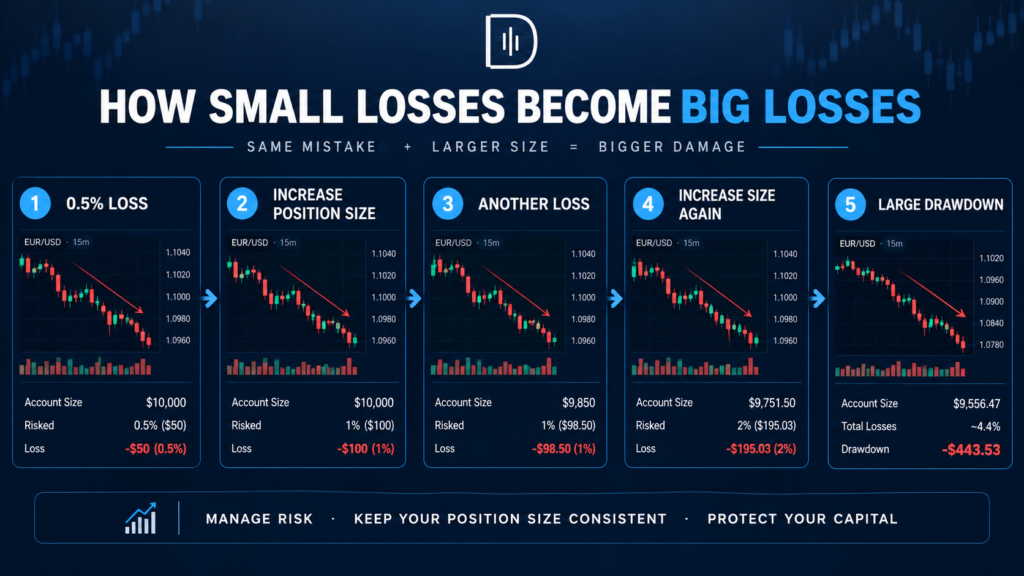
A trader takes a planned 0.5R loss. The setup was valid, the stop was logical, and nothing unusual happened. Then the trader sees another setup five minutes later and increases size slightly because, in their mind, they are “only getting back what they lost.”
The next trade loses.
Size increases again.
The third trade loses.
Suddenly a sequence of ordinary small losses has turned into a drawdown that was never part of the original strategy.
This is one of the least appreciated problems in day trading: scaling can turn normal losses into abnormal damage if the trader scales emotionally rather than statistically.
Scaling itself is not the enemy.
In fact, scaling can be one of the most useful tools a trader has. A trader can begin with smaller exposure, add after confirmation, reduce size when conditions deteriorate, and increase exposure only when the strategy has earned it.
The problem begins when “scaling” becomes a disguised form of revenge trading.
There is another misunderstanding worth clearing up immediately.
If you searched for “lossless scaling” because you are looking for a way to scale trades without taking losses, there is no trading technique that can guarantee that outcome. Scaling should not be designed to eliminate losses. It should be designed to keep individual losses small enough that they remain statistically and psychologically manageable.
That distinction changes everything.
The objective is not to build a trading system that never loses.
It is to build a system where a normal losing trade remains normal.
Small Losses Are Part of the Strategy, Not Evidence That the Strategy Failed
A professional trader does not evaluate a single loss in isolation.
Suppose your strategy has a 45% win rate and your average winner is 2R while your average loser is 1R.
You can lose several trades in a row and still have a positive expectancy.
That is not a theoretical curiosity. It is a practical reality of probabilistic trading.
The problem is that traders rarely experience losses as mathematical events.
They experience them emotionally.
The first loss feels like information.
The second loss feels like confirmation that something is wrong.
The third loss starts feeling personal.
Then the trader changes position size.
That is where the real damage begins.
A losing trade does not automatically mean your strategy is deteriorating.
It may simply mean that the probability distribution produced another losing outcome.
The skill is learning to distinguish between normal variance and evidence that your process needs to change.
Why Small Losses Feel Bigger Than They Look
There is a well-documented behavioral tendency in which investors become reluctant to realize losses and tend to hold losing positions longer than winning ones.
Research summarized by Berkeley finance professor Terrance Odean and colleagues has documented this type of behavior, commonly referred to as the disposition effect. Research across different investor groups has found that losing positions can receive different treatment from winning positions, including longer holding periods for losers.
For a day trader, this has an important implication.
A small loss can create pressure to avoid realizing another one.
That can lead to moving stops.
Adding to losing positions.
Taking a second setup that does not meet the original criteria.
Increasing size on the next trade.
All of those actions have one thing in common.
They attempt to make the current emotional discomfort disappear.
But trading does not reward emotional relief.
It rewards positive expectancy executed consistently.
The Difference Between Scaling and Chasing
This distinction should be written into every serious trader’s plan.
Scaling means changing exposure according to predefined conditions.
Chasing means changing exposure because of what just happened.
Suppose you risk 0.25% on the initial entry.
Price confirms your thesis.
You add another 0.25%.
The market continues in your favor.
You add again.
That is scaling because the increase in exposure was connected to market information.
Now consider another scenario.
You risk 0.5%.
You lose.
Your next setup appears.
You risk 0.75% because you want to recover the previous loss.
That is not scaling.
It is a recovery trade.
The chart may look identical.
The psychology is completely different.
A Simple Rule for Handling Small Losses
One of the most useful rules you can introduce is:
A loss should not automatically change the risk of the next trade.
Read that again.
The previous trade’s result should not determine the next trade’s position size.
The next trade’s setup should.
If your standard risk is 0.5%, then a 0.5% loss should normally be followed by another trade carrying 0.5% risk, assuming the setup qualifies.
Not 0.75%.
Not 1%.
Not 1.5% because you are “due.”
The market does not know that you lost money five minutes ago.
Your position size should not pretend that it does.
Scaling Should Follow Information, Not Emotion
There are several legitimate reasons to change position size.
Volatility changes.
Stop distance changes.
Setup quality changes.
Liquidity changes.
Market regime changes.
Your predefined risk model calls for a different exposure.
These are information-based adjustments.
“I just lost” is not.
This is where a trader’s scaling plan becomes useful.
You can define three basic exposure states.
Normal conditions receive normal risk.
Exceptional conditions receive increased or reduced risk according to tested rules.
Poor conditions receive reduced exposure or no trade.
The important part is that the trader knows which state they are in before the trade.
That removes the temptation to make a sizing decision after seeing the outcome of the previous trade.
The Small-Loss Ladder
A useful practical model is to create a loss ladder before the trading session.
Suppose your normal trade risk is 0.5%.
Your daily loss limit is 1.5%.
You could define the session as three independent risk units.
Trade one loses 0.5%.
Nothing changes.
Trade two loses 0.5%.
Nothing changes.
You now have 1% of drawdown.
At that point, your rules might require stopping for the day or reducing activity depending on your tested plan.
What you should not do is think:
“I need to make 1% back.”
That statement changes your psychological objective from executing setups to recovering money.
The moment recovery becomes the objective, trade selection often deteriorates.
Why Position Size Matters More Than Most Traders Realize
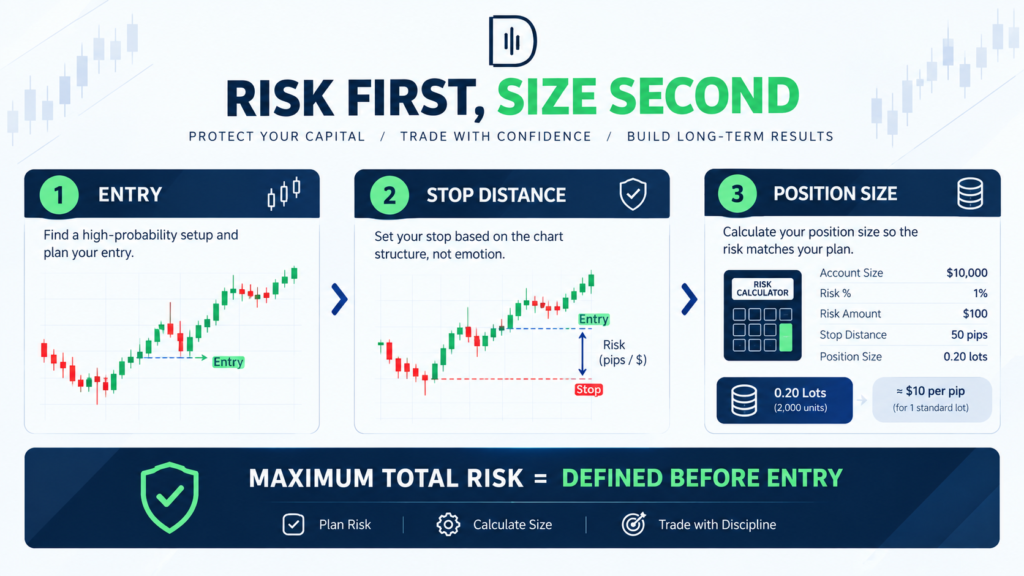
CME’s education material makes an important point about position sizing: traders should determine the logical stop location first and then calculate position size based on the amount of account capital they are willing to risk.
That order matters.
Many traders do the reverse.
They decide:
“I want to trade two lots.”
Then they find a stop that fits the position.
That is backwards.
The market should determine where your trade idea is invalidated.
Your risk model should then tell you how much you can trade.
The proper order is:
Entry → structural invalidation → stop distance → monetary risk → position size.
No:
Desired position size → convenient stop → hope.
This is where most traders miscalculate risk. Using a Position Size Calculator removes unnecessary guesswork and makes it much easier to maintain consistent monetary exposure when stop distances change.
Why Scaling After a Loss Is So Dangerous
Consider a trader with a $20,000 account.
They normally risk 0.5%, or $100, per trade.
The first trade loses $100.
Instead of maintaining $100 risk, the trader increases the next trade to $150.
That trade loses.
The next position becomes $225.
That trade loses too.
The trader has now lost $475.
Notice something important.
The first loss was completely manageable.
The damage came from the response to the first loss.
This is how a strategy with controlled risk becomes a strategy with uncontrolled risk.
The trader did not necessarily need a better entry.
They needed a better response to being wrong.
The Mathematics of Recovery
This is why aggressive scaling after losses is particularly dangerous.
Suppose you lose 5%.
You now need approximately 5.26% to return to your original account value.
Lose 10%, and you need about 11.11% to recover.
Lose 20%, and you need 25%.
Lose 30%, and you need about 42.86%.
The larger the drawdown becomes, the harder recovery becomes.
This creates a strong argument for keeping ordinary losses ordinary.
A 0.5% loss should remain a 0.5% event.
It should not become the beginning of a recovery campaign.
The Psychology of “Getting Back to Break-Even”
One of the most dangerous thoughts in trading is:
“I just need to get back to where I was.”
It sounds reasonable.
It is not a trading rule.
It is an emotional reference point.
Suppose you begin the morning up 1%.
Then you lose 0.5%.
You now feel as if you have given something back.
Then you lose another 0.5%.
Now you want to recover the morning’s profits.
But the market does not owe you the original 1%.
Your correct reference point is not yesterday’s high-water mark.
Your reference point is your current trading plan.
If the next setup has positive expectancy, take it according to the normal risk model.
If there is no setup, do nothing.
The account balance is not a signal.
Scaling Into Winners Is Different From Scaling Out of Losers
This distinction is particularly important.
Suppose you enter long after a breakout confirmation.
The market moves in your favor.
Your thesis becomes stronger.
You add.
That is potentially rational because the market has provided additional information supporting your original thesis.
Now consider entering long, watching the market move against you and adding because the price is cheaper.
That can be rational in some specifically designed strategies, but it should never be confused with ordinary risk-controlled scaling.
If you add to a losing trade, your thesis must become more attractive because of objective market information, not simply because your average entry improves.
A lower average price is not evidence that the trade is better.
It is only evidence that you now own more of it at a different average price.
A Better Scaling Model: Risk First, Size Second
Imagine a trader has a setup with three possible entries.
Initial entry risks 0.25%.
Confirmation entry adds another 0.25%.
Continuation entry adds another 0.25%.
The maximum planned exposure is therefore 0.75%.
That is scaling.
The critical detail is that the trader knows the maximum risk before entering the first position.
The trader is not inventing.
Whether all three steps are triggered is decided by the market.
This is in stark contrast to:
“Begin with 0.25%, and if it turns against me, add another 0.25%.”
The initial model scaled up with confirmation.
The second can easily become averaging into a losing thesis.
The “Maximum Risk Before Entry” Rule
Before placing your first order, answer one question:
If every planned scale-in gets triggered, what is my maximum total risk?
If you cannot answer that immediately, you do not have a scaling plan.
You have a position-sizing idea.
Those are different things.
Suppose your initial stop is 20 points.
You plan three entries.
Your total maximum risk is $300.
That $300 must already be allocated across the three entries.
If the first entry uses $100 of risk, the second cannot casually add another $100 unless the remaining structure and stop placement support it.
The maximum must be known before the market starts moving.
Scaling Based on R Instead of Dollars
Using R can make scaling much easier to understand.
Suppose 1R equals your predefined initial trade risk.
You come in with 0.5R.
On confirmation you add an extra 0.5R.
Your maximum exposure is 1R.
If the trade fails after all entries are active you know exactly what the planned loss will be.
This gives a cleaner performance analysis.
You can compare trades regardless of account size.
A trader who risks $50 and a trader who risks $500 can both evaluate a trade as -1R.
That is especially useful when your account grows.
Scaling When Your Account Grows
This brings us to the second meaning of scaling.
There is scaling within a trade.
Then there is scaling across your trading career.
These should not be confused.
Suppose your account grows from $10,000 to $15,000.
If your risk model is percentage-based, your dollar risk naturally increases while the percentage risk remains constant.
For example, 0.5% risk changes from $50 to $75.
You did not become more aggressive.
Your capital base became larger.
This is healthy scaling.
The dangerous version is increasing from 0.5% to 1% simply because your recent trades have gone well.
That is a different decision.
It increases the risk of drawdown precisely when confidence is likely to be highest.
Why Winning Streaks Can Be Just as Dangerous as Losing Streaks
Most traders worry about revenge trading after losses.
There is another problem that gets less attention.
Overconfidence after wins.
Suppose you have four winning trades in a row.
You begin to feel that your strategy is “locked in.”
You increase size.
The fifth trade loses.
Because the position was larger, the loss feels unusually significant.
Now you reduce size dramatically.
The account starts experiencing unstable exposure.
This is why scaling should be connected to a tested capital curve rather than your emotions about the last five trades.
Your confidence can change daily.
Your risk model should not.
The Psychology of Small Losses During a Scaling Phase
Scaling introduces another psychological challenge.
When the position size is small, a loss may feel irrelevant.
When the account grows, the same percentage loss can become a much larger dollar amount.
A 0.5% loss on a $10,000 account is $50.
On a $100,000 account, it is $500.
The percentage is identical.
The emotional response may not be.
This is where traders discover whether they were actually comfortable with their risk percentage or merely comfortable with the dollar amount.
If your heart rate changes dramatically when the account gets larger, your risk model may have outgrown your psychology.
That does not mean you should force yourself to become comfortable.
It means you may need to scale more gradually.
Use a Psychological Risk Limit
Most traders have a financial risk limit.
Few have a psychological risk limit.
Suppose your plan says 1% risk is acceptable.
But after three consecutive losses, you find yourself thinking about the money constantly.
You begin watching every tick.
You hesitate to take valid setups.
You move stops.
Your financial risk may still be within your rules.
Your psychological risk is not.
This matters because trading decisions are being affected.
A useful rule is:
The largest position size you can execute consistently is more important than the largest position size your account can mathematically tolerate.
Small Losses Should Be Boring
That may be one of the best definitions of mature risk management.
A normal losing trade should feel boring.
You entered according to plan.
The stop was logical.
The market invalidated the setup.
You lost the predefined amount.
You move on.
If a normal loss creates a strong urge to immediately recover it, your position size may be too large.
That does not necessarily mean your strategy is wrong.
It may mean your exposure is wrong for your current psychology.
A Three-State Scaling Framework
A simple framework is to divide your trading into three states.
Base state is your normal risk.
Reduced state is used when conditions are less favorable or when predefined drawdown rules require lower exposure.
Expanded state is reserved for situations that your research has demonstrated deserve greater exposure.
The important part is that you define the conditions for each state before the session.
For example, an expanded state might require a specific setup, favorable volatility, strong liquidity and confirmation from higher-timeframe structure.
A reduced state might be activated after a predefined drawdown or during unusual market conditions.
What should never trigger an expanded state?
A previous loss.
What should never trigger a reduced state?
A single winning trade.
Your risk state should respond to the market and your tested process, not your emotional reaction to the previous outcome.
A Practical Example
Imagine you trade EUR/USD.
Your normal risk is 0.5%.
Your setup is a liquidity sweep, then a market structure change.
London session price sweep low.
You enter after being confirmed.
Trade is down 0.5%.
Nothing has changed.
An hour later, another good setting shows up.
Your risk remains 0.5%.
This trade wins 1.5R.
Your account is now positive relative to the start of the sequence.
You do not increase risk because you won.
Later, a third setup appears under unusually poor liquidity conditions.
Your rules say reduced exposure.
You risk 0.25%.
The trade loses.
That loss is also small.
Notice what happened.
The account experienced three different outcomes, but the trader never needed to emotionally respond to any of them.
The process controlled the exposure.
What If You Have Three Small Losses in a Row?
Do not automatically reduce size.
Do not automatically increase it either.
First ask whether the trades were valid.
If all three trades followed the strategy and occurred under normal conditions, the sequence may simply represent variance.
If all three losses occurred because you violated the strategy, that is different.
If market conditions changed, that is different again.
This gives you a useful diagnostic framework:
Was the trade valid?
Was execution correct?
Was the market environment normal for the strategy?
Was the loss within expected historical variance?
Only after answering those questions should you consider changing exposure.
The Difference Between a Small Loss and a Bad Loss
A small loss can be a good trade.
A large loss can be a bad trade.
But there is another category:
A small loss can be a bad trade.
Suppose you entered without confirmation.
You moved the stop closer.
You exited manually because you became nervous.
You lost only 0.2%.
The dollar loss was small.
The process failure was large.
If you judge the trade only by money, you may conclude:
“That was fine.”
It was not.
This is why your journal needs a process score separate from P&L.
Journal the Reason for the Loss
A useful Trade Journal Template should not only ask:
“Did I win or lose?”
It should ask:
“Why did I get beat?
Loss classification
Normal loss for strategy
Error in running.
Late check-in.
Early release.
Stop too tight,
Noticia
Liquidity issues.
Psychological error.
Oversized.
Revenge trading.
Averaging into a loser.
Then look at the distribution.
If 80% of your losses are normal strategy losses, that is one problem.
If 30% come from oversizing after previous losses, you have found a behavioral leak.
That leak can often be fixed without changing the strategy.
Measure Drawdown in R
R-based drawdown is particularly useful when scaling.
Suppose you lose:
-1R
-1R
+2R
-1R
+1.5R
Your dollar results will depend on account size and position sizing.
But the sequence in R tells you much more about the strategy.
When you change your position size, continue recording the results in R.
This helps separate strategy performance from capital allocation.
That distinction becomes extremely important as your account grows.
Your Position Size Calculator Should Be Part of the Routine
A position size calculator is not just for beginners.
It can become more useful as strategies become more complex.
Suppose volatility increases and your stop goes from 10 pips to 18 pips.
Your stake must decline if your targeted monetary risk stays the same.
If you are scaling into 3 entries, the calculator can find the total exposure instead of guessing it in your head.
The objective is simple:
Decide the risk first. Let the calculator determine the size.
That removes one of the easiest places for emotion to enter the process.
When Should You Actually Increase Risk?
This question deserves a careful answer.
Do not increase risk because you are recovering from losses.
Do not increase risk because you are excited about a setup.
Do not increase risk because you have had a winning streak.
Increase risk only when your broader trading plan has a predefined reason for doing so.
That might involve account growth.
It might involve a validated strategy improvement.
It might involve a specific market regime that your data shows produces superior expectancy.
Even then, increase gradually.
If your normal risk is 0.5%, moving directly to 2% is not scaling.
It is changing the risk profile of the strategy.
Scaling Should Be Slower Than Your Confidence
Confidence can change in minutes.
Capital should not.
This is especially important for active day traders because intraday feedback is intense.
Five trades can happen in an hour.
A trader can feel like a genius at 10:00 and completely incompetent at 11:00.
If position size follows those emotional swings, your equity curve becomes a reflection of your mood.
A professional scaling process should feel almost boring.
The account grows.
Risk changes gradually.
Rules remain stable.
There is no dramatic jump after a big winner or loss.
How Scaling Affects Your Trading Psychology
There is a point where increasing size changes the way you see the chart.
At small size, you analyze.
At larger size, you may start monitoring your P&L.
That is dangerous.
The candle moves against you.
You see -$300.
Then -$500.
Instead of asking whether the setup remains valid, you start thinking about the money.
That is when traders interfere with trades.
They close winners too quickly.
They move stops.
They hesitate on valid entries.
They avoid normal losses.
The solution is not always psychological training.
Sometimes the solution is simply smaller size.
If reducing risk allows you to execute the strategy correctly, that is a performance improvement.
Scaling and the Risk of Strategy Drift
Another problem appears when traders scale.
They start with a simple tactic.
As account size grows, they start introducing rules.
A different start.
Other halt.
Different goal.
More signs.
More trades.
Separate sessions.
Why do you?
Because larger roles bring more emotional pressure.
The trader starts trying to make the strategy “safer.”
Instead, they have changed the strategy.
This makes performance analysis almost impossible.
If you want to scale, keep the strategy as stable as possible.
Change one variable at a time.
Measure it.
Then decide.
Scaling Capital Through Evaluation Programs
There is a point where a trader can have a reasonably mature process but still be limited by personal trading capital.
This is where evaluation programs can become relevant.
The logic should be straightforward.
You do not use an evaluation account to manufacture an edge.
You use it after developing an edge to access a different capital structure under defined rules.
That distinction is important.
If you cannot control a 0.5% loss on your own account, a larger nominal account will not fix the problem.
It can make the problem larger.
But if your strategy is documented, your drawdown is controlled and your execution is consistent, a structured evaluation can provide another route to scaling capital without simply increasing the percentage of your own account at risk.
The5ers is one example worth researching. Its current High Stakes program is a two-step evaluation with published daily-loss and maximum-loss parameters, and its current scaling structure increases account size through defined profit milestones. The company currently states that High Stakes can scale up to $500,000 under its published plan.
That is relevant to this discussion because the scaling is tied to predefined performance milestones rather than simply telling the trader to increase risk after a winning trade.
The5ers also currently states that High Stakes funded accounts can be scaled after each 10% target, with the exact payout and account progression varying by tier.
Other proprietary trading firms use different evaluation models, drawdown calculations, consistency requirements and payout structures.
That means the trader should compare the actual rules with their strategy.
If you rely on news-driven trades, for example, read the news restrictions.
The5ers currently allows holding positions over high-impact news but prohibits executing orders during a two-minute window before and after high-impact releases under its High Stakes rules.
That could materially affect a strategy that depends on entering immediately around major releases.
The professional approach is therefore simple:
Build the edge.
Prove the edge.
Control the drawdown.
Then choose a capital structure whose rules are compatible with the way you actually trade.
If those conditions are already satisfied, traders can consider a [The5ers High Stakes evaluation] as one potential route for scaling, while also comparing alternatives such as other evaluation-based proprietary trading programs before committing capital.
Scaling Is Not the Same as Leveraging Up
This is a significant difference.
Now let’s say your account doubles, and you still risk 0.5% every deal.
Your risk dollar is doubled.
Your % risk does not.
That’s scaling.
Now suppose your account doubles and you increase risk from 0.5% to 2%.
That is leverage expansion.
The two can look identical when the account is growing.
They are not.
Scaling preserves the risk framework.
Aggressive leverage changes it.
Serious traders need to know which one they are doing.
The Best Scaling Plan Protects Your Ability to Think
A trading strategy is useless if the position size makes you unable to execute it.
If you cannot watch a normal drawdown without interfering, your size is too large.
If you take profits early because you cannot tolerate seeing open profit disappear, your size may be too large.
If you hesitate on your best setup because the dollar amount feels uncomfortable, your size may be too large.
The solution is not to “be tougher.”
The solution is to bring exposure back to a level where decision-making remains stable.
That is what sustainable scaling looks like.
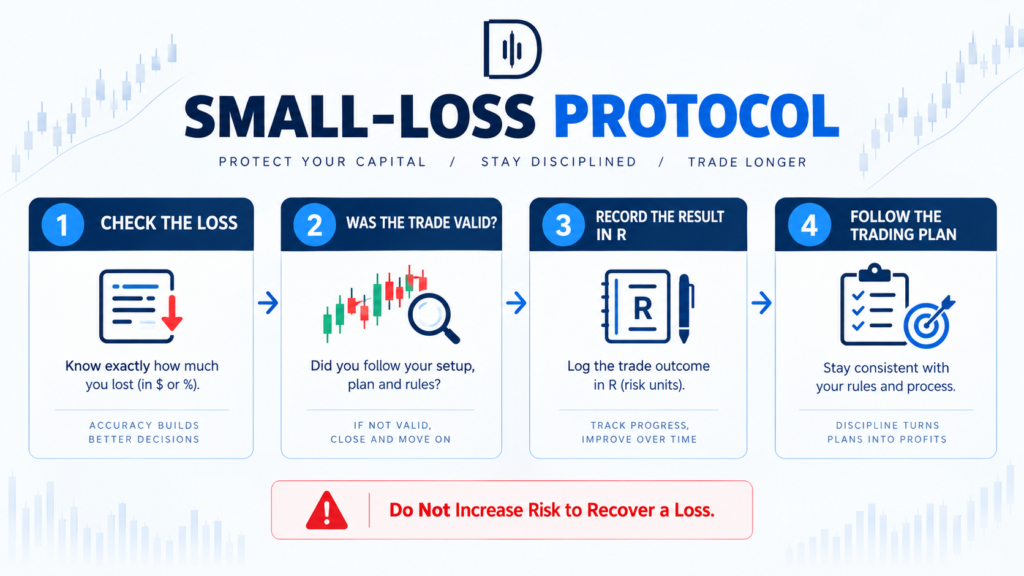
A Practical Small-Loss Protocol
Before the session, define your normal risk.
Define your maximum daily loss.
Define your maximum number of consecutive losses before you reassess.
Define when you are allowed to reduce risk.
Define when you are allowed to increase risk.
Define your maximum total exposure if scaling into a position.
Then write one sentence:
“A previous trade result does not determine the risk of my next trade.”
That sentence sounds simple.
It can prevent an enormous amount of damage.
What To Do Immediately After a Small Loss
Do not analyze the entire strategy immediately.
First determine whether the loss was within plan.
If yes, record it and move on.
If no, identify the process error.
If the loss came from an execution mistake, correct the execution.
If it came from a market condition your strategy does not handle well, record the condition.
If it came from oversizing, reduce the next position to the correct risk.
What you should not do is attempt to repair the loss with the next trade.
The market is not a customer-service department.
It does not issue refunds.
When Small Losses Become a Warning Sign
Small losses are not automatically harmless.
Suppose you have taken 15 trades this week and 11 were stopped out.
Your average loss is small.
But your win rate has collapsed.
That deserves investigation.
Maybe the market regime changed.
Maybe your entry criteria became too loose.
Maybe volatility changed.
Maybe you are trading outside your optimal session.
Maybe your setup has degraded.
The answer is not necessarily to increase or decrease size.
The first task is diagnosis.
This is why separating risk management from strategy evaluation is so important.
Risk management determines how much you lose.
Strategy research determines whether the setup deserves to be traded.
Do not use position size to compensate for a strategy problem.
A Better Way to Review a Losing Streak
When you experience several small losses, divide them into three groups.
The first group is valid losses.
The second is valid setups traded under unfavorable conditions.
The third is process errors.
This classification is far more useful than simply counting losses.
Say you have six losing trades.
Four of them were absolutely valid.
One was during a huge news event outside your typical trading window.
One was a trade for revenge.
The headline reads:
“Six losses.
The journal states:
“Four normal losses, one environment mismatch, one psychological error.”
Those are very different problems.
The Real Goal of Scaling
Scaling is often presented as a way to make more money.
That is incomplete.
The real purpose of scaling is to increase capital exposure without proportionally increasing behavioral instability.
If your account grows but your decision-making becomes worse, the scaling process has failed.
If your position size grows while your process remains stable, you are actually scaling.
That is a much better definition.
Frequently Asked Questions
How should I handle small losses in day trading?
Treat them as predefined business expenses of the strategy when the trade followed your rules. Do not automatically increase the next position to recover the loss. Review whether the trade was valid, whether execution was correct and whether the market conditions matched your strategy.
Should I increase position size after a losing trade?
Normally, no. A previous loss is not evidence that the next setup deserves greater exposure. Any increase in position size should come from predefined conditions supported by your trading data, not from the desire to recover money.
What is lossless scaling in trading?
There is no guaranteed way to make scaling lossless. Scaling should be used to reduce exposure, not remove losing transactions. A reasonable goal is to keep the individual losses minimal, predetermined and statistically controllable.
Is scaling into a losing trade a good strategy?
It can be appropriate for specifically designed systems, but adding to a losing trade simply because the price is cheaper is not a sufficient reason. Any scale-in should have a predefined maximum risk and an objective condition that makes the trade thesis stronger.
How much should I risk when scaling?
The appropriate amount depends on your strategy, account size, drawdown tolerance and historical performance. The important principle is that maximum total risk should be defined before the first entry. Position size should then be calculated from the structural stop and predetermined risk.
How many losing trades should I allow before reducing size?
There is no universal number. Use your historical distribution to determine what losing streaks are normal for your strategy. Then create a predefined rule for when exposure changes. Do not invent the rule after a losing streak begins.
Why do small losses lead to revenge trading?
The trader often interprets the loss as something that must be recovered rather than as one outcome in a probability distribution. This creates urgency, and urgency can lead to larger positions, lower entry standards and more frequent trades.
Should I scale position size as my account grows?
A percentage-based risk model can naturally increase dollar exposure as the account grows while keeping percentage risk constant. That is fundamentally different from increasing the percentage risk itself.
Can prop firm evaluations help with scaling?
They can provide a structured way to pursue larger nominal capital under specific rules, but they do not create an edge. Traders should first establish consistent execution and understand the evaluation’s drawdown, position, news and payout rules before considering an evaluation.
How can I tell whether my losses are normal?
Record results in R rather than only dollars and compare your actual losing streaks, drawdowns and expectancy with your historical testing. Also separate normal strategy losses from execution mistakes and psychological errors.
Final Takeaway
The professional response to a small loss is surprisingly boring.
You do not need to win it back.
You do not need to increase size.
You do not need another trade immediately.
You need to determine whether the loss was normal.
If it was, accept it.
If it was not, identify why.
Then continue according to the plan.
The biggest improvement many traders can make is to stop treating every loss as an event that requires a response.
Some losses require analysis.
Some require a strategy adjustment.
Some require an execution correction.
And some require absolutely nothing except moving to the next valid setup.
Your challenge for the next 30 trades is simple.
Record every loss in R, then label it either normal, execution error, market-condition mismatch, or psychological error.
At the same time, record whether your position size was determined before or after the previous trade’s outcome.
You may discover that the most expensive losses in your trading history were not the trades where your analysis was wrong.
They were the trades where you changed your risk after being wrong.
Once you understand that distinction, scaling becomes much less about making bigger trades and much more about building a process that can survive growth.
For the next step, review your existing DayTradersDiary material on position sizing and entry risk, then use your Trade Journal Template to test whether your current scaling rules actually improve expectancy rather than simply increasing exposure.
The objective is not to make losses disappear.
It is to make sure a small loss stays small.