
A trader can get the direction right and still misunderstand the risk.
I have seen this happen with traders who use the same lot size across EUR/USD, USD/JPY, GBP/CHF, and other pairs because they assume one standard lot always means roughly the same dollar exposure per pip.
It doesn’t.
The number of pips your trade moves is only half of the equation. The other half is what each pip is actually worth in your account currency.
That value changes depending on the currency pair, the exchange rate, the position size, and the currency in which your account is denominated.
This becomes particularly important when you trade several pairs at the same time.
A 20-pip stop on EUR/USD does not necessarily represent the same monetary risk as a 20-pip stop on USD/JPY. And if your account is denominated in GBP, EUR, or another currency, the conversion changes again.
This is not a minor calculation detail.
It directly affects position sizing, drawdowns, reward-to-risk ratios, and whether you are actually risking the percentage of capital you think you are.
Why Pip Value Changes By Currency Pair
A pip is a standardized unit of price movement, but the money attached to that movement depends on the pair.
For most major currency pairs, one pip is 0.0001. For JPY pairs, one pip is generally 0.01. IG explains this distinction and shows how the pip value depends on the currency pair, position size, and the current exchange rate.
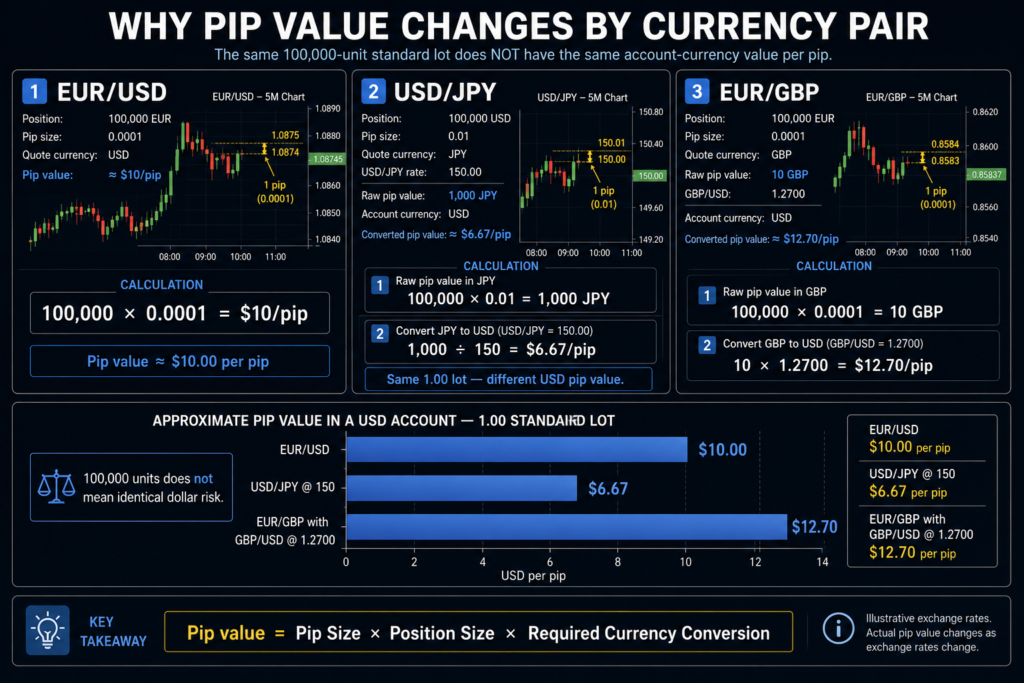
Look at EUR/USD.
If you trade one standard lot of 100,000 EUR, then a one pip move is:
100,000 x 0.0001 = 10 USD
So, about $10 is the value of a pip, when the quote currency is USD.
Now look at USD/JPY.
A typical lot is still 100,000 units but one pip is 0.01 JPY.
The initial pip value is therefore:
100,000 × 0.01 = 1,000 JPY
But your account might be denominated in USD.
You now have to convert those 1,000 JPY into dollars using the current USD/JPY exchange rate.
That is where the pip value changes.
The Quote Currency Is The First Thing To Check
The easiest way to avoid confusion is to identify the currency of the quote.
In EUR/USD, USD is the quote currency.
In GBP/USD, USD is the quote currency.
In USD/JPY, JPY is the quote currency.
In USD/CHF, CHF is the quote currency.
When your account currency matches the quote currency, the pip-value calculation is much simpler.
For example, with a USD account and EUR/USD, one standard lot has a pip value of approximately $10.
But if you trade USD/JPY, the pip value is initially expressed in JPY and must be converted into USD.
This is why saying “one standard lot equals $10 per pip” is only a useful shortcut for certain pairs and conditions.
It is not a universal rule.
The Basic Pip Value Formula
If the account currency is the quote currency, it’s easy to calculate for a pair:
Pip Value = Pip Size x Position Size
For EUR/USD:
0.0001 × 100,000 = $10 per pip
For a mini lot of 10,000 units:
0.0001 × 10,000 = $1 per pip
For a micro lot of 1,000 units:
0.0001 × 1,000 = $0.10 per pip
This is why position size matters just as much as the currency pair.
IG’s pip calculation examples show the same relationship between pip size, position size, and monetary value.
When The Quote Currency Is Different From Your Account Currency
This is where traders start making mistakes.
Suppose you have a USD account and trade USD/JPY.
A standard lot produces a pip value of:
100,000 × 0.01 = 1,000 JPY
That is not $1,000.
You still need to convert the 1,000 JPY into USD.
If USD/JPY is 150.00:
1,000 ÷ 150 = approximately $6.67
So one standard lot of USD/JPY is worth roughly $6.67 per pip at that exchange rate.
Notice what happened.
The same 100,000-unit standard lot that produces approximately $10 per pip on EUR/USD produces approximately $6.67 per pip on USD/JPY at this exchange rate.
That difference directly affects your position sizing.
Pip Value Is Not Fixed
This is one of the most important things to understand.
Even when you stay with the same currency pair, the monetary value of a pip can change as exchange rates change.
Suppose USD/JPY moves from 150 to 140.
The JPY pip value remains 1,000 JPY for a standard lot.
But when converted into USD:
At 150:
1,000 ÷ 150 = $6.67
At 140:
1,000 ÷ 140 = $7.14
The pip value in your USD account has increased.
Nothing changed about the position size.
Nothing changed about the pip definition.
The exchange rate changed.
That is why a pip value changes by pair and can also change over time within the same pair.
Cross-Currency Pairs Make This More Interesting
Now consider EUR/GBP with a USD trading account.
The quote currency is GBP.
A standard lot produces:
100,000 × 0.0001 = 10 GBP per pip
But your account is in USD.
So the 10 GBP must be converted into USD using the current GBP/USD rate.
If GBP/USD is 1.2700:
10 GBP × 1.2700 = $12.70 per pip
If GBP/USD later falls to 1.2000:
10 GBP × 1.2000 = $12.00 per pip
The same EUR/GBP trade now has a different dollar value per pip.
This is the part that many fixed pip-value tables hide.
They provide convenient estimates, but the actual account-currency value is dynamic.
Why This Matters For Position Sizing
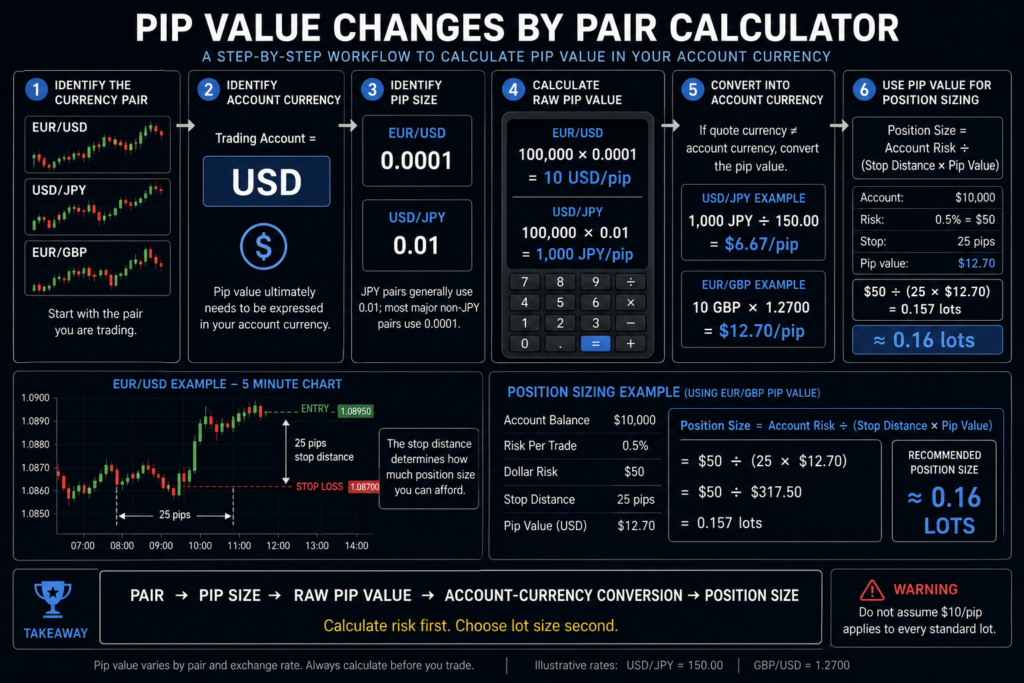
Suppose you have a $10,000 trading account.
You want to risk .5%”
Your max projected risk is:
$10,000 × 0.005 = $50
What if your stop was 25 pips now.
If your pip value is $10 per normal lot, risking $50 means
$50 ÷ 25 ÷ $10 = 0.20 of a lot
But if the actual pip value is $12.70, the proper calculation is:
$50 / 25 / $12.70 ≈ 0.157 lot
That is quite a change.
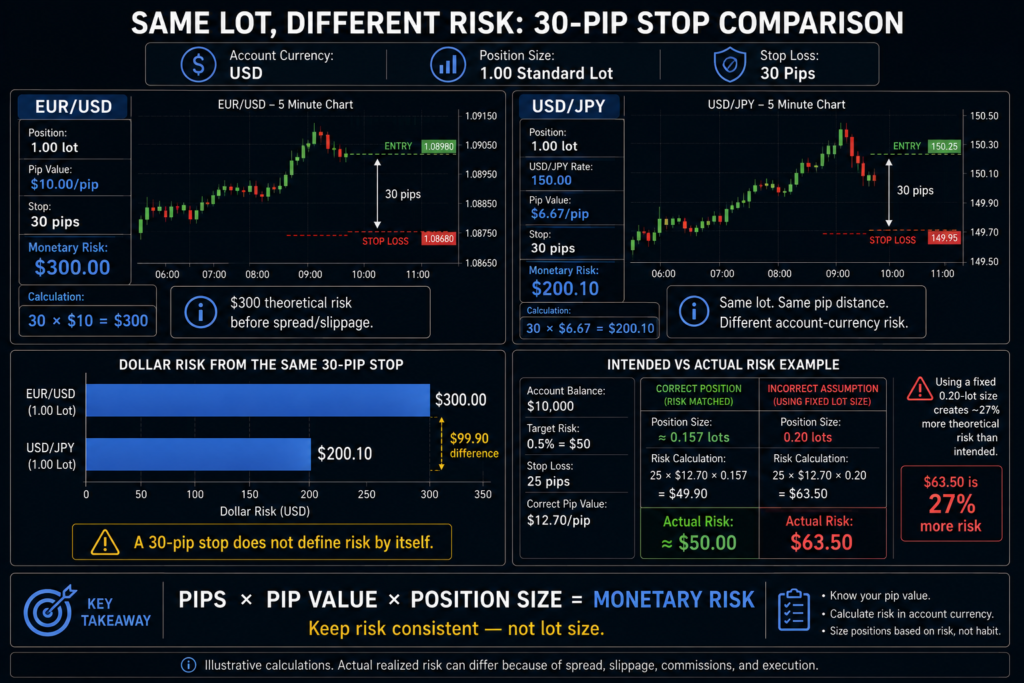
In this example we are using 0.20 lots and each pip is worth $12.70, thus your theoretical risk is:
25 × $12.70 × 0.20 = $63.50
You were going to bet 50 bucks.
In the real world you are risking around $63.50 before you even worry about spread/slippage.
That is more than 27% higher than your intended risk.
This is how seemingly small pip-value errors become real drawdown problems.
Pip Value Changes By Pair Calculator Logic
A practical pip-value calculator needs four pieces of information:
The currency pair.
The position size in units or lots.
The pip size.
The account currency.
Then it needs the relevant exchange rate when conversion is required.
For a standard non-JPY pair where the quote currency matches the account currency:
Pip Value = 100,000 × 0.0001 = 10 units of quote currency
For a JPY pair:
Pip Value = 100,000 × 0.01 = 1,000 JPY
Then convert the result into your account currency if necessary.
This is why a good pip value calculator should not simply show a fixed “$10 per pip” number for every forex pair.
It should account for the conversion path.
A Better Way To Think About Pip Value
I prefer to think about pip value as a translation mechanism.
Price movement happens in the currency pair.
Your account measures profit and loss in your account currency.
Pip value is the bridge between those two.
That means the calculation is not really about pips.
It is about translating market movement into actual account risk.
Once you look at it this way, the reason for the calculation becomes much clearer.
EUR/USD Versus USD/JPY Example
Let’s compare two trades.
You have a USD account.
You trade one standard lot.
EUR/USD is trading at a level where the quote currency is USD.
One pip is approximately $10.
Now you trade USD/JPY at 150.
One pip equals 1,000 JPY.
Converted to USD:
1,000 ÷ 150 = $6.67
If both trades have a 30-pip stop, their approximate monetary risks are very different.
EUR/USD:
30 × $10 = $300
USD/JPY:
30 × $6.67 = $200.10
Same lot size.
Same number of pips.
Very different dollar risk.
This is why comparing trades purely by pip distance can be misleading.
Pip Value And Risk Are Connected
A trader might say:
“My stop is only 20 pips.”
That statement tells you almost nothing about the actual financial risk.
Twenty pips on a small position can be trivial.
Twenty pips on a large position can be significant.
And 20 pips across different currency pairs can represent different monetary values, even when the position size is identical.
A more useful statement is:
“My stop represents 0.5% of my account.”
That is a risk measurement.
The pip distance is simply part of the calculation required to achieve it.
The Position Size Should Come Last
One of the worst habits is choosing a lot size first.
For example:
“I usually trade 0.50 lots.”
Then the trader finds an entry.
Then they calculate the stop.
Then they discover the stop is 35 pips away.
The problem is already built into the process.
A more disciplined sequence is:
Determine the account risk.
Determine where the trade becomes invalid.
Measure the stop distance.
Calculate the pip value.
Then calculate position size.
This keeps the position subordinate to the risk plan.
DayTradersDiary’s Position Size Calculator exists for exactly this type of calculation. The site’s tools section includes a dedicated Position Size Calculator and other trading risk tools.
A Practical Position Size Formula
The basic formula is:
Position Size = Account Risk / (Stop Distance * Pip Value)
Say your account is $20,000.
You risk 0.5%
Your maximum risk is :
$20,000 × 0.005 = $100
Your stop is 20 pips.
Your pip value at the chosen position size must be taken into account.
If one standard lot is worth $10 per pip:
$100 ÷ (20 × $10) = 0.50 lots
But if the pair’s converted pip value is $12.50:
$100 ÷ (20 × $12.50) = 0.40 lots
That is the difference between approximate sizing and proper sizing.
Why Leverage Does Not Change Pip Value
This is another common misunderstanding.
Leverage affects the margin required to control a position.
It does not magically change the value of each pip for a given position size.
If 100,000 units of EUR/USD produce approximately $10 per pip, increasing leverage does not make it $20 per pip.
Your exposure determines the pip value.
Leverage changes how much capital is required to maintain that exposure.
Confusing these two concepts can lead traders to underestimate their actual market exposure.
Pip Value And Volatility Should Be Considered Together
The pip value tells you how much each pip costs.
Volatility tells you how far the price tends to move.
You need both.
Suppose GBP/USD has a $10 pip value for your position.
A 10-pip average movement produces roughly $100.
But if the market regularly moves 40 or 50 pips during your trading window, using a fixed 10-pip stop may have little practical meaning.
This connects directly with the ideas discussed in How To Trade Only With Volatility Cones. Volatility changes the environment in which your pip-based risk calculations operate.
A larger predicted range may necessitate a larger structural stop.
A larger stop results in a smaller position if account risk is fixed.
The chain is …
Volatility ← Stop distance → Position size → Money at risk
That is a much more useful framework than treating lot size as a constant.
Pip Value And The Japanese Yen Exception
JPY pairs deserve special attention because the standard pip size is 0.01 rather than 0.0001.
For USD/JPY:
A move from 150.20 to 150.21 is one pip.
For EUR/USD:
A move from 1.1000 to 1.1001 is one pip.
This does not mean JPY pairs are inherently more or less risky.
It simply means the price quotation uses a different decimal convention.
Some other currencies may also use different quoting conventions depending on the broker and market, so your trading platform’s contract specifications should always be checked rather than relying unthinkingly on a generic pip table.
Five-Digit Brokers And Pipettes
Modern forex platforms commonly quote many pairs to five decimal places.
For EUR/USD, you might see:
1.10000
A movement to:
1.10001
It is one pipette, not one full pipette.
A movement to:
1.10010
It is one pip.
For JPY pairs, the extra digit works similarly:
1 pipette = 150.000 to 150.001
One pip is 150.000-150.010.
This is important when you are calculating stops as sometimes traders mistake the last digit shown for a full pip.
IG also distinguishes between pips and pipettes in its forex education materials.
Why Different Currency Pairs Have Different Trading Costs
The pip value is only one part of the execution cost.
Spread matters.
Commission matters.
Slippage matters.
Swap can matter if positions are held overnight.
This is particularly important for short-term traders because transaction costs can consume a meaningful part of a small expected edge.
Research examining foreign exchange price response and bid-ask spreads has found that larger pip spreads can have a stronger impact on price response behavior.
The practical lesson is simple.
Do not compare currency pairs only by their pip value.
Compare their complete trading economics.
A pair with a slightly lower pip value but tighter spreads may be more attractive for a short-term strategy than a pair with a larger pip value but much higher execution costs.
Liquidity Changes The Practical Value Of A Pip
The foreign exchange market is enormous, but liquidity is not evenly distributed across all currency pairs and at all hours.
The Bank for International Settlements’ triennial survey provides extensive data on global FX turnover and the concentration of trading activity across currencies and instruments.
For day traders, this matters because a theoretical pip value does not tell you how easy it will be to enter or exit.
A pair can have a perfectly calculated $ X-per-pip value and still produce poor execution during a thin trading period.
This is why pip-value analysis should be combined with the session and liquidity analysis discussed in How to Track Win Rate by Session. The same setup can behave differently when spreads, participation, and execution conditions change.
The Psychological Trap Of Fixed Lot Sizes
Lot sizing is fixed. It feels disciplined.
easy to recall:
EUR/USD: 0.50 lot.
But that can give an illusion of consistency.
What you truly want to stay consistent is risk.
If one trade risks $50 and another risks $85 simply because the pairs have different pip values or stop distances, your strategy is not operating with a consistent risk unit.
The lot size should be allowed to change.
The risk percentage should remain stable.
That is a subtle but important shift in thinking.
What To Record In Your Trading Journal
Your journal should record the pip value used at entry.
It should also record the currency pair, account currency, lot size, stop distance, planned monetary risk, and actual result.
This becomes especially useful if you trade several pairs.
After 100 or more trades, you can examine whether certain pairs consistently create larger deviations between planned and realized risk.
You can also compare average spread and slippage by pair.
A downloadable Trade Journal Template is useful here because you can add pip value and account-currency risk as fields rather than relying on memory. DayTradersDiary’s existing trading content also emphasizes recording execution details rather than focusing only on final profit and loss.
A Simple Pre-Trade Pip Value Routine
Always check the account currency before entering a deal.
Then decide the currency for quoting.
Confirm PIP size.
Determine the current pip value for the position you are considering.
Measure the structural stop.
Calculate the position size required for your predefined account risk.
Then account for the spread and realistic execution.
This process takes very little time once it becomes habitual.
The important part is doing it before the order rather than explaining the mistake afterward.
How To Test Whether Your Pip Calculations Are Working
For the next 50 to 100 trades, compare planned risk with actual initial risk.
Do not just compare the dollar amount.
Check whether the position size, pip value, stop distance, spread, and account conversion were all correctly incorporated.
You are looking for errors in the process.
If your intended risk is 0.5% but your average actual initial exposure is 0.58%, something is wrong.
The pip value calculation may be being rounded too aggressively.
Your broker’s contract specifications may differ from your assumptions.
Is the spread being ignored?
The position size may be being manually entered incorrectly.
These are operational problems, and they are often easier to fix than strategic problems.
Scaling And Capital Growth
Once you get pip-value changes right scaling is simpler.
You are no longer thinking:
‘I want to handle larger lots.
You are thinking:
“I want to use the same risk process with a larger capital base.”
That distinction matters if you eventually consider an evaluation program.
Firms such as The5ers, FTMO, and FundedNext use different rules around drawdown, position limits, objectives, and scaling. The important question is not which firm offers the largest headline account.
It is whether your existing strategy can operate within the firm’s risk framework.
For a trader who has already demonstrated consistent execution, a The5ers evaluation account can be considered a professional route to accessing greater nominal trading capital without simply increasing personal account leverage.
But the evaluation should come after the process is proven.
If you still make basic pip-value and position-sizing errors, additional capital only magnifies those mistakes.
Final Thoughts
Pip value is one of those details traders tend to understand intellectually but neglect operationally.
You know that currency pairs are different.
You know JPY pairs use a different pip convention.
You know, lot size affects profit and loss.
But the real edge comes from connecting all of those pieces before every trade.
The question is not:
“How many pips can I make?”
It is:
“What does each pip actually mean for my account?”
Once you start thinking that way, position sizing becomes more precise.
A 20-pip stop is no longer a vague number.
It becomes a defined amount of account risk.
For your next 30 trades, stop using a fixed lot size across different currency pairs. Calculate the pip value first, then calculate the position size from your predefined account risk.
At the end of those 30 trades, compare your planned risk with your actual exposure.
That small change can reveal more about your risk management than any other indicator ever will.
For your next read, revisit How to Backtest a Day Trading Strategy and test whether your position-sizing process remains consistent across different currency pairs, volatility regimes, and trading sessions.
Frequently Asked Questions
Why does the pip value change between currency pairs?
The pip value will vary depending on the quotation currency of the currency pair, pip size, exchange rate and the need to convert currencies.
Is one pip always worth $10?
No. One normal lot is around $10 per pip for many big USD quoted pairs, but not always. Pairs with JPY and cross currency pairs have distinct calculations.
Does pip value change while I am holding a trade?
Yes. If the pip value must be converted into your account currency, changes in exchange rates can change the monetary value of each pip.
Does leverage change pip value?
No. Leverage changes the margin required to control a position. Pip value is determined primarily by position size, pip size, exchange rates, and account-currency conversion.
How can I calculate the correct position size?
The first step is to evaluate how much of your account you’re willing to risk. Then calculate the current pip value and the stop distance. Divide your money risk allowance by the product of the stop distance and the pip value.