
Every trader remembers the day they gave back an entire week’s profits.
It rarely happens because the strategy suddenly stopped working.
It usually starts with one thought.
“I’ll just take one more trade.”
That extra trade often isn’t part of the plan. It comes from greed after a winning streak or frustration after a losing trade. Either way, discipline disappears, and drawdown begins.
After reviewing hundreds of trading journals over the years, one pattern appears again and again.
The traders with the smallest drawdowns are rarely the ones chasing the biggest daily profits.
They’re the ones who stop trading when they’ve accomplished enough.
They don’t wake up trying to make 5% in a day.
They focus on executing a handful of quality decisions.
Ironically, those smaller daily objectives often lead to larger monthly returns because they dramatically reduce unnecessary losses.
In this article, readers will learn why tiny daily goals are one of the most underrated tools for drawdown control, how they impact trader psychology, and how to create a practical framework that protects your capital and your confidence.
The Real Cause of Large Drawdowns
Most traders think drawdowns happen because of bad market conditions.
Sometimes they do.
More often, they’re caused by behavior.
A trader loses two planned trades.
Instead of accepting the day’s result, they double their position size.
Another trader reaches their profit target before lunch but keeps trading out of excitement.
A third trader becomes bored during a quiet market and forces mediocre setups.
The market created none of these losses.
They were created by abandoning a process.
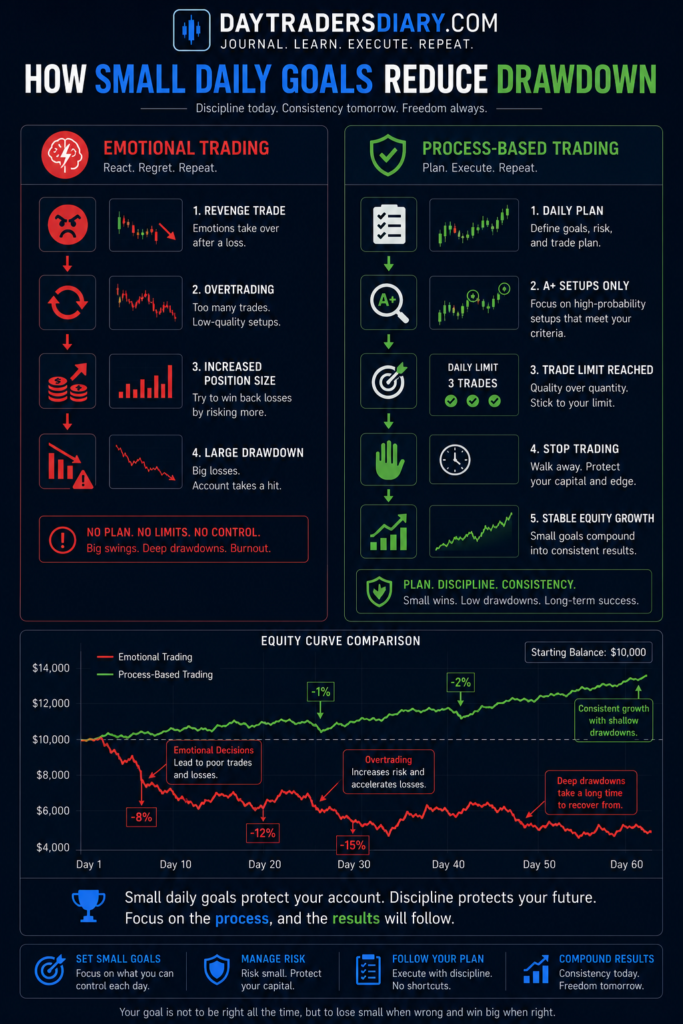
Large drawdowns are often the accumulation of small emotional decisions.
Research Shows Discipline Outperforms Activity
Behavioral finance research published by the CFA Institute has consistently shown that emotional decision-making reduces investment performance.
Studies by Barber and Odean on investor behavior also found that excessive trading generally leads to lower long-term returns because more activity often means more mistakes rather than more opportunities.
For active day traders, the lesson is straightforward.
More trades do not automatically create more profits.
In many cases, they create more exposure to poor decisions.
Small daily goals naturally reduce unnecessary trading.
That alone can improve consistency.
Why Daily Goals Should Focus on Process
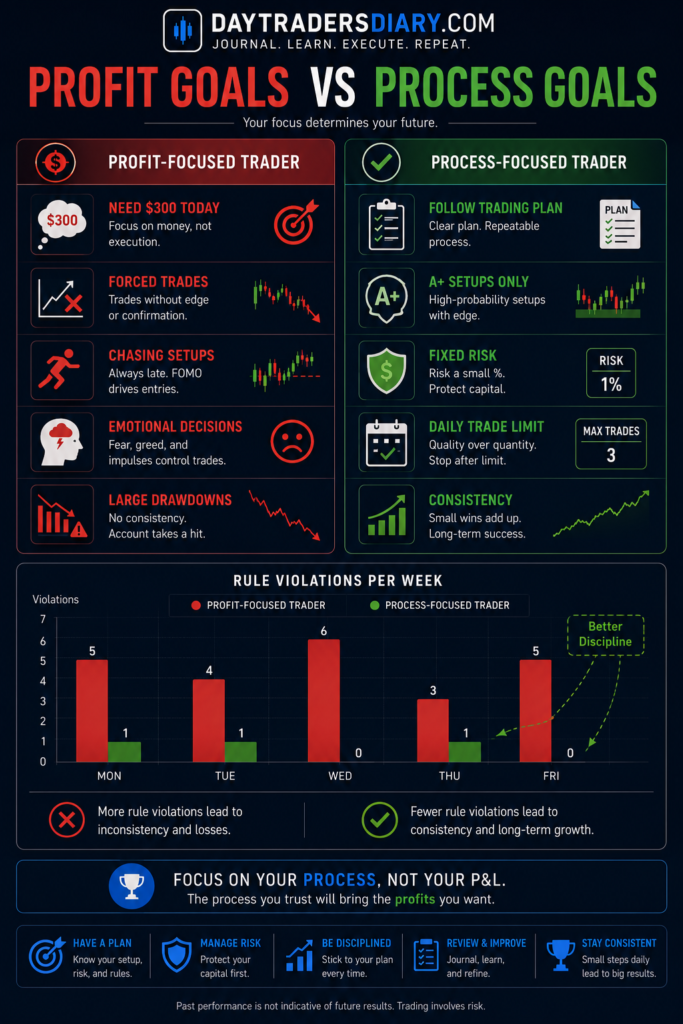
One mistake traders make is setting profit targets that encourage forced trades.
For example:
“I need to make $300 today.”
The market doesn’t know your target.
It may only offer one high-quality setup all day.
Trying to force additional trades to reach a financial objective often increases drawdown.
Instead, experienced traders build process-based goals.
Examples include:
Execute only A-quality setups.
Follow every rule in the trading plan.
Risk is exactly the planned percentage on every trade.
Stop after reaching the daily trade limit.
These goals remain under your control.
Profit does not.
Ironically, focusing on process often improves profitability over time.
The Psychology Behind Small Wins
Small goals create positive reinforcement.
Suppose your objective is not to make money today.
Instead, it’s to execute three trades exactly according to your plan.
You finish the session with one winner and two small losses.
Financially, the day is nearly flat.
Psychologically, it’s a success.
You followed your process.
That matters because trading confidence should come from disciplined execution, not random outcomes.
This mindset reduces revenge trading, overconfidence, and impulsive decisions.
These behavioral gains over months equate to reduced drawdowns.
A Practical Framework for Daily Trading Goals
Don’t enter every day with expectations of profits. Build your session on things you have control over.
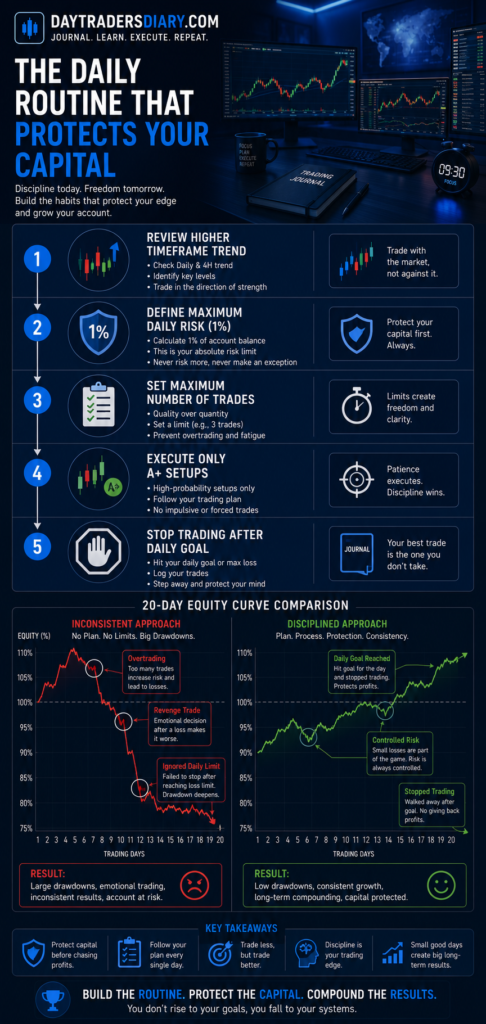
Start by reviewing the higher timeframe market structure.
Our article on Best Daily Charts Setup for Forex Traders explains why understanding the broader trend before the market opens helps eliminate low-quality trades later in the day.
Next, define your maximum daily risk before placing a single order.
Many experienced traders stop trading after losing 1% of their account in a day.
This creates a natural circuit breaker that prevents emotional spirals.
Then establish a maximum number of trades.
Some traders perform best with two trades.
Others need four.
The exact number matters less than respecting the limit.
Finally, define what success looks like before the session begins.
Success should mean following your rules.
Not simply making money.
Know When to Stop
One of the hardest skills in trading is ending the session.
Many traders know how to enter.
Few know how to stop.
Imagine finishing the morning with two well-executed winning trades.
Your daily objective has been achieved.
The market slows during the afternoon.
Instead of closing the platform, you continue searching for opportunities.
Three unnecessary trades later, half the profits are gone.
Professional traders understand that protecting gains is just as important as earning them.
Sometimes the highest-quality trade is no trade at all.
Small Daily Goals Create Better Risk Decisions
When traders chase large daily returns, position sizing often becomes inconsistent.
One trade risks 0.5%.
The next risks 2%.
Then comes an oversized recovery trade.
Eventually, drawdown accelerates.
Smaller daily goals encourage stable risk management because there’s less emotional pressure to recover losses quickly.
This is where most traders miscalculate risk.
Using the Position Size Calculator before every trade removes guesswork and ensures that each position matches your predetermined risk regardless of market conditions.
Consistency begins with consistent exposure.
Journaling the Right Daily Metrics
Most journals record profits.
Few record behavior.
Your Trade Journal Template should include questions such as:
Did I follow my daily trading plan?
Did I stop trading when my process required it?
Did I exceed my trade limit?
Did I increase risk after losing?
Did I force trades during slow market conditions?
After several weeks, patterns become obvious.
You may discover your largest drawdowns always occur after your fourth trade of the day.
Or after reaching a daily profit target.
Behavioral data often provides more valuable insights than financial results alone.
Why Small Goals Lead to Bigger Monthly Returns
This appears non-intuitive.
Smaller targets lead to bigger growth in the long run.
Here’s why.
Now imagine two traders.
Trader A wants to make the most of every trading session.
Trader B sole purpose is to trade high quality setups and to minimize any avoidable losses.
Month’s end:
Trader A had a few great days and a lot of significant drawdowns.
Trader B makes less profit every day yet the equity increases constantly.
Professional trading is rarely about spectacular individual sessions.
It’s about eliminating large setbacks.
Capital compounds far more effectively when drawdowns remain controlled.
Building an Evaluation-Friendly Trading Routine
This disciplined mindset becomes even more valuable for traders pursuing funded accounts.
Evaluation firms rarely reward aggressive trading.
They reward consistency.
Firms such as The5ers, FTMO, and FundedNext evaluate traders based on disciplined execution, drawdown control, and repeatable performance.
Traders who create routines around minor daily targets naturally meet those expectations.
Instead of hunting for unachievable daily wins, they guard capital and allow positive expectancy to play out over time.
If you have a proven track record, have reduced your drawdowns, and have disciplined risk management, then a The5ers evaluation account can be a logical step to access more trading capital without having to rely only on the funds you own.
Final Thoughts
Every trader wants larger profits.
Few realize those profits often begin with smaller goals.
The objective isn’t to win every day.
It’s to avoid the kind of emotional decisions that create unnecessary drawdowns.
Tomorrow morning, don’t ask yourself how much money you want to make.
Ask yourself one better question.
“What would a perfectly executed trading day look like?”
Then measure success against that answer.
You’ll trade less.
You’ll almost certainly manage risk better.
And over time, your equity curve may become smoother than you ever expected.
For your next read, explore What Is the Daily Routine of Successful Day Traders to learn how structured habits create consistent trading performance over months and years.
Frequently Asked Questions
Why do small daily trading goals reduce drawdown?
Small daily objectives ease mental stress, curb overtrading and help traders follow their trading strategy more consistently leading to less unwarranted losses.
Should daily trading goals focus on profit?
Not exactly. Process goals, such as sticking to your trading plan or limiting the number of trades, tend to work better since they are within your control.
How many trades should I take each day?
There is no universal number. Your trade limit should reflect your strategy and historical performance. Many experienced day traders find that limiting trades improves decision quality.
What is a reasonable daily risk limit?
One size does not fit all. Your trading limit should be in line with your plan and past experience. Many experienced day traders believe that limiting trades leads to better decisions.
Can small goals improve trading psychology?
Yes. Short-term financial results are not what develop confidence but discipline in the pursuit of realistic process-oriented goals.
How do I track whether my daily goals are working?
Record both trading results and behavioral metrics in your trading journal. Reviewing these records regularly helps identify whether your daily routine is reducing drawdowns and improving consistency.