
Most traders don’t blow up their accounts because they have a bad strategy.
They blow up because they underestimate risk.
I’ve watched traders spend weeks perfecting entries, searching for the best indicators, and studying chart patterns. Then they risk 10% of their account on a single trade and wonder why one losing streak wipes out months of progress.
The uncomfortable truth is that trading success is often less about how much you make and more about how much you don’t lose.
Professional traders understand this.
New traders usually learn it the hard way.
The irony is that risk management is not the most thrilling element of trading. Nobody posts screenshots of properly sized positions or disciplined stops on social media. But these routines are typically the difference between traders who stay around long enough to establish an edge and others who disappear after a few months.
In this beginner’s guide to forex risk management we’ll cover: What does risk management really mean? How to quantify risk in forex trading. Practical frameworks used by experienced traders to protect their capital.
Why Risk Management Matters More Than Strategy
One of the biggest misunderstandings in trading is that profitability begins with the ideal setup.
No, it doesn’t.
A brilliant strategy with irresponsible risk-taking is often beaten by a mediocre plan with exceptional risk management.
Research from the CFA Institute and educational resources published by the CME Group Education Center consistently emphasize capital preservation as a foundation of long-term market success.
The lesson is simple.
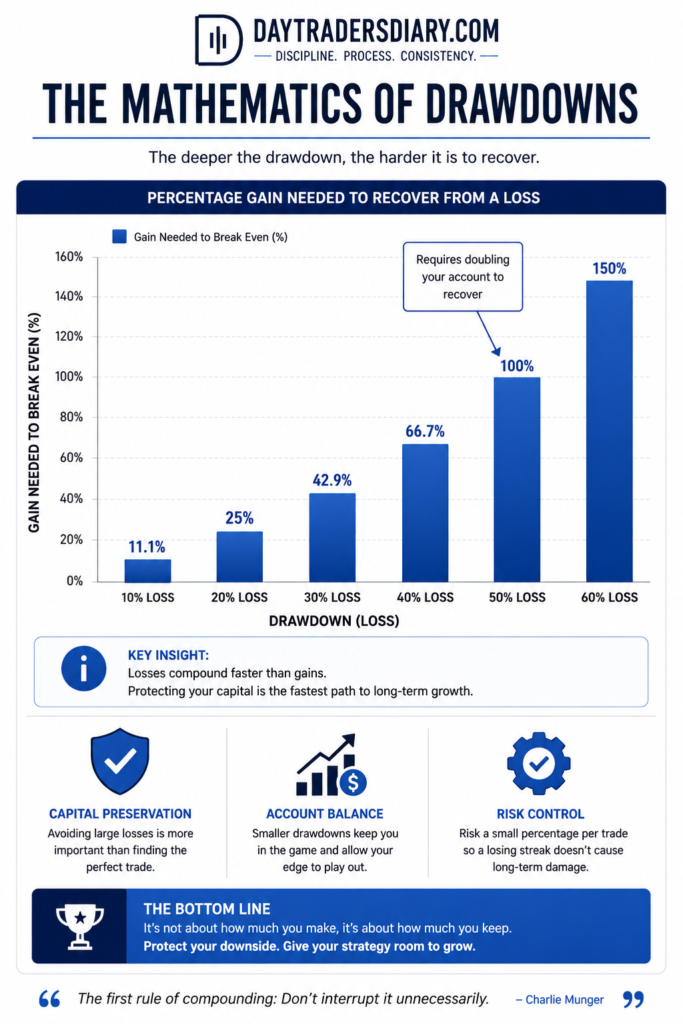
If your account suffers a 50% drawdown, you need a 100% gain just to get back to breakeven.
Large losses create mathematical problems that become increasingly difficult to overcome.
Professional traders understand this reality.
That is why protecting capital always comes before growing capital.
What Is Risk Management in Forex?
Forex risk management is the process of controlling how much money you can lose on any trade, trading day, or trading period.
The goal isn’t to eliminate losses.
Losses are part of trading.
The goal is to ensure that no single trade or series of trades can cause catastrophic damage to your account.
Risk management involves decisions such as:
How much to risk per trade
Where to place stop losses
How large your position size should be
How much exposure to have at one time
When to stop trading after losses
These decisions often matter more than the entry itself.
The Biggest Beginner Mistake
Most new traders focus on potential profits.
Experienced traders focus on potential losses.
Imagine two traders.
Trader A sees a setup and immediately thinks about making $500.
Trader B sees the same setting and immediately calculates the most worst case scenario.
Who is more likely to survive long term as a trader?
Trader B.
Optimism is punished by the market.
Best to be prepared.
Every professional trader I know defines risk before thinking about profit.
How to Calculate Risk Management in Forex
Risk calculation is much simpler than many beginners assume.
Start with your account size.
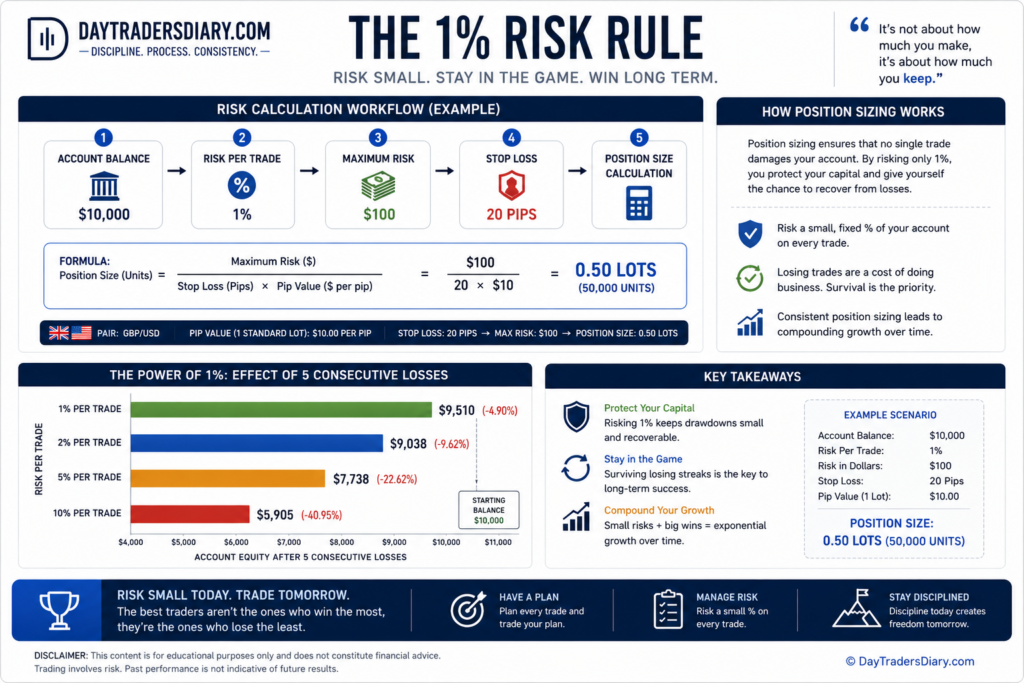
Let’s say your account balance is $10,000.
If you decide to risk 1% per trade, your maximum loss is $100.
Now assume your stop loss is 20 pips away.
Your position size should be adjusted so that a 20-pip loss equals approximately $100.
This process ensures consistency.
Whether your stop loss is 10 pips or 50 pips, the percentage of account risk remains the same.
Many traders ignore this step and simply trade fixed lot sizes.
That approach often creates inconsistent results because risk fluctuates from trade to trade.
The Different Types of Risk Management in Forex
Most traders think risk management begins and ends with stop losses.
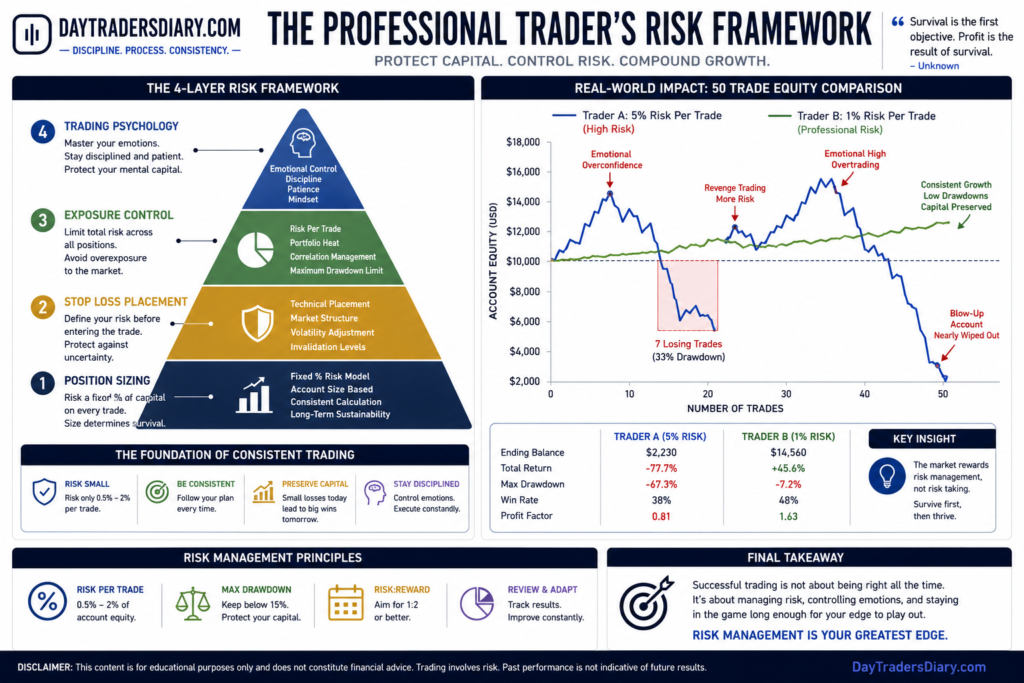
In reality, there are several layers.
Trade risk management focuses on the amount risked per position.
Daily risk management limits how much you can lose in one day of trading.
Portfolio risk management takes into account exposure across several deals.
Psychological risk management is about making emotional choices that lead to pointless losses.
For example, opening three trades on EUR/USD, GBP/USD, and EUR/GBP may appear diversified.
In reality, those positions are often highly correlated.
A single market event could impact all three simultaneously.
This is why understanding exposure matters.
The 1% Rule and Why It Works
Many successful traders risk between 0.5% and 1% per trade.
Some newer traders view this as too conservative.
The problem is that most people underestimate how difficult drawdowns become.
Consider a trader risking 5% per trade.
Five consecutive losses result in a significant decline in account equity.
A trader risking 1% per trade can survive the same losing streak with far less damage.
The smaller risk profile creates more opportunities to recover and continue executing the strategy.
Risking less often feels slower.
Ironically, it usually leads to longer-term growth.
Building a Practical Risk Management Framework
Good risk management is not complicated.
The trick is to be consistent with it.
Before you enter a trade, ask yourself:
Where is my stoploss?
How much is at stake?
Does this trade match my plan?
How many open positions do I have already?
What is the reward relative to the risk?
If any of those questions cannot be answered clearly, the trade probably isn’t ready.
One framework I often recommend is thinking in terms of risk units rather than dollars.
Instead of saying, “I made $300,” think, “I made 3R.”
This keeps focus on process rather than money.
Risk Management and Trading Psychology
Many trading mistakes are actually risk management mistakes disguised as psychological problems.
Overtrading usually starts after a loss.
Revenge trading is frequently a product of dissatisfaction.
Fear often makes people move stop losses.
Emotional decision making is the universal denominator.
“Strong risk management provides emotional stability as every trade is bounded by pre-defined limits.
Traders who know exactly what they may lose tend to make better decisions.
This is why psychology and risk management are inseparable.
They work together.
Risk Management During High-Impact News
One area where beginners frequently get caught off guard is economic news.
Inflation reports, employment data, central bank pronouncements and other events might cause abrupt volatility.
Spreads may widen and slippage may develop during those times.
Many experienced traders cut position size or don’t enter just before a major announcement.
If you regularly trade news-driven markets, reviewing economic calendar articles on DayTradersDiary.com can help improve preparation and execution.
Position Sizing: The Most Important Risk Tool
If there is one tool every trader should understand, it is position sizing.
Many traders place a stop loss and assume risk is managed.
Not necessarily.
The size of the position determines how much money is actually at risk.
This is where most traders miscalculate exposure. Using a Position Size Calculator removes guesswork and ensures every trade aligns with your predetermined account risk.
A great setup with poor position sizing can still produce poor results.
Position sizing is what connects strategy and risk management.
Tracking Risk Through Journaling
Most traders record wins and losses.
Few measure risk quality.
Your trading journal must contain:
Trade risk as a percentage
Position sizing
Placement of stop-loss
Risk vs reward ratio
Mood and emotions during performance
Eventually, the information reveals patterns.
You may discover that your biggest losses occur after multiple winning trades.
You may find that oversized positions consistently underperform.
These insights are difficult to spot without proper documentation.
A structured Trade Journal Template can make this review process far more effective.
Scaling Without Increasing Risk Recklessly
One of the biggest mistakes traders make is increasing risk after a few profitable weeks.
Confidence builds.
The discipline drops away.
Position sizes double overnight.
Then the inevitable losing streak begins.
Professional traders generally grow slowly.
They only rise in size after they have shown consistency across a wide sample of trades.
This mindset becomes particularly important for traders interested in funded trading opportunities.
Programs offered by The5ers, FTMO, and TradeThePool are built around risk discipline. These firms aren’t looking for traders who can generate one extraordinary month.
They are searching for traders who can safeguard capital and provide regular profits.
If you have a repeatable procedure and are risk-averse, an assessment account with The5ers could be a structured means to access more cash without adding personal financial risk.
Final Thoughts
The longer you trade, the more you realize that risk management is not a defensive skill.
It’s an offensive advantage.
Good risk management allows you to stay in the game long enough for your edge to work.
Even the best strategy can be destroyed by poor risk management.
If there is one habit to focus on improving this week, make it position sizing.
Not entires.
Not signals.
Not chart-patterns.
Position size.
Because once you adjust for risk, everything else is easier to objectively judge.
Now check out our guides on position sizing and trading psychology. Together they create the foundation for consistent long term trading.
FAQs
What is risk management in forex?
Risk management is the process of controlling possible losses by using appropriate position sizing, stop-loss placement and exposure management.
How much should beginners risk per forex trade?
Many experienced traders recommend risking between 0.5% and 1% of account equity per trade.
How do you calculate risk management in forex?
Calculate the percentage of your account you’re willing to risk, determine your stop-loss distance, and adjust position size accordingly.
Why is position sizing important?
Position sizing determines how much money is at risk on a trade. Even a good setup can become dangerous if the position size is too large.
What is the biggest risk management mistake?
Risking too much on a single trade is one of the most common reasons traders experience severe drawdowns.
Can good risk management make an unprofitable strategy profitable?
No. Risk management cannot create an edge, but it can help preserve capital long enough for a genuine edge to develop and perform consistently.