
One of the most frustrating experiences in trading is being right about direction but still losing money.
You’ve probably seen it happen.
You identify a strong support level. Price reaches it. Buyers step in exactly where you expected. The market eventually rallies.
Yet somehow you’re already out of the trade.
Your stop loss gets hit first.
A few hours later, price moves exactly where you originally thought it would.
After enough screen time, most traders discover that support and resistance alone are not enough. Markets do not move with perfect precision. Price breathes. It expands and contracts based on volatility.
This is where Average True Range, better known as ATR, becomes incredibly useful.
Many traders treat ATR as just another indicator sitting beneath the chart. In reality, it can become one of the most practical tools for understanding how much room the market needs to move naturally before your trade idea is considered invalid.
When combined with support and resistance, ATR helps solve one of the biggest problems traders face: placing stops and targets in locations that make sense.
This article breaks down how experienced traders combine ATR with support and resistance, where most traders misuse the indicator, and how you can apply it to real-world forex and day trading setups.
Why Support and Resistance Alone Often Fail
Support and resistance are among the first concepts traders learn.
The idea is simple.
Support is an area where buyers may step in.
Resistance is an area where sellers may become active.
The problem is that many traders treat these levels as exact prices.
Markets do not work that way.
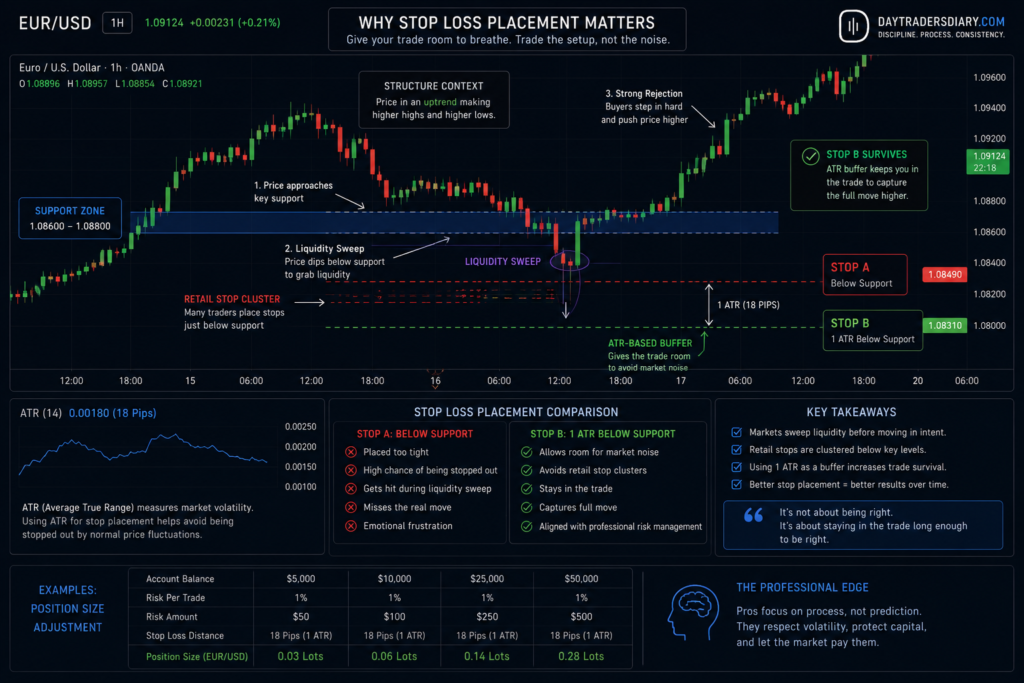
Institutional orders are distributed across zones, not single price points. Liquidity often sits slightly above resistance and slightly below support.
That means price frequently overshoots important levels before reversing.
A trader who places a stop loss directly beneath support often discovers this reality the hard way.
The market dips slightly below the level, triggers the stop, and then moves in the anticipated direction.
The support level was valid.
The stop placement was not.
What ATR Actually Measures
ATR was developed by J. Welles Wilder Jr. and remains one of the most practical volatility indicators available today.
ATR does not predict direction.
It measures movement.
Specifically, it measures how much a market typically moves over a given period.
If EUR/USD has a 14-period ATR reading of 20 pips on a specific timeframe, that means the pair has recently been moving approximately 20 pips per candle on average.
Research and educational material from CME Group Education consistently emphasize the importance of volatility measurement when managing risk and trade placement.
For traders, ATR answers an important question:
“How much room does this market normally need?”
That information becomes extremely valuable when working with support and resistance zones.
Why ATR and Support & Resistance Work So Well Together
Think of support and resistance as location.
Think of ATR as a cushion.
Support tells you where purchasers will wake up.
ATR informs you how far the price can go before the trade idea is really in trouble.
Without ATR, traders place stops on arbitrary values.
Ten pips.
Fifteen pips.
Twenty pips.
The problem is that markets do not care about arbitrary numbers.
A 15-pip stop may be perfectly reasonable during quiet Asian session conditions and completely inadequate during a high-volatility New York session.
ATR helps adjust risk placement according to actual market behavior rather than personal preference.
The ATR Support Resistance Strategy Experienced Traders Use
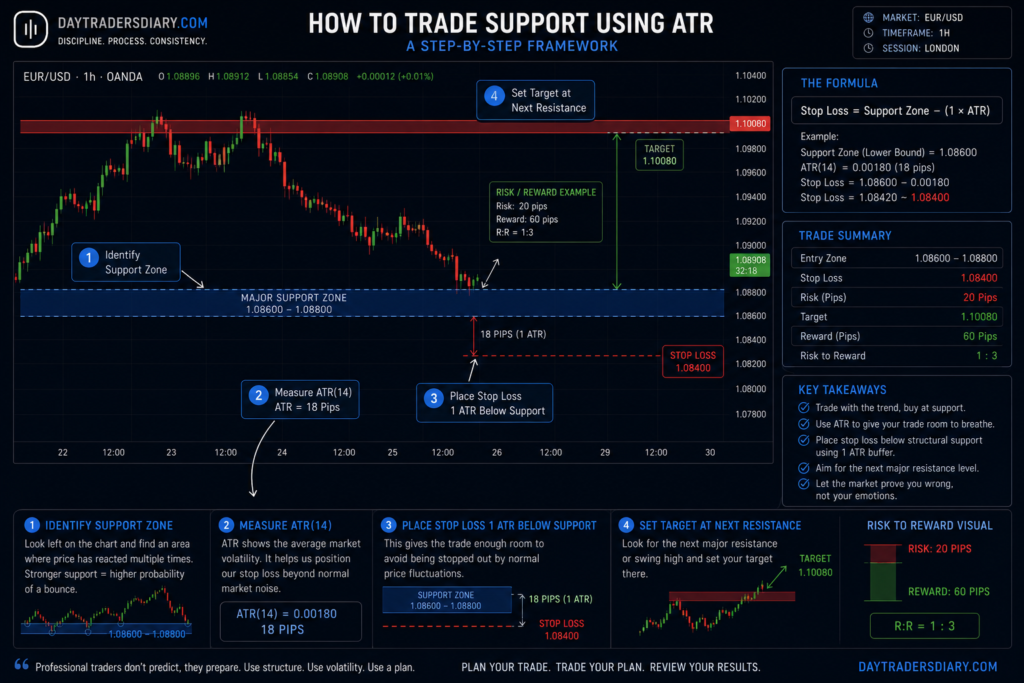
One practical approach is to combine support zones with ATR-based stop placement.
Assuming EUR/USD is moving to a strong support area.
Rather than putting a stop just below support, the trader measures the current ATR.
If ATR is at an average of 18 pips then it may not be possible to place a stop 5 pips below support.
The market may move that much easily without affecting the overall arrangement.
Many experienced traders will set stops beyond support and a percentage of ATR.
The exact multiplier changes with approach and time range, but the rationale is the same.
The stop is based on market behavior, not hope.
This simple adjustment often reduces premature stop-outs significantly.
Using ATR to Validate Breakouts
ATR can also help determine whether a breakout has real momentum.
One mistake traders make is assuming every break of resistance represents a new trend.
In reality, many breakouts are simply liquidity grabs.
Price briefly pushes through a level, attracts breakout traders, then reverses.
ATR helps give context.
The chance of real momentum grows when breakout candles exceed recent ATR averages and volume participation is increasing.
If the price narrowly clears resistance while the ATR stays compressed, a caution may be needed.
This concept is particularly useful during major forex sessions and economic news releases.
ATR Can Improve Profit Targets Too
Most traders focus only on entries and stop losses.
Targets deserve equal attention.
One common mistake is expecting unrealistic moves from low-volatility environments.
Imagine EUR/USD has an intraday ATR of 40 pips.
A trader enters a long position and expects a 150-pip move during a quiet session.
The expectation may not align with current market conditions.
ATR helps establish realistic target zones.
It provides a framework for understanding what the market is currently capable of delivering.
This creates more logical reward-to-risk planning.
The Biggest ATR Mistake Traders Make
The most common mistake is treating ATR as a signal generator.
ATR does not tell you when to buy.
It does not tell you when to sell.
It simply provides information about volatility.
The edge is taking ATR and merging it with market structure.
Support/resistance makes sense.
ATR provides you measurement.
Together they offer a more complete decision-making framework.
Neither instrument is very powerful on its own.
How ATR Changes Risk Management
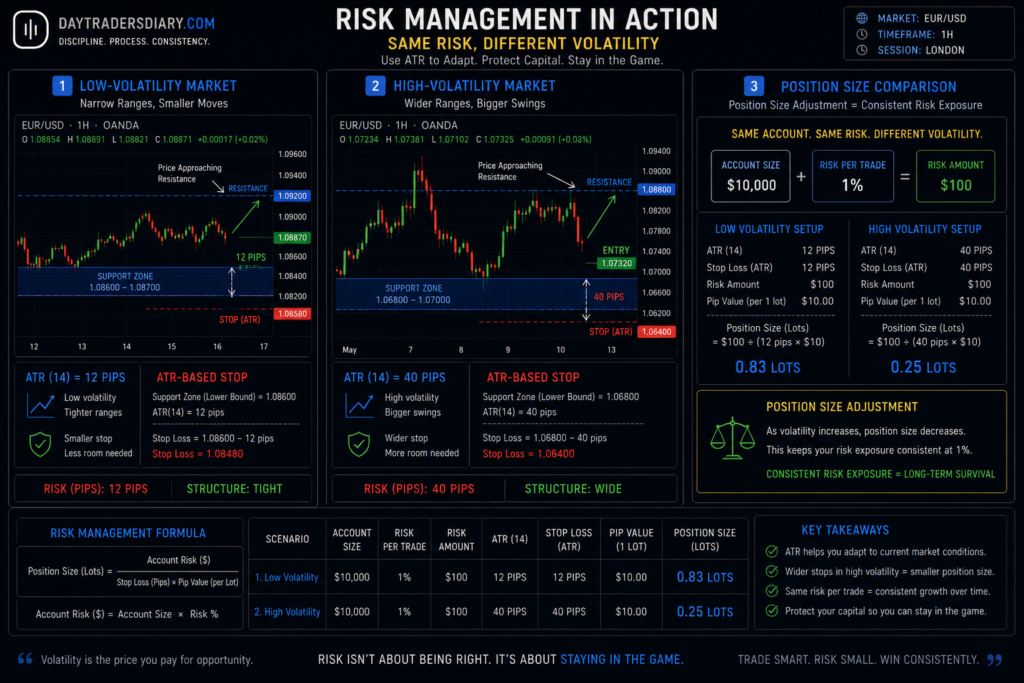
One lesson every experienced trader eventually learns is that identical position sizes rarely make sense across different market conditions.
A setup with a 12-pip stop and a setup with a 40-pip stop should not carry identical exposure.
This is where many traders unintentionally damage performance.
Using a Position Size Calculator helps align position size with ATR-based stop placement. Instead of risking random amounts across different setups, traders maintain consistent account risk regardless of volatility conditions.
This is one reason professional traders often appear calmer during market fluctuations.
Their risk is calculated before the trade begins.
Journaling ATR-Based Trades
Most traders record entries and exits.
Few record conditions of volatility.
That’s a lost chance.
A decent trading journal should contain:
ATR @ entrance
Stop loss range
Trading sessions
Trade result
Support / Resistance scenario
Patterns begin to form over time.
You may discover that ATR performs exceptionally well during trending sessions but requires adjustment during range-bound conditions.
This is where a Trade Journal Template becomes valuable. It allows traders to evaluate whether ATR-based decisions are genuinely improving execution rather than relying on memory.
Why Professional Traders Focus on Volatility Awareness
One of the biggest differences between newer traders and experienced traders is awareness of market conditions.
Beginners often see setups.
Professionals see environments.
ATR creates that consciousness.
Rather than asking
Can I get it here?
Experienced traders will ask:
“Is volatility supporting this trade idea?”
That small variation can significantly increase the quality of decision making.
Scaling Beyond Personal Capital
After traders get consistent with structured risk management, position size, and volatility-based execution, the next hurdle is capital efficiency.
Even successful traders may be limited in growth when dealing solely personal capital.
This is one reason many disciplined traders explore evaluation programs from firms such as The5ers, FTMO, and TradeThePool.
These firms are not shortcuts to success.
They simply provide access to larger capital pools for traders who can demonstrate consistency.
A trader who understands ATR, support and resistance, and disciplined risk management is often better prepared for evaluation environments than someone focused solely on finding more trade entries.
For traders looking to scale responsibly, a The5ers evaluation account can be a logical next step after developing a proven trading process.
Final Thoughts
ATR is not a magic bullet.
Support and resistance levels are not magical.
But as a pair they solve a very serious trade problem.
They help traders to see volatility and location.
Support and resistance tell you where important decisions may occur.
ATR tells you how much room the market may need to make those decisions.
This week, review your last ten trades.
How many stop losses were placed based on convenience rather than actual volatility?
The answer may tell you more about how you’re doing than any indication can.
For your next read, take a look at some related DayTradersDiary.com articles about ATR-based stop losses, risk management and position sizing. Those themes directly relate to long-term trading consistency.
FAQs
What is ATR in trading?
ATR Average True Range – a measure of market volatility that averages the price movement over a given period of time.
How do traders use ATR with support and resistance?
Many traders use ATR to determine realistic stop loss placement beyond support or resistance zones rather than placing stops directly at key levels.
What is an ATR support resistance strategy?
An ATR support resistance strategy combines key market levels with volatility measurements to improve entries, stop losses, and profit targets.
Does ATR predict market direction?
No. ATR only measures volatility. It does not indicate whether the market will move higher or lower.
Can ATR help with profit targets?
Yes. ATR helps traders estimate realistic price movement expectations based on current market conditions.
Why should traders combine ATR with a Position Size Calculator?
ATR based stops are often different for different volatilities. A Position Size Calculator. This keeps the risk constant, regardless of the stop distance.