
Many traders destroy good trading days silently because they walk in the market with a figure already determined in their head.
“I gotta make $500 today.”
At first, that aim feels inspiring.
Then the real thing happens.
The market is opening slowly .
The setup is average.
London session Nothing ever turns out clearly.
Price becomes wedgied.
But the merchant still desires the total.
They start trading things they would normally pass up.
They take entries too early.
Increase lot size slightly.
Hold losing trades longer than planned.
By the end of the session, the real problem was never the market.
It was the pressure attached to the daily goal.
Almost every trader goes through this phase at some point. Especially newer traders trying to replace income quickly or recover recent losses.
But after enough time in the market, something changes.
Experienced traders stop thinking like employees trying to earn a guaranteed paycheck every day.
They begin to think like risk managers.
Some days the market provides you an opportunity.
Some days it makes noise.
Some days, the best thing you can do is protect your capital.
That change is more important than most traders know.
Because once traders stop forcing money out of random market conditions, execution usually becomes cleaner, calmer, and far more consistent.
This guide breaks down how professional traders approach daily profit goals, why most retail traders handle them emotionally, and how to create realistic performance targets that improve discipline instead of quietly destroying it.
Why Most Traders Set Daily Profit Goals the Wrong Way
Most traders choose profit goals based on emotion, not statistics.
They usually start with lifestyle thinking:
“I want to make enough to quit my job.”
“I need consistent daily income.”
“If I can make $300 a day, I’ll be financially free.”
The problem is that markets do not pay evenly.
Some trading sessions are full of momentum and clean movement.
Others are slow, unpredictable, and frustrating.
Trying to force the same income from completely different conditions creates emotional pressure almost immediately.
Research from the CFA Institute on behavioral finance consistently shows that performance pressure increases emotional decision-making under uncertainty.
And trading is nothing but uncertainty.
Meanwhile, educational research from CME Group Education regularly highlights how volatility conditions constantly shift between expansion and contraction.
In simple terms:
Some days are naturally easier to trade than others.
Professional traders understand this.
They stop asking:
“How much money can I force out of the market today?”
And start asking:
“Do current conditions even justify aggressive trading?”
That one shift changes everything.
Why Daily Profit Goals Often Lead to Overtrading
Profit targets increase discipline in the opinion of most traders.
Sometimes they do the reverse.
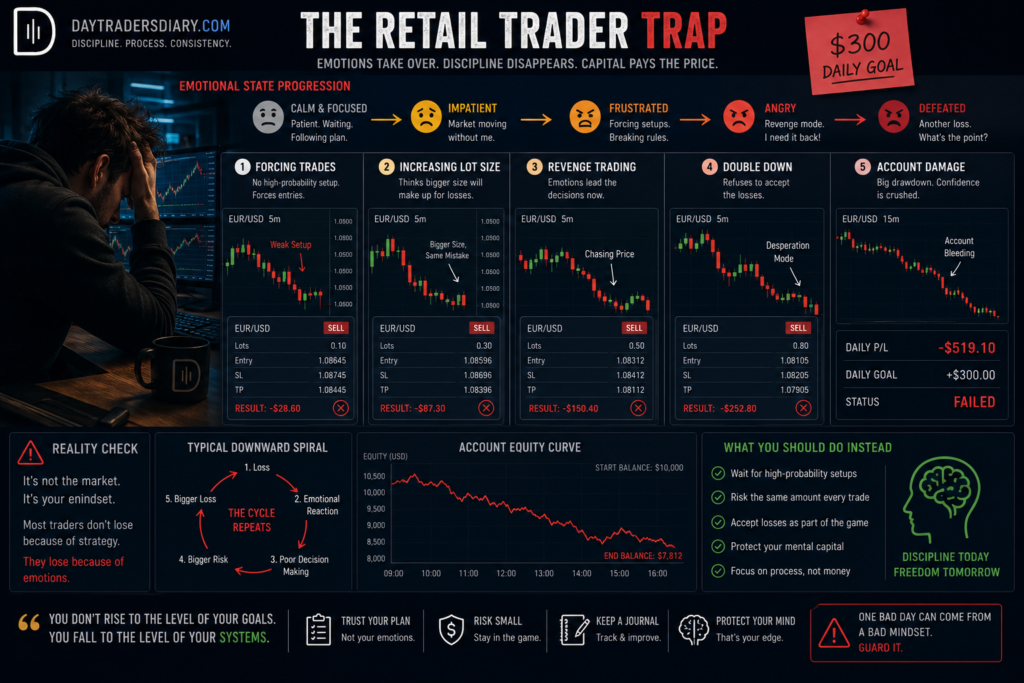
Imagine a trader has two minor losses in the session.
Nothing serious.
Perhaps 1R allin down.
But emotionally the trader still wants to accomplish that daily objective that was set originally.
Now the pressure starts to rise.
The mindset shifts to:
“I’ll wait for the right setups.
To:
“I need to recover.”
That is where problems usually begin.
Trades become impulsive.
Position sizes quietly increase.
Patience disappears.
One of the hardest truths traders eventually learn is this:
The market does not care about your daily target.
And the moment you emotionally need the market to pay you, decision-making usually gets worse.
The Difference Between Amateur and Professional Trading Goals
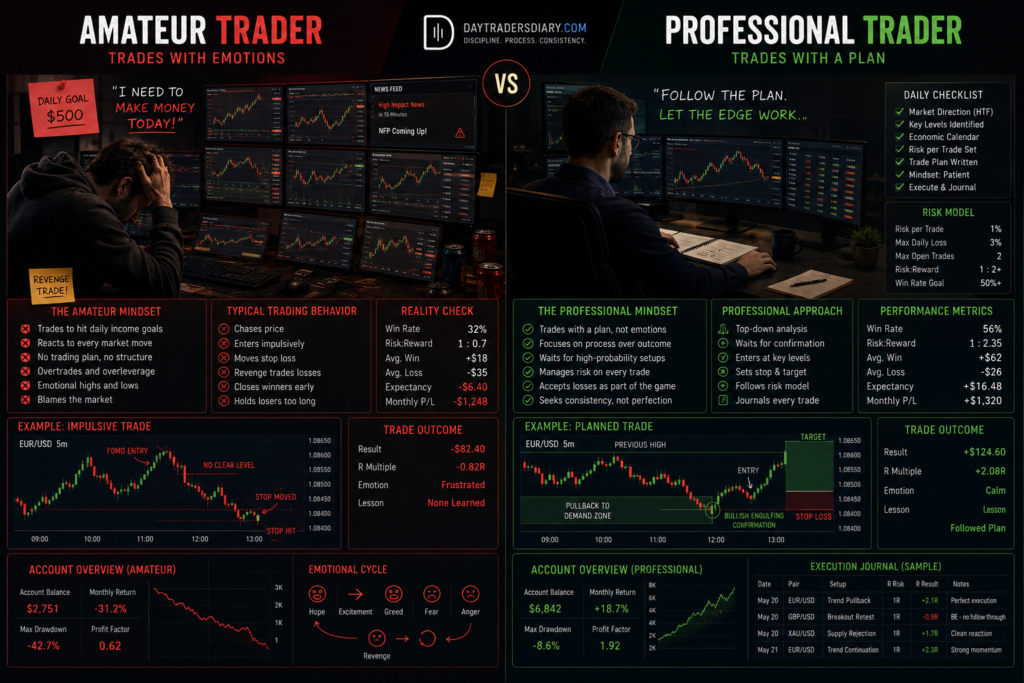
Most struggling traders focus heavily on profit goals.
Experienced traders focus more on execution goals.
That sounds small, but psychologically it is massive.
Instead of saying:
“I need to make 2% today.”
Professional traders believe:
“I got to do my procedure.
“I gotta respect risk.”
“I can’t have my feelings interfering with my trading.”
“I have to be disciplined in the slow conditions.
Ironically traders that focus on execution frequently become more profitable long term than traders worrying over money every session.
Because consistency grows from behavior, not desperation.
How Professional Traders Actually Approach Daily Targets
Professional traders still use goals.
But their goals are usually flexible and process-driven.
For example:
Maximum daily loss limits.
Maximum number of trades.
Specific setup criteria.
Risk exposure limits.
Session discipline rules.
Some traders also use what could be called “soft profit targets.”
Meaning:
If the market provides strong conditions and quality setups, they may stop trading after a strong session instead of continuing unnecessarily.
That approach creates balance.
The trader works with the market instead of emotionally fighting it.
Why Market Conditions Matter More Than Daily Numbers
One thing that rookie traders don’t realize is how much opportunity varies from day to day.
A robust New York session after important economic news is behaviourally quite different than a quiet pre-holiday market.
Yet many traders expect the same results regardless of conditions.
That expectation becomes dangerous.
Research discussed through NASDAQ Market Research consistently shows how liquidity and volatility shift dramatically across sessions and macroeconomic environments.
This is something that the pros do naturally.
They know this:
Aggression is reserved on some days.
Some days need patience.
There are days when simply not trading is best.
That flexibility stops traders from forcing low quality setups just because there is an emotional daily earning target.
A Smarter Framework for Setting Daily Profit Goals
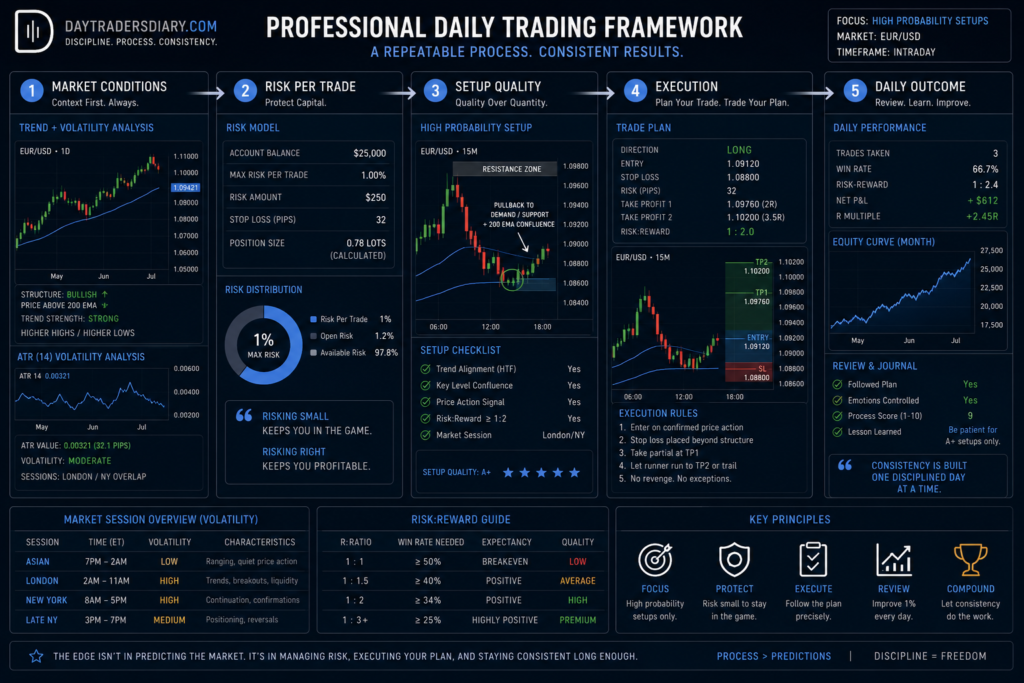
A healthy daily profit framework usually starts with risk, not money.
That is the opposite of how most traders think.
Experienced traders often focus on:
Average risk per trade.
Historical win rate.
Average reward-to-risk ratio.
Market volatility conditions.
For example:
A trader risking 1% with a strategy averaging 2R winners may only need one or two quality setups during strong market conditions.
That mindset reduces pressure dramatically.
Instead of emotionally needing constant action, the trader becomes selective.
And selectivity is often where consistency begins.
Why Fixed Dollar Goals Become Dangerous for Small Accounts
This is where many traders quietly destroy accounts.
A trader with a $1,000 account decides they want to make $200 daily.
The math immediately creates emotional pressure.
To hit unrealistic targets, the trader starts overleveraging.
Risk increases.
Patience disappears.
Eventually the account becomes unstable psychologically.
Experienced traders understand that consistency matters first.
The larger dollar numbers come later through:
Compounding.
Scaling.
External capital access.
Trying to skip that process usually ends badly.
That idea connects directly with many related DayTradersDiary.com articles discussing trading psychology, position sizing, and long-term account growth.
Why Risk Management Matters More Than Profit Goals
Most traders spend more time thinking about how much they can make than how much they can lose.
Professional traders reverse that thinking completely.
They protect downside first.
Because once emotional losses begin stacking, discipline usually disappears shortly afterward.
This is where many traders quietly miscalculate exposure. Using a structured Position Size Calculator helps traders standardize risk across different setups, volatility conditions, and currency pairs instead of emotionally changing size based on profit pressure.
Consistent risk sizing creates emotional stability.
And emotional stability improves trading far more than aggressive profit chasing ever will.
Why Journaling Daily Goals Improves Performance
Most traders never track how their daily goals affect behavior.
That’s not right.
A organized record often exposes trends that traders utterly overlook in real time.
Some traders said they over-traded following initial losses.
Others find out they’re reckless when they hit profit targets rapidly.
Some discover they force trades during slow sessions because they feel emotionally obligated to make money daily.
Without documentation, these patterns stay hidden.
Using a structured Trade Journal Template helps traders review:
Mentality
Quality of execution.
Pressure to make a profit.
Risk taking behavior.
Emotions.
Traders start distinguishing between emotional emotions and actual strategy performance as time goes on.
That self-awareness becomes really valuable.
Why Serious Traders Think Bigger Than One Day
One of the biggest mindset shifts in trading happens when traders stop obsessing over daily results.
A single day means very little.
Professional traders think in:
Weekly performance.
Monthly consistency.
LargeSamples.
That takes a big emotional burden off you.
It also fits well with professional trading situations.
Firms like The5ers, FTMO and TradeThePool judge traders based on consistency, discipline and risk management, not one big trading day.
A trader producing stable, controlled execution usually survives much longer than someone emotionally swinging for huge daily profits.
For disciplined traders looking to scale responsibly, a The5ers evaluation account can become a logical next step because it rewards consistency and process stability rather than reckless short-term performance.
The Real Purpose of a Daily Profit Goal
A daily profit objective should provide you structure.
No emotional blackmail.
This gap is more important than most traders think.
The best traders eventually cease looking at success by daily P&L alone.
Instead they ask,
Did I follow my process?
Did I handle risk correctly?
Did I wait with patience?
Did I avoid emotional trading?
Ironically, those traders that focus on those questions tend to become more profitable over the long run.
This week, look honestly at your own trading.
How many bad trades came from trying to force a number instead of waiting for genuine opportunity?
That answer usually reveals more about long-term trading performance than strategy alone ever will.
For more on trading psychology, position sizing and risk management discipline, browse through more related DayTradersDiary.com articles for your next read. Those issues are directly relevant to the long term consistency.
FAQs
What is a realistic daily profit goal in forex trading?
A Realistic Goal is not driven by emotional income expectations, but rather by account size, risk management, strategy performance and current market conditions.
Why do daily profit goals hurt many traders?
Strict daily goals put emotional pressure on you, leading to over-trading, revenge trading and bad decisions.
Should traders focus on profit or execution quality?
“Most experienced traders will put more emphasis on execution quality, discipline and risk consistency rather than forcing daily income targets,” he says.
Why are fixed dollar goals dangerous for small accounts?
Aggressive profit expectations often encourage overleveraging and emotional trading behavior that damages consistency.
How do professional traders approach daily goals?
Professional traders tend to have process goals such as respecting setups, following risk guidelines and having discipline during changing market circumstances.
Why do funded trader programs value consistency so much?
Programs such as The5ers, FTMO, and others reward traders who are able to manage risk consistently and trade with emotional discipline over lengthy periods of time.