
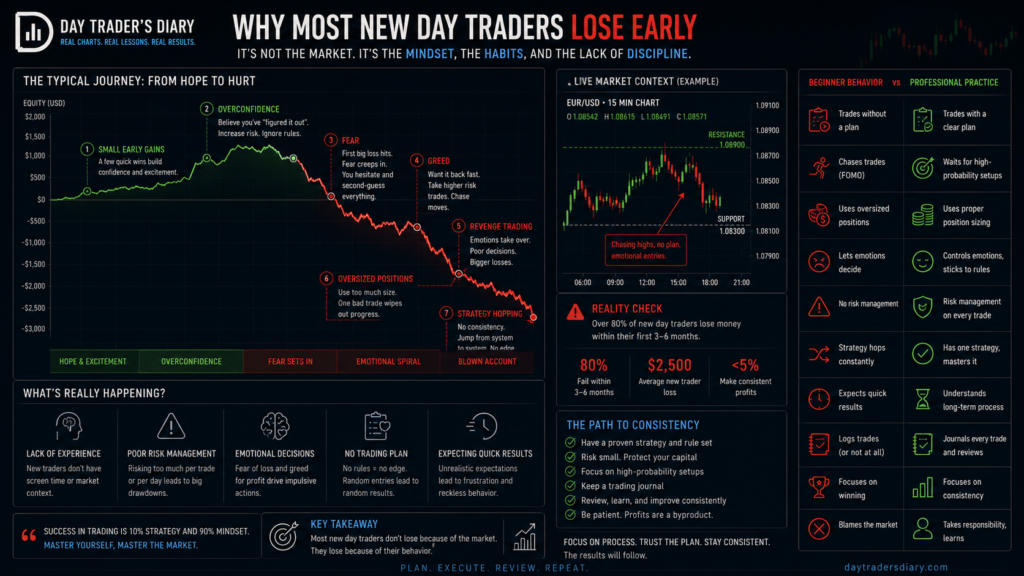
Most traders lose money before they ever develop real skill.
Not because they are incapable of trading.
Because they start risking real money far too early.
A trader watches a few strategy videos, opens a live account, catches one decent trade, and suddenly feels ready for the markets. Then reality shows up fast. A losing streak hits. Emotions change. Risk management disappears. The trader starts forcing setups, revenge trading, or increasing size to recover losses.
Almost every experienced trader has gone through some version of this phase.
The painful part is that many of those early losses could have been avoided completely.
Good traders are not built by throwing money into the market blindly. They are built through repetition, observation, emotional control, and structured practice long before serious capital is involved.
That is where risk-free trading practice becomes valuable.
Not as a shortcut to success.
As preparation for pressure.
After years of watching traders develop, one thing becomes obvious:
The traders who survive long term usually learn how to practice correctly before they learn how to scale aggressively.
In this article you will learn how professional traders execute day trading without putting themselves at excessive financial risk, how to avoid creating false confidence in demo trading, and how to set up routines that truly prepare you for real market situations rather than just generate random demo profits.
Because practicing trading properly is not about pretending to trade.
It is about building habits that still work when emotions become real later.
Why Most Traders Learn the Wrong Lessons Early
Most new traders focus almost entirely on finding a strategy.
They search for the perfect indicator, the perfect entry model, or the perfect setup. But after watching thousands of traders over the years, one thing becomes very clear:
Most traders do not fail because they lack strategy knowledge.
They fail because they never learned execution discipline.
Research published by the CFA Institute on behavioral finance shows that financial pressure changes decision-making dramatically. Traders become more emotional after losses, more aggressive after wins, and less objective once money becomes emotionally important.
Another study from MIT Sloan School of Management found that stress and uncertainty heavily impact short-term decision-making quality, especially in fast-moving environments like day trading.
Even execution itself changes once real money is involved.
NASDAQ Market Research Offers You a Glimpse into Live Trading Conditions and How They Differ from Many Demo Environments with Slippage, Spread Expansion and Liquidity Shifts.
Simply said, many traders grasp setups intellectually before they can execute them emotionally.
That gap destroys a lot of accounts.
Why Demo Trading Alone Usually Fails
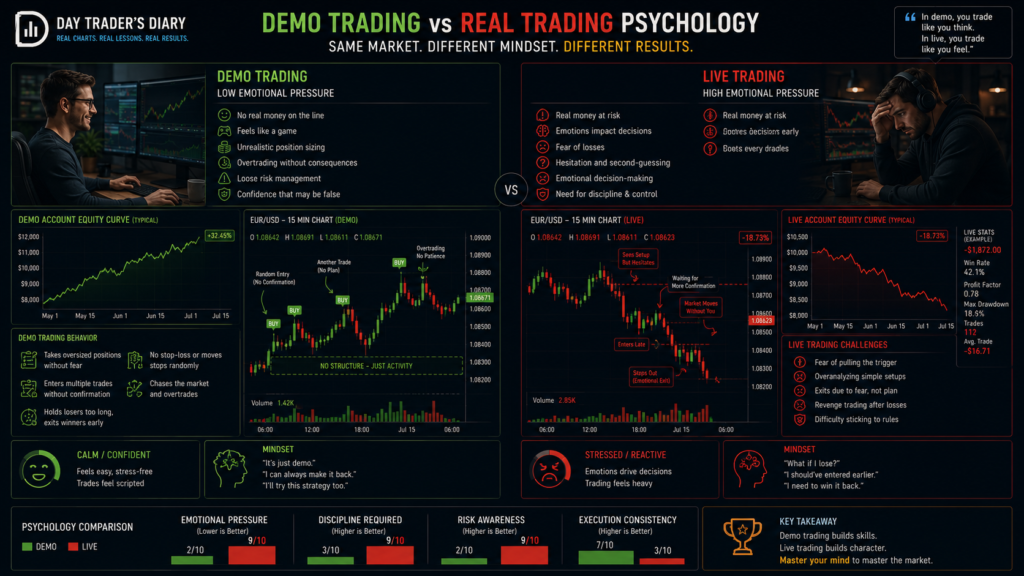
A demo account by itself does not make someone disciplined.
In fact, demo trading often creates bad habits if it is approached carelessly.
Losses feel unreal, that’s why a trader takes big position sizes. They overtrade because they may make mistakes with little consequence. They will maintain losing positions forever since emotionally they have nothing to lose.
Then they go into live trading and things alter virtually immediately.
The same situations are suddenly stressful.
Losses are personal.
Hesitation shows.
Fear affects the execution.
Professionals trade in a different way on a demo account.
They aim to make practice seem real:
Realistic scale of account.
Realistic risk attenuation.
Realistic trading frequency
Real-world market sessions.
That realism is important since traders are not just practicing entry.
They are practicing behavior.
If a trader plans to eventually trade a $1,000 or $2,000 live account, their demo environment should reflect that reality from the beginning.
Otherwise the transition into live trading becomes emotionally chaotic.
What Smart Trading Practice Actually Looks Like
Most effective trading practice is surprisingly boring.
That may sound disappointing, but consistency is usually built through repetition, not excitement.
Experienced traders tend to focus extensively during development.
Instead of exchanging everything they focus on:
1-2 marketplaces,
Particular trading sessions.
A few set-ups.
Rules of structured realisation.
That repetition creates familiarity.
For example, a trader who studies EUR/USD every London session for several months will usually develop much stronger market awareness than someone randomly switching between forex pairs all day.
Through time traders automatically develop pattern recognition:
How momentum acts when session opens.
Creation of liquidity sweeps
Why Breakouts Fail.
How trends fade out.
That knowledge comes from observation, not from jumping from strategy to strategy.
This is why many related DayTradersDiary.com articles on breakout trading, liquidity sweeps, and trading psychology connect directly with proper practice routines.
Why Most Traders Practice the Wrong Things
One of the biggest mistakes traders make is thinking improvement comes from taking more trades.
Usually the opposite is true.
New traders often spend entire sessions clicking constantly because movement feels exciting. Every breakout looks tradable. Every candle feels important.
Experienced traders understand that a huge part of professional trading is waiting.
Waiting for timing.
Waiting for confirmation.
Waiting for liquidity.
Waiting for conditions that actually match the strategy.
One of the best ways to practice day trading without risk is by learning selective execution.
Instead of asking:
“How many trades can I take today?”
Ask:
“Would I still take this trade if real money were involved?”
That single question improves discipline faster than most traders expect.
Why Replay Trading Helps More Than People Realize
One of the most underrated ways to improve as a trader is replay training.
Most traders ignore it completely.
Replay tools allow traders to slow the market down and study behavior without emotional pressure. That creates a much deeper understanding of:
Breakout failures.
Trend continuation.
Liquidity grabs.
Momentum exhaustion.
Poor entries caused by impatience.
Experienced traders often replay previous sessions to review how markets behaved around major news events, session opens, or high-volatility conditions.
The goal is not memorizing candles.
It is understanding behavior.
That distinction matters because traders who understand behavior adapt far better when conditions change.
Why Risk Management Should Be Practiced Early
Many traders ignore risk management while practicing because “the money is not real yet.”
That mindset creates dangerous habits.
Risk management is not just about protecting capital.
It protects emotional stability too.
A trader who constantly risks unrealistic amounts during practice usually struggles emotionally once live trading begins. Oversized exposure creates fear, hesitation, and emotional decision-making very quickly.
Good traders develop good habits early.
This is where a lot of traders get exposure wrong. A structured position size calculator takes the emotional guessing out of it, allowing the trader to consistently risk the same amount on varied setups and volatility environments.
That consistency becomes incredibly valuable later.
Because once emotions control position sizing, execution quality usually falls apart soon after.
Why Journaling Becomes the Real Edge
Most traders underestimate how important journaling actually is.
Emotional memory becomes faulty after stressful sessions and traders make the same mistakes again and again without organized review.
A good trading journal will record:
The reason behind the trade.
How the trader felt emotionally.
What the merchant sensed in his feelings.
Whether rules were adhered to.
How the danger was managed.
What mistakes keep coming back.
Eventually you can see the patterns.
Some traders know they push trades after losing.
Others notice they become impulsive after missing earlier opportunities.
These patterns are difficult to recognize without documentation.
Using a structured Trade Journal Template helps traders analyze performance objectively instead of emotionally reacting to short-term outcomes.
The traders who improve fastest are usually the ones willing to review themselves honestly.
Why Real Growth Eventually Requires Emotional Exposure
Risk-free practice is valuable.
But eventually traders need exposure to real emotions too.
Demo trading can’t fully replicate:
Fear.
Greedy.
Pressure.
Hesitations.
Money connection emotion.
At some point traders have to feel it in their own.
The smartest way is to do it gradually.
Very little trade.
Use tiny lots.
Don’t focus on earnings, focus on execution.
The idea is not to make big money right now.
The idea is to understand how emotional pressure affects conduct when the stakes are genuine.
Why Serious Traders Eventually Explore Evaluation Accounts
Many disciplined traders find themselves checking out assessment programs. They offer organized trading without the need to risk a lot of their own capital upfront.
Firms like The5ers, FTMO, and TradeThePool allow traders to access larger capital while operating under strict risk-management rules and consistency requirements.
The most crucial is attitude.
The professional trader doesn’t take a funded account personally.
They leverage them as scale opportunities for focused execution that already exists.
A trader who developed good habits through controlled practice is generally far more adaptable to financed situations than someone who jumped headlong into aggressive live trading.
For disciplined traders with stable execution, a The5ers evaluation account can become a realistic next step toward long-term growth.
The Real Purpose of Practicing Without Risk
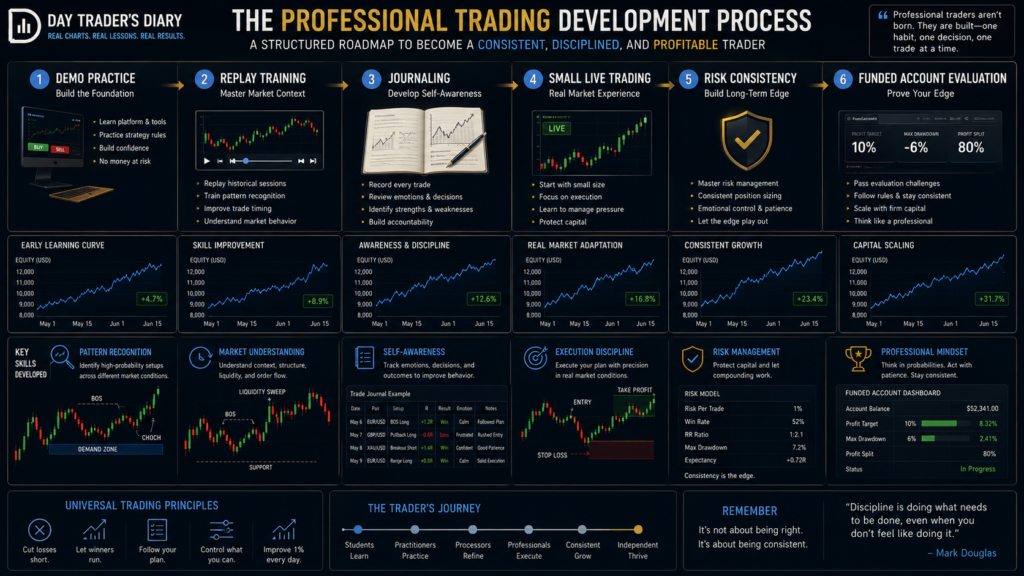
The goal of practicing without risk is not avoiding losses forever.
It is learning how to execute properly before emotional pressure becomes intense.
That changes how serious traders approach development completely.
Instead of chasing fast profits, they focus on:
Consistency.
Patience.
Risk control.
Execution quality.
Emotional discipline.
Those skills compound much more than most traders realize.
This week, focus on improving one part of your process instead of trying to fix everything at once.
Maybe trade less often.
Perhaps look at your journal more objectively.
Maybe stop changing strategies all the time.
Perhaps work on waiting for better setups.
Small improvements done regularly often build considerably bigger progress than huge short-term changes.
Related DayTradersDiary.com articles on trading psychology, risk management, and demo trading discipline – check them out for your next read. These issues are directly related to long-term trading consistency.
FAQs
Can you learn day trading without risking real money?
Yes. Demo accounts, replay tools and organized simulation practice give traders the means to build their technical competence and execution habits without any financial exposure.
Is demo trading enough to become profitable?
Demo trading helps build technical consistency, but traders eventually need exposure to real emotional pressure through small live trading experience.
What is the best way to practice day trading forex?
Most experienced traders advise focusing on one or two markets, reasonable risk management, organized sessions and consistent set-ups.
Why do traders fail after successful demo trading?
Because emotional pressure changes behavior. Fear, greed, hesitation, and risk perception all become much stronger once real money is involved.
Should beginner traders use replay trading?
Sure. Replaying training lets traders learn about market behavior, enhance pattern recognition, and practice execution without the strain of emotions.
How do funded trader programs help traders grow?
Disciplined traders can use programs like The5ers and FTMO to scale up capital, all while trading within the bounds of a professional risk management structure.