
The truth is that most scalpers don’t blow accounts because their method suddenly stops working.
They blow accounts due to little execution mistakes that add up over time until discipline is gone.
That’s usually a slow process.
A trader begins the week focused. Entries are clean and . . . Risk remains controlled. Losses are typically accepted. And then one trade strays from the plan. A missed move becomes a revenge entry. One rash scalp gives birth to three others. One passionate trading session and a whole week of disciplined trading is wiped out before the trader knows it.
The dangerous part is that these mistakes rarely feel reckless while they are happening.
They feel justified.
That is why scalping is one of the hardest forms of trading to master consistently. The lower timeframe does not just test your strategy. It tests your patience, emotional control, reaction speed, and ability to stay objective under pressure.
After years of watching intraday traders, funded account evaluations, and execution journals, one thing becomes obvious:
Most scalping losses come from trader behavior, not technical analysis.
This guide breaks down the most common scalping mistakes forex and day traders make, why they happen, and how experienced traders build routines to avoid repeating them.
If you already know basic price action and market structure, this is the layer that matters next.
Why Scalping Magnifies Every Weakness
Scalping leaves very little room for emotional mistakes.
A swing trader can survive hesitation. A scalper often cannot.
Research from the CFA Institute on behavioral finance shows that fast decision-making environments increase emotional bias and reduce rational thinking under stress. That becomes extremely relevant in scalping because traders are forced to make repeated decisions within minutes.
Another study by the MIT Sloan School of Management indicated that traders tend to overreact to the most recent results under pressure. This is why in real trading you see a lot of scalpers abruptly increase risk after a lost trade or give up on perfectly good setups after 2 tiny losses .
Market data supplied by NASDAQ Market Activity Research demonstrates that intraday volatility grows considerably during session openers and major economic announcements. New traders typically regard this volatility as simple opportunity but it really elevates execution risk.
That distinction matters.
Scalping is not simply about entering fast trades.
It is about maintaining decision quality while the market moves quickly around you.
That is a completely different skill.
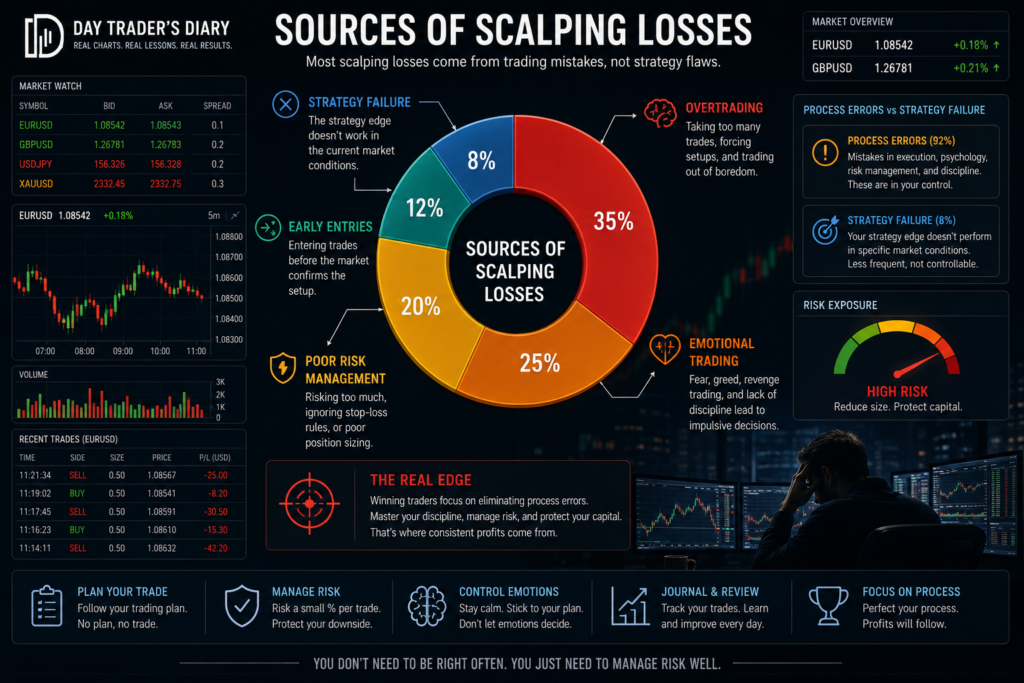
The First Major Mistake: Trading Every Small Movement
One of the biggest traps in scalping is becoming addicted to activity.
After a few successful trades, many traders start believing every candle matters.
A trader catches two quick EUR/USD momentum moves during London open and suddenly feels the need to participate in every breakout, every pullback, and every minor fluctuation on the chart.
The lower timeframe creates the illusion that opportunity is everywhere.
Experienced scalpers know most intraday movement is meaningless noise.
The traders who survive long term usually separate setups into three categories: high-quality liquidity setups, reactive trades, and emotional trades.
Only the first category deserves serious attention.
High-quality setups usually appear around session opens, liquidity sweeps, high-volume reversals, or structured breakout retests. There is context behind the move. There is participation behind the move. The trade has a logical reason to exist.
Reactive trades are different.
This is when a trader sees momentum after the move already started and jumps in out of fear of missing continuation. Most of the time, the market immediately slows down because the real move already happened before the retail entry arrives.
Then you get the emotional ones.
Those are the risky ones because traders always tend to convince themselves they are still trading logically. Position size rises slowly. There is no patience. Losses widen emotionally. Rules are loosened.
That is usually the beginning of a bad trading day.
Ironically, one of the fastest ways to improve as a scalper is trading less.
Not more.
Many struggling scalpers would improve dramatically simply by reducing their total number of trades and becoming more selective with execution.
If overtrading has become a recurring problem, related DayTradersDiary.com articles on revenge trading psychology and discipline can help connect those patterns together.
The Hidden Scalping Problem Nobody Talks About: Decision Fatigue
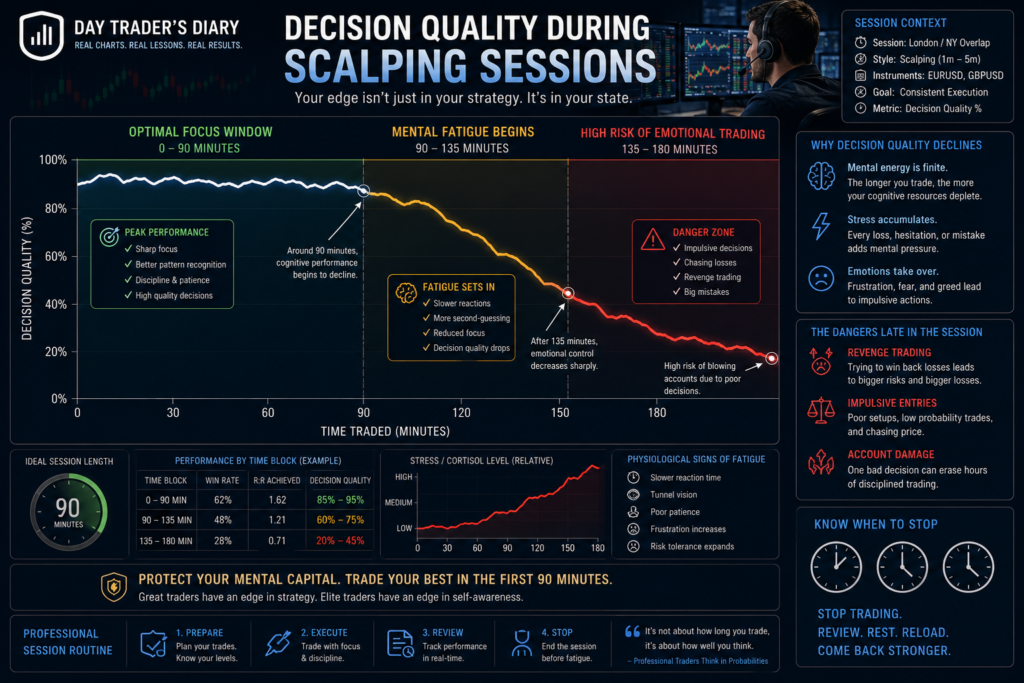
Most traders underestimate how mentally exhausting scalping really is.
After one or two hours of intense execution, concentration starts slipping even if the trader does not notice it immediately.
This is where many unnecessary losses begin.
Professional prop traders understand this very well. Retail traders often stay glued to the charts all day believing more screen time automatically creates more opportunity.
Usually the opposite happens.
The majority of profitable scalping opportunities tend to appear during very specific periods such as the London open, New York open, session overlaps, or major news releases.
Outside those windows, spreads widen, momentum slows, and traders start forcing setups simply because they are still sitting in front of the screen.
That is why experienced scalpers often build strict trading windows into their routine.
Some only trade the first ninety minutes of a session. Others cap the number of trades they can take before walking away for the day. Some automatically stop trading after consecutive losses because they understand emotional quality deteriorates quickly after frustration builds.
These restrictions are not weaknesses.
They protect execution quality.
The goal is not to trade constantly.
The goal is to stay sharp when opportunity actually appears.
Why Most Scalpers Lose Money After Winning Streaks
Most traders expect losing streaks to hurt performance.
Few realize winning streaks can be just as dangerous.
After several successful trades, confidence starts changing behavior quietly.
A trader begins entering slightly earlier. Risk starts increasing a little. Trade quality becomes less important because recent wins create the illusion that market reading ability has improved.
This is something that happens all the time in the funded account challenges.
A trader makes gains over two weeks and then blows a big chunk of them in one aggressive session in an attempt to accelerate growth needlessly.
The market punishes emotional overconfidence just as aggressively as fear.
Experienced traders understand that every trade is independent.
A good setup does not deserve larger size simply because the previous trade won.
That mindset alone protects traders from countless emotional mistakes.
Many of the best traders become almost boring with their execution during winning streaks because they know consistency matters more than excitement.
This is also why DayTradersDiary.com articles on drawdown management and funded account survival are worth studying together with scalping psychology.
The problems are deeply connected.
The Entry Mistake That Destroys Scalpers
Most losing scalpers are not entering too late.
They are entering too early.
That usually comes from trying to predict the move before confirmation actually appears.
For example, a trader sees price compressing under resistance and assumes a breakout is coming. Instead of waiting for confirmation through volume, liquidity sweeps, or acceptance above the level, they enter before the market proves intention.
Then the fakeout happens.
Price sweeps liquidity, reverses sharply, and stops them out before moving in the original direction later.
Almost every experienced scalper has lived through this cycle repeatedly.
The difference is that experienced traders eventually stop trying to predict every breakout before confirmation appears.
They become more reactive and less emotionally anticipatory.
That patience feels uncomfortable at first because social media trading culture rewards early entries and aggressive predictions.
Real consistency usually comes from waiting.
Professional traders spend less energy trying to be first and more energy trying to be correct.
That mindset changes execution completely.
Spread, Slippage, and Execution Costs Are Killing More Traders Than Strategy
To get so many scalpers spend months adjusting indicators while neglecting execution expenses.
That error quietly kills profitability.
Profit targets are generally relatively tiny therefore scalping depends greatly on efficiency. But the approach itself might become mathematically worse if spreads widen unexpectedly or slippage increases during volatility, even if the setup quality is the same.
A trader targeting five pips consistently cannot ignore losing two pips to execution friction.
This is why experienced scalpers become extremely selective about when they trade.
They avoid unstable market conditions, random low-volume hours, and environments where spreads become unpredictable.
Execution quality matters far more than many traders realize.
In many cases, traders improve simply by tightening execution conditions rather than changing strategy again.
Risk Management Mistakes That Quietly End Scalping Careers
The main killer of scalping accounts is uneven risk.
Not a tactic.
Not signs.
Not fake-outs.
Emotional exposure is unpredictable.
One big revenge trade can undo months of focused execution.
This is often after the emotional frustration has built up. A trader misses a move, loses in a row or feels the pressure to make it up. Suddenly, position sizing is an emotional decision, not a methodical one.
Traders who make a living trading think about risk differently.
They think in terms of probabilities and risk first, then profits.
It is a big time behavioural changer.
Fixed percentage risk, daily loss limits, session shutdown restrictions and standardised position sizing all help with emotional stability since decision making becomes less reactive.
This is where many traders misjudge exposure without even knowing it. A structured position size calculator takes the emotional guesswork out of the equation and ensures you stay consistent no matter the volatility or setup type.
The psychological relief that comes from standardized risk is massive.
Most traders do not appreciate that until they experience it personally.
The Psychology of “Making It Back”
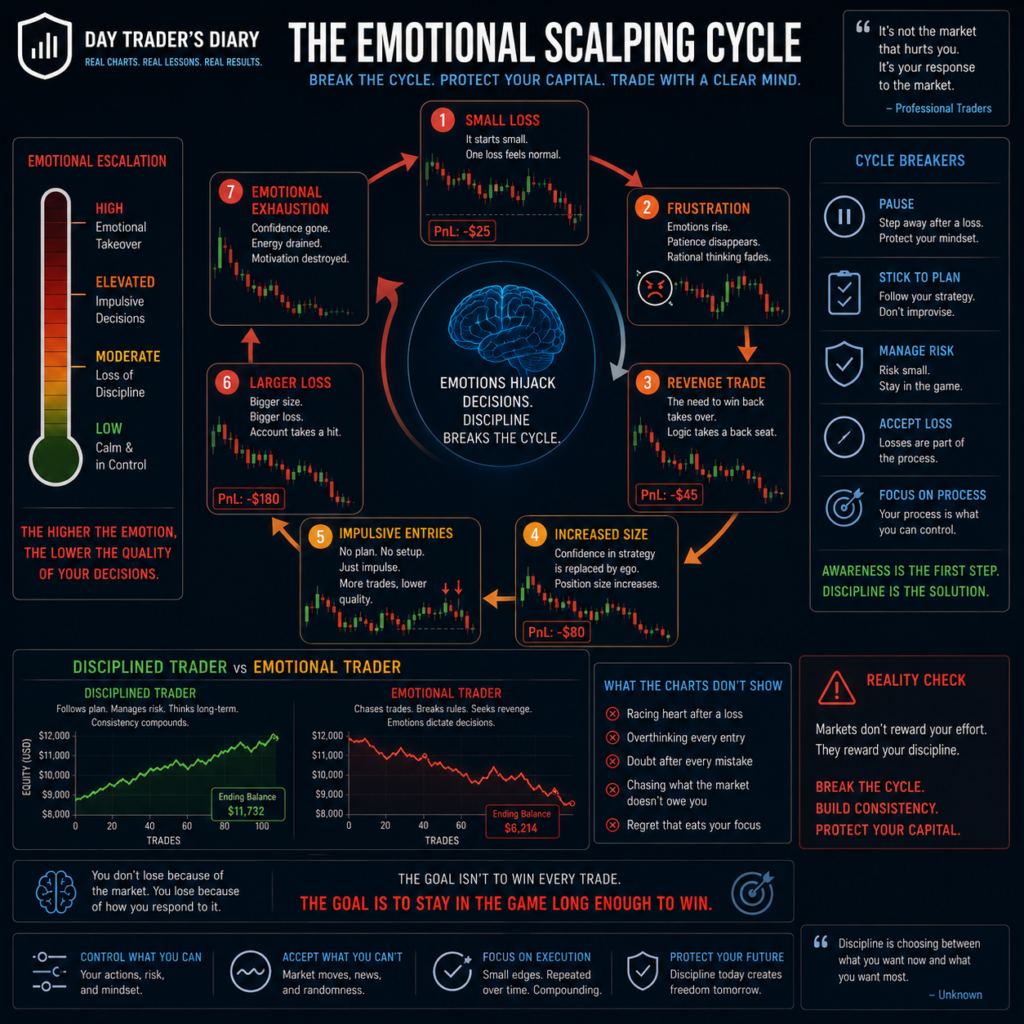
Few trading habits destroy accounts faster than trying to recover losses immediately.
Once a trader becomes emotionally focused on recovering PnL, objectivity disappears.
The market stops being information.
It becomes personal.
You can usually recognize this shift quickly. Entries become rushed. Patience disappears. Position size increases. Every chart suddenly looks tradable.
This emotional state feels urgent, which is exactly why it becomes dangerous.
Experienced traders interrupt this cycle intentionally.
Some stop trading immediately after hitting a daily drawdown limit. Others reduce size automatically after emotional disruption appears. Some step away completely for the rest of the session.
The important part is recognizing that emotional urgency does not improve market reading ability.
Usually it destroys it.
Markets do not reward desperation.
Why Journaling Separates Serious Scalpers From Emotional Traders
Most trading journals are incomplete because traders just jot down the results.
That overlooks the true issue.
The objective of journaling is not just to measure profit and loss.
That’s tracking behaviour.
Serious scalpers will consider emotional state, time of session, quality of execution, rules broken, market conditions and transaction background. Patterns start to emerge over time.
You may discover most bad trades happen during slow market hours. Or immediately after a large winner. Or after missing a setup earlier in the session.
Without journaling, these behavioral leaks often remain invisible for months.
Using a structured Trade Journal Template helps traders review performance objectively instead of emotionally.
The traders who improve fastest are rarely the most talented.
They are usually the most honest with themselves.
Scalping and Capital Growth: The Problem Most Traders Ignore
Even skilled scalpers eventually run into a capital limitation problem.
A trader consistently generating returns on a small account still faces emotional pressure, scaling limitations, and restricted opportunity.
That’s a reason why so many professional traders eventually look into funded account reviews.
Not because they’re looking for shortcuts.
Capital efficiency is important.
Disciplined traders can trade with higher capital allocations under specific risk parameters from companies such as The5ers, FTMO and TradeThePool.
The important distinction is mindset.
Professional traders do not see evaluations as gambling tickets.
They see them as business scaling opportunities.
If a trader cannot maintain consistency under evaluation rules, managing larger personal capital becomes difficult anyway.
A The5ers evaluation account can be a useful vehicle for long-term growth for disciplined scalpers with a proven process, without needing to take additional personal leverage.
The Real Goal of Scalping
The real goal of scalping is not nonstop action.
It is not adrenaline.
It is not trying to predict every market move.
The real goal is maintaining consistent execution under pressure.
That is what separates emotionally reactive traders from professionals.
Most scalp errors are not technical errors.
behavioural leakage such as impatience, escalation of risk emotionally, overtrading, revenge trading, and inconsistent discipline.
Usually fixing those problems will enhance performance faster than changing approach again.
This week, make one thing better, and one thing only.
Maybe it’s cutting down on unneeded exchanges.
Maybe it’s looking for further confirmation, more consistent proof.
Maybe improved risk management after losses.
The advantages in execution are tiny, but the compounding happens far faster than most traders anticipate.
For your next reading, check out related DayTradersDiary.com information on trading psychology, revenge trading control, and funded trader risk management. These topics are directly related to long term consistency in scalping.
FAQs
What is the biggest mistake beginner scalpers make?
The most typical mistake is taking too many bad trades. Many newbies are in a hurry to be in the market all the time instead of waiting for the good possibilities with solid confirmation.
Why do most scalpers fail?
Most scalpers fail because of emotional decision-making, inconsistent risk management, and poor execution discipline rather than strategy issues alone.
How many trades should a scalper take per day?
There is no perfect number, but experienced scalpers usually focus on quality over quantity. Many profitable traders only take a handful of strong setups during high-liquidity sessions.
Is scalping more psychological than technical?
At advanced levels, yes. Most experienced scalpers understand technical analysis already. The real challenge becomes emotional control and execution consistency under pressure.
Should scalpers use tight stop losses?
Tight stops work, if they are linked with market structure and volatility. Just randomly placing extremely tight stops results in getting stopped out repeatedly, without increasing the overall risk management.
How do funded trader programs help scalpers?
Evaluation firms like The5ers and FTMO allow disciplined traders to access larger trading capital while operating within professional risk parameters.