
Most traders don’t fail because they lack knowledge. They fail because they don’t follow what they already know.
You’ve probably experienced it. You see a setup that almost fits your rules, you take it anyway, and within minutes you’re managing a trade you shouldn’t be in. Later, when you review it, the mistake is obvious.
The problem isn’t strategy. It’s not a decision filter in real time.
That’s where a day trading checklist comes in handy.
Not a generic list you look at once. A disciplined process that requires clarity before every trade. The difference between impetuous trading and consistent execution is typically one thing and one thing only. A checklist you’ll actually use.
This guide is not about building a perfect list. It’s about building a checklist that reflects how real markets behave and how traders actually make decisions under pressure.
What the Research Says About Checklists in Decision-Making
Checklists are not a trading invention. They are employed in aviation, health and military activities where errors are costly.
The idea received worldwide prominence through research in World Health Organization surgical checklist trials showing dramatic reductions in key errors when organised checklists were utilised. Harvard Business Review has also written extensively on how professionals use checklist systems to combat decision fatigue.
The same thing applies for trading.
The markets are quick. The cognitive strain increases. Emotions are poor judges.
A checklist cuts through the noise.
It doesn’t make you any smarter. It makes you reliable.
And that is where consistency makes money.
Why Most Trading Checklists Don’t Work
The issue is not having a checklist. It’s having the wrong one.
Most traders create lists that are too vague or too long.
“Is the trend strong?”
“Is this a good setup?”
But those questions don’t assist when the price is moving fast. They suggest interpretation, rather than require decisions.
The second issue is timing.
Traders look at their list after they get in the trade, not before. Then the checklist becomes excuse, not discipline.
A real checklist should slow you down before you commit risk.
The Day Trading Checklist Framework That Actually Works
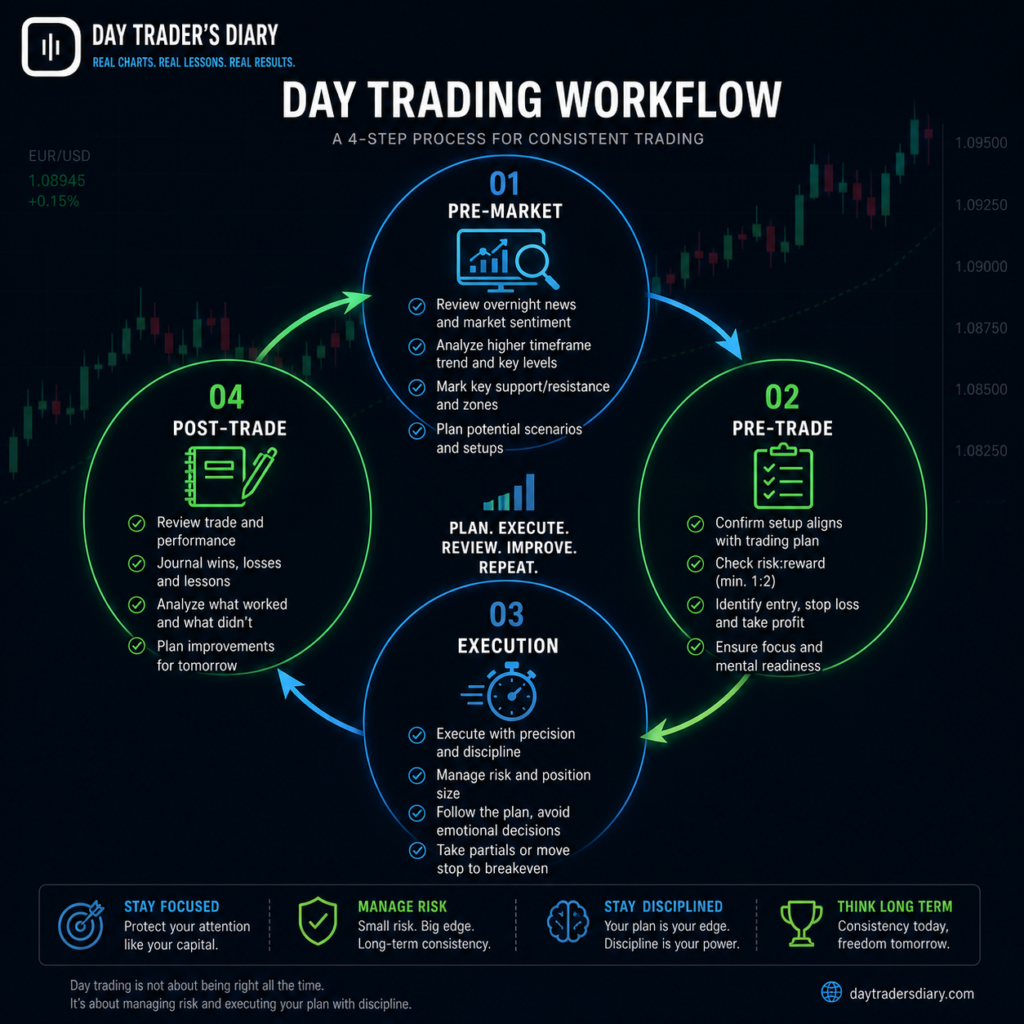
Instead of one long list, think in phases.
Pre-market, pre-trade, and post-trade.
Each phase serves a different purpose.
Pre-Market Checklist
That’s where you provide context.
Before the class starts, you need to understand what kind of day you are walking into.
What is the trend on the higher timeframe?
What are the major support and resistance levels?
Are there major economic events scheduled?
Is volatility expanding or compressing?
If you have read our guide on How to Use Multiple Time Frame Analysis, this is where that process begins. You define bias before looking for trades.
Without this step, you are reacting to price instead of preparing for it.
Pre-Trade Checklist
This is the most important part.
Before entering any trade, you should be able to answer a few specific questions clearly.
Is this trade in the direction of the higher timeframe?
Is the setup part of my tested method?
Is the entrance point justified or am I chasing?
Where is my stop-loss? Is it safe ( structurally ) ?
What is the practical aim in the present circumstances?
If you hesitate on any of these, that hesitation is information.
One of the biggest improvements I see in traders is when they stop forcing answers. If the checklist is unclear, the trade is usually not worth taking.
This is also where understanding Best Risk/Reward Ratios for Day Trading becomes practical. Not theoretical ratios, but realistic expectations based on the current market structure.
Execution Checklist
And as you walk through, the checklist changes from decision to discipline.
Am I sticking to my stop-loss?
Am I moving stops on logic or on feeling?
Does the trade work or not?
This is where many traders break their own rules.
They had a perfect pre-trade checklist, but once in the trade, they start interfering.
A checklist here keeps behavior consistent.
Post-Trade Checklist
Most traders skip this, which is why they repeat mistakes.
Most traders miss this out, which is why they keep making the same mistakes over and over again.
Once you have exited a trade, ask:
Did I complete my checklist, or did I skip any steps?
“Did the trade happen voluntarily or was it forced?
Was the outcome skill or luck?
Real-World Example of Checklist Use
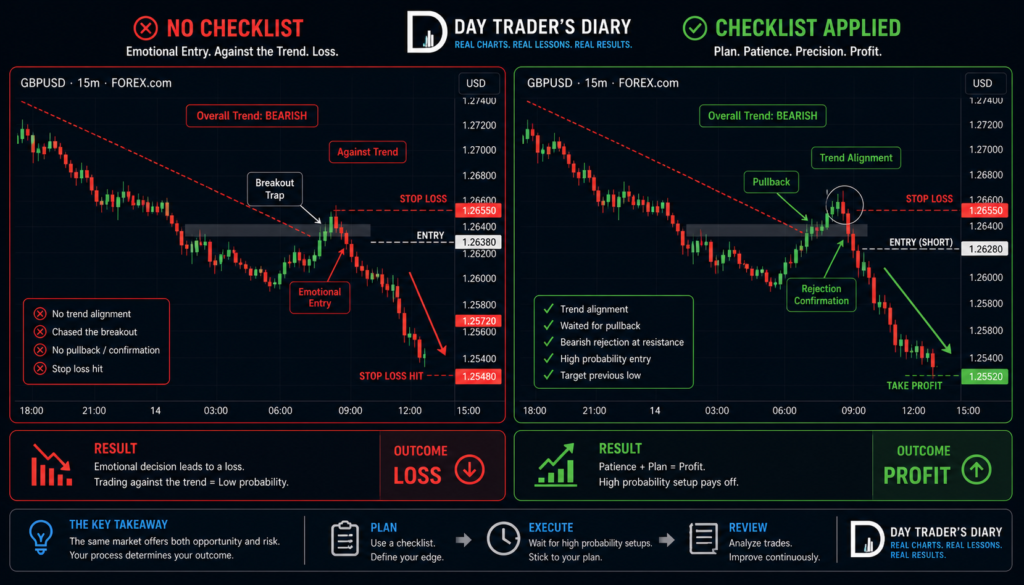
Let’s say GBPUSD is trending down on the 1-hour chart.
You see a small bullish breakout on the 5-minute chart.
Without a checklist, you might take the trade.
With a checklist, you pause.
Higher timeframe direction is bearish.
Your strategy requires alignment.
The breakout is counter-trend.
The checklist blocks the trade.
Now compare that to a pullback into resistance followed by a bearish rejection.
Same market, different decision.
The checklist didn’t give you a signal. It filtered out a bad one.
Internal Process Matters More Than Tools
A checklist is only effective if it matches your actual trading behavior.
If you trade price action, your checklist should reflect structure, not indicators.
If you trade momentum, your checklist should reflect volatility and continuation patterns.
For example, if you are using setups from How to Trade Pin Bars in Forex or Best Forex Chart Patterns for Day Traders, your checklist should include confirmation rules specific to those patterns.
Generic lists create generic results.
Risk and Execution Still Decide Outcomes
A checklist will help you pick trades, but risk control is what keeps you alive.
This is where most traders go wrong with their risk. A Position Size Calculator removes the hassle of making sure your lot size is right for your stop distance and account size.
A good checklist keeps you out of bad trades.
Proper position sizing keeps bad trades from damaging your account.
You need both.
How to Turn a Checklist Into a Performance Tool
A checklist becomes powerful when you track it.
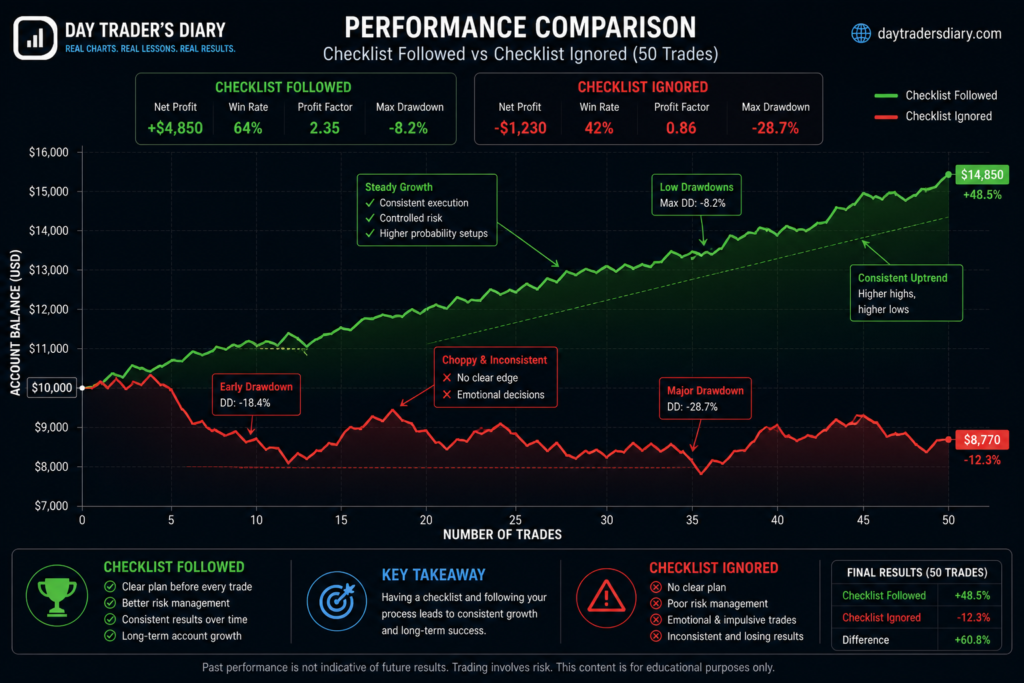
Inside your Trade Journal Template, log whether each trade followed your checklist completely.
Do not just track profit and loss.
Track compliance.
After 30 to 50 trades, you will see patterns clearly.
Your best trades will almost always come from full checklist alignment.
Your worst trades will often come from skipping one or two steps.
This is where real improvement happens.
Not by adding new indicators, but by tightening execution.
Scaling Discipline Into Capital Growth
When your checklist becomes automatic, something interesting happens.
Your results are consistent.
You don’t chase every single move. You’re sitting on your setups. Drawdowns are becoming more managed.
At that stage, many traders face a different limitation. Capital.
You may be consistent, but account size limits your returns.
This is where evaluation programs come into the picture.
Firms like The5ers, FTMO, and similar prop firms provide structured opportunities to trade larger capital once you prove discipline and risk control.
The key point is this.
A checklist-driven trader is exactly the type of trader these firms are designed for.
If your process is consistent and your journaling confirms it, exploring a The5ers evaluation account can be a logical next step to scale your edge.
If your process is inconsistent, more capital will only amplify mistakes.
The Insight Most Traders Miss
A checklist is not there to tell you what to do.
It is there to stop you from doing what you should not do.
Most losing trades are not due to lack of knowledge. They come from breaking your own rules under pressure.
A checklist externalizes those rules so you cannot ignore them easily.
Final Takeaway
If your trading feels inconsistent, do not change your strategy yet.
First, build a checklist that reflects your actual decision process.
Then use it on every trade for the next 20 sessions without exception.
Not 90 percent of the time. Every single trade.
That discipline alone can clean up a large portion of your mistakes.
Next read: Best Day Trading Mistakes Checklist or How to Use Multiple Time Frame Analysis.
FAQs
What is a day trading checklist?
It is a system of rules and questions that traders follow before, during and after trading to increase consistency and eliminate errors.
How detailed should a trading checklist be?
It should be specific enough to guide judgements yet simple enough to be used in real time without hesitation.
Do professional traders use checklists?
Yes. A lot of expert traders have organised systems to minimise emotional decisions, and stay disciplined.
Can a checklist improve trading performance?
Yes, particularly by curbing impulsive trading and enhancing consistency in execution.
Should I customize my checklist?
You got it. The checklist should be a reflection of your strategy, attitude and approach to the market – not someone else’s system.