
Many traders think price moves because candles decide to rise or fall. That is the retail view.
In reality, price often moves because orders need to be filled.
That shift in perspective changes everything. Once you understand that markets are constantly searching for liquidity, random moves start looking more logical. Sudden spikes above highs, fast reversals below lows, and stop hunts around session opens begin to make sense.
Most traders lose money not because they cannot read indicators, but because they do not understand where large pools of orders sit. They buy straight into sell-side liquidity, they short straight into buy side liquidity or they panic when price briefly washes their stop ahead of moving in the original path.
A liquidity zone is a zone where big clusters of pending orders, stops, entries, and exits are anticipated to be placed. If you learn to identify those zones, you stop responding to candles and start reading intent.
This tutorial de-mystifies forex liquidity zones from a trader’s perspective, offering practical guidelines for day traders who want cleaner entrances, wiser exits and better trade selection.
What a Liquidity Zone Actually Means
Liquidity is the ability to transact size without causing major price distortion. In forex, where institutions, banks, funds, and retail traders all participate, liquidity matters because larger participants need counterparties.
If a fund wants to buy significant EURUSD size, it needs sellers. If a desk wants to sell GBPUSD, it needs buyers.
That is why price often moves toward areas where orders are likely resting.
A liquidity zone is not a magic rectangle on the chart. It is an area where many traders are likely positioned or forced to act.
Examples include:
Previous swing highs where breakout buyers and short stops sit
Previous swing lows where breakdown sellers and long stops sit
Round numbers like 1.1000 on EURUSD
Session highs and lows
Tight consolidations where breakout orders build
News-event ranges where trapped traders remain active
The large impact of liquidity concentration on pricing behaviour is highlighted by the Bank for International Settlements, CME Group instructional content and central bank market structure studies. For day traders it means location is as important as direction.
Why Price Targets Liquidity
Many retail traders see price run above highs and assume breakout strength. Sometimes that is true. Often it is also a liquidity event.
You may discover above a visible high:
Short sellers cease losses
Breakout Buy Stops
Late momentum traders coming in…
That bunch makes fuel.
When price hits it , orders are triggered , liquidity is consumed , and price can either continue or violently reverse based on the larger aim .
That’s why stop hunts seem personal. They’re not individual. They’re structural.
Markets are attracted to evident pools of orders.
Common Liquidity Zones in Forex
Previous Day High and Low
These are classic magnets, especially on EURUSD, GBPUSD and USDJPY. Many intraday traders base decisions on previous session extremes.
A sweep over the prior day high and then rejection can provide a reversal opportunity. Break cleanly with acceptance. It can make for continuance.
London Session High and Low
Active day traders require London range liquidity. New York often responds to those levels.
Equal Highs and Equal Lows
If price is making several comparable highs, many traders will put stops right above those highs. That produces buy-side liquidity.
Equal lows are frequently good sell side liquidity below.
Round Numbers
Such levels like 150.00 on USDJPY or 1.2500 on GBPUSD draw attention since people tend to cluster judgements around neat numbers.
Consolidation Boxes
Tight ranges often hold breakout orders on both sides. When price escapes, the first move can be a liquidity grab before true direction forms.
How to Identify Liquidity in Trading
This is where many traders overcomplicate the process. You do not need institutional data feeds to begin reading liquidity.
Start with visible chart behavior.
Look for obvious highs and lows everyone can see.
If it is obvious to you, it is obvious to thousands of traders.
Look for repeated touches at a level.
More touches often mean more attention and more clustered orders.
Look for session transitions.
Liquidity behaviour fluctuates around the London open, New York open, and major news releases.
Look for quick wick through levels.
But a sharp rejection following a sweep usually means liquidity was taken and the other orders jumped in.
If you like studying reversals, then this guide on How to Identify Trend Reversals Intraday is a logical fit as many reversals start following liquidity sweeps.
A Practical Liquidity Zone Framework for Day Traders
Instead of asking “Will price go up or down?” ask better questions.
Where is the nearest liquidity pool?
If EURUSD is trading mid-range and previous day high sits 18 pips above, that may be the more logical destination than a random midpoint.
What happens after price reaches the zone?
Is the price rejecting strongly? “Does it get up?” Does it expand in size and force?
Risk, neatly defined?
Liquidity zones are useful as they often serve as logical invalidation sites.
Example: Buy-Side Liquidity Sweep
GBPUSD moves up to London high. Price rises 10 pips above the high, ignites breakout buyers and then closes back below the level on a 5 minute candle.
That’s often a clue that there’s stalled breakout participation and a potential short opportunity.
Entry logic May come on retest failure.
The stop could be above the swing highs.
Target can be opposite liquidity or mid-range.
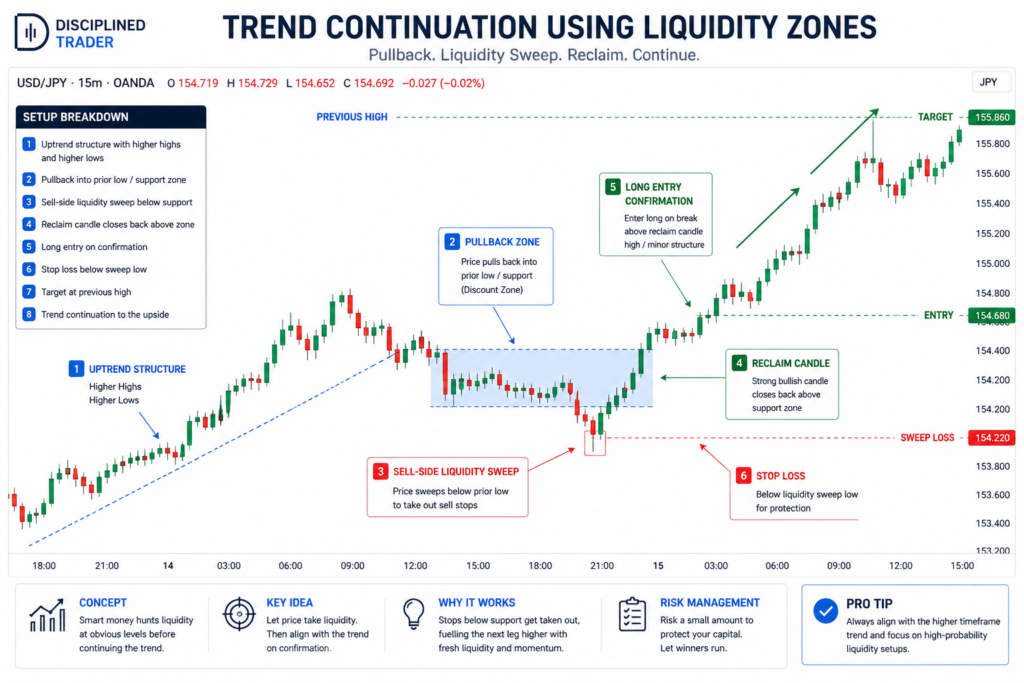
Example: Sell-Side Liquidity Sweep
USDJPY sells into prior low, flushes through it, then quickly reclaims the level.
This can trap the breakdown sellers and set up a reversal.
That’s why the reaction following the sweep is more important than the sweep itself.
Liquidity Zones and Trend Trading
Some traders wrongly believe liquidity concepts are only for reversals.
Not true.
Trend markets also use liquidity.
In an uptrend, pullbacks to prior lows may sweep sell-side liquidity before continuing higher. Big trends usually shake off the weak hands before continuing.
So if you are trading pull backs, use liquidity combined with trend context.
Your post on How to Find High-Probability Setups links in well here since trend + liquidity typically generates exceptional intraday opportunities.
Where Traders Misuse Liquidity Concepts
They assume every sweep means reversal.
Sometimes highs are swept because price genuinely wants higher prices.
They mark too many zones.
If every level is liquidity, no level is useful.
They ignore higher timeframe context.
A minor 5-minute sweep into strong daily trend may only be noise.
They enter before confirmation.
The zone matters. Reaction matters more.
Risk Management Around Liquidity Trades
Liquidity arrangements are powerful but they may also be volatile.
Which makes bad sizing dangerously fast.
This is how most traders underestimate risk. The Position Size Calculator takes the guess work out of it and helps match lot size to stop distance after a sweep or rejection setup.
If you have to put your stop beyond a volatile wick, trim your size instead of taking on an overleveraged position.
Smart traders size to structure.
Journaling Liquidity Zone Performance
Most traders say they trade liquidity but never measure results.
Use your Trade Journal Template and track:
Type of zone traded
Session traded
Sweep only or sweep plus confirmation
Trend or countertrend
Stop size
Outcome in R multiple
Emotional quality of execution
After 30 to 50 trades, patterns become clear.
You may find London sweeps work better than New York midday setups. You may discover countertrend sweeps underperform trend continuation sweeps.
That is real edge creation.
Liquidity Zones and Capital Growth
The next obstacle after traders become consistent with organised setups is capital.
Many traders can make good percentages but on modest accounts. This is why some seasoned traders check out evaluation algorithms from firms like The5ers, FTMO and similar prop models.
The appeal is not short-cuts. It’s access to bigger pools of capital with rules.
If your journal demonstrates disciplined execution around repeated liquidity setups then a The5ers evaluation account can be a logical next step to scale expertise without overleveraging personal resources.
Consistency first, funding not.
Advanced Insight Most Retail Traders Miss
The cleanest liquidity zone is often the most obvious one.
Retail traders avoid obvious levels because they think edge must be hidden. In reality, obvious levels attract orders, and orders create opportunity.
What matters is not spotting the level first. It is interpreting what price does there better than others.
That is the difference between chart decoration and market understanding.
Final Takeaway
Liquidity zones key because markets gravitate to where orders dwell.
Stop thinking simply about candles and indicators. Start thinking in terms of trapped traders, grouped stops, breakout participation and reaction at crucial levels.
This week’s assignment is easy. Before every trade, identify the nearest buy-side and sell-side liquidity zones first. Then ask whether your trade is moving into liquidity or away from it.
That one habit can improve entries and exits immediately.
Next read: How to Trade the EURUSD Daily Range or Best Forex Chart Patterns for Day Traders.
FAQs
What is a liquidity zone in forex?
A liquidity zone is a price area where many orders are likely concentrated, such as stops, entries, exits, or breakout orders.
How do I identify liquidity in trading?
Utilise highs, lows, equal highs/lows, round figures, session ranges and strong reaction zones.
Do liquidity zones always reverse price?
No. Sometimes price reverses after reaching liquidity, and sometimes it continues after absorbing orders.
Are liquidity zones useful for day trading?
Yes. They aid with entrances, exits, placement of targets and avoiding bad trading positions.
Which forex pairs respond well to liquidity zones?
Major pairs like EURUSD, GBPUSD, and USDJPY often show clear liquidity behavior because of high participation and session-driven flows.