
Most traders come to GBPUSD for one reason. Movement.
They hear that “Cable” moves faster than EURUSD, offers bigger ranges, and creates strong intraday opportunities. That part is true. The problem is they treat that movement like free money.
GBPUSD can swiftly reward solid execution, but it can also quickly punish indecision, bad timing, too big positions, and emotional chasing more than many other major pairings. A beginner trader may think they have a chance, but they often end up hurting themselves for no reason.
This article is for traders who already know the basics and want a real plan for trading GBPUSD during the day. Not guesses. Not random signals. A practical way to approach one of the most traded and misunderstood forex pairs.
Why GBPUSD Behaves Differently Intraday
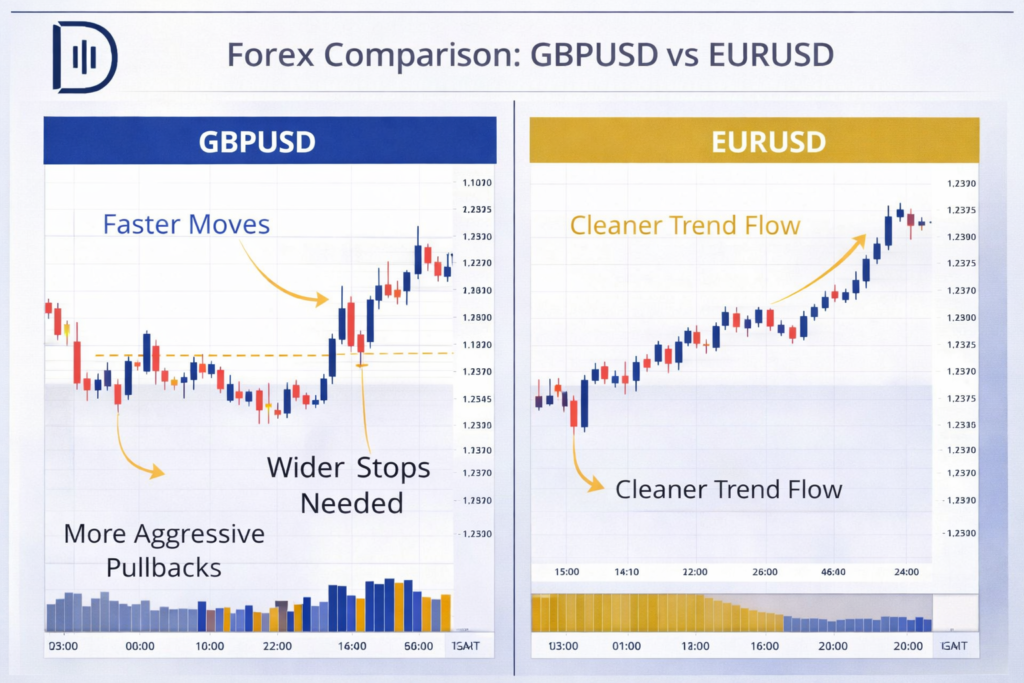
GBPUSD has a personality. If EURUSD often feels smoother and more balanced, GBPUSD can feel sharper, faster, and more aggressive.
That behavior comes from liquidity flows tied to both London and New York, frequent macro reactions to U.K. data, and the pair’s sensitivity to shifts in U.S. dollar sentiment.
According to data from the Bank for International Settlements, GBPUSD remains one of the most actively traded currency pairs globally. CME Group futures volume and institutional flow data also show heavy participation during London and the London-New York overlap.
What this means for a day trader is simple.
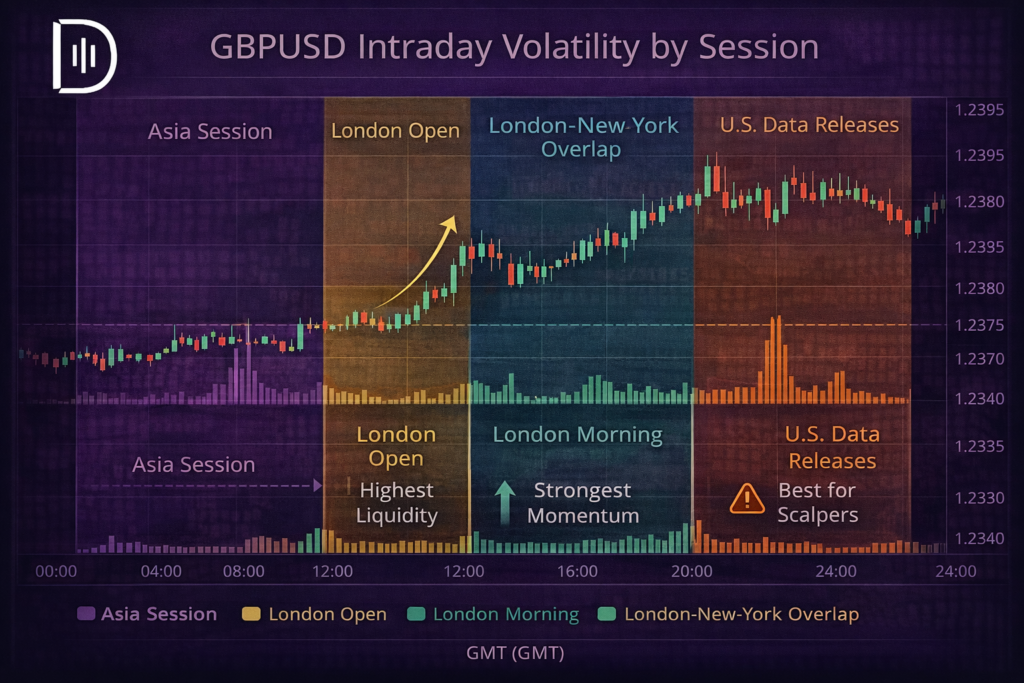
GBPUSD often delivers its best movement when liquidity is highest. That usually means:
London open
London morning continuation
New York overlap
U.S. data releases
Outside of these windows, spreads can get bigger, momentum can slow down, and bad moves happen more often.
You are not just trading one pair. You are trading when people are active.
The Biggest Mistake Traders Make on GBPUSD
They use EURUSD logic on GBPUSD.
A stop that works on EURUSD may be too tight on GBPUSD. A breakout that grinds upward on EURUSD may spike, retrace, and only then trend on GBPUSD.
Many traders call the pair “manipulated” when the truth is simpler. They are using the wrong expectations.
GBPUSD needs room to move. It also demands patience after entry because clean immediate follow-through is less consistent than many assume.
The Intraday Framework That Actually Works
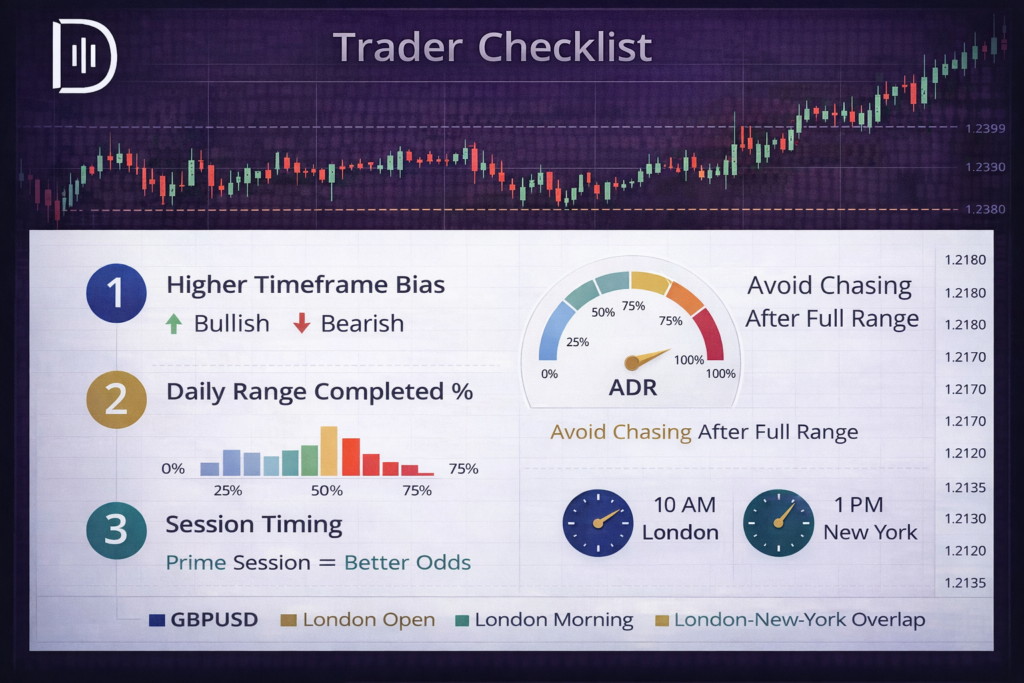
Before placing any trade, start with three questions.
Where is today’s higher timeframe bias?
How much of the average daily range is already completed?
Which session am I trading?
These three filters remove many low-quality trades.
If the daily chart is bullish, London opens strong, and only 25 percent of the average range is complete, continuation longs make sense.
If price has already run most of its daily range into New York resistance, chasing longs becomes low quality.
If you skip this context, you are guessing.
Best Times to Trade GBPUSD Intraday
The strongest intraday conditions usually appear between the London open and first half of New York.
London session often creates the initial directional move. New York either confirms it, reverses it, or accelerates it after U.S. data.
The overlap between London and New York is especially valuable because liquidity is deep and volatility is real rather than random.
Late U.S. afternoon and most of Asia session often offer lower quality conditions for GBPUSD unless there is major news.
If you’ve had trouble with overtrading, cutting down on screen time to only the best session windows will help you get better outcomes faster than changing your strategy.
High Probability GBPUSD Setups
London Break and Retest
Price consolidates during Asia, London opens, breaks the range, then retests the breakout zone.
This works best when aligned with higher timeframe direction. If the retest holds and the momentum comes back, continuation entries can be clear.
New York Reversal After London Exhaustion
London trends aggressively upward, but by New York open price has stretched into resistance and already covered most of the daily range.
If U.S. open cannot continue higher, reversal opportunities can emerge.
Pullback Into Trend Structure
Don’t chase candles; instead, wait for a pullback into an area of previous support, the moving average structure, or the session breakout zone.
GBPUSD typically pays off more for being patient than for entering quickly.
What to Watch on Economic Calendar Days
GBPUSD reacts strongly to:
Bank of England decisions
U.K. CPI and GDP
U.K. employment data
U.S. CPI
Nonfarm Payrolls
Things that happen at the Federal Reserve
The first move on these days might be emotional. The second step is usually cleaner.
A lot of experienced traders wait for the first spike and then trade structure after the response calms down.
Risk Management Matters More on GBPUSD
Because GBPUSD moves quickly, poor sizing becomes expensive.
This is where most traders miscalculate risk. They think the risk is low because the stop is only 15 pips, but if the magnitude is too big, the loss still hurts.
Before you enter, use a Position Size Calculator to make sure your lot size matches your account risk, not your feelings.
Also, keep in mind that a pair that moves more doesn’t mean you need to take on more risk. You need to be more precise.
Execution Discipline on Fast Pairs
Fast pairs show bad tendencies.
Moving stops wider because “it will come back.”
Going in after three big candles.
Trading again after a stop-out to get back at someone.
Doubling the size since the duo moves more.
GBPUSD makes every poor behaviour worse.
That’s why rules are important. Stop that was set. Planned goal. Risk that is set. Trade limitations based on the session. Volatility becomes a trap when there is no framework.
Journaling GBPUSD Performance Properly
Don’t just write down if you won or lost.
Follow:
Session traded
Type of setup
Range finished before entry
Spread when you enter
State of mind
If trade was in line with a greater timeframe bias
Patterns become clear after more than 30 trades.
You may discover your London breakout trades work well but your New York revenge trades damage performance.
This is where using a Trade Journal Template becomes powerful. It turns vague frustration into measurable feedback.
Can You Scale a GBPUSD Edge?
Yes, but only after consistency.
A lot of traders can use GBPUSD on a demo account or with a little amount of money. Fewer people can do it when there are tight drawdown rules.
That’s why evaluation accounts are there.
Firms like The5ers, FTMO, and others provide disciplined traders a means to get more money if they can show that they can limit risk and do the same thing over and over. GBPUSD can be a good match for these systems because it gives clear chances during certain sessions. If you already have a tested procedure and can control your impulses, getting a The5ers evaluation account can be the next natural step. Not as a way to get there faster, but as a way to grow.
A Practical Daily GBPUSD Routine
Pre-session, mark previous day high and low, Asian range, major support and resistance, and scheduled news.
During the session, wait for liquidity to show you which way to go. Don’t enter on your initial impulse unless it’s part of your tested plan.
After the session, think about whether you traded the market that was there or the one you wanted to be there.
That one question can change how you grow.
Final Thoughts
It’s not about guessing every move when you trade GBPUSD during the day. It is about knowing when the pair is busy, when it is stretched, and when the chances are really in favour of action.
Many traders lose because they see volatility as a chance and don’t respect structure.
Make one alteration for the next five days of trade.
Trade GBPUSD just during your best two-hour window and only when your setup matches the bias on higher timeframes. Less activity. Better decisions. Better results.
Next read: Explore our guide on how to trade the London session if you want to understand where many GBPUSD moves truly begin.
FAQs
Is GBPUSD good for intraday trading?
Yes. GBPUSD is one of the best intraday pairs because of strong liquidity, reliable session movement, and frequent technical reactions.
What is the best time to trade GBPUSD?
Usually the London session and London-New York overlap provide the best conditions.
How many pips does GBPUSD move daily?
It varies by volatility regime, but GBPUSD often has a larger average daily range than EURUSD.
Is GBPUSD harder than EURUSD?
For many traders, yes. It moves faster and can be less forgiving of poor entries or tight stops.
Can beginners trade GBPUSD?
Yes, but with reduced size and strong discipline. It rewards skill but punishes emotional trading quickly.