
Most traders don’t lose all their money in one trade.
They slowly bleed out.
This position is a little too big. A trade for revenge there. Moving a stop only once because “this setup is different.”
At the time, none of these seem like significant faults.
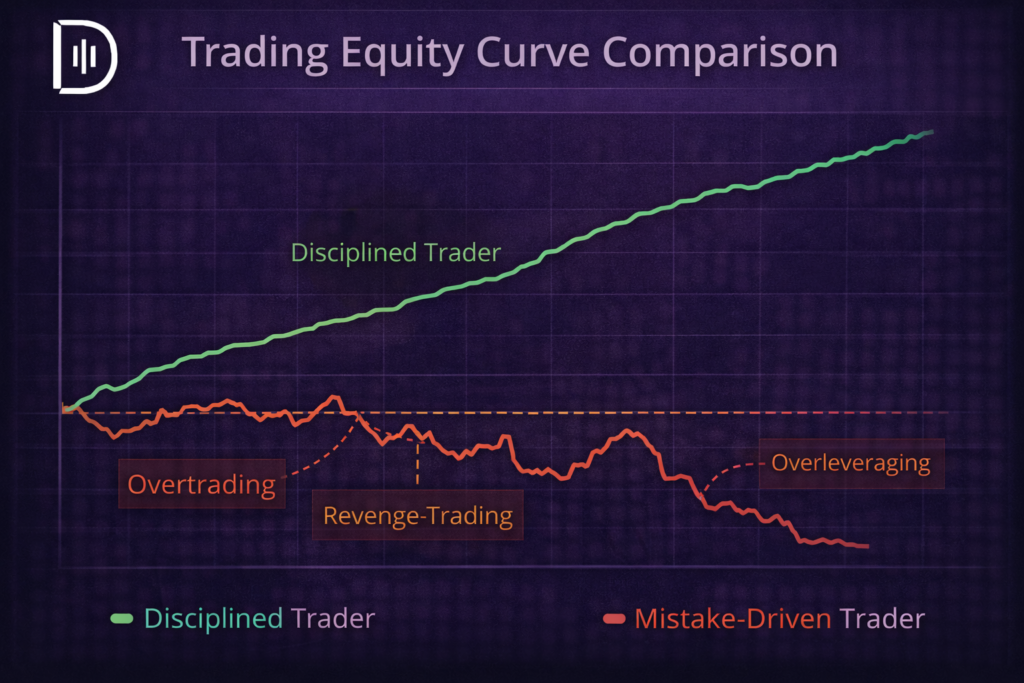
But if you stack them over a week or a month, your equity curve will show the truth.
This is the bit that makes me mad.
You already know most of these mistakes. You have read about them. You have experienced them. Yet they keep showing up.
That is because knowing mistakes is not the same as recognizing them in real time.
This is not another generic list.
This is a working checklist built from actual trading behavior. The kind you review before, during, and after your session to catch problems before they cost you money.
What the Data Says About Why Traders Fail
Most traders assume losses come from bad strategies.
The data suggests otherwise.
Broker reports and regulatory summaries, like those from the European Securities and Markets Authority, consistently reveal that most retail traders lose money because they don’t manage their risks well or make bad decisions.
The Bank for International Settlements says that liquidity and positioning have a big effect on short-term price movement. This means that making decisions based on emotions is much more risky in quick markets.
Studies in trading psychology, including some that the CFA Institute has put together, reveal that cognitive biases like loss aversion and overconfidence have a direct effect on the quality of execution.
For a day trader, this means one thing.
Your biggest enemy is not the market.
It is inconsistency in your own behavior.
The Real Day Trading Mistakes Checklist
Instead of memorizing mistakes, you need a system to catch them.
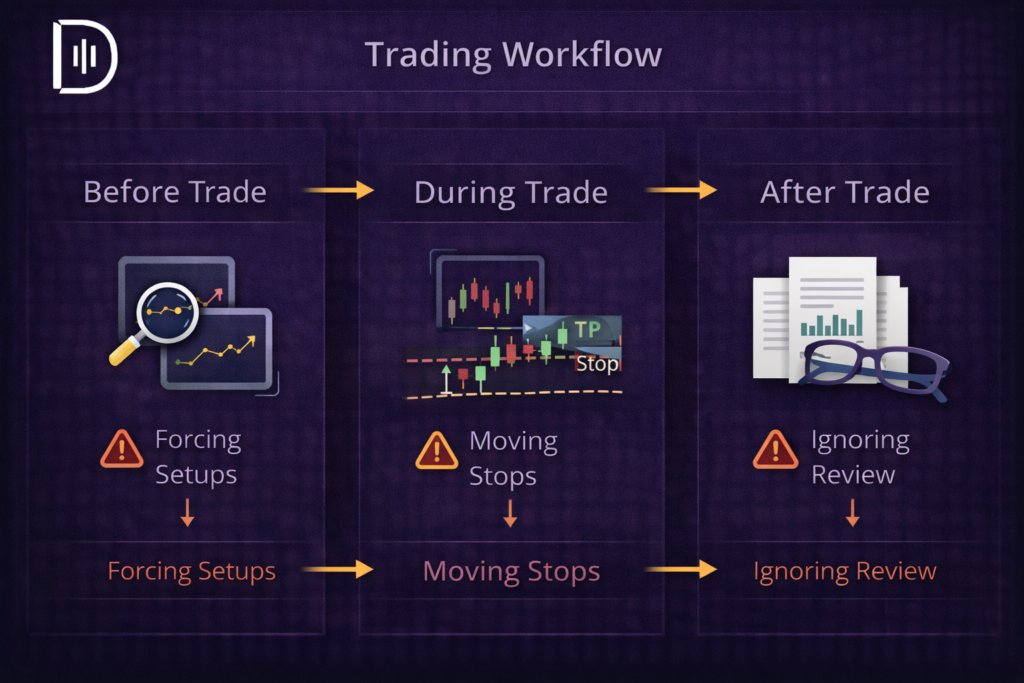
Before the trade, during the trade, and after the trade.
Before you enter, the mistake usually starts with forcing a setup.
You convince yourself that a pattern is valid even when the market conditions do not support it. Maybe volatility is low, maybe the session is dead, or maybe you are just bored.
If you have studied chart patterns or volatility conditions, you already know that context matters more than the setup itself.
During the trade, the most common mistake is interfering with your plan.
You move your stop because price gets close. You take profit early because you do not trust the move. Or worse, you add to a losing position hoping it will turn.
This is not a strategy problem. It is a discipline problem.
After the trade, the mistake is ignoring feedback.
You either celebrate a win without analyzing it or dismiss a loss without learning from it. Both are equally damaging.
A win from bad execution reinforces bad habits. A loss without review guarantees repetition.
A Practical Framework to Eliminate These Mistakes
Change your attention from results to the process first.
Three questions should be answered by each trade.
Was the arrangement valid given the state of the market?
Did I follow through with my plan?
Did I handle risk well?
If the response to any of these is no, the trade is wrong, no matter how much money you make or lose.
Now make a simple plan. Before your session, define what you are allowed to trade. This includes session timing, volatility conditions, and setups that fit your strategy.
If you are trading during the London or New York session, your expectations should match the volatility profile of those sessions. If you are unsure how sessions affect your trades, reviewing your understanding of forex trading hours can immediately improve your timing.
During the session, your job is not to find trades.
It is to filter them.
You are looking for reasons to stay out as much as reasons to enter.
After the session, review only your mistakes.
Not every trade. Just the ones where you broke your own rules.
This keeps your focus on behavior, not random market outcomes.
The Mistakes That Hurt the Most
Some mistakes are more expensive than others.
Overleveraging is one of them.
It feels good when it works, but it destroys accounts when it doesn’t. Most traders increase size after a win or during a losing streak, both of which are emotionally driven decisions.
Another major mistake is trading in the wrong conditions.
Taking breakout trades in low volatility or trying to fade strong trends is a common pattern. If you have explored how to measure volatility in forex, you already know that conditions dictate strategy.
There is also the silent killer.
Overtrading.
Not because you see opportunities, but because you feel the need to be in the market. This usually happens after a loss or during slow sessions.
The market does not reward activity. It rewards patience.
Risk and Execution: Where Most Mistakes Become Losses
Mistakes only become expensive when combined with poor risk control.
You can make a bad trade idea and still survive if your risk is controlled.
You can have a good trade idea and still lose heavily if your risk is not.
This is where most traders miscalculate risk.
They focus on entries and ignore position sizing.
Using a position size calculator removes that inconsistency and forces you to define risk before entering the trade.
Execution also improves when risk is predefined.
You are less likely to interfere with the trade because the downside is already accepted.
Journaling Mistakes Instead of Trades
Most traders journal trades.
Few journal mistakes.
That is a problem.
You do not need more data about entries and exits. You need clarity on behavior.
Start tagging your trades based on mistakes.
Was this a forced trade?
Did I move my stop?
Did I break position sizing rules?
Was this trade outside my plan?
Over time, patterns will emerge.
You will see that a small number of repeated mistakes are responsible for most of your losses.
This is where a structured trade journal template becomes powerful. It helps you isolate behavior patterns instead of drowning in data.
Scaling Without Fixing Mistakes Is a Trap
Many traders think the solution to their problems is more capital.
It is not.
More money makes your behaviour worse.
If your method isn’t perfect, scaling will speed up losses.
This is why serious traders employ evaluation models before they handle bigger amounts of money.
It’s not just about money for companies like The5ers, FTMO, and FundedNext. They are about making sure people follow the rules.
If you can consistently follow your system when it’s being tested, that’s a strong evidence that your edge is real.
If your journaling demonstrates that you are controlling mistakes and doing things regularly, the next natural step is to look into a The5ers evaluation account.
Not as a quick fix, but as a planned approach to make something that currently works bigger.
FAQs
What is the most common day trading mistake?
Risk management that isn’t constant. Most traders take too many risks or vary the size of their positions dependent on how they feel.
Why do traders repeat the same mistakes?
Because they do not track behavior. Without awareness, patterns repeat automatically.
How can I stop overtrading?
By defining strict trading conditions and limiting the number of trades per session.
Is a trading journal really necessary?
Yes. It is the only way to objectively track mistakes and improve performance over time.
Closing: The One Change That Improves Everything
You do not need a new strategy.
You need fewer mistakes.
For the next five trading days, do something different.
Do not focus on making money.
Focus on eliminating one mistake completely.
Just one.
Maybe it is moving stops. Maybe it is overtrading. Maybe it is ignoring position sizing.
Track it. Be strict about it.
You will quickly realize that consistency does not come from finding better trades.
It comes from removing the behaviors that keep costing you.
As a next read, go deeper into your risk management process and position sizing approach. That is where most hidden mistakes are quietly draining your performance.