
Most traders don’t fail because they don’t know how to read charts.
They fail because they put too much faith in them.
You notice a great head and shoulders pattern, so you get in early, and the market keeps going up. You see a breakout triangle, get in, and the price goes back to the range.
It seems like patterns stop working after a while.
It’s easy to tell the truth. Patterns in charts are not signals. They are traces of the flow of orders. You will always be late or wrong if you take them as assured setups instead of context.
This essay isn’t about remembering patterns. It’s about knowing which ones are important for day traders and how to trade them with purpose.
What the Data Says About Chart Patterns
Most retail teaching treats chart patterns as if they were set in stone. But institutional research reveals a different tale. The Bank for International Settlements says that short-term price changes in forex are mostly caused by changes in liquidity and positioning, not by static formations.
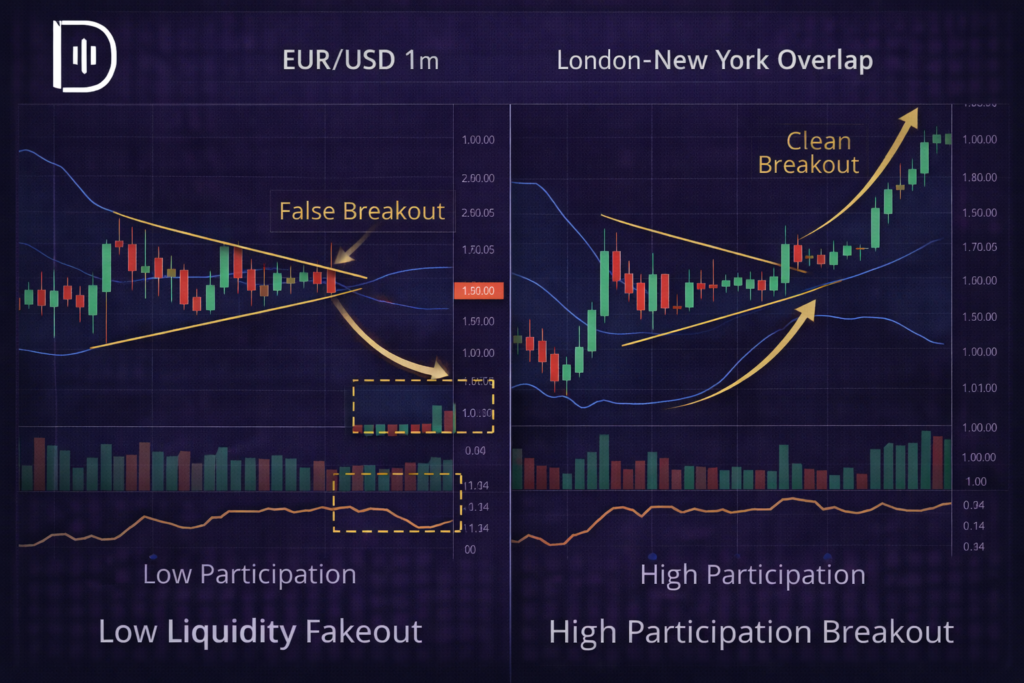
CME Group data shows that breakout strategies tend to perform best during periods of high participation, particularly during session overlaps.
Thomas Bulkowski’s large-scale pattern studies found that success rates vary widely depending on market conditions, not just pattern type.
What does this mean for you as a day trader?
A pattern is only as good as the environment it forms in.
A breakout pattern during low liquidity is unreliable. A continuation pattern during high momentum is far more meaningful.
The edge is not the pattern itself. It is knowing when it matters.
The Patterns That Actually Matter Intraday
Let’s cut through the noise.
You don’t need twenty patterns. You need a few that align with how the market moves during intraday sessions.
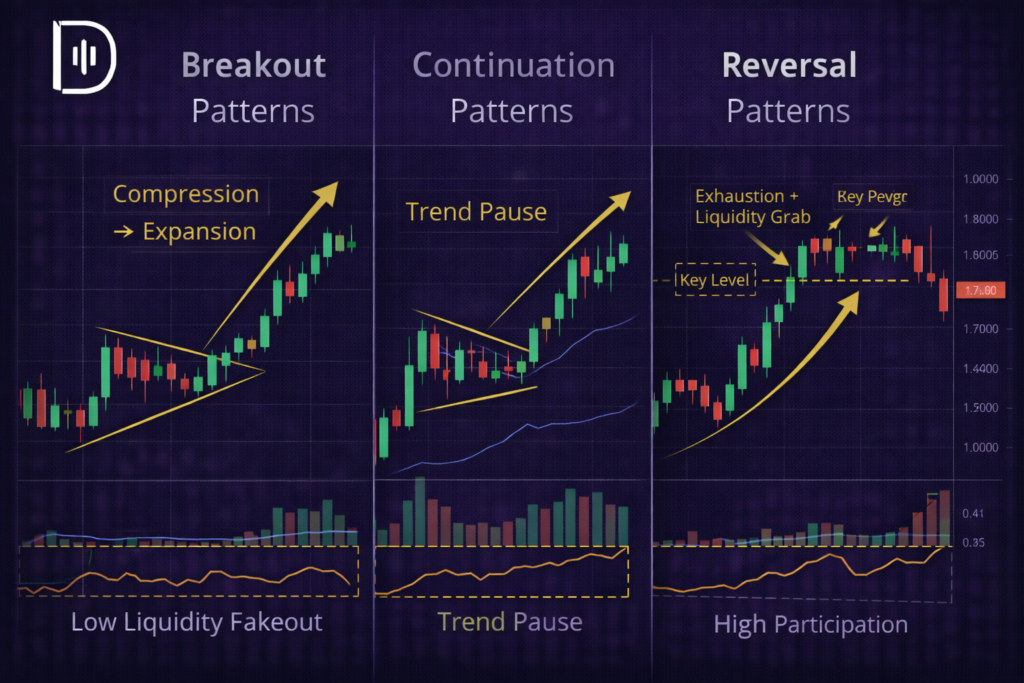
When volatility is rising, breakout structures like triangles and range compressions are quite useful. These patterns show how uncertainty can lead to growth.
In strong trends, continuation structures like flags and pennants perform well. They are not reversals; they are pauses. Double tops and head and shoulders are examples of reversal structures that can operate, but only when they fit with conditions of weariness and liquidity.
The most important thing is not to figure out what the shape is.
It is knowing the tale behind it.
A triangle doesn’t mean that the market is going up or down. It is compression. The direction of the breakout will depend on who steps in with volume.
A flag isn’t merely a break. It is a controlled pullback where institutions get back into their positions.
A double top doesn’t automatically mean a change in direction. Sometimes it’s merely a way to get more money before things keep going.
A Practical Framework for Trading Chart Patterns
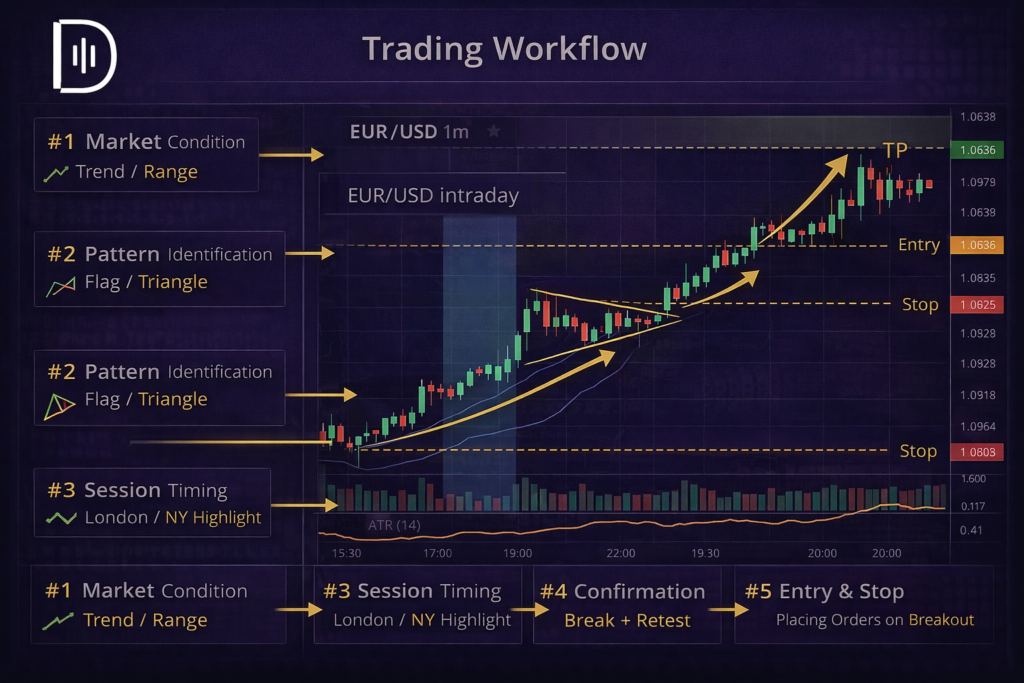
Start with context, not patterns.
Before even looking for a setup, define the market condition.
If the market is trending strongly, your priority is continuation patterns. You are not trying to pick tops or bottoms.
If the market is ranging, breakout patterns become more relevant, but only when volatility begins to expand.
If the market is overextended, then and only then do reversal patterns come into play.
Now layer timing.
Patterns during the Asian session behave differently than those during London or New York. A breakout during low liquidity often fails. The same breakout during high participation can run clean.
This is where your understanding of forex trading sessions becomes critical. Patterns are not independent of time.
Now think about confirmation.
A pattern without confirmation is just a drawing.
You want to see how price behaves at the key level. Does it reject aggressively? Does it break with momentum? Does it retest and hold?
For example, a breakout above a triangle that immediately pulls back and holds above the structure is far more reliable than a breakout that stalls.
Where Most Traders Get Trapped
The biggest mistake is anticipation.
Traders see a pattern forming and enter before it completes. They try to predict instead of react.
Another mistake is ignoring volatility.
A breakout pattern in a low volatility environment is likely to fake out. This is where traders who don’t understand volatility get chopped up.
If you have studied how to measure volatility in forex, you already know that expansion matters more than shape.
There is also the issue of overtrading.
Seeing patterns everywhere leads to forcing trades. Not every structure is worth trading.
The best traders are selective. They wait for alignment between pattern, volatility, and timing.
Risk and Execution: Where Patterns Either Pay or Fail
Even the best pattern fails with poor execution.
Chart patterns often give tight invalidation levels. That is an advantage, but it can also lead to oversized positions if you are not careful.
This is where most traders miscalculate risk.
Using a position size calculator removes guesswork and keeps your exposure consistent, regardless of the setup.
Execution also means accepting that not every pattern will follow through.
You can have the right read and still get stopped out.
The goal is not to win every trade. It is to structure trades where the reward justifies the risk over time.
Journaling Patterns Like a Professional
You need to quit focusing about winning and losing transactions if you want to get better. Start tracking pattern performance based on conditions.
Was the pattern formed during high or low volatility?
Did it occur during a major session or off-hours?
Was there confirmation at the breakout or reversal point?
Did price respect structure after entry?
Over time, patterns will stop being random.
You will see that certain setups work better for you under specific conditions.
This is where a structured Trade Journal Template becomes a real edge. It turns experience into data you can actually use.
Scaling a Pattern-Based Strategy
Once you develop consistency with a small set of patterns, the next challenge is capital.
Even a strong strategy struggles to grow meaningfully on a small account.
This is why many traders move toward prop firm models.
Firms like The5ers, FTMO, and FundedNext provide access to larger capital while enforcing strict risk parameters.
Pattern-based trading works well in these situations since it depends on structured setups with clear risks.
If your journal demonstrates that you are consistently following through and being disciplined, it seems sense to look into a The5ers evaluation account. It’s not about taking the easy way out. It’s about making an edge that has already worked bigger.
FAQs
What is the best chart pattern for day trading forex?
There is no single best pattern. Continuation patterns like flags and breakout structures tend to perform well in trending and high-volume conditions.
Do chart patterns really work in forex?
Yes, but only when combined with volatility, timing, and confirmation. Patterns alone are not enough.
Are reversal patterns reliable for day trading?
They can be, but they require strong confirmation and usually perform better in overextended markets.
How many patterns should a day trader focus on?
A few. Mastering a small set of patterns in the right conditions is far more effective than trying to trade everything.
Closing: What Actually Gives You an Edge
Chart patterns are not your edge.
Your edge is understanding when they matter.
If you shift your focus from memorizing formations to reading conditions, you will start seeing the market differently.
For your next trading week, limit yourself to one or two patterns and track them obsessively. Focus on when they work, not just how they look.
That shift alone can change your consistency.
As a next step, revisit your approach to volatility and session timing. When you combine those with pattern recognition, you move from guessing to structured decision-making.