
Most traders think Bollinger Bands are simple.
Price over the upper band indicates overpricing.
The lower price indicates oversale. So they fade the move.
And then they get run over.
If you have traded long enough, you have seen this happen repeatedly. Price rides the band, keeps pushing, and what looked like an “overbought” condition turns into a full trend continuation.
The problem is not the indicator.
The problem is how it is interpreted.
Bollinger Bands are not reversal signals. They are a visual representation of volatility and distribution. If you treat them like static boundaries, you will keep fighting the market instead of reading it.
This guide breaks down how experienced day traders actually use Bollinger Bands to understand volatility, timing, and trade selection.
What the Data Actually Says About Volatility and Bands
Bollinger Bands are built on standard deviation, which means they expand and contract based on volatility.
That matters more than most traders realize.
The Bank for International Settlements has found that currency markets go through cycles of growth and decline, which are caused by liquidity and institutional participation. CME Group data confirms that volatility clustering is real. Quiet periods tend to be followed by expansion, and expansion eventually leads back to contraction.
John Bollinger himself has repeatedly emphasized that tags of the bands are not signals on their own. They need context.
For a trader, this changes the way you read the indicator.
The bands are not telling you where price will reverse. They are telling you how aggressive or quiet the market currently is.
What Bollinger Bands Really Show You
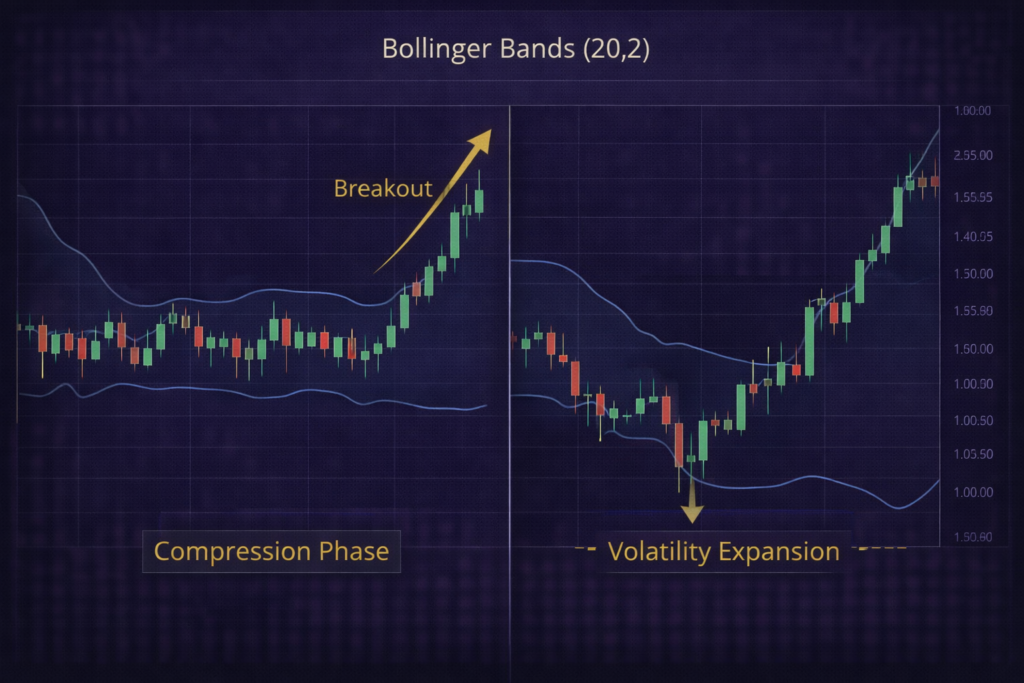
At a basic level, the bands expand when volatility increases and contract when volatility decreases.
But the real edge comes from understanding behavior inside those conditions.
When bands are expanding and price is hugging one side, the market is trending with strength. This is not a place to fade. It is a place to look for continuation.
When bands contract tightly, the market is compressing. This often precedes a breakout, but direction is not guaranteed.
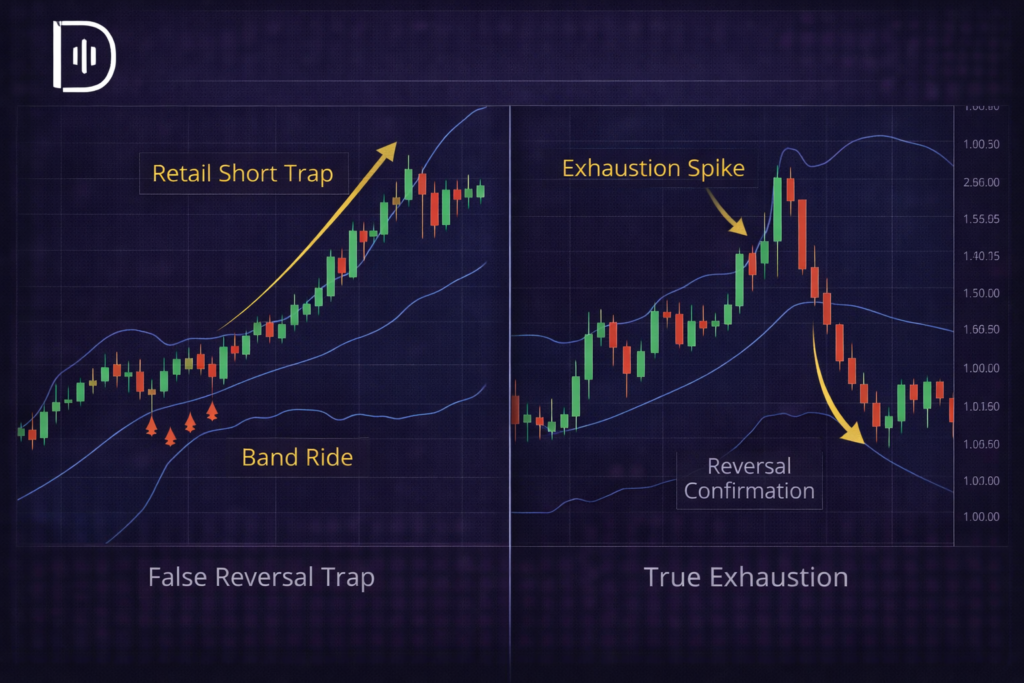
When price moves outside the bands and quickly returns, it can signal exhaustion, but only if supported by context like structure or liquidity.
The mistake most traders make is focusing on where price is relative to the bands instead of how the bands themselves are behaving.
A Practical Framework for Using Bollinger Bands Intraday
Start by asking a simple question.
Is the market expanding or compressing?
If the bands are tight and narrowing, you are in a low volatility environment. This is where many breakout traders get trapped because the move has not fully developed yet.
Instead of guessing direction, you wait for expansion.
Once the bands begin to widen and price breaks out of the range, that is your first clue that volatility is entering the market.
Now the focus shifts.
If price starts riding the upper band with strong candles, you are likely in a bullish trend. In this scenario, shorting because price touched the upper band is a mistake. The better approach is to look for pullbacks toward the middle band as continuation entries.
The same logic applies in reverse for downtrends.
Now consider a different situation.
Price expands aggressively outside the bands, then quickly snaps back inside and fails to continue. This often signals exhaustion, especially if it occurs near a key level.
But even here, the band alone is not enough.
You still need confirmation through price action and structure. If you have studied reversal trading or inside bar setups, you will notice how these tools align with Bollinger Band behavior.
The Middle Band Is More Important Than You Think
Most traders focus only on the outer bands.
Most judgements should be made in the middle band, usually a moving average.
The middle band acts as dynamic support or resistance while markets are changing.
If the price goes back to the middle band and stays there, it usually follows the pattern.
If the center band breaks and doesn’t come back, it could mean that the momentum has changed.
This makes your framework better.
You trade at a balance point, not at extremes.
When Bollinger Bands Fail
Bollinger Bands aren’t magic.
They don’t work when traders utilise them without knowing what they mean.
When there are strong trends, fading the bands leads to repeated losses since the price can be extended longer than predicted.
Stormy markets make bands hard to read since they move around.
Volatility spikes during major news events can distort bands, making them less dependable.
Treating every band contact as a signal is a big mistake. If you don’t understand volatility, you’ll overtrade unfavourable setups.
Risk and Execution: Turning Insight Into Results
Even with a solid read on volatility, execution determines whether you make or lose money.
Bollinger Band strategies often involve tight entries, especially when trading pullbacks or breakouts. This can lead to overconfidence and excessive position sizing.
This is where most traders miscalculate risk.
Using a position size calculator removes guesswork and ensures consistency across trades.
Because here is the reality.
Volatility-based strategies can produce strong moves, but they also come with periods of whipsaw. If your sizing is inconsistent, those periods will damage your account.
Journaling Volatility Behavior
If you want to improve your use of Bollinger Bands, you need to track how volatility behaves in your trades.
Don’t just record when people come and go; pay attention to the conditions.
Were the bands getting bigger or smaller?
Was pricing going with the band or against it?
Did the setup match the session time?
Did structure confirm it?
These insights can help you figure out which surroundings are optimal for you to trade in over time.
This is where a structured Trade Journal Template is really important. It helps you connect outcomes with conditions rather than relying on memory.
Scaling a Volatility-Based Edge
Once you understand how to read Bollinger Bands properly, you start to see consistent patterns.
The challenge then becomes scaling that edge.
This is where many traders look at prop firm models.
Firms like The5ers, FTMO, and E8 Funding provide you access to more money while also making sure you follow the rules around risk.
Bollinger Band techniques, especially those that focus on volatility expansion and continuation, work well with these models since they reward being patient and only doing what needs to be done.
If your journaling shows that you are always doing well, the next step might be to look at a The5ers evaluation account. You can expand without putting more of your own money at risk.
FAQs
Are Bollinger Bands good for day trading?
Yes, when used to understand volatility and not just overbought or oversold conditions.
What is the best setting for Bollinger Bands?
The standard 20-period with 2 standard deviations works well, but the edge comes from interpretation, not settings.
Should I trade reversals at the bands?
Only with confirmation. Band touches alone are not reliable reversal signals.
Can Bollinger Bands be used with price action?
Yes, putting them together with structure and patterns makes them much more accurate.
Closing: The Shift That Changes How You See the Market
Bollinger Bands don’t predict price changes.
Reading volatility is the focus. If you stop treating them as signals and start using them as context, your entire approach to trading changes.
For your next 20 trades, focus only on identifying whether the market is in expansion or compression before making a decision.
Track what happens.
You will begin to see that understanding conditions matters more than reacting to patterns.
As your next step, revisit your approach to trend continuation strategies or reversal setups so you can integrate Bollinger Bands into a broader, more structured trading system.