
Pin bars are one of the first patterns traders learn.
Long wick, small body, rejection of price. Simple.
And yet, most traders lose money trading them.
You spot a clean pin bar at resistance, jump into a reversal, and price keeps going. Or worse, it reverses just enough to pull you in, then continues in the original direction.
After a while, it starts to feel random.
It is not random. It is misunderstood.
A pin bar is not a reversal signal. It is evidence of rejection. And rejection by itself does not guarantee a move in the opposite direction.
This post will teach you how skilled day traders utilise pin bars not as signals, but as part of a bigger decision-making process.
What the Data Says About Pin Bars and Price Rejection
Most retail education treats pin bars as standalone reversal patterns. Institutional behavior suggests something more nuanced.
The Bank for International Settlements has consistently shown that the forex market is driven by large institutional flows. These players are not reacting to candlestick patterns. They are reacting to liquidity, positioning, and execution needs.
CME Group’s data on intraday price behaviour demonstrates that severe rejections happen a lot during liquidity events, especially when stops are triggered beyond crucial levels.
Barclays FX research has also shown that false breakouts and stop runs happen a lot at technical levels where retail traders put in a lot of orders.
When you add pin bars to this, the picture becomes clearer.
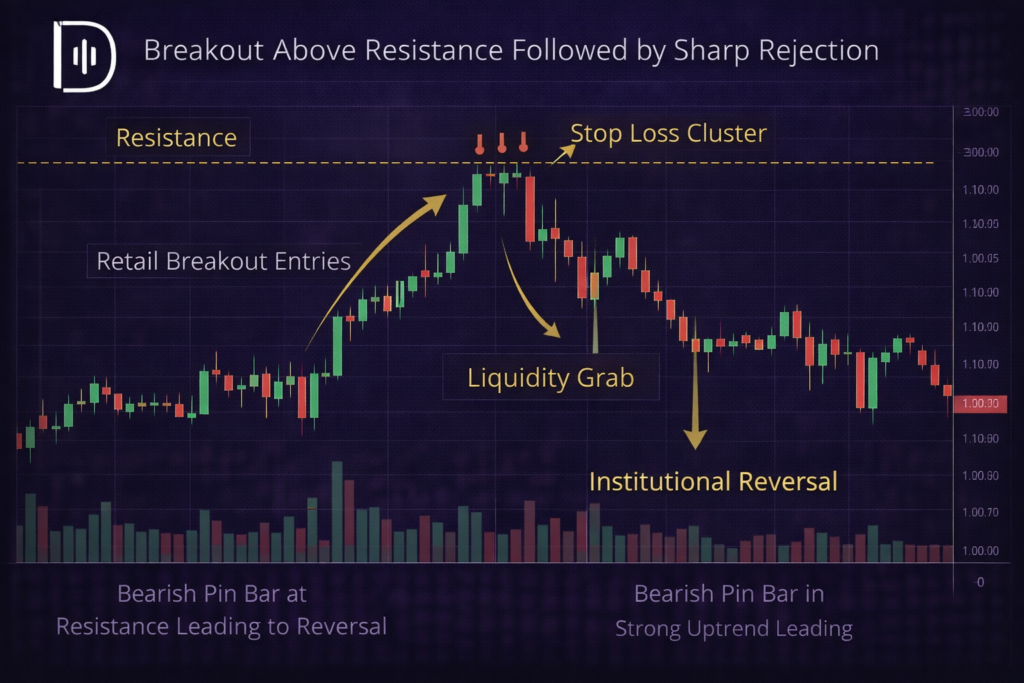
A pin bar often forms because liquidity was taken aggressively and then rejected. It reflects a battle, not a decision. The outcome depends on what happens next, not just the candle itself.
What a Pin Bar Really Means in Live Markets
A pin bar is simply a footprint of rejection.
The long wick shows that price moved in one direction and was pushed back.
But here is the critical part.
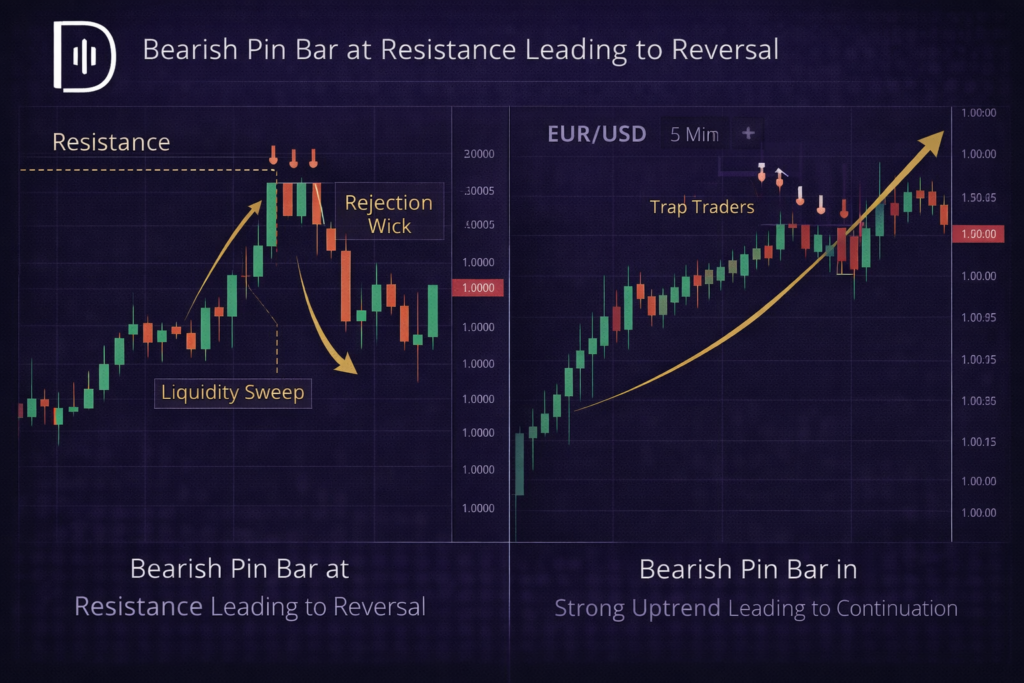
That rejection could mean two completely different things.
It could signal that the market tried to break a level and failed, which can lead to a reversal.
Or it could mean that the market is absorbing orders before continuing in the same direction.
This is why blindly trading every pin bar leads to inconsistent results.
The context determines the meaning.
A Practical Framework for Trading Pin Bars Intraday
The first thing to understand is location.
A pin bar in the middle of nowhere has no edge. It is just noise. But a pin bar at a key level or after a strong move deserves attention.
In a trending market, pin bars often act as continuation signals rather than reversals. Price pulls back slightly, prints a rejection wick, and then continues in the direction of the trend.
This is where many traders get it wrong. They see a bearish pin bar in an uptrend and try to short it, only to get run over when the trend resumes.
Now consider a different situation.
Price pushes into a well-defined resistance level, breaks slightly above it, and then closes back below with a long upper wick. That is not just a pin bar. That is a liquidity sweep and rejection.
In that case, the pin bar becomes meaningful because it reflects trapped breakout traders.
But even then, the candle alone is not enough.
You still need confirmation.
Entry Timing: Where Most Traders Improve Instantly
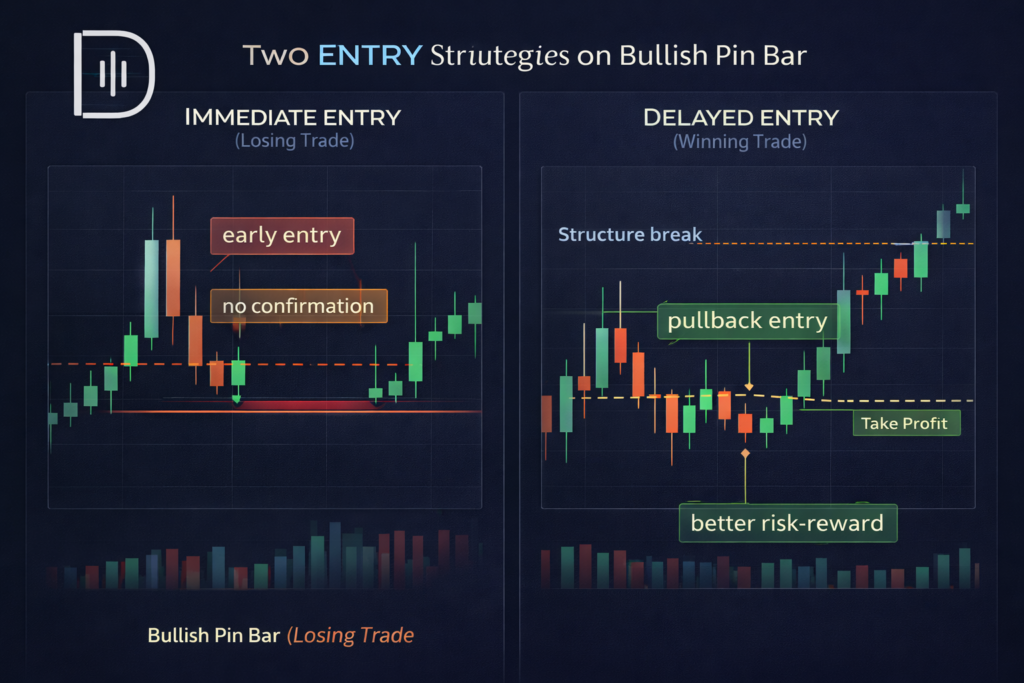
The biggest mistake traders make is entering as soon as the pin bar closes.
It feels logical. The rejection has already happened, so you want to catch the move early.
But early entries often come with poor confirmation.
A better approach is to wait and see how price behaves after the pin bar.
If the market starts to move in the expected direction and breaks nearby structure, that adds confidence.
In many cases, the best entry comes on a small pullback after the initial move, not at the close of the pin bar itself.
This gives you tighter risk and better alignment with momentum.
If you are unsure how structure plays into this, it is worth revisiting your understanding of trend continuation setups and market structure concepts from your previous study.
Understanding When Pin Bars Fail
Pin bars fail more often than most traders expect.
They fail in strong trends where momentum overrides short-term rejection.
They fail in choppy markets where price moves back and forth without direction.
They fail when they form in low liquidity conditions, especially during quieter sessions.
One of the most common traps is during high-impact sessions like London or New York opens.
You might see a perfect pin bar, but if it forms during a liquidity sweep, the market may reverse again shortly after.
If you have studied trading the London session or New York session, you will recognize how often these false signals appear around session opens.
The key insight is that failure is not random. It is predictable when you understand the environment.
Risk and Execution: Where the Real Edge Lives
The wick of a pin bar makes it easy to find a good stop placement, which makes them a good risk-to-reward configuration.
This is why traders like them.
But this benefit goes away if the execution isn’t consistent.
A lot of traders make their positions bigger since the stop looks minor. Some people move their stops as the price gets close, which turns controlled risk into emotive choices.
This is where most traders miscalculate risk.
Using a position size calculator removes guesswork and keeps your exposure consistent across trades.
Pin bar setups can produce strong moves when used correctly, but only if your risk management stays disciplined.
Journaling Pin Bar Trades the Right Way
If you want to get better at trading pin bars, you need to track more than just whether the trade worked.
Start focusing on the story behind the setup.
Where did the pin bar form in relation to structure?
Was there a liquidity sweep before the rejection?
What session did it occur in?
Did the market confirm the move after the pin bar?
When you track these details, patterns start to emerge.
You will begin to see which types of pin bars you execute well and which ones consistently fail.
This is where a structured Trade Journal Template becomes essential. It turns subjective observations into measurable improvements.
Scaling With Capital Once the Edge Is Clear
Once you develop consistency with pin bar setups, growth becomes a question of capital.
A lot of traders look for prop firm chances here.
Firms like The5ers, FTMO, and E8 Funding provide you access to more money while also making sure you follow tight risk rules.
Pin bar trading fits nicely with these models because it requires patience and careful entry points.
If your data demonstrates a repeatable edge, it makes sense to think about getting a The5ers assessment account. It lets you grow without putting further stress on your own finances.
FAQs
Are pin bars reliable for day trading?
They can be reliable when used in the right context, especially at key levels or within strong trends. On their own, they are not enough.
Should I trade pin bars as reversals or continuation?
Both are possible, but continuation trades tend to be more consistent in strong trends.
What timeframe is best for pin bar trading?
Lower durations are appropriate for intraday setups, while higher temporal context improves accuracy.
Do I need indicators to trade pin bars?
No. Price action, structure, and context are more important than indicators.
Closing: The Mindset Shift That Changes Everything
Pin bars are not signals to act rashly. They are clues about what just happened in the market.
If you stop reacting to the candle itself and start analyzing the story behind it, your trading decisions become sharper.
For your next 20 trades, only take pin bar setups that form at clear levels and show confirmation afterward.
Ignore everything else.
You will notice something important. Fewer trades, better timing, and more control.
As your next step, go back and look at how you set up your scalp trades in forex or your trend continuation methods. This will help you use pin bars as part of a whole trading strategy instead of just by themselves.