
Most traders are interested in scalping for the wrong reasons.
They think that making trades quickly will make them more money.
Instead, they get losses that happen faster.
Entries seem random, spreads eat away profits, and little mistakes add up quickly. After a few sessions, people start to lose faith in the technique.
Scalping isn’t the problem, though.
How traders deal with it is important.
Scalping is not a faster version of day trading. It is a completely different execution model that punishes hesitation and rewards precision.
This guide is built from real trading experience and execution data. If you want to trade scalp setups in forex, you need structure, not speed.
What Research Reveals About Short Term Trading Performance
Short term trading is heavily influenced by execution quality and market conditions.
Data from the CME Group shows that transaction costs and timing play a disproportionate role in high frequency and short duration trades.
The Bank for International Settlements highlights how liquidity fluctuates rapidly during active sessions, which directly impacts spreads and slippage.
Investopedia’s educational insights confirm that traders with structured execution methods beat those who rely on reactive decisions.
This is a simple fact for scalpers.
You can’t anticipate the future.
It is how well you can do things under pressure.
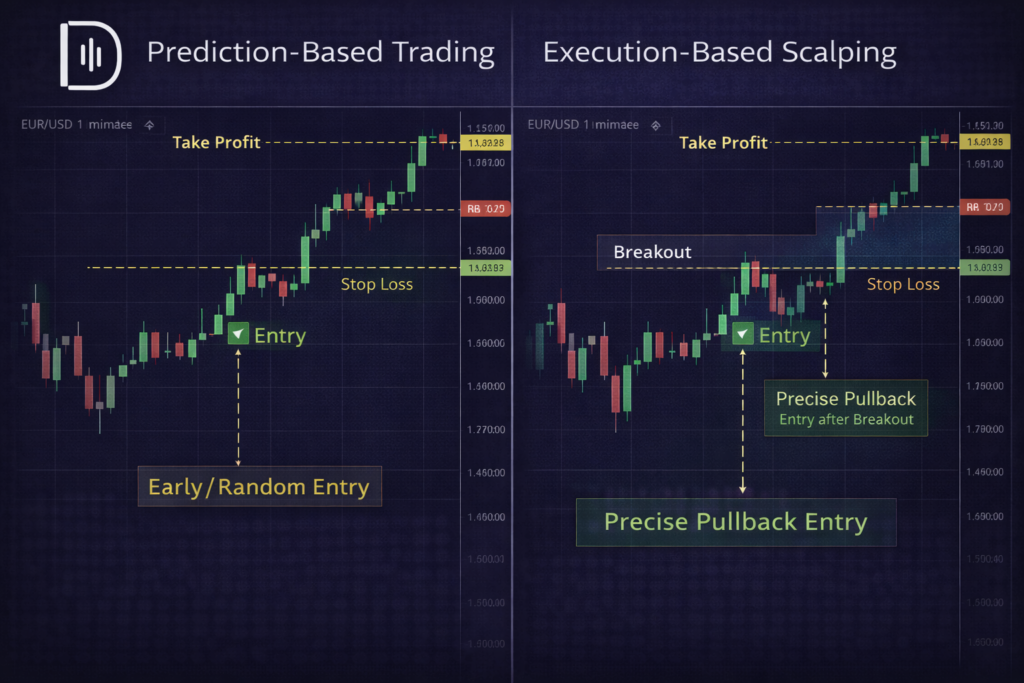
Why Most Forex Scalping Strategies Fail
Most scalping strategies look good on paper.
Tight stops, quick profits, high frequency.
In practice, they don’t work for three reasons.
First, costs and spreads are not taken into account. If your goal is 5 to 10 pips, a 1 pip spread is not modest. It’s a big part of your trade.
Second, delays in execution kill entries. A valid setup can become a bad entry in just a few seconds of indecision.
Third, merchants trade too much. Scalping makes it seem like more trades mean more chances. In practice, more trades usually mean more mistakes.
The best forex scalping strategy is not about frequency.
It is about selectivity.
A Practical Framework for Trading Scalp Setups
Start with session selection.
Scalping only works when there is enough liquidity and movement.
The London and New York sessions provide the best conditions. The DayTradersDiary.com guide on forex trading hours illustrates why timing is more important than strategy if you’re not sure how volatility changes from session to session.
Next is the state of the market.
Scalping works best when there is structured movement, not random noise.
You want either a clear range with clear limits or a crisp trend that lasts all day.
Stay away from low volatility chop, where spreads control price movement. Then define your setup type.
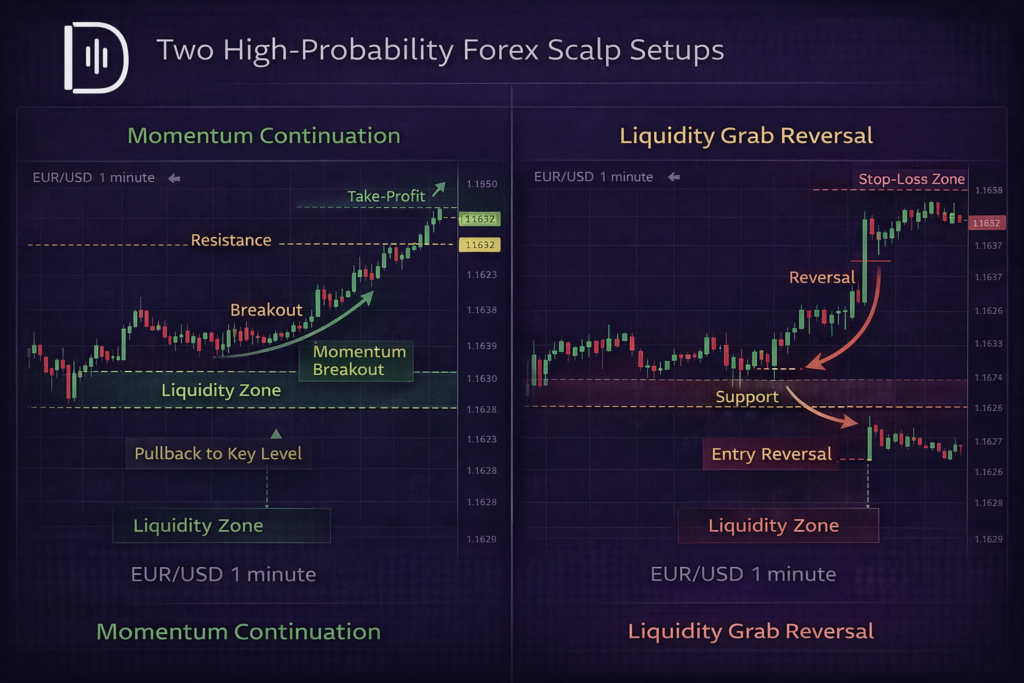
There are two high probability scalp structures.
Momentum continuation and liquidity grab reversal.
Momentum continuation happens when price breaks a level with strength and pulls back slightly before continuing.
When the price sweeps a level, traps traders, and then quickly reverses, this is called a liquidity grab reversal.
Both configurations depend on speed and clarity.
For instance, think of EURUSD breaking through a critical resistance level when London opens. Price drops 3 to 5 pips, stays in the same pattern, and then moves on.
That pullback is when you should enter.
Not the candle that breaks out.
Not the move that came following.
Accuracy is important.
Entry Timing and Execution Logic
Scalping is about entering at the right moment, not just the right level.
You are not trading zones.
You are trading reactions.
Wait for confirmation that price is responding to your level.
That could be a rejection wick, a micro structure break, or a quick shift in momentum.
If you enter before confirmation, you are guessing.
If you enter too late, the risk to reward collapses.
This is why many traders benefit from revisiting the DayTradersDiary.com article on candlestick patterns for day trading. It sharpens your ability to read short term price behavior.
Execution must be instant once your condition is met.
Hesitation is not neutral.
It is a cost.
The Hidden Role of Spread in Scalping
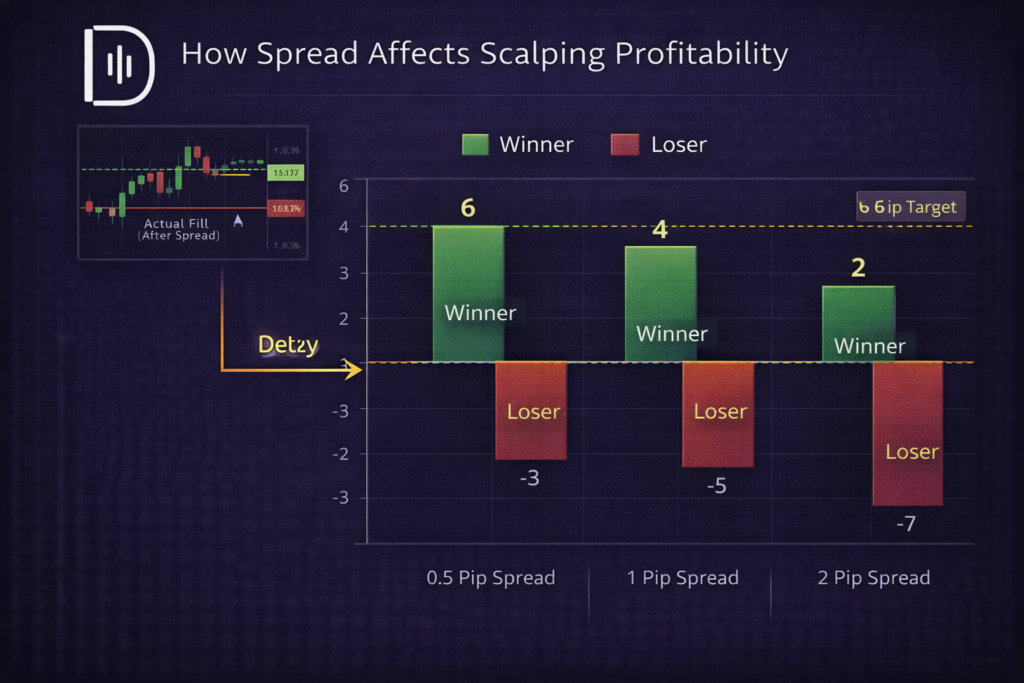
Spread isn’t just a cost.
It is a screen.
The deal is not valid if the spread is too wide.
That’s all there is to it.
A lot of traders don’t pay attention to this and wonder why their win percentage goes down.
You are starting at a disadvantage if your aim is 6 pips and the spread is 2 pips.
For this reason, professional scalpers frequently don’t trade when news rises or there isn’t much liquidity.
The trade is not just about direction.
It is about conditions.
Risk and Trade Management for Scalpers
Risk management in scalping is different from swing trading.
You are dealing with tighter stops and faster decisions.
This is where most traders miscalculate risk. Before you place an order, make sure the size of your lot matches the distance of your stop by using a position size calculator.
Put your stop where the arrangement doesn’t work, not where it feels good.
Goals should be possible.
Scalping isn’t about capturing big moves.
It involves producing little, likely profits on a regular basis.
Too many goals can turn winners into losers.
In this scenario, being consistent is more important than being ambitious.
Journaling What Most Scalpers Ignore
Scalpers generally pay attention to results.
They keep track of wins and defeats, but not how well they did.
You shouldn’t do this.
Your diary should have information like when you made your entries, what the conditions were like, and whether or not you followed the setup requirements. Using the Trade Journal Template on DayTradersDiary.com, you can track these variables and identify patterns.
You might discover that your losses cluster during specific times or when you trade outside your defined setups.
That insight is more valuable than any new strategy.
Scaling a Scalping Strategy
After your scalping gets steady, the next limit is money.
Scalping edges are usually minor but can be repeated.
Growth seems slow when you don’t have a lot of money.
This is why a lot of serious traders go to proprietary trading firms.
Firms like The5ers, FTMO, and Topstep judge traders on how disciplined and consistent they are.
These assessment models work well with scalping since it focuses on limited risk and repetitive execution when done correctly. For example, The5ers rewards stable growth and modest drawdown, which works well with organised scalping methods.
If you have a good strategy to scalp but your account size is getting in the way, the next step is to look at a The5ers evaluation account.
Scaling is not about changing your strategy.
It is about applying it with more capital.
Frequently Asked Questions
What is the best forex scalping strategy?
The best strategy focuses on momentum continuation or liquidity based reversals with strict execution rules.
How many pips do scalpers target?
Typically between 5 to 15 pips depending on market conditions and spread.
Is scalping suitable for beginners?
It can be done, but it takes self-control and quick decisions. A lot of beginners have trouble with consistency in execution.
What time is best for forex scalping?
London and New York sessions due to higher liquidity and tighter spreads.
Final Thoughts
Scalping looks simple.
It is not.
It requires accuracy, discipline, and a clear plan for how to carry it out.
Most traders fail because they don’t handle it as structured trading; they treat it like rapid trading.
For the next several sessions, work on one thing at a time.
Do fewer setups.
Wait for things to get cleaner.
Do it right away when your requirements are met.
That change by itself can change your results.
If you want to go deeper, your next read on DayTradersDiary.com should be the guide on how to measure volatility in forex, because volatility determines whether your scalp setups have room to work or not.