
Traders believe their strategy is the issue.
No, it isn’t.
They observe good setups, mark clean levels, and are still upset at the end of the day.
Why?
Because they can’t do both at the same time when they try to analyse and act.
They analyse on one platform, execute on another, and lose their timing when they switch between the two.
That’s where the money goes to waste.
If you are using TradingView for day trading, the real question is not whether it is good.
It is whether you are using it as a charting tool or as a decision engine.
This guide is built to close that gap.
What Research Says About Visual Decision Making in Trading
Most traders underestimate how much visual clarity impacts performance.
Research from the CME Group highlights that execution timing and decision speed are critical in short term trading environments.
The Bank for International Settlements has emphasized that liquidity conditions shift rapidly, meaning hesitation or delayed interpretation leads to worse fills.
Educational insights from Investopedia consistently point out that traders who simplify inputs tend to make faster and more consistent decisions.
Here is what that means in practice.
TradingView is not just about better charts.
It is about reducing the time between seeing a setup and acting on it.
If your chart slows you down, it is working against you.
Why Most Traders Misuse TradingView
TradingView is quite useful.
That’s why most traders don’t use it correctly.
They add a lot of indicators, follow community scripts, and change layouts all the time.
What begins as analysis develops into a diversion.
People who work in trading use TradingView in different ways.
They take out everything that isn’t crucial to the decision.
The goal isn’t to guess everything. The goal is to act decisively when conditions align.
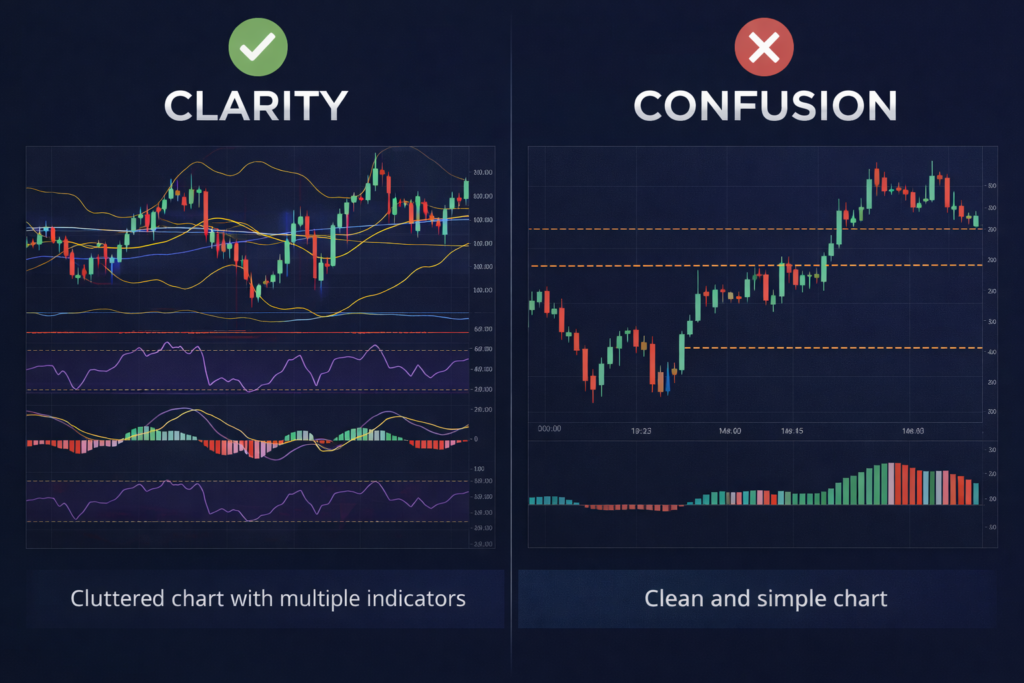
A Practical TradingView Workflow for Day Traders
Start with chart structure.
Your chart should answer three questions instantly.
Where is price now?
Where are key levels?
What condition is the market in?
Trending, ranging, or expanding.
Anything that does not help answer those questions should be removed.
This is why many traders benefit from revisiting the DayTradersDiary.com guide on candlestick patterns for day trading. It reinforces how price behavior often provides clearer signals than layered indicators.
Next is multi timeframe alignment.
TradingView makes it easy to switch timeframes, but most traders overdo it.
Use a simple structure.
Higher timeframe for context.
Execution timeframe for entries.
Nothing more.
If you are flipping between five timeframes, you are creating confusion.
Then comes alerts.
Alerts are one of the most underused features.
Instead of staring at charts for hours, set alerts at key levels.
Let the market come to you.
This reduces emotional trading and improves focus.
Finally, use layouts.
TradingView allows multiple chart layouts.
Use this to monitor correlated pairs or related assets.
For example, if you trade EURUSD, having DXY or gold on a secondary chart provides context without cluttering your main chart.
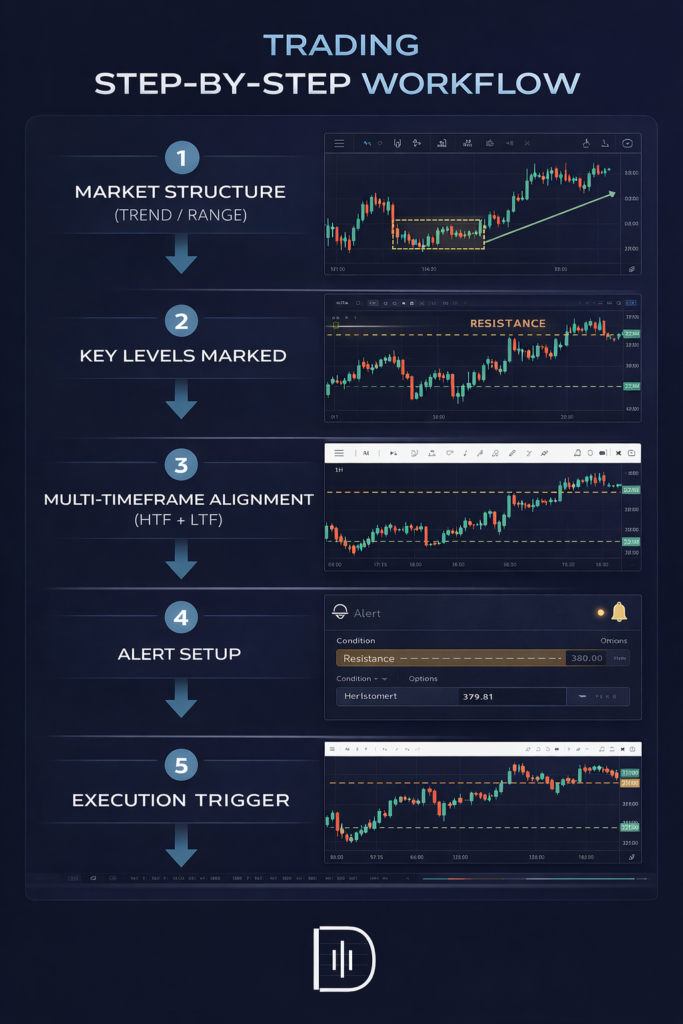
Indicators on TradingView That Actually Help
The question is not what is the best indicator for TradingView.
The real question is how indicators fit into your decision process.
Indicators should not start trades; they should confirm them.
Using RSI to validate that a market is overbought at resistance, for example, makes sense.
It doesn’t make sense to use RSI alone to start trading.
Tools that show momentum, like MACD, can aid, but only when they are in line with the structure.
The DayTradersDiary.com article on MACD in day trading discusses why momentum alone might give you incorrect signals. TradingView gives you access to thousands of scripts.
That is not an advantage unless you know exactly what you are looking for.
More tools do not create clarity.
They dilute it.
Execution Gap Most Traders Never Fix
Here is the uncomfortable truth.
TradingView does not execute trades for most forex brokers.
You still need to switch to another platform like MetaTrader 5 or MT4.
That transition is where many traders lose edge.
They see the setup on TradingView.
They switch platforms.
They hesitate.
They miss the entry or chase price.
To fix this, you need a pre defined execution plan.
If price reaches this level, I enter.
If spread is within acceptable range, I execute.
If volatility spikes beyond expectation, I wait.
The decision should already be made before you switch platforms.
TradingView is for clarity.
Execution platform is for action.
Blending the two without a plan leads to inconsistency.
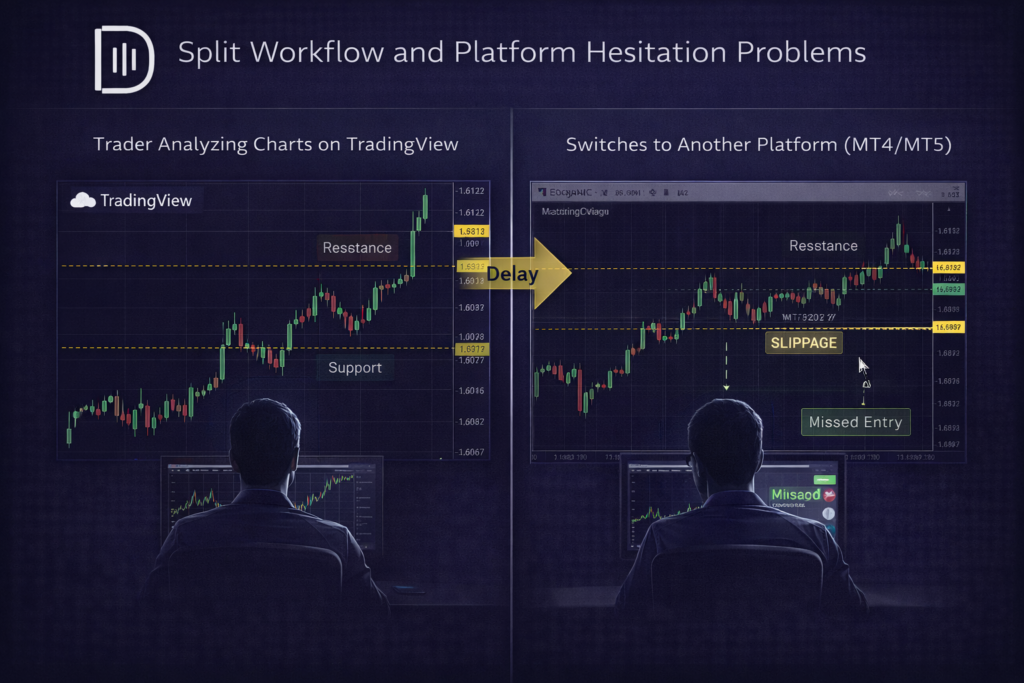
Risk Management and Platform Discipline
TradingView makes analysis easier.
That can create overconfidence.
You see clean setups and assume high probability outcomes.
That is where risk discipline breaks.
This is where most traders miscalculate risk. Using a position size calculator removes guesswork and forces you to define risk before execution.
Your job is not to find perfect trades.
Your job is to execute consistent risk.
TradingView helps you see opportunities.
It does not protect your account.
Only discipline does.
Journaling How You Use TradingView
Most traders journal trades.
Very few journal how they used their tools.
This is a missed opportunity.
Your journal should include questions like:
Did I wait for my alert or did I jump early?
Was my chart clean or cluttered?
Did I follow my multi timeframe plan or improvise?
Using the Trade Journal Template on DayTradersDiary.com, you can track not just outcomes, but process quality.
Over time, you will notice patterns.
You may realize your losses come from impatience before alerts trigger.
Or from over analyzing after the setup appears.
These are not strategy issues.
They are workflow issues.
And they can be fixed.
Scaling Beyond Retail Limitations
Once your process becomes consistent, your results stabilize.
At that point, capital becomes the limiting factor.
This is where proprietary trading firms come into play.
Firms like The5ers, FTMO, and Topstep evaluate traders based on consistency and discipline.
TradingView plays a role here.
Clean analysis leads to better execution decisions.
More consistent performance metrics come from making better choices.
The5ers, in particular, focuses on steady growth and controlled drawdowns, which works well with traders that employ organised TradingView routines.
If your plan works but your account size keeps you from growing, the next natural step is to improve your technique and think about getting a The5ers evaluation account.
Scaling is not about taking bigger risks.
It is about applying the same edge with more capital.
Frequently Asked Questions
Is TradingView good for day trading?
Yes, especially for analysis and charting. Its real strength is clarity and speed of decision making.
What is the best indicator for TradingView?
There is no single best indicator. The best approach is combining price action with one or two confirmation tools.
Can I trade directly from TradingView?
In some cases, yes, but most forex traders still execute through platforms like MT5 or MT4.
How do I avoid over analysis on TradingView?
Limit indicators, use alerts, and stick to a predefined workflow.
Final Thoughts
TradingView is one of the best tools available for traders.
But tools don’t make an edge.
Process does.
For the next week, work on one thing that needs to be better.
Take out one thing that isn’t needed from your charts.
Make your work easier.
Instead of watching every tick, set alarms.
You will notice something right away.
Things become clearer.
Execution goes faster.
Results begin to stabilise.
If you want to go deeper, your next read on DayTradersDiary.com should be the guide on how to trade currency correlations, because understanding relationships between pairs will make your TradingView analysis far more effective.