
Most traders do not lose because they have no confirmation.
They lose because they confirm the wrong thing.
A trader sees resistance, waits for a bearish candle, checks RSI, notices declining volume, and then convinces himself that five separate signals are agreeing. The problem is that those signals may all be measuring the same underlying price movement.
That is not a confirmation cluster.
It is often just one idea repeated five times.
A genuine confirmation cluster is different. It combines independent evidence to improve an entry’s quality without requiring the trader to wait until most of the move has already happened.
This is important since in day trading, there is always a trade-off. Jumping in too soon means taking on greater risk. If you wait for too much confirmation, your stop gets broader and your remaining prize gets smaller.
The goal is not maximum confirmation.
The goal is enough independent confirmation to justify the risk.
What Is A Confirmation Cluster?
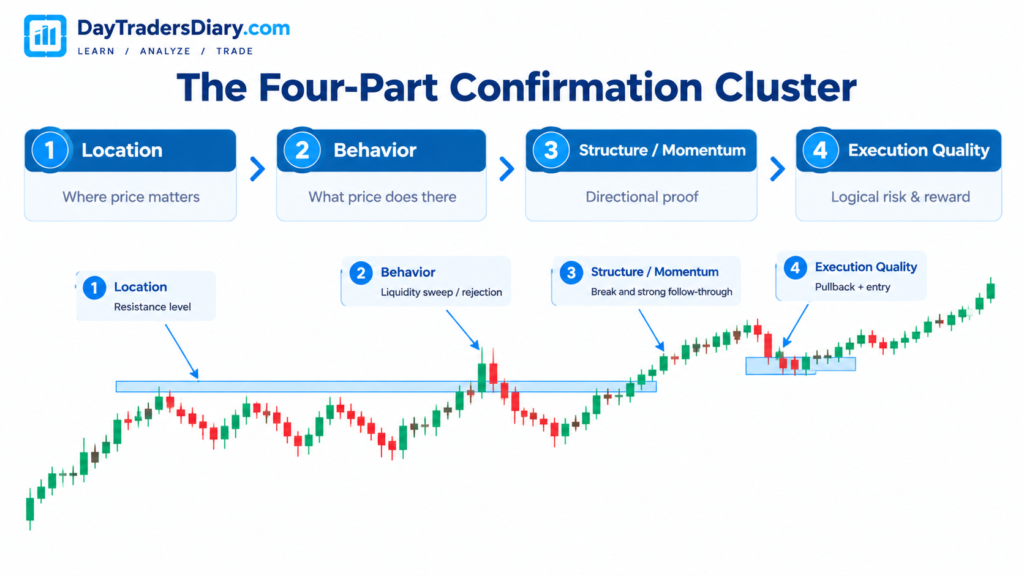
A confirmation cluster is a group of different market observations that support the same trade idea around the same location and time.
EUR/USD is reaching a previous high.
Price rises above the level, rejects, falls below it, breaks a nearby intraday swing low, and retests it with negative momentum.
Those observations are more useful together than separately.
The level gives you the location.
The sweep gives you evidence of failed acceptance.
The structure break gives you directional confirmation.
The retest allows you to execute.
That is a cluster.
The important word is independent.
If you use RSI, Stochastic and Williams %R and all three say overbought, you have not necessarily gathered three confirmations. They are largely variations of momentum measurement.
Why Confirmation Clusters Can Improve Entry Quality
Technical analysis often blends price, volume, volatility and momentum to assess market activity. Fidelity says technical indicators can help traders see trends, momentum, volatility and volume, and its volume research says rising volume can assist validate a price move.
For a day trader, the practical lesson is simple.
Different types of information can answer different questions.
Price structure can tell you where.
Momentum can tell you whether movement is strengthening.
Volume can tell you whether participation is increasing.
Volatility can tell you whether there is enough movement for the trade to develop.
Execution behavior tells you whether the market is actually accepting the level.
The strongest clusters are therefore built from different dimensions of evidence.
Confirmation Is Not The Same As Certainty
This distinction changed how I would approach confirmation.
A trader can collect six signals and still lose.
That does not mean the confirmation cluster failed.
It means confirmation changes probability. It does not remove uncertainty.
Academic research also provides useful context here. Research on intraday time-series momentum has found evidence of economically significant momentum across developed markets and reported stronger effects under certain combinations of volatility, liquidity, and new information.
The implication for active traders is not that momentum should always be traded.
It is that market conditions influence whether a signal has the same meaning.
A bullish breakout with expanding participation is not necessarily the same chart pattern as during a quiet session.
Context is part of confirmation.
The Four-Part Confirmation Cluster
A practical entry cluster can be built around four layers.
The first is location.
You need a reason why price should matter in this particular area. That could be a previous-day high, support or resistance, a liquidity zone, VWAP, an opening range, a higher-timeframe level, or a tested supply or demand area.
The second is behavior.
Watch what price actually does when it reaches the location. Does it reject, sweep liquidity, compress, accelerate or accept above the level?
The third is structure or momentum.
After the initial reaction, does price prove the expected direction by breaking nearby structure or generating directional momentum?
The fourth is execution quality.
Can you enter with a logical stop and enough remaining reward?
If those four layers align, you have something considerably stronger than a single candle pattern.
The Location Should Come First
This is where many confirmation systems go wrong.
Traders start with indicators.
They see a bullish MACD crossover, RSI recovering from oversold conditions, and price moving above a moving average.
Then they search the chart for a reason to buy.
That is backward.
Start with location.
Suppose GBP/USD is approaching a major resistance level that has rejected the price several times.
You now have a location worth watching.
If the price reaches that level and produces a bearish rejection, you have behavior.
If it then breaks the most recent intraday higher low, you have structural confirmation.
If the retest fails and selling volume increases, you have additional confirmation.
The sequence matters.
Confirmation Should Happen Close To The Entry
A common mistake is using stale confirmation.
Suppose your higher timeframe trend was bullish three hours ago.
That is useful context.
It is not necessarily entry confirmation now.
Likewise, an RSI reading from ten candles ago should not be treated as confirmation for a trade you are entering today.
So confirmation is more helpful when the evidence is time linked to the decision.
This makes for a practical rule:
The closer the proof is to the entry, the more significant it is normally, unless it is just the same pricing information repeated.
Confirmation Clusters And Liquidity Sweeps
Liquidity sweeps are particularly useful for building confirmation clusters because they create a clear sequence.
Price reaches an obvious liquidity area.
It pushes beyond the level.
The breakout fails.
Price returns inside the prior range.
Then, the nearby structure breaks.
That sequence provides several distinct observations.
DayTradersDiary’s existing research on liquidity sweeps and failed breakouts explores this behavior in greater detail.
The important point is not to sell simply because a sweep occurred.
Wait for evidence that the market actually rejected the level.
A sweep is a location event.
The structure break is often the confirmation event.
A Practical Short-Entry Example
EUR/USD could test the prior day high in the London session.
First move takes the high down by 5 pips.
You watch the breakout instead of buying it.
Soon the price goes back below the level.
That’s the first confirmation.
The next 5-minute candle breaches the most recent small swing low.
That’s two.
Price then retraces back to the damaged structure but fails to retake it.
That is the third one.
The entry now contains a logical cluster:
liquidity sweep + rejection + structure break + failed retest .
Your stop can be placed above the invalidation point.
Your aim can be the next logical liquidity zone.
This is far cleaner than selling simply because resistance exists.
Do Not Require Every Possible Confirmation
There is another trap.
Once traders learn about confirmation clusters, they start adding conditions.
Price action must confirm.
RSI must confirm.
MACD must confirm.
Moving average must confirm.
Volume must confirm.
ATR must confirm.
A higher timeframe must be confirmed.
The correlated pair must confirm.
News must confirm.
Eventually, the trader takes one trade every three weeks.
That is not necessarily better trading.
You need to determine which confirmations actually improve expectancy.
A cluster should be selective, not enormous.
Think In Evidence Categories
A good way to think about confirmation is to break it into groups.
Location answers where the trade makes sense.
Structure answers whether market behavior changes.
Momentum tells us whether the motion is accelerating.
Participation answers whether the activity supports the move.
Volatility answers whether there is enough movement.
Execution answers the question of whether the trade still offers acceptable risk and reward.
You do not need all six every time.
But try to avoid collecting five signals from the same category.
That is where false confidence develops.
The Confirmation Diversity Test
Before entering, ask:
“How many independent reasons support this trade?”
Then ask a tougher question:
If I take away my favorite indicator, does the transaction still make sense?
If not, your cluster may not be as powerful as you think.
If the removal of RSI wrecks the setup, you may be over-reliant on one metric.
But if removing RSI changes nothing because the trade already has a strong location, rejection, structure break and retest failure, then RSI is merely a secondary context.
That is a much healthier relationship with indicators.
Confirmation Clusters And Entry Delay
More confirmation comes with a cost.
Every additional condition takes time.
The price may change while you wait.
This is why confirmation clusters should be designed around minimum sufficient confirmation.
You want enough evidence to reduce low-quality trades without waiting until the market has already travelled most of the expected move.
This directly relates to entry delay risk.
If your planned entry offers 2.5R but your confirmation process causes you to enter after half the move has already occurred, you may be trading a completely different setup.
The confirmation improved confidence but damaged expectancy.
That is a critical distinction.
Confirmation Clusters And Risk Management
A high-quality cluster does not justify a larger risk.
This is one of the most dangerous psychological effects of confirmation.
When several factors agree, traders feel certain.
Certainty encourages oversized positions.
But a five-factor setup can still fail.
Your risk should therefore be calculated from the invalidation level, not from your confidence level.
This is where the DayTradersDiary Position Size Calculator becomes useful. If confirmation requires a wider structural stop, your position size should normally change rather than allowing the wider stop to increase your monetary exposure.
The professional mindset is simple:
Better confirmation can justify taking the trade. It does not justify risking more than planned.
When Confirmation Clusters Fail
Confirmation clusters struggle in several environments.
The first is fast news.
Price can move through multiple technical levels before your confirmation process finishes.
The second is extremely low liquidity.
Signals can appear clean but have little follow-through.
The third is late-stage momentum.
By the time all conditions align, the market may already be exhausted.
The fourth is correlated confirmation.
Several indicators can appear independent while simply describing the same price movement.
The fifth is confirmation bias.
Once a trader wants to buy, they unconsciously search for evidence supporting the long thesis.
That last problem is especially dangerous.
Research into technical price patterns has examined how confirmation bias can affect the interpretation of market information and trading behavior.
The solution is to define your cluster before the trade rather than assembling it afterwards.
Create A Pre-Trade Confirmation Rule
Before the session, define what qualifies as confirmation.
For a breakout strategy, you might require a meaningful level, range expansion, a close outside the level and a successful retest.
For a reversal strategy, you might require a liquidity sweep, a rejection, a structure break, and a retest.
For a pullback strategy, you might require higher-timeframe alignment, controlled retracement, momentum recovery and a defined trigger.
Now you are testing a process.
You are not confirming after seeing the result.
Journal The Cluster, Not Just The Trade
Your journal should record exactly which confirmations were present.
The DayTradersDiary Trade Journal Template can be adapted to include fields for location, structure confirmation, momentum confirmation, participation, volatility state, entry delay and result in R.
After 50 trades, break them up.
Maybe four-factor clusters have +0.62R expectancy.
Three-factor clusters provide +0.38R.
Two-factor clusters: -0.08 R.
Or maybe you find the three-factor clusters do better, since confirming the fourth element means entering too late.
That is the kind of information that can actually improve a trading system.
Do not assume more confirmation is better.
Measure it.
Confirmation Clusters And Scaling Capital
Once you have demonstrated that a specific confirmation cluster improves your execution and expectancy, the next limitation may become capital rather than strategy quality.
That is where evaluation programs can become relevant.
The purpose should not be to use a funded account to compensate for an unproven strategy.
It should be to apply a proven process under another set of capital and risk constraints.
The5ers today promotes its High Stakes as a two-step review with drawdown restrictions and scaling requirements. The laws also restrict fresh order execution on high-impact news, which is critical if your confirmation cluster depends on volatility.
That makes the rulebook part of the strategy decision.
Other firms, such as FTMO and Topstep, use different structures and restrictions, so traders should compare the actual rules with their own execution style rather than selecting a firm simply because the headline account size looks attractive.
If your confirmation process is already validated through backtesting, forward testing and journaling, you can explore a The5ers evaluation as one possible route to scaling your process without simply increasing risk on personal capital.
The important word is validated.
An evaluation account should be the next stage of a process, not the place where you discover whether you actually have an edge.
Final Thoughts
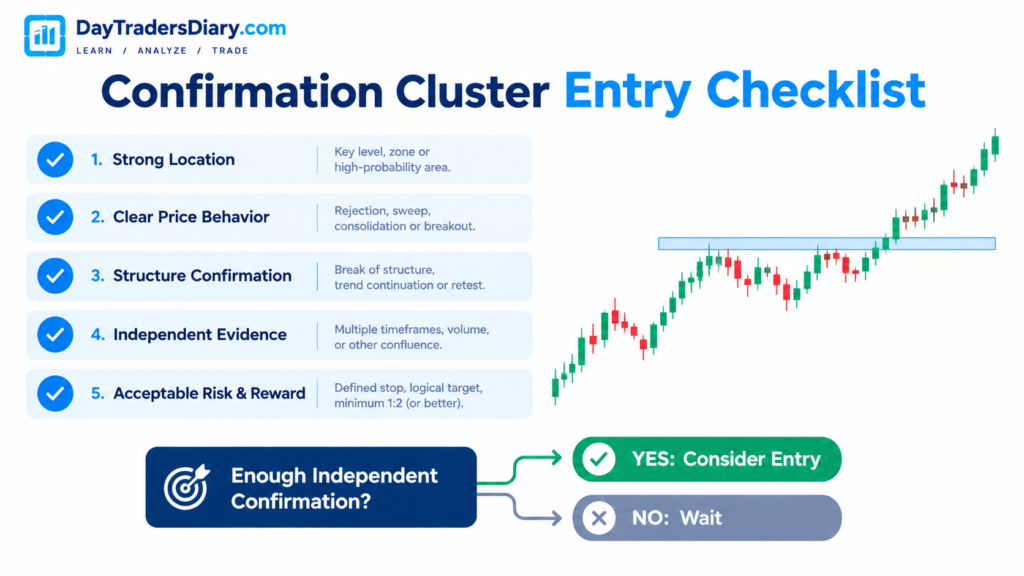
The best confirmation cluster is not the one with the most signals.
It’s the one that offers you enough independent evidence to make a disciplined decision, and enough room for the transaction to pay you off.
Start with place.
Watch the behavior.
Look for structure or momentum to confirm.
See where the engagement and volatility matters
Then the question most traders miss:
after checking Is the deal still worth it?
The last question is the difference between certain and uncertain.
This week, review your last 30 trades and mark exactly which confirmations were present before each entry. Do not judge them yet. Just record them.
Then compare the results.
You may discover that your best trades were not the ones with the most confirmation. They were the ones in which two or three independent pieces of evidence arrived at the same location almost simultaneously.
For the next step, read “How To Find High-Probability Setups” and compare your confirmation clusters with the quality, location, timing, and execution of your highest-expectancy trades.
Frequently Asked Questions
What is a confirmation cluster in trading?
A confirmation cluster is a collection of independent market signals, all of which point toward the same trading idea. It can include price structure, liquidity behavior, momentum, volume, volatility and market environment.
How many confirmations should an entry have?
There is no universal number. Two or three independent confirmations can be more useful than six correlated indicators. The correct number should come from your own trade data.
Is confirmation clustering better than using one indicator?
It can be, because different evidence categories can answer different questions. However, adding more indicators does not automatically improve a strategy. The quality and independence of the evidence matter more than the quantity.
Can confirmation clusters reduce false entries?
They can assist screen out lesser quality setups by requiring the market to show certain behavior before entrance. They can ‘t get rid of bad trades . Confirmation changes likelihood , not certainty.
What is the difference between confluence and confirmation?
Confluence is a word that usually means several things leading to the same place or same direction. Confirmation is confirmation that the behavior you expect is indeed happening. Confluence is a support level and a higher time frame trend. Stronger confirmation is a support rejection and a breach of structure.
Can confirmation clusters work for forex and stocks?
Yes. The framework can be applied to forex, stocks, futures and other liquid markets. The specific evidence used should vary with the instrument and the available data.
Does waiting for confirmation hurt risk-to-reward?
It does. Late confirmation may increase conviction, but can reduce remaining reward or need a larger stop. This is why timing of entry and confirmation should be looked at in conjunction.
Should volume always be part of a confirmation cluster?
No. Volume can be valuable, especially in centralised markets such as stocks and futures, but its usefulness depends on the instrument and data source. It should be tested rather than treated as mandatory.
How should I backtest confirmation clusters?
Define the precise criteria for confirmation before to starting your testing, and then record the criteria used for each trade. Compare expectancy, win rate, average R, MAE, MFE, and execution delay in different combinations of clusters.