
A trader sees the setup, waits for confirmation, hesitates for 20 seconds, enters, and then watches the price move another 12 pips before finally turning around.
The immediate reaction is usually, “I got unlucky.”
Sometimes you did.
But if this keeps happening, luck is probably not the problem.
The real problem is that you are treating entry timing as a simple yes-or-no decision. Either the setup is valid, or it is not. In reality, a setup can remain technically valid while becoming progressively worse to enter.
That difference matters.
A breakout at 1.0850 may be attractive when the signal appears. The same breakout at 1.0862 can have a completely different risk profile. Your stop may now be farther away, your remaining reward may have shrunk, volatility may have expanded, and the market may already have completed much of the move that justified the trade.
This is what I mean by entry delay risk.
Entry delay risk is the deterioration in a trade’s expected quality caused by entering after the original setup or trigger has occurred.
It is not simply slippage. Slippage is the difference between your expected execution price and your actual fill. Entry delay is broader because it includes hesitation, waiting for another candle, checking another timeframe, platform delays, execution delays, and the market movement that happens while you are waiting.
The good news is that entry delay risk can be measured.
Once you measure it, you can stop guessing about whether you are entering too late and start determining exactly how much late execution is costing your strategy.
Why Traders Underestimate Entry Delay Risk
Most trading journals record the entry price.
Very few record the price where the trader originally intended to enter.
That creates a blind spot.
Suppose your journal contains 200 trades and shows an average win rate of 52%. Your strategy is performing reasonably well.
But imagine that the strategy produces a 1.8R average reward-to-risk when you enter close to the original trigger and only 1.1R when you enter more than 30 seconds later.
If you record only the final entry, those two groups get mixed.
Your journal tells you that you have a trading strategy.
It does not tell you whether your execution is damaging that strategy.
This is why entry delay needs to be treated as a separate performance variable.
The sequence is actually more complicated than most traders realize.
There is the setup, the trigger, the decision, the execution, and finally the actual entry.
Each stage can introduce deterioration.
What Entry Delay Risk Actually Measures
Consider a EUR/USD breakout.
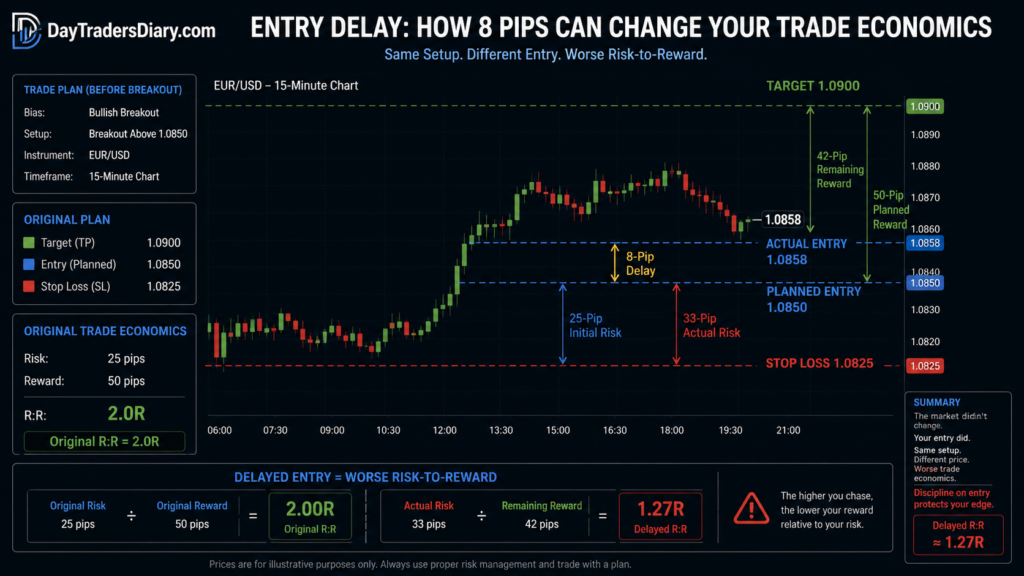
Your planned entry is 1.0850. Your initial stop is 1.0825, giving you 25 pips of planned risk. Your target is 1.0900, giving you 50 pips of planned reward.
At the original entry, the trade offers 2R.
Price breaks 1.0850.
You hesitate.
Price reaches 1.0860.
You finally enter.
If you leave your stop at 1.0825, your risk is now 35 pips. Your remaining reward to 1.0900 is only 40 pips.
The original trade offered 2R.
The delayed trade offers approximately 1.14R.
You did not simply enter 10 pips late.
You changed the economics of the trade.
That is the key concept behind entry delay risk.
Entry Delay Is Not Always Measured in Seconds
One of the biggest mistakes traders make is creating a universal rule, such as “I should enter within 10 seconds.”
There is no reason for 10 seconds to have the same meaning in every market condition.
Ten seconds during a quiet trading session may barely matter.
Ten seconds during a high-volatility breakout can completely change the trade.
The more useful question is not how many seconds late you were.
The question is how much the price moved during those seconds relative to the trade’s normal risk and volatility.
A five-second delay that costs one pip may be irrelevant.
A five-second delay that costs six pips can be significant.
The clock tells you how long you waited.
Price tells you what that waiting actually costs.
The Four Sources of Entry Delay
Entry delay usually comes from more than one source.
The first is decision delay. This is the time between recognizing that your trading condition has been satisfied and actually deciding to enter. Fear, recent losses, over-analysis, perfectionism, and a lack of confidence in the setup can all create this type of delay.
The second is execution lag. You opt to order now, but the actual order is filled later. This might be due to platform responsiveness, connection, broker execution and fast moving markets.
The third is market movement during the delay. This is where the problem becomes visible on the chart. Price moves away from your planned entry while you are still deciding or waiting for execution.
The fourth is risk deterioration. This is ultimately the most important component because the question is whether the delayed entry has made the trade materially worse.
A delayed entry is not necessarily a negative entry. If the stop is still fundamentally viable, if the goal still makes sense, if the predicted R is still appealing and if volatility hasn’t altered much, then the trade can still be absolutely sensible.
The point is to measure that deterioration rather than assume it.
How To Calculate Entry Delay Risk
Start with a simple price-delay calculation.
For a long trade, subtract your planned entry from your actual entry.
For a short trade, subtract your actual entry from your planned entry.
Suppose you planned to buy EUR/USD at 1.0850 but actually entered at 1.0857.
Your price delay is 7 pips.
Now convert that into risk.
Suppose your original stop was 25 pips away.
Seven divided by 25 equals 0.28.
Your delay consumed approximately 0.28R of the original risk distance.
That is much more informative than simply saying, “I entered seven pips late.”
Seven pips can be insignificant for one strategy and disastrous for another.
The Delay-to-Risk Ratio
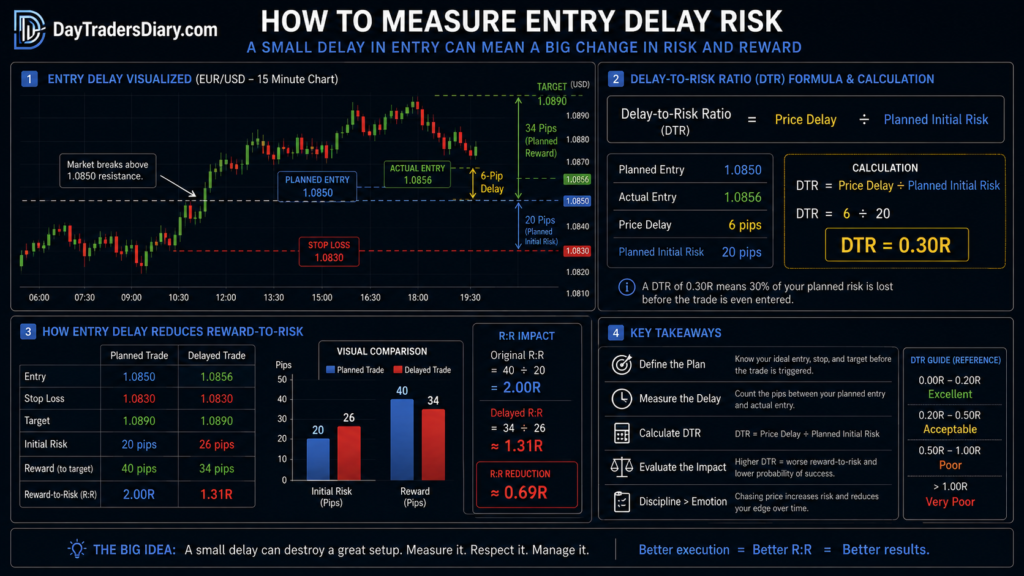
A useful metric is the delay-to-risk ratio.
The calculation is straightforward:
Delay-to-Risk Ratio = Price Delay ÷ Planned Initial Risk
Let’s say you want to stop 20 pips away, and you enter 6 pips late.
Six divided by 20 is 0.30.
Your late arrival took up 30% of the original risk distance.
Now observe an alternative method with a 40 pip halt.
The same six-pip delay represents only 15% of the initial risk.
The price movement is identical, but its effect on the trade is completely different.
This is why fixed pip-based delay rules are often less useful than risk-normalized rules.
Measure the Change in Reward-to-Risk
The next calculation is even more important.
Calculate the reward-to-risk ratio before the delay and then calculate it again at your actual entry.
Suppose your planned EUR/USD trade has an entry at 1.0850, a stop at 1.0825, and a target at 1.0900.
Your initial risk is 25 pips.
Your expected reward is 50 pips.
Your planned reward-to-risk ratio is 2R.
Now, suppose you hesitate and enter at 1.0858.
Your new risk is 33 pips.
Your remaining reward is 42 pips.
Your new reward-to-risk ratio is approximately 1.27R.
The eight-pip delay did much more than move your entry.
It reduced the trade’s expected reward relative to its risk.
That is the measurement that matters.
Entry Delay Depends on Market Volatility
Another useful approach is to compare your entry delay with current volatility.
Suppose EUR/USD is normally moving two pips per minute during your trading period. You wait 15 seconds, and the price moves four pips.
That is a meaningful move relative to the market’s normal pace.
Now imagine a news-driven environment where EUR/USD is moving 20 pips per minute.
A four-pip movement over 15 seconds means something very different.
You can therefore think about entry delay in volatility terms.
One simple approach is to compare the price movement during your delay with the expected movement during the same period.
Another approach is to compare your price delay with ATR.
Suppose ATR(14) is 80 pips and your entry delay costs 8 pips.
Eight divided by 80 equals 10%.
Your delay consumed 10% of the ATR.
That does not automatically make the trade invalid, but it gives you context.
The same method can be used across different currency pairs and volatility regimes.
What Research Says About Execution Conditions
Entry delay is not purely psychological.
Market liquidity and execution conditions affect the price traders actually receive.
The Bank for International Settlements has researched FX execution algorithms and the evolving structure of foreign currency markets. It has conducted research on the expanding role of electronic execution and the link between trading technology and market liquidity.
For a day trader, the practical lesson is straightforward.
The price displayed on a chart is not necessarily the same price you will receive when you attempt to execute during a fast market.
Research into FX market microstructure has also found substantial intraday differences in trading activity and spreads. Studies of electronic FX markets show that liquidity and trading activity can vary significantly across market periods.
This matters because a strategy that works during a highly liquid period may behave differently when liquidity becomes thinner.
CME Group also discusses the direct role of bid-ask spreads and execution costs in FX trading.
The practical takeaway is simple.
Do not treat execution costs and entry timing as something that happens after your strategy has already done its job.
They are part of the strategy.
The Critical Difference Between Delay and Confirmation
Here is where experienced traders need to be careful.
Not every later entry represents poor execution.
Sometimes waiting actually improves the trade.
Imagine price breaks resistance at 1.0850.
Your trading plan specifically requires a breakout followed by a retest.
Price breaks 1.0850, pulls back to 1.0851, holds the level, and then begins moving higher.
You enter at 1.0853.
You entered later than the original breakout, but that does not necessarily mean you suffered entry delay risk.
You were following a different, predefined entry condition.
Now compare that with a trader whose original plan was to buy the breakout at 1.0850.
The breakout occurs.
The trader hesitates for 20 seconds.
Price reaches 1.0858.
The trader enters because they are afraid the move will continue without them.
That is a genuine entry delay.
The distinction matters because the two trades should not be classified the same way in your journal.
Classify Your Entries
A simple classification can make your data much more useful.
An immediate execution is a trade entered according to the original trigger.
A delayed execution occurs when the original trigger happens, but you fail to execute without a new predefined condition.
A deliberate confirmation entry occurs when your strategy intentionally waits for a secondary condition before entering.
After 50 or 100 trades, these categories can reveal significant differences.
You may discover that immediate entries have a 48% win rate but 1.9R average winners.
Delayed entries might have a 45% win rate with 1.1R average winners.
Deliberate confirmation entries might have a 55% win rate but fewer opportunities.
That gives you something useful to work with.
You can determine whether your problem is hesitation, strategy design, or simply the wrong entry model for certain market conditions.
A Practical Entry Delay Decision Framework
Skip an original entry? Don’t start asking yourself, “Should I still take it?”
Ask a smarter question.
First, have prices fallen more than your maximum allowable entry?
If it has, the original trade may no longer exist.
Next, has the risk structure changed?
Look at the distance to your stop, the distance to your target, current volatility, nearby support or resistance, and the location of the price relative to the original breakout or pullback zone.
Then ask whether the market has created a new entry condition.
If it has, evaluate that new setup on its own terms.
If it has not, you are probably chasing the original move.
Finally, ask yourself one of the most useful questions in execution psychology:
Would I take this trade if I had never seen the original signal?
If the answer is no, you are probably trying to recover a missed opportunity rather than trading a valid setup.
Entry Delay Risk During Breakouts
Breakouts are where entry delay becomes particularly obvious.
A breakout strategy often depends on entering near the point where market participants are forced to reprice.
Suppose the high of a London session range is 1.2700.
You plan to buy when the price breaks above that level.
Price trades at 1.2702.
Then 1.2705.
Then 1.2709.
Then 1.2714.
A trader entering at 1.2714 may still believe they are trading the breakout.
But they are no longer entering at the same location relative to the original market structure.
The further the price travels, the more likely it is that part of the expected move has already happened.
This creates a common problem.
If you maintain the original stop, your monetary risk may become too large.
If you tighten the stop to compensate, you may place it inside ordinary market noise.
Neither solution is particularly attractive.
That is why breakout traders should define their maximum acceptable extension before the breakout happens.
Do not create the rule after the price has already moved.
Entry Delay Risk During Pullbacks
Pullback strategies create a different problem.
Suppose you plan to buy a retracement into a previous breakout zone.
Price reaches your preferred level.
You hesitate.
Price begins moving higher.
You finally enter the middle of the reaction.
The market may continue higher, but your entry is now farther away from the location where risk was easiest to define.
This often creates stop inefficiency.
The original trade may have required a 12-pip structural stop.
The delayed trade might require a 20-pip stop.
That is a 67% increase in stop distance.
If you keep the same position size, your monetary risk increases.
This is where entry timing and position sizing become directly connected.
Entry Delay and Position Size
Suppose you plan to risk $100 on a trade.
Your original stop is 20 pips away.
Your position size is calculated around that 20-pip stop.
You delay the entry and now need a 30-pip stop.
If you keep the same position size, you are no longer risking the same amount.
Your risk has increased by roughly 50%, before accounting for changes in pip value or execution costs.
This is one of the most common mistakes caused by late entries.
The trader thinks they are following the original risk plan because they are using the same lot size.
They are not.
The stop distance changed.
The risk changed.
This is where a position size calculator becomes useful. Instead of trying to adjust lot size after the trade has already moved mentally, calculate your position from the actual entry and structurally valid stop.
The principle is simple.
When the entry changes, the stop relationship can change.
When the stop changes, position size may need to change.
Your DayTradersDiary.com Position Size Calculator should therefore be part of the process whenever a delayed entry materially changes your stop distance.
Define Your Maximum Entry Deterioration
Instead of saying, “I will never enter more than 10 pips late,” define a maximum deterioration based on your initial risk.
For example, you may not enter if the price delay has consumed more than 20% of your planned initial risk.
If your planned stop is 25 pips, 20% equals 5 pips.
Your maximum acceptable extension is 5 pips.
If the price moves from 1.0850 to 1.0853, you may still have a valid trade.
If the price reaches 1.0858, you may be outside your predefined threshold.
This is a much better rule because it adapts to the structure of the trade.
Use Minimum R as a Second Filter
Your second filter can be the minimum acceptable reward-to-risk.
Suppose your original trade offers 2R.
You decide that you will not take the trade if the delayed entry reduces expected reward-to-risk below 1.5R.
Now your decision is objective.
You do not need to debate whether the price “looks like it will continue.”
You work out the new connection.
It might still be worth it if the transaction is still offering 1.6R.
If it has dropped to 1.2R then the original trade has gone against your rule.
That’s how you turn entry delay into an execution framework rather than an emotional judgment.
Why Time Alone Is a Poor Delay Metric
Consider two trades.
In the first trade, you wait 15 seconds, but the price moves only one pip.
In the second trade, you wait five seconds, and the price moves six pips.
Which trade suffered more entry delay risk?
Clearly the second one.
This is why your journal should record both time delay and price delay.
Time tells you about your behavior.
The price tells you about the economic consequence.
You need both.
What To Record in Your Trading Journal
Your trade journal should capture the original trigger as well as the eventual execution.
A useful record includes the signal time, execution time, planned entry, actual entry, price delay, initial risk, actual R, reason for the delay, setup type, and final result.
You can structure it like this:
MetricExample
Signal time 09:32:14
Entry time 09:32:26
Time delay 12 seconds
Planned entry 1.0850
Actual entry 1.0854
Price delay 4 pips
Initial risk 25 pips
Delay/Risk 0.16R
Planned R 2.0R
Actual R 1.56R
Delay reason Hesitation
This gives you enough information to determine whether the execution problem is actually damaging your strategy.
The DayTradersDiary.com Trade Journal Template can be used to track these variables consistently instead of relying on memory after the session.
That matters because traders are surprisingly bad at remembering exactly why they hesitated.
Record Why You Were Late
Do not simply write “late entry.”
Write the actual reason.
Maybe you were afraid because your previous two trades had lost.
You may have been checking another timeframe.
Maybe you wanted a perfect candle close.
Your platform may have become unresponsive.
The spread may have widened.
Maybe you intentionally waited for confirmation.
These situations require completely different solutions.
You cannot solve platform latency by becoming more confident.
You cannot solve unclear strategy rules by forcing yourself to click faster.
You cannot solve fear-driven hesitation by pretending that fear does not exist.
You need to identify the source first.
Find Your Personal Entry Delay Threshold
Do not copy another trader’s threshold.
Calculate your own.
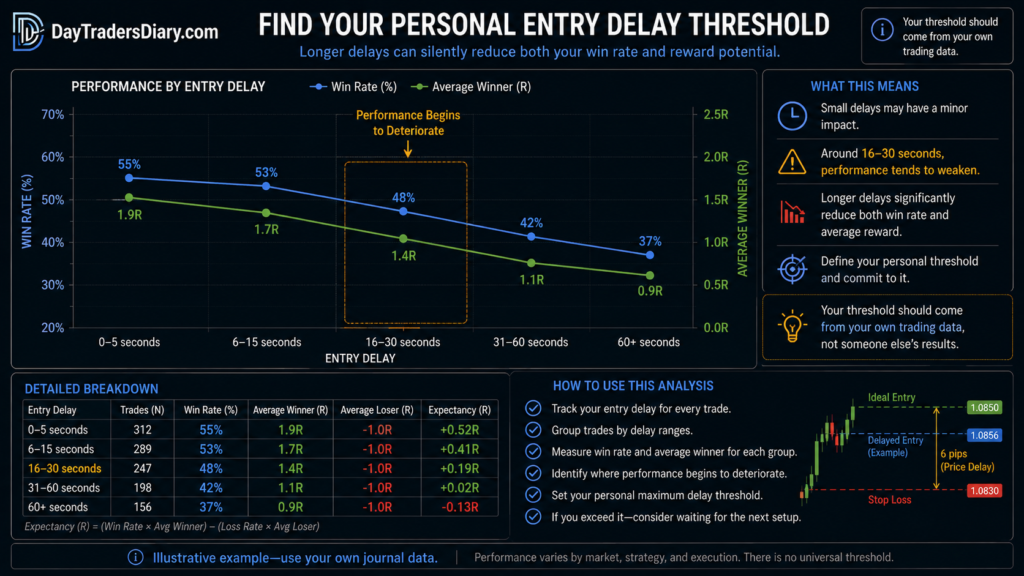
Take your historical trades and divide them into delay ranges.
Delay Trades Win Rate Average Winner Average Loser General Result
0 to 5 sec 42 55% 1.9R -1R Strong
6 to 15 sec 38 53% 1.7R -1R Positive
16 to 30 sec 31 48% 1.4R -1R Weaker
31 to 60 sec 24 42% 1.1R -1R Poor
60+ sec 19 37% 0.9R -1R Negative
These numbers are only an illustration.
Your results may look completely different.
The important thing is to find where your own strategy starts to deteriorate.
You may discover that a 10-second delay has almost no effect, while anything beyond 30 seconds damages expectancy.
That 30-second threshold is far more valuable than a generic rule from another trader.
Separate Your Results by Strategy
Do not combine every trade into one dataset.
A 20-second delay on a five-minute pullback can be almost irrelevant.
A 20-second delay on a one-minute breakout can be disastrous.
Separate your data by setup type and market condition.
Compare breakout trades with pullbacks.
Compare reversals with continuation setups.
Compare London-session trades with New York-session trades.
Compare normal market conditions with high-volatility periods.
You may find that your execution problem is not universal.
Your pullback strategy tolerates delayed entries quite well, while your breakout strategy deteriorates rapidly.
That is valuable information.
It means you do not necessarily have an execution problem across your entire trading business.
You have a strategy-specific execution constraint.
The Psychology Behind Entry Delay
There is usually a psychological conflict underneath hesitation.
A trader thinks:
“I know the setup is there, but what if this is the one that fails?”
Then another thought appears:
“Maybe I should wait for confirmation.”
Price moves.
Now the trader feels that they have missed the trade.
Eventually, the fear of missing the move becomes stronger than the fear of losing.
They enter late.
The market retraces.
The trader blames the market.
But the actual mistake happened much earlier.
It happened when the trader allowed an undefined emotional decision to replace a predefined execution rule.
The solution is not to eliminate hesitation through willpower.
The solution is to define the decision before the market reaches the entry point.
If your plan says that you enter when a specific condition occurs, provided the spread and price deviation remain within predefined limits. You do not have to make a new decision while the price is moving rapidly.
You execute the rule you already tested.
Entry Delay and FOMO
FOMO usually appears after the original entry has already been missed.
The sequence is predictable.
The setup triggers.
You hesitate.
Price moves.
You regret not entering.
Price continues moving.
You become afraid that you will miss the entire move.
You enter late.
Price retraces.
You decide the market is manipulating you.
The market probably did nothing unusual.
Your mistake was allowing the original execution window to disappear without having a rule for what happens next.
This is why a missed-trade journal can be so useful.
Keep a Missed-Trade Log
Record the trades you did not take.
Write down the original setup, trigger price, reason you hesitated, price after 10 seconds, price after 30 seconds, and price after one minute.
Then evaluate whether the original setup would still have been valid at those later prices.
This creates useful counterfactual data.
You may discover that many trades you thought you missed were actually better avoided.
You may also discover that your hesitation consistently costs you the first part of high-quality moves.
Both findings are valuable.
The purpose of the exercise is not to make you regret missed trades.
It is to identify whether your hesitation is systematically damaging expectancy.
Do Not Judge Delay Only by the Outcome
A late entry can win.
That does not prove the delay was good.
A perfectly timed entry can lose.
That does not prove the execution was bad.
You are evaluating the quality of the decision, not simply the final result.
Suppose you enter eight pips late and still make 2R.
The market may have continued strongly enough to overcome your poor entry.
That does not mean the eight-pip delay was harmless.
Likewise, a perfectly executed trade can lose because the underlying setup failed.
This is why execution quality needs to be reviewed separately from P&L.
Build an Entry Quality Score
If you want to go deeper, you can create a simple entry-quality score.
Give the trade 20 points for entering within your planned timing window, 20 points for remaining within the acceptable price deviation, 20 points for maintaining a structurally valid stop, 20 points for maintaining your minimum R, and 20 points for following the predefined execution rule.
A trade that wins 2R but scores 45 out of 100 is a poor process.
A trade that loses 1R but scores 95 out of 100 may be excellent execution.
This distinction becomes extremely important during drawdowns.
If you judge every decision only by whether it won or lost, you can easily abandon a good strategy because of normal statistical variance.
Entry Delay During High-Impact News
High-impact news requires a separate approach.
During major economic releases, prices can move much faster than normal.
Spreads can change.
Liquidity can change.
Quotes can update rapidly.
Your normal entry-delay threshold may therefore become meaningless.
If your strategy is not specifically designed for news trading, one sensible rule may be to avoid entering once the news move has materially displaced the original setup.
That is not necessarily being overly cautious.
It is recognizing that the market may have entered a different regime.
The same chart pattern can have completely different execution characteristics before and after a major release.
The Difference Between Speed and Preparation
Once traders learn that entry delay can hurt them, some make the opposite mistake.
They start entering immediately.
That is not the objective.
The goal is fast execution of a slow, deliberate decision process.
Spend the time before the deal deciding the exact set up, what gets you in, where the invalidation sits, the expected reward, how much wait is acceptable and what cancels the trade.
Then, when the trigger occurs, execution should be relatively boring.
You prepared before the market moved.
You do not need to debate the trade while it is moving.
That is professional execution.
A Practical Pre-Session Entry Plan
Before your session begins, choose the setups you are prepared to trade.
For each setup, define the trigger price, stop location, target, maximum acceptable price deterioration, minimum R, and any confirmation condition.
For example, you might have a EUR/USD breakout with an entry at 1.0850, a stop at 1.0825, and a target at 1.0900.
Your initial risk is 25 pips.
You decide that the maximum acceptable price delay is 5 pips.
You also decide that the trade must maintain at least 1.5R.
Now you have a complete decision framework.
If price breaks 1.0850 and you execute at 1.0853, the trade may still qualify.
If the price reaches 1.0858 before you act, you already know that the original entry condition has been exceeded.
You do not need to negotiate with yourself.
When Should You Completely Skip the Trade?
Skip the trade when the original reason for entering has materially disappeared.
If price has exceeded your maximum extension, if minimum R has disappeared, if stop placement has become structurally poor, or if volatility has changed dramatically, the trade may no longer be worth taking.
The same applies when a breakout has already traveled into a major target area or when a new opposing market structure has formed.
Most importantly, skip the trade when the only reason you want to enter is that you are afraid the market will continue without you.
That is not a trading signal.
It is emotional pressure.
The ability to skip a deteriorated trade is part of execution skill.
Not every missed trade needs to be recovered.
Scaling Your Edge Beyond Your Own Capital
Once you start measuring something as specific as entry delay, you begin to see how professional trading is actually built.
It is rarely one magical setup.
The advantage usually comes from dozens of small improvements.
Better entries.
More consistent risk.
Fewer unnecessary trades.
Lower execution costs.
Cleaner data.
Better review.
More disciplined position sizing.
Eventually, capital becomes another constraint.
A trader can have a legitimate edge and still find that a small personal account limits the financial impact of that edge.
That is one reason experienced traders sometimes explore evaluation-based prop trading programs.
The important distinction is that an evaluation account should not be treated as a shortcut to profitability.
It is another trading environment with its own rules, restrictions, drawdown structure, and psychological pressures.
The5ers, for example, offers evaluation-style programs with defined risk parameters and profit targets. Traders considering an evaluation should study the current rules carefully rather than choosing a program simply because the advertised account size looks attractive.
Other firms, including FTMO and FundedNext, also operate evaluation-based models, but their rules and risk structures differ.
For a serious trader, the right question is not which firm advertises the biggest account.
The better question is whether the rules fit the way you already trade.
A trader who consistently violates a 20% entry-delay threshold on a small personal account will not magically become disciplined when given access to a larger nominal account.
In fact, stricter evaluation rules can expose execution weaknesses faster.
That is why I would only consider a The5ers evaluation after establishing measurable execution statistics in your own trading journal.
The objective should not be to pass an evaluation as quickly as possible.
The objective should be to determine whether your existing edge survives a structured risk environment.
Entry Delay and Capital Scaling
Suppose your journal shows that your average planned risk is 0.5% and your average execution deterioration costs another 0.12R.
That means poor execution is consuming a meaningful portion of your planned risk budget.
If you increase your position size before fixing that problem, you are simply increasing the dollar value of the same mistake.
This is why execution statistics should improve before position size increases.
A sensible scaling process is to prove the strategy, prove execution consistency, prove risk control, increase capital, and then monitor whether behavior changes under larger monetary stakes.
Scaling should amplify a proven process.
It should not be used to compensate for an unproven one.
The Seven Metrics Worth Tracking
You do not need dozens of statistics.
For entry delay, focus on average time delay, median time delay, average price delay, delay-to-risk ratio, R deterioration, delayed-trade expectancy, and the reason for the delay.
The average gives you a general idea of your overall behavior.
The median keeps a few extreme deals from skewing the image.
The economic cost is shown by price delay.
Delay-to-risk illustrates the impact against your projected risk.
R deterioration shows whether the trade itself became less attractive.
Delayed-trade expectancy tells you whether the problem is actually affecting your edge.
The reason for the delay tells you what needs fixing.
Together, those metrics provide a much clearer picture than simply looking at your average entry price.
Your Weekly Entry Delay Review
At the end of each week, sort your trades by delay.
Look at the five most delayed trades.
Ask if the original set up still stood, if the hesitation was justified, if the price had gone above your pre-set threshold, if the trade was taken because of a new signal or because of FOMO, if the delay changed the stop, if it changed the R, if you would take the same trade again under the same conditions.
Then look at your fastest trades.
The lesson may surprise you.
Your best trades may not necessarily be the ones with the shortest delay.
They may be the trades where execution speed was appropriate for the strategy.
That is the real objective.
The Real Goal Is to Minimize Unpriced Deterioration
The biggest lesson from entry delay risk is not simply “enter faster.”
It is to avoid allowing the quality of a trade to deteriorate without recognizing it.
A professional trader does not think of an entry as one exact price.
The entry is often a range of acceptable conditions.
At the beginning of that range, the setup may have its strongest expected value.
As the price moves away, the expected value can deteriorate.
Eventually, the trade crosses a point where participation no longer makes sense.
That boundary should come from your data.
Not frustration.
Not FOMO.
Not the fact that the price is moving.
Frequently Asked Questions
What is the entry delay risk in forex?
Entry delay risk is the deterioration in a forex trade’s expected quality between the moment the original entry condition occurs and the moment the trader actually enters. It can increase effective risk, reduce reward-to-risk, worsen stop placement, and lower expected trade quality.
How do you calculate entry delay risk?
Start by calculating the price difference between your planned entry and actual entry. Then divide that price difference by your planned initial risk.
For example, if your planned risk is 20 pips and you enter 5 pips late, the calculation is 5 divided by 20, which equals 0.25R.
Your entry delay consumed 25% of the original risk distance.
Is entry delay the same as slippage?
No. Slippage is the difference between expected execution and actual execution. Entry delay is broader and includes hesitation, waiting for confirmation, platform delays, execution delays, and market movement that occurs while you are waiting.
How many seconds of entry delay is acceptable?
There is no universal number. A better approach is to measure the price movement during the delay relative to your strategy’s initial risk, current volatility, and reward-to-risk ratio.
A five-second delay can be significant during a fast breakout and almost irrelevant during a slow pullback.
Should I enter a trade if I missed the original entry?
Only if the trade still meets your predefined criteria.
Price extension. Stop distance. Expected R. Volatility. New viable setup?
If the original edge is gone it’s usually best to pass on the trade than chase it.
How can I reduce entry hesitation?
Define the entry, stop, target, maximum acceptable price deviation, and cancellation conditions before the trade triggers.
Then record the reason whenever you hesitate.
If hesitation repeatedly comes from fear after losing trades, the problem may be psychological. If it comes from unclear rules, the problem is your trading plan.
Can an entry delay make a profitable strategy unprofitable?
Yes.
A strategy can have positive expectancy at the intended entry price but become significantly less attractive after execution deterioration.
This is especially relevant for short-term breakout and momentum strategies where a large portion of the expected move can happen quickly.
Should delayed trades use a smaller position size?
If the delayed entry requires a wider structurally valid stop while maintaining the same monetary risk, position size should normally be recalculated.
Do not keep the same lot size simply because that was the size specified in your original plan.
How should I delay my journal entry?
Record the trigger time, execution time, planned entry, actual entry, price delay, initial risk, actual R, reason for delay, setup type, and final result.
It is also useful to classify each trade as immediate execution, delayed execution, or deliberate confirmation.
What is the best entry delay forex strategy?
There is no universal best strategy.
A better approach is to establish a maximum acceptable price deterioration based on initial risk and test that threshold across your historical trades.
For example, you may discover that your breakout strategy performs well when the entry delay remains below 0.15R but deteriorates significantly above 0.30R.
That becomes your evidence-based threshold.
Final Takeaway
Most traders measure whether they were right.
Better traders measure whether they executed the right decision at the right time.
That distinction matters.
If your strategy identifies a valid setup at 1.0850 but you repeatedly enter at 1.0857, 1.0860, or 1.0865, you may not have a strategy problem.
You may have an execution deterioration problem.
Start measuring it.
For your next 30 trades, record the original trigger, actual entry, time delay, price delay, delay-to-risk ratio, R deterioration, and reason for the delay.
Then compare expectancy across different delay ranges.
You may discover that the biggest improvement available to you is not another indicator, another setup, or a more complicated entry model.
It may be learning exactly when a late trade stops being the trade you originally planned.
Once you know that number, execution becomes much less emotional.
Your next read should be the DayTradersDiary.com article on Break-Even Stops With Micro Adjustments, because entry quality and stop management are closely