
Many traders believe they have a strategy problem.
In reality, they have a timing problem.
I’ve reviewed trading journals in which a trader reported an overall win rate of just 46%. At first glance, the strategy looked average.
But after separating trades by session, something surprising appeared.
The trader won nearly 65% of trades during the London session.
During the Asian session, the win rate dropped below 30%.
The strategy hadn’t changed.
The trader had.
Or more accurately, the market had.
This is one of the biggest blind spots in retail trading. Most traders track their overall performance but never ask a more valuable question.
When am I actually profitable?
Professional traders know that market behavior changes throughout the day. Liquidity, volatility, spreads, institutional participation, and momentum all vary across trading sessions.
Your edge may not exist all day.
It may only exist for a few hours.
This guide explains how to track your forex win rate by session, why session analysis reveals opportunities hidden inside your statistics, and how to use that data to improve consistency without changing your strategy.
Why Trading Session Analysis Matters
The forex market operates 24 hours a day.
That doesn’t mean every hour offers the same opportunity.
According to the Bank for International Settlements (BIS), forex trading volume increases significantly during the overlap between major financial centers, particularly London and New York. Greater liquidity often leads to tighter spreads, stronger trends, and more efficient price discovery.
Research from the CFA Institute also emphasizes that market conditions and liquidity directly influence execution quality and trading performance.
For day traders, this means an identical setup can produce completely different results depending on when it occurs.
Understanding this relationship is one of the fastest ways to improve consistency.
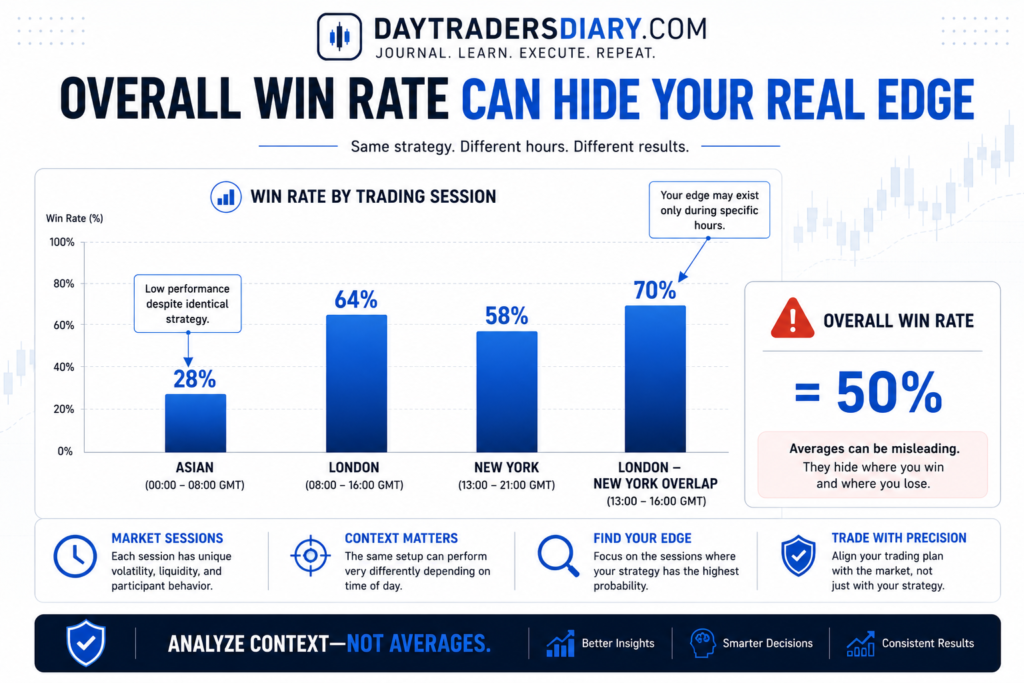
Why the Overall Win Rate Can Be Misleading
Suppose your journal shows:
Overall win rate: 50%
That statistic tells you almost nothing.
Imagine breaking it down.
Asian session: 28%
London session: 64%
New York session: 58%
London and New York overlap: 70%
Suddenly, the picture changes.
Instead of searching for a better strategy, you stop trading during your weakest session.
Your strategy improves without changing a single entry rule.
This is why experienced traders analyze context rather than averages.
The Four Main Forex Trading Sessions
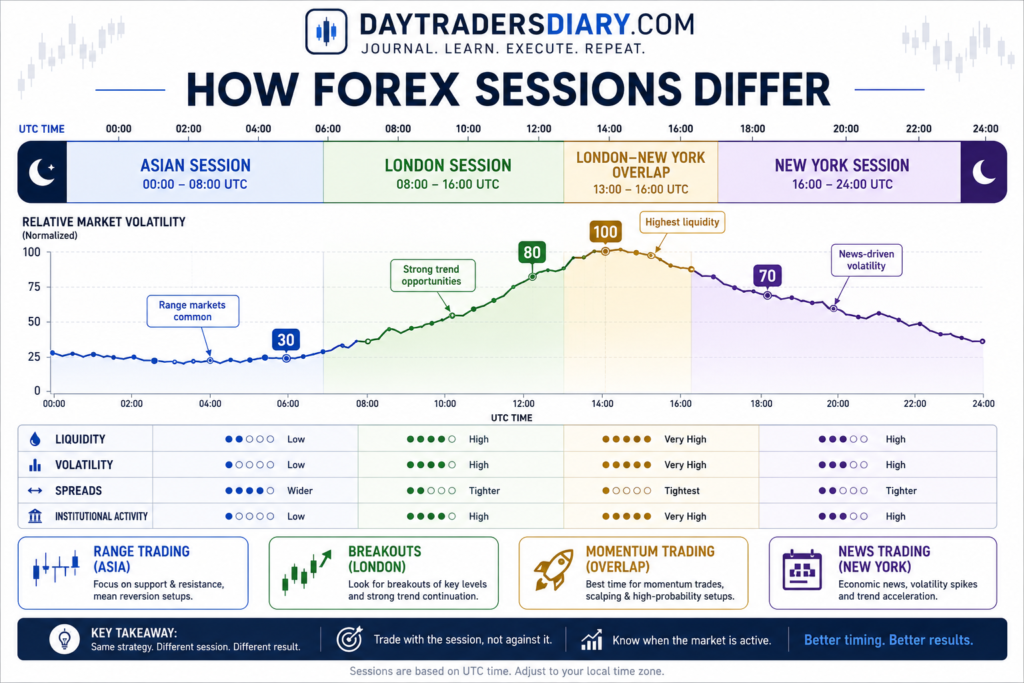
Before tracking results, understand the characteristics of each session.
The Asian session typically offers lower volatility and slower price movement. Range-trading strategies often outperform momentum strategies here.
The London session usually produces increased volatility and stronger directional moves as European institutions become active.
The New York session often continues established trends or creates reversals around major U.S. economic releases.
The London and New York overlap generally produces the highest liquidity of the trading day, making it attractive for many intraday traders.
Each session rewards different trading styles.
Knowing where your strategy naturally fits is far more valuable than forcing it into every market environment.
Categorize Every Trade by Session
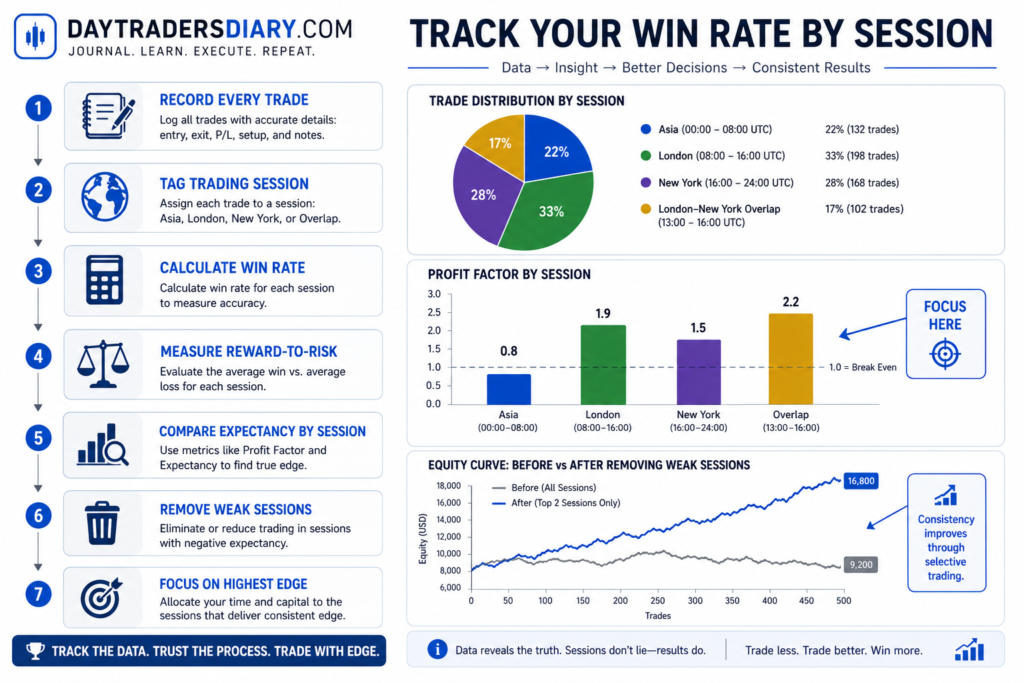
Your journal should record more than profit and loss.
Every trade should include the session in which the position was opened.
For example:
Asian.
London.
New York.
London and New York overlap.
Over time, meaningful patterns begin to emerge.
Many traders are surprised to discover that they consistently lose money in one session while generating nearly all their profits in another.
That discovery often improves performance more than changing indicators.
Don’t Focus Only on Win Rate
A higher win rate isn’t automatically better.
Suppose your London session produces:
Win rate: 55%
Average reward-to-risk ratio: 2.5:1
Now compare that with your Asian session:
Win rate: 65%
Average reward-to-risk ratio: 0.8:1
Despite winning more trades in Asia, the London session may generate significantly higher overall profitability.
Professional traders evaluate complete performance.
Win rate.
Average reward.
Average loss.
Expectancy.
Profit factor.
Drawdown.
If you’ve already read our guide on How to Track Your Win Rate Like a Pro, you’ll know why no single metric should ever be analyzed in isolation.
Evaluate Market Conditions Within Each Session
Sessions alone don’t explain everything.
Market conditions matter too.
For example, your London breakout strategy may perform well only when the daily chart shows a clear trend.
During consolidation, the same setup may struggle.
This is why experienced traders combine session analysis with higher timeframe context.
Our article on the Best Daily Charts Setup for Forex Traders explains how using the daily chart before each session helps make better trading decisions throughout the day.
Context always strengthens statistics.
Review Losing Trades by Session
One of the fastest ways to improve is by reviewing your losing trades separately.
Ask yourself:
Did losses occur during low-volatility hours?
Were spreads unusually wide?
Did I force trades because I felt I should be active?
Was major news approaching?
Did I ignore higher timeframe direction?
The answers often reveal behavioral mistakes rather than strategy flaws.
Many traders eventually discover they were trading because the market was open.
Not because opportunity existed.
Build Session-Specific Trading Rules
Once enough data has been collected, create rules based on evidence.
For example:
Only trade breakouts during London.
Avoid range strategies during major news.
Reduce trading activity during quiet Asian sessions if historical performance is weak.
Trade only the first three hours of New York.
These rules should be based on your statistics.
Not from social media opinions.
Professional traders let their data shape their routine.
Use Risk Management to Reinforce Your Edge
Session analysis also improves risk allocation.
Suppose your data shows exceptional consistency in London but mediocre results elsewhere.
Rather than increasing overall risk, you may focus more attention on your highest-quality session while maintaining disciplined position sizing.
Regardless of the session, risk should remain consistent.
The Position Size Calculator ensures that every trade risks an appropriate percentage of capital based on the stop-loss distance, rather than on emotional confidence.
That consistency makes session statistics far more reliable over time.
Track Session Performance in Your Journal
Your Trade Journal Template should include more than screenshots and comments.
Record:
Trading session.
Currency pair.
Strategy.
Market condition.
Higher timeframe trend.
Risk percentage.
Trade outcome.
Emotional state.
After several months, you’ll possess something far more valuable than a win rate.
You’ll have a detailed map of where your edge actually exists.
That level of self-awareness separates experienced traders from those constantly searching for new strategies.
High Win Rate Doesn’t Mean High Profitability
Many traders search online for a “high win rate trading strategy.”
The better question is whether the strategy produces positive expectancy.
A strategy winning 45% of trades with a 3:1 reward-to-risk ratio may outperform another winning 75% with small gains and occasional large losses.
Looking at session analysis, we see how positive expectation happens organically.
It doesn’t pull it out of thin air.
Thus, specialists analyze the quality of each session, not pursue remarkable percentages.
Scaling a Proven Trading Routine
Consistently profitable traders eventually reach a point where capital becomes the limiting factor instead of skill.
Proprietary trading firms understand that successful traders are rarely profitable every hour of every day.
They’re profitable because they recognize where their edge exists and execute consistently within those conditions.
Firms such as The5ers, FTMO, and FundedNext reward disciplined traders who respect risk limits, trade selectively, and demonstrate repeatable performance.
A The5ers evaluation account is a reasonable next step for a trader with a trading record showing consistent strong outcomes during some sessions and disciplined execution and risk management, to trade more capital without significantly increasing his own financial exposure.
Final Thoughts
Your strategy doesn’t have to perform equally well every hour.
Neither do you.
Stop asking whether you’re a profitable trader.
Start asking when you’re a profitable trader.
That one question often reveals opportunities hidden inside months of trading data.
Over the next month, record the session for every trade you take.
Review the results honestly.
You may discover that your biggest improvement doesn’t come from finding a new strategy.
It comes from trading at the right time.
For your next read, explore How to Evaluate Your Day Trading Performance to learn how combining session analysis with deeper performance metrics can uncover even more opportunities for improvement.
Frequently Asked Questions
Why should I track my win rate by trading session?
By tracking your win rate by session you may see when your strategy is working best and spend more time trading during the sessions with the highest probability of success and avoid periods that consistently diminish your profitability.
Which forex trading session is best for day trading?
The London session and the London-New York overlap are commonly preferred as they usually provide better liquidity, tighter spreads and stronger price action. But the optimal session depends on your plan and your prior results.
Is win rate the most important trading metric?
No. To get a true picture of how a trading strategy is performing, you need to look at win rate along with reward/risk ratio, expectation, profit factor, and drawdown.
How many trades do I need before evaluating session performance?
A meaningful analysis usually requires at least 50 to 100 trades per session. Larger sample sizes produce more reliable conclusions.
Can the same strategy perform differently in different sessions?
Yes. The trading day is not a constant environment for market volatility, liquidity, spreads and institutional participation which can have a material impact on the efficacy of a strategy.
How do I effectively track trading session performance?
Use a detailed trading log that captures the trading session, technique, market circumstances, position size, outcome, and your own observations. Regularly reviewing this data can assist you in determining when you trade the best and avoiding transactions that you don’t need to take.