
Most traders think their strategy is the reason they are losing money.
In reality, many traders are profitable on paper long before they become profitable in execution.
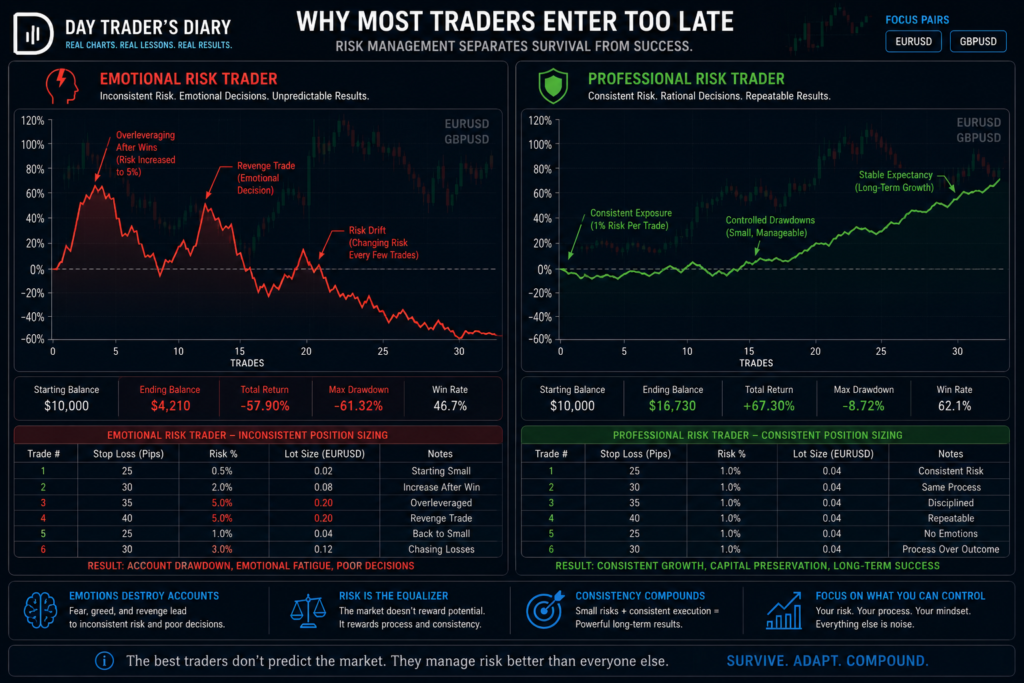
Usually the real concern is risk inconsistency.
1 trade = 0.5% risk
Next up risk 4%.
One stoploss is calculated logically
Next is the emotional.
One position size is a strategy.
Next up is revenge trading disguised as confidence.
This is where trading performance quietly breaks apart.
Professional traders understand something retail traders often ignore: survival comes before growth. If your risk exposure changes emotionally from trade to trade, even a strong strategy becomes statistically unstable.
That is why risk calculators are not optional tools for serious traders. They are execution stabilizers.
A forex risk calculator removes guesswork from position sizing, stop placement, and account exposure. More importantly, it forces consistency during emotional market conditions where traders usually sabotage themselves.
This guide covers how expert day traders use risk calculators, why they are more important than most indicators, and how proper risk calculation affects long-term profitability, psychology, and scaling potential.
Why Most Traders Misunderstand Risk
Most beginner traders think risk is stop losses.
Risk consistency is the exposure, professional traders believe.
That distinction counts.
Two traders with the exact same technique can have radically different results because their risk models differ.
You are always taking a fixed percentage risk.
The other one emotionally alters size with wins and losses.
Expectancy is frequently destroyed by the second merchant over time.
The CFA Institute’s research has repeatedly shown that position sizing and drawdown management are more important for long-term portfolio survival than the precision of short-term entries alone.
The Chicago Mercantile Exchange has also published several research that demonstrate the expansion in volatility during macroeconomic releases significantly improves loss and execution risk, especially for overleveraged retail traders.
In the meantime, broker behavioural data studies provided by firms such as FXCM and DailyFX historically have shown many losing retail traders were directionally correct more frequently than not, but nevertheless lost money since average losses were far larger than average wins.
That insight changes how professionals think about trading.
Risk management is not defensive.
It is mathematical edge protection.
What a Forex Risk Calculator Actually Does
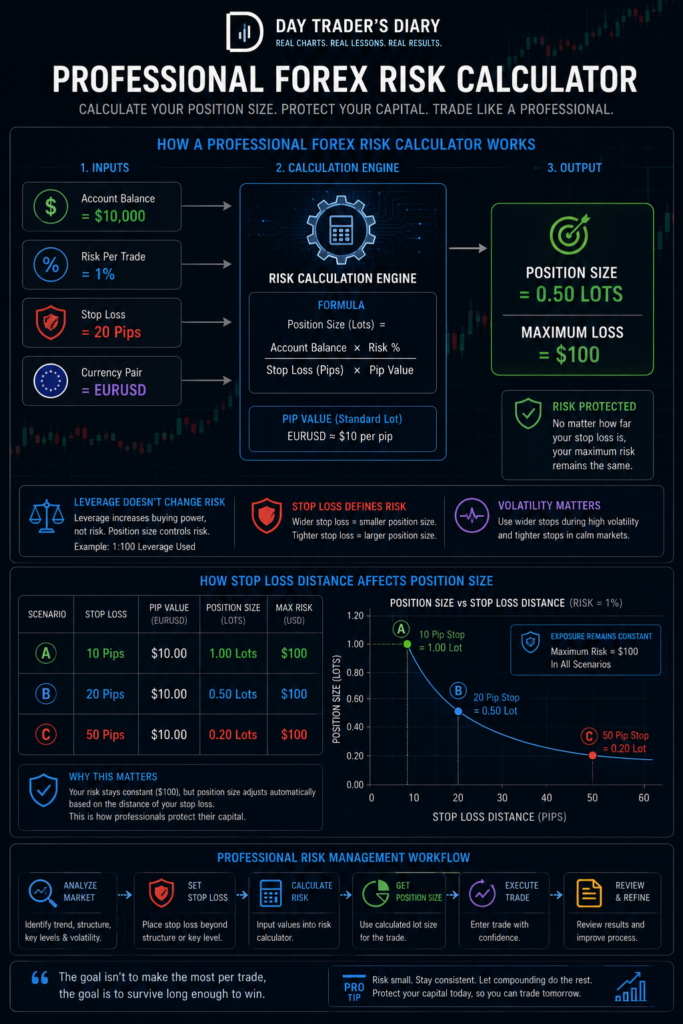
A forex risk calculator determines how much position size you can take based on:
Account size
Percent risk
Stop-loss distance
Currency pair
Pip value
Environment leverage
And the calculator standardises exposure instead of emotive lot size guesswork.
For example:
If you have a $10,000 account and risk 1% per trade, your maximum loss should remain around $100 regardless of setup type.
If your stop loss is 20 pips, your lot size changes.
If your stop loss is 50 pips, your lot size changes again.
The calculator adjusts automatically so risk remains stable.
This is where many traders make costly mistakes manually.
They keep the same lot size but change the stop distances which inadvertently increases exposure considerably under volatile conditions.
Professional traders never do this.
Why Risk Calculators Matter More During Volatility
One of the biggest trading misconceptions is that volatility creates opportunity alone.
Volatility also creates hidden risk expansion.
For example, EURUSD during quiet Asian session conditions behaves very differently compared to Non-Farm Payroll release volatility.
A 15-pip stop during low volatility may be reasonable.
That same stop during major economic releases may become meaningless noise.
This is why professional traders constantly adjust exposure relative to volatility conditions.
Often experienced traders will combine:
ATR analysis:
Volatility session
Liquidity conditions
risk news calendar
Volatility ultimately reveals emotional decision-making in the absence of systematic risk evaluation.
The Professional Risk Framework
Most always profitable traders utilise a simple hierarchy of:
Stop placement is a function of market structure.
The risk percentage is what you are allowed to expose.
Position size changes accordingly.
Retail traders tend to do the opposite.
They pick the position size first and force stops around that.
This results in emotionally warped execution.
Professionals do not ask:
“How much money can I get?”
They are asking:
“What is the right amount of controlled exposure if this idea doesn’t work?
This change of thinking is what sets gambling apart from organised trading.
The Biggest Mistakes Traders Make With Risk
Using Fixed Lot Sizes
This is one of the fastest ways to create inconsistency.
A fixed lot size across all trades ignores volatility differences entirely.
A 10-pip stop and a 50-pip stop cannot logically use identical exposure.
Professional traders adapt position size dynamically.
Increasing Risk After Winning Streaks
It is frequently sub-conscious.
Confidence increases.
Discipline fades off.
Exposure rises.
Paradoxically, many traders incur their greatest losses right following a string of significant wins.
Why?
Because emotional assurance takes the place of statistical discipline.
Revenge Trading After Losses
This is where calculators become psychologically helpful.
A structured risk model is a check against emotional increasing.
When risk is predefined mechanically, impulsive exposure becomes harder.
How Professional Day Traders Use Risk Calculators
Experienced traders usually calculate risk before analyzing profit targets.
That may sound backwards to newer traders, but it is one of the most important mindset shifts in trading.
This process generally appears like follows:
First, you need to identify the trade thesis.
Second, define the level of invalidation.
Third, calculate stopping distance.
Fourth, compute allowable position size .
Only then the reward potential matters.
This creates cleaner decision-making because risk becomes objective instead of emotional.
Why Small Accounts Need Risk Calculators Even More
Smaller accounts are psychologically dangerous.
Why?
Because traders often feel pressure to grow them quickly.
That pressure leads to overleverage.
A trader risking 8% to 10% every transaction will stick around for a while on winning streaks but variance will eventually destroy the account.
Professional traders know consistency builds slower than social media promises.
Ironically, traders who survive longest usually grow fastest over time because they avoid catastrophic drawdowns.
This is especially important for traders using forex micro accounts or prop firm evaluation accounts where drawdown limits are strict.
The Relationship Between Risk and Psychology
Most trading psychology problems are actually risk problems.
Fear usually comes from oversized positions.
Impulse trading usually comes from emotional recovery attempts.
The most common reason for premature evacuation is that exposure is uncomfortable.
As traders trim their exposure to appropriate levels, their emotional clarity gets a huge boost.
This is why many experienced traders say:
“If you cannot sleep comfortably during a trade, you are too big.”
That seems like a simple statement, yet it speaks to a deep trading maturity.
Position Sizing and Long-Term Survival
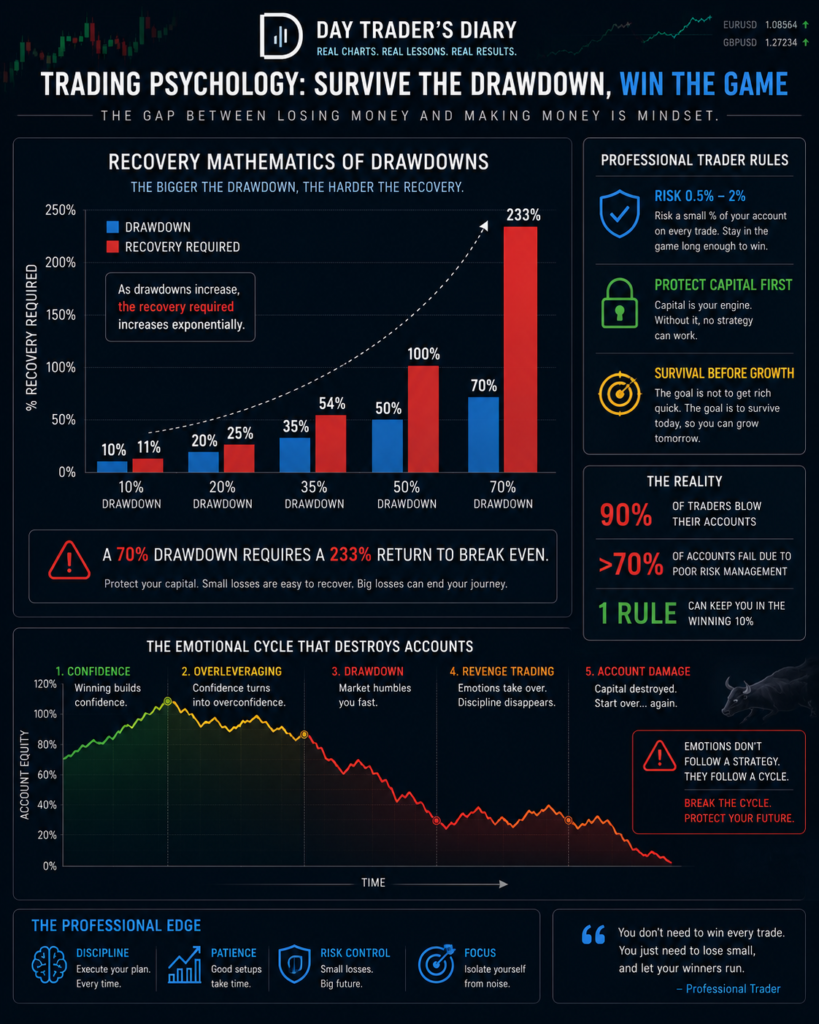
One of the least discussed realities in trading is recovery mathematics.
A 10% drawdown demands something like 11% recovery.
A 50% drawdown is a 100% rebound.
That’s why it’s more important to prevent large losses than to maximise short-term gains.
Survival curves are a major concern for professional traders.
Retail traders often think only about profit potential.
The difference changes everything over multi-year performance.
Using a Position Size Calculator Properly
Many traders misuse calculators because they still think emotionally afterward.
The tool itself is not the edge.
Consistency is the edge.
When using a Position Size Calculator, the goal is not maximizing lot size. The goal is stabilizing execution quality across all market conditions.
Professional traders, no matter how experienced, routinely employ calculators before each trade.
That habit reduces excessive cognitive burden and minimises drift in execution.
Journaling Risk Decisions
Most traders document their entrances and exits.
Few risk behaviours diary.
This is not so.
Your journal should keep a record of:
Risk % per Trade
Deviations in position size
Mood on entry
If rules were followed
Slippage conditions
Exposure to news events
Quality of risk-to-reward
This reveals behavioural tendencies over time that are otherwise hidden.
For example:
Your worst transactions can be when you impulsively increase size.
Or you may realize your best trading periods occur when exposure remains extremely consistent.
This is why maintaining a structured Trade Journal Template becomes critical for serious performance analysis.
The goal is not recording random statistics.
The goal is understanding behavioral risk patterns.
Risk Calculators and Prop Firm Evaluations
One reason many traders fail prop firm evaluations is not strategy weakness.
It is risk instability.
Evaluation programs at firms like The5ers, FTMO, and FundedNext are designed around drawdown discipline because firms understand a simple truth:
A trader without risk control eventually self-destructs.
This is why professional traders preparing for funded accounts become obsessive about consistent risk exposure.
The traders who pass evaluations repeatedly are usually not the most aggressive traders.
They’re the most stable of dealers.
And that distinction counts.
If you already have discipline in your execution on demo or small live accounts, a structured risk framework with a The5ers evaluation account could be a sensible next step to get access to more capital without overleveraging.
Advanced Insight Most Retail Traders Ignore
Risk calculators are more than account protectors.
They enhance decision-making quality.
Standardising exposure prevents traders from being emotionally obsessed with single trades.
That changes psychological performance dramatically.
A trader risking 1% consistently can think probabilistically.
A trader risking random amounts becomes emotionally reactive.
Professional trading requires emotional neutrality.
Neutrality is impossible without stable exposure.
This is one reason great traders appear to be calmer when volatility strikes.
Not because they forecast markets better.
That is because their risk is managed before a deal is even placed.
FAQs
What is a forex risk calculator?
Forex risk calculators enable traders to calculate the correct size of a position depending on their account balance, the distance at which they set their stop loss and what percentage of the account they are willing to risk.
Why is a risk calculator important in trading?
It normalises exposure and avoids emotional overleveraging, particularly in turbulent market conditions.
How much should I risk per forex trade?
Professional traders usually risk 0.5% to 2% per trade depending on the consistency of their technique and the market they are operating in.
Can risk calculators improve trading psychology?
Yes. Consistent exposure minimises emotional pressure, fear, vengeance trading and impulsive decision making.
Do professional traders use risk calculators?
Absolutely. Most experienced traders calculate exposure before entering trades to maintain long-term consistency.
Are free forex risk calculators accurate?
Most reputable free calculators are accurate if traders input correct account size, stop loss distance, and pair information.
What is the difference between leverage and risk?
Leverage increases buying power. Risk refers to actual account exposure if the trade fails. Many traders confuse the two.
Final Thoughts
Most traders search endlessly for better indicators, better entries, and better strategies.
Meanwhile, the biggest leak in their trading sits quietly underneath every decision:
inconsistent risk.
The traders who survive long enough to become consistently profitable almost always develop one shared habit:
They accept the risk calculation as a given.
Not because it feels good to do so.
Not because it ensures revenues.
But it keeps them alive long enough for edge and experience to build up.
This week, focus on one improvement only:
Calculate every position before entrance, demo trades included.
All of them.
Professional trading starts when trading becomes a system and not an emotional one.
When you’re searching for your next book, learn how risk-to-reward ratios affect your long-term expectancy and why win rate doesn’t convey the whole picture of trading performance.