
Most day traders do not lose money because their strategy fails.
They lose money because their execution leaks edge in ways they never measure.
One of the most significant leaks is slippage.
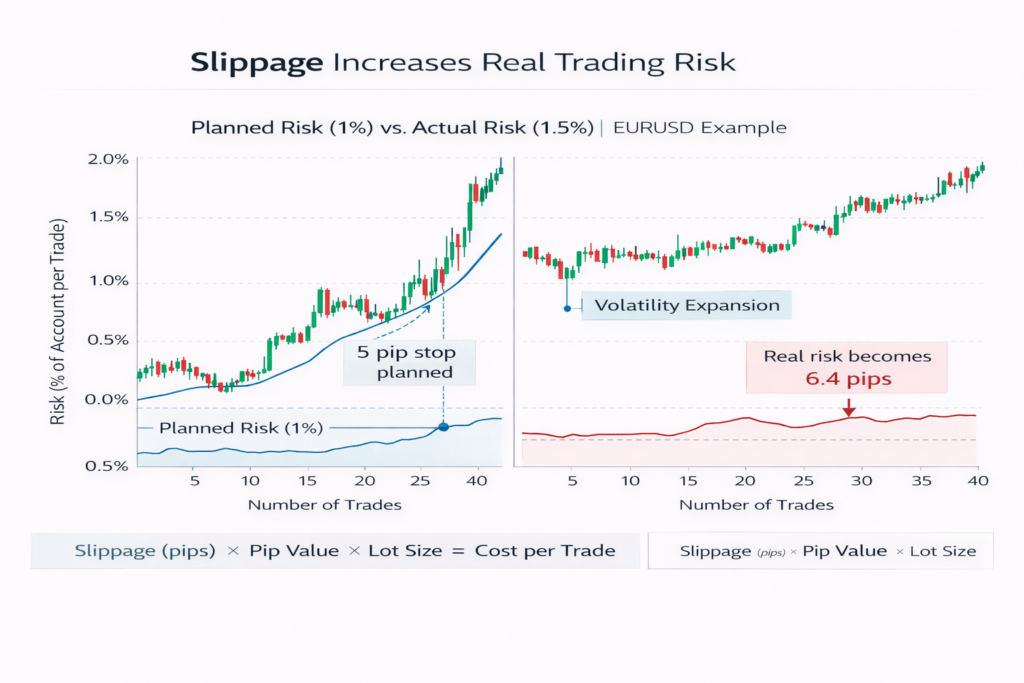
You plan a 5 pip stop on EURUSD. You risk 1 percent. Everything is calculated. Price spikes on a news candle, your stop fills 2.4 pips worse than expected, and suddenly, your real risk was 1.5 percent. Do that 40 times a month and your equity curve quietly bends downward.
Slippage in day trading forex is not just a technical inconvenience. It is a structural cost of doing business. If you ignore it, it compounds against you. If you understand it, you can design around it.
This guide is not a definition from a dictionary. It is a useful execution framework made from real trading desks, retail data, and years of looking at trader journals.
What Slippage Actually Is in Live Markets
Slippage is the difference between the price you expect and the price you get.
It happens because markets move between the moment you send the order and the moment liquidity fills it. In fast conditions, there may not be enough volume at your chosen price. Your broker fills you at the next available level.
The concept is simple. The implications are not.
According to research and educational material from the U.S. Securities and Exchange Commission, execution quality and order routing materially affect fill prices, especially during volatile periods. FINRA also requires brokers to produce transparency reports showing how execution speed and pricing improvement vary by venue. The Bank for International Settlements has also noted how stress lowers liquidity, worsening short-term price movements and slippage.
What does that mean for you as a trader?
This means that slippage isn’t just a matter of chance. It tends to group during sessions with a lot of volatility, little liquidity, big news, and aggressive order types. It has a structure.
If you scalp 3 to 8 pips in London open and hold through U.S. CPI, you are not trading the same execution environment. Your strategy may be constant. Your fill quality is not.
The Hidden Math: How to Calculate Slippage in Trading
Most traders underestimate slippage because they do not calculate it correctly.
The formula is simple:
Slippage in pips equals actual fill price minus intended price.
If you intended to buy EURUSD at 1.1000 and got filled at 1.1003, that is 0.3 pips of negative slippage. If you shorted at 1.1000 and got 1.0997, that is 0.3 pips of positive slippage.
But the most important calculation is how it affects performance.
To find the impact per trade, you need to multiply the slippage in pips by the position size per pip.
If you trade 2 standard lots and each pip is worth $20, then 0.5 pips of negative slippage costs you $10 for each trade. That is $1,000 for more than 100 trades. That is often the difference between having enough money and not having enough.
This is why in our article on market order vs limit order, we emphasize execution context. Market orders guarantee participation. Limit orders control price but risk missing the move. Slippage day trading forex is largely a function of which tool you use and when.
Your edge is bigger if your backtest assumes perfect fills. Before putting their own money at risk, professional traders lower the anticipated return by the amount of slippage they anticipate.
When Slippage Is Most Dangerous
Slippage becomes lethal in three scenarios.
First, during high impact news. Spreads widen. Liquidity disappears. Stops get filled at the worst available price. If you insist on trading during central bank releases, your stop placement and size must reflect that execution reality.
Second, in ultra tight stop strategies. If your stop is 3 pips and average slippage is 0.6 pips, you are leaking 20 percent of your defined risk before the trade even plays out.
Third, in scaling systems. If you pyramid into breakouts with market orders, the slippage gets worse with each add-on. What seemed like strong momentum in the replay turns out to be a bad average price in real life.
This is where a lot of traders get their system wrong. Instead of measuring execution friction, they change indicators.
Look over your execution logs before you change the rules of the strategy.
A Practical Framework to Control Slippage
You can’t get rid of slippage. You can get around it.
Pick a session to begin with. Asian session ranges often have smaller slippage but bigger spreads in some pairs. The London open makes spreads tighter, but it moves faster. Choose the environment that works best for how long you want to hold. Then, make sure the type of order fits the situation. When you trade in ranges, use limit orders at structural levels where you think the price will drop. In breakout trades during times of high volatility, you should be aware that market orders are the cost of doing business, but you should also widen your stops to account for execution risk.
Third, make sure your system design includes a slippage buffer. If your strategy aims for 10 pips, expect an average negative slippage of 0.3 to 0.5 pips in liquid majors and more in crosses. Change the reward to risk ratio as needed.
Finally, keep an eye on how each broker acts. The quality of execution changes. Some brokers do a better job of filling orders when things are normal, but they have trouble when news spikes. Your information is more important than reviews on the internet.
If you have not deeply understood order mechanics, revisit our guide on what is a market order vs limit order before refining your execution logic.
Slippage and Risk Management
Here is where most traders miscalculate risk.
They define 1 percent risk based on stop distance, but ignore slippage in the equation.
Planned risk plus expected negative slippage equals real risk.
Your real risk per trade is closer to 6.4 pips if your system’s average stop is 6 pips and your average negative slippage is 0.4 pips. That changes the drawdown statistics over time.
This is where a position size calculator comes in handy. When you model effective stops that are a little wider, you get the right size and don’t end up with too much exposure by mistake.
Being disciplined when you do things is part of managing risk. Slippage is not a separate problem. It’s a risk that comes with the territory.
Journaling Slippage Like a Professional
Most trade journals track entry, exit, and R multiple.
Few track expected versus actual fill.
Add two columns to your journal:
Intended entry price
Actual entry price
Intended stop price
Actual stop fill price
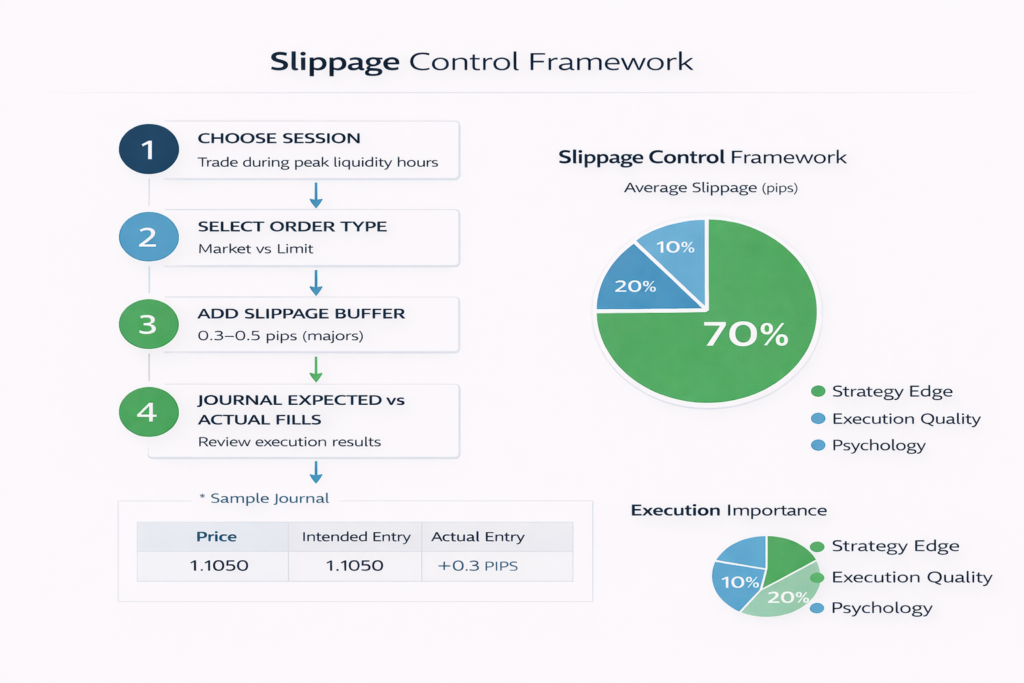
Calculate average negative slippage per session and per strategy type. You will likely discover patterns.
Breakout trades during New York open may show 0.7 pips average slippage. Pullback trades during London mid session may show 0.2.
Download and use our Trade Journal Template and add a slippage metric. After 50 trades, you will have real data. After 200, you will have an execution edge.
Professionals optimize micro inefficiencies. Retail traders chase new indicators.
Slippage, Edge, and Capital Scaling
The truth is that this is uncomfortable.
If you don’t have a lot of money and the costs of getting things done eat into your returns, you can still have positive expectations and have trouble growing.
A lot of disciplined traders reach a point where their psychology is stable and their edge is proven, but their account size stops them from making a lot of money. This is where the conversation turns to evaluation models. Firms like The5ers, FTMO, and Topstep offer structured evaluation accounts with clear rules about risk. The benefit is not money that comes from nowhere. It gives you access to more money while keeping risks under control.
If your journal shows that you can consistently control slippage, follow the rules, and keep your drawdown stable, the next logical step is to open an evaluation account. Not a quick fix. A scaling tool.
Traders who are serious see these programs as professional ways to get money. If you are sure about your execution discipline, you might want to think about reviewing Check out The5ers’ evaluation structure to see if your system metrics match up with their risk model.
Capital without control over execution makes mistakes worse. Execution edge with capital increases returns.
Frequently Asked Questions
What is slippage in day trading forex?
Slippage is the difference between your intended trade price and the actual fill price. It increases during volatility, low liquidity, and fast market conditions.
Is slippage always negative?
No. When you get filled at a better price than you thought you would, that’s called positive slippage. But day traders should model systems with a little bit of negative slippage to get more conservative estimates of how well they’ll do.
How much slippage is normal in forex?
Under normal circumstances, 0.1 to 0.5 pips may be common in major pairs during liquid sessions. It can get a lot bigger when there is big news.
Can limit orders eliminate slippage?
Limit orders set the price at which you can enter, but they don’t guarantee that the order will be filled. They lower the risk of negative slippage but raise the risk of missing a trade. Stops can still slip in fast markets.
How do I reduce slippage in trading?
Trade when there is a lot of liquidity, stay away from big news spikes unless you plan for them, use the right order types, keep track of execution data, and size your positions realistically.
Final Thoughts
There is no broker conspiracy behind slippage. It is the structure of the market.
Your backtests will lie if you don’t pay attention. You improve your edge by measuring it.
This week’s challenge is easy. For the next 30 trades, keep track of how many fills you actually get versus how many you want. Don’t change your plan. Just measure how well it works.
Then make it different. That one thing can improve your equity curve more than any new indicator, and you might not even know it. Read our in-depth comparison of market orders and limit orders again, and look at your execution logic with fresh eyes.