
A lot of traders don’t blow accounts because their strategy is bad. They blow accounts because they don’t follow through.
You make the trade plan perfectly. The structure is neat. What is risk? But you hit buy with a market order when the market is volatile and you get slipped three pips. Or your limit order never goes through, and the price moves on without you. Over a month, those small execution mistakes quietly destroy expectancy.
This article is not about definitions. You already know what a market order and a limit order are. This is about when to use each, why they fail, and how execution logic becomes a real edge in forex day trading.
If you have ever searched for market order vs limit order forex strategy, this is the framework you were actually looking for.
The Hidden Execution Problem Most Traders Ignore
The majority of retail traders focus on entries as patterns. Very few think in terms of order mechanics. Yet execution quality directly impacts your R multiple.
The Bank for International Settlements Triennial FX Survey says that the forex market trades more than $7 trillion every day. That liquidity sounds nice, but it’s not spread out evenly. It changes based on sessions, news releases, and flows from institutions.
Research from the CFA Institute has repeatedly shown that transaction costs and slippage meaningfully reduce active trading returns. At the same time, FINRA’s materials for teaching investors show how choosing the right order type affects the quality of the fill and the certainty of the price.
For day traders, this is very simple. Your edge can go away between when you click “buy” and when you get your order filled.
A market order guarantees that the trade will happen, but not the price.
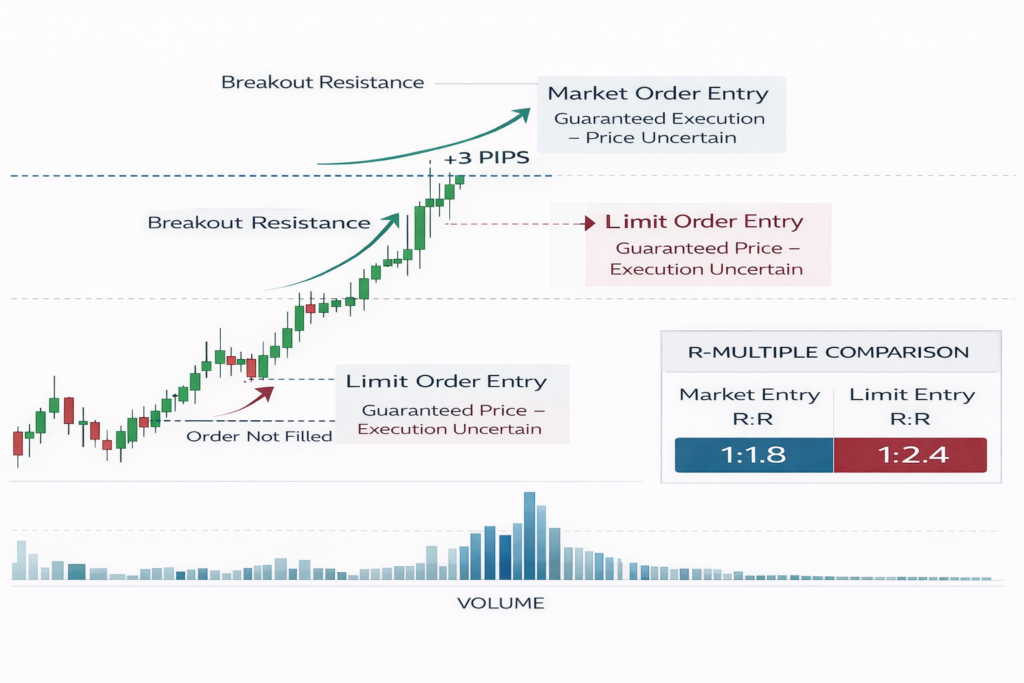
A limit order guarantees the price but not the execution.
That tradeoff isn’t just a theory. It is psychological and statistical.
The real question is not market order vs limit order forex. The real question is which risk matters more in this exact setup: price risk or opportunity risk?
Market Orders in Forex: Speed Over Precision
A market order tells you to fill me now at the best price you can find.
In fast situations, like when there is a lot of important news or a big price movement, speed is more important than accuracy. If EUR/USD breaks a major daily high with a lot of volume, waiting can cost more than slipping.
Three situations are best for market orders.
First, trades that build momentum when you miss the move are worse than paying less.
Stop losses. Limit stops might not fill in fast markets. Hard stops should usually work like market orders because it’s more important to keep your money safe than to get the right price.
Trends that are strong but have small pullbacks. Price rarely goes back to limit orders that are waiting for the right retracement. Not a flow, but an offer.
Here, things go wrong.
Market traders utilise market orders when markets move. Spreads grow more than movement in chop. Enter at market, pay spread, price stops. A horrible start to your trade. That friction kills over time.
You already know how small spread differences add up over dozens of trades if you read our breakdown of how spread and liquidity change during active sessions.
Market orders are aggressive. They want bias and momentum to be clear.Limit Orders in Forex: Precision Over Certainty
A limit order tells you to fill me at this price or better.
Limit orders work best in structured pullback strategies. Limit entries make R:R much better if you trade support and resistance, Fibonacci retracements, VWAP reversion, or liquidity sweeps.
This is a real-life example.
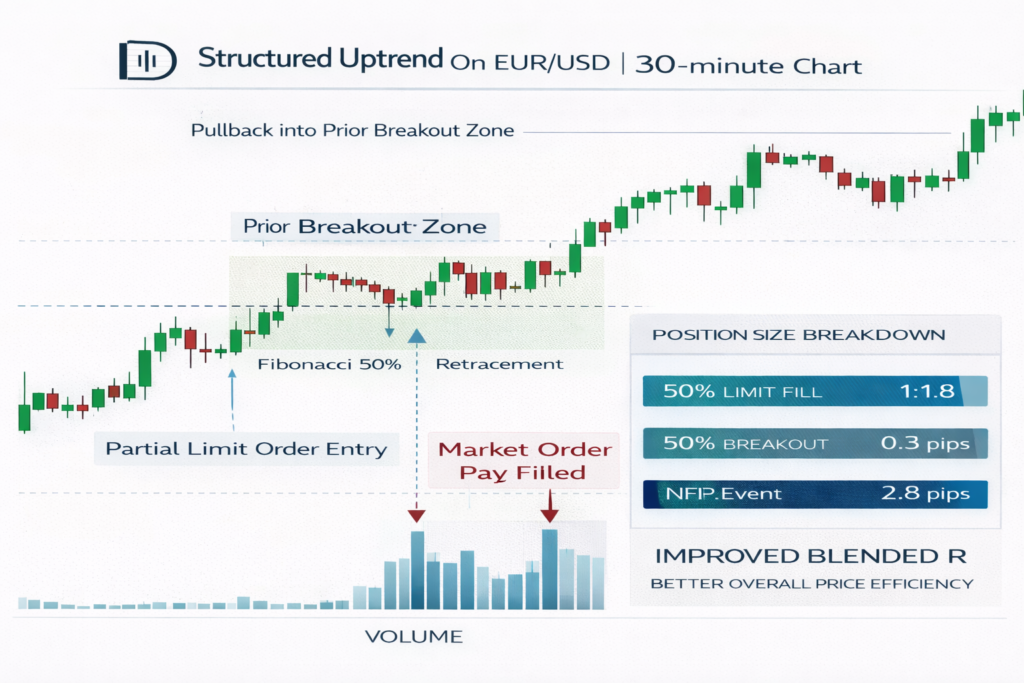
There is a clear upward trend in EUR/USD. The price goes back into a previous breakout zone that lines up with the 50 percent retracement. You put a limit order inside that liquidity pocket instead of chasing.
Your stop distance gets shorter when you fill it. Your R multiple gets bigger. Better entry efficiency leads to more account growth over time, even if the win rate stays the same.
But it’s clear that it failed. In markets with strong momentum, the price touches your level and then turns around without touching it. You keep missing winners. When people get frustrated, they buy into the market without thinking and pay more.
You need to be emotionally detached when you place limit orders. You have to accept missed trades as part of the edge.
Professional traders think in distribution terms. If 30 percent of valid setups run without filling but the 70 percent that fill offer superior R:R, expectancy still improves.
If this concept is new to you, revisit our article on risk to reward ratios in day trading before changing execution style.
A Real Decision Framework for Active Day Traders
Instead of asking which order type is better, ask three questions before every trade.
What is the volatility regime right now
Is this expansion or contraction
Is liquidity thick or thin
During times of growth, like after news or when a session opens, market orders are in line with flow. There is a risk of slippage, but momentum makes it less likely that the market will turn around right away.
During contraction phases, like mid-session ranges, limit orders let you take advantage of mean reversion with tighter entries.
Next question: Where is my invalidation?
Limit orders are usually better if your stop has to be very tight for the trade to work. If your stop is based on structure and is wider, the friction of entering the market becomes less important compared to the overall move potential.Final question: what hurts more psychologically, missing trades or bad fills?
This matters. Traders who cannot handle missed opportunities sabotage limit strategies. Traders who cannot handle slippage overtrade with market entries.
Execution must match personality.
The Market Order vs Limit Order Forex Strategy Blend
Advanced traders rarely use only one.
One effective blend is scaling.
Place a limit order for a partial size in a value area. If the price confirms and breaks structure, use a market order to add the rest of the size.
Confirmation plus retrace is another way to do it. Get in small when the market breaks out. Add a bigger position with a limit on the first pullback.
This hybrid model strikes a balance between price efficiency and opportunity risk.
If you’re not sure how to size your trades during these mixed entries, this is where most traders make mistakes about risk. Using the Position Size Calculator removes guesswork and keeps total exposure consistent across multiple fills.
Execution logic without position control is still gambling.
Risk and Slippage: The Silent Account Killer
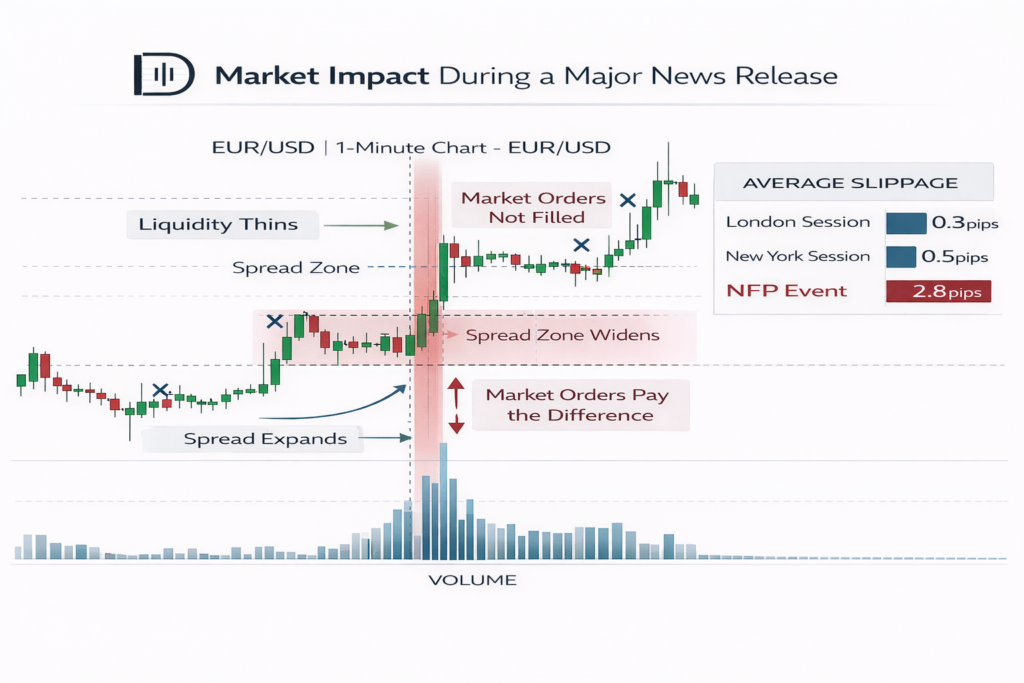
There is no randomness in slippage. It groups together around events that cause volatility.
Liquidity providers widen spreads when big news comes out, like the NFP or CPI. Market orders get filled at prices that are worse. Limit orders might not be filled at all.
A lot of traders blame their brokers when the real problem is that they used the wrong type of order for the situation.
If you plan to trade on news, you should keep track of execution data in a separate journal. Compare average slippage between market and limit entries across sessions. Most traders are shocked by the difference once quantified.
If you have not built that habit, download and use the Trade Journal Template from DayTradersDiary.com and start tracking entry type, slippage, and session conditions. Patterns will appear within 30 days.
Psychological Discipline Around Order Types
This is a small truth.
Market orders seem like they will work. Limit orders seem to be patient.
People who are aggressive tend to choose market execution. People with analytical personalities like limit precision.
There is no better one. But mismatch makes things inconsistent.
Execution variance goes up when traders change the type of order they place without thinking after a losing streak. That makes the data less clear. You can’t make something better if you keep changing it.
You should pick an execution model for at least 50 trades before you look at it.
Consistency in execution builds statistical trust.
Scaling Beyond Retail Capital
Even with refined execution, many traders hit a ceiling. Account size limits meaningful income. You can have a strong market order vs limit order forex strategy and still feel stuck because capital is constrained.
This is why serious traders explore evaluation programs.
Firms like The5ers focus on structured risk parameters and long term scaling plans. Other firms, like FTMO and FundingPips, have different models with different ways of splitting profits and drawdowns.
The point is not to get people excited. The point is numbers.
If your edge makes 5% a month with controlled risk, scaling capital will multiply your results without raising your percentage risk.
A professional framework can be found in an evaluation account for The5ers. It makes you follow the rules about risk, keep track of your performance, and do things consistently. That kind of environment often makes it easier to choose the right order because breaking the rules has consequences.
If you think your execution edge is real, you should test it in a structured evaluation model instead of just relying on your own capital.
Frequently Asked Questions
Is it better to use a market order or a limit order for forex scalping?
It depends on how unstable it is. Market orders stop missed moves when the market is moving quickly. Limit orders lower the spread and raise the R:R in tight ranges.
Do limit orders help with slippage in the forex market?
Yes, as long as nothing changes. But in fast markets, the price can go higher than your level and not fill you.
Should new traders use market or limit orders?
A lot of the time, beginners use market orders in ranges wrong. Learning how to make strategic limit entries early on helps with discipline and risk management.
Why do professional traders use both?
This is because markets go through cycles of growth and shrinkage. Execution that is too rigid is not as powerful as execution that is flexible and structured.
Final Thought
For the next 20 trades, keep an eye on one thing: the type of entry and the quality of the outcome.
Not the win rate. Not PnL.
Keep track of slippage, how well you enter trades, and how often missed trades would have hit your target.
Make that better.
Execution is the hidden part of your edge. It’s not so much about definitions as it is about being aware of yourself and your trading style when it comes to mastering market order vs limit order forex.
If you want to go deeper next, read our guide on session based trading strategies and notice how execution logic shifts between London and New York volatility cycles.