
Most losing forex traders don’t blow up because of bad entries. They bleed out slowly because they misunderstand pips.
I’ve reviewed thousands of trade journals over the years, from retail day traders to funded traders managing six figures. One pattern shows up relentlessly. Traders say, “I only risked 10 pips,” without understanding what those 10 pips actually meant in dollars, volatility context, or execution reality.
A pip is treated like a universal unit. It isn’t.
This guide isn’t here to explain pips the way a beginner article does. You already know the basics. This is about how professional day traders make decisions, assess risks, and quantify performance using pips. Calculating pip value accurately makes position sizing easier, not wiser, and your statistics make sense.
Research-Backed Insight: Why Pips Are Not Equal Across Pairs
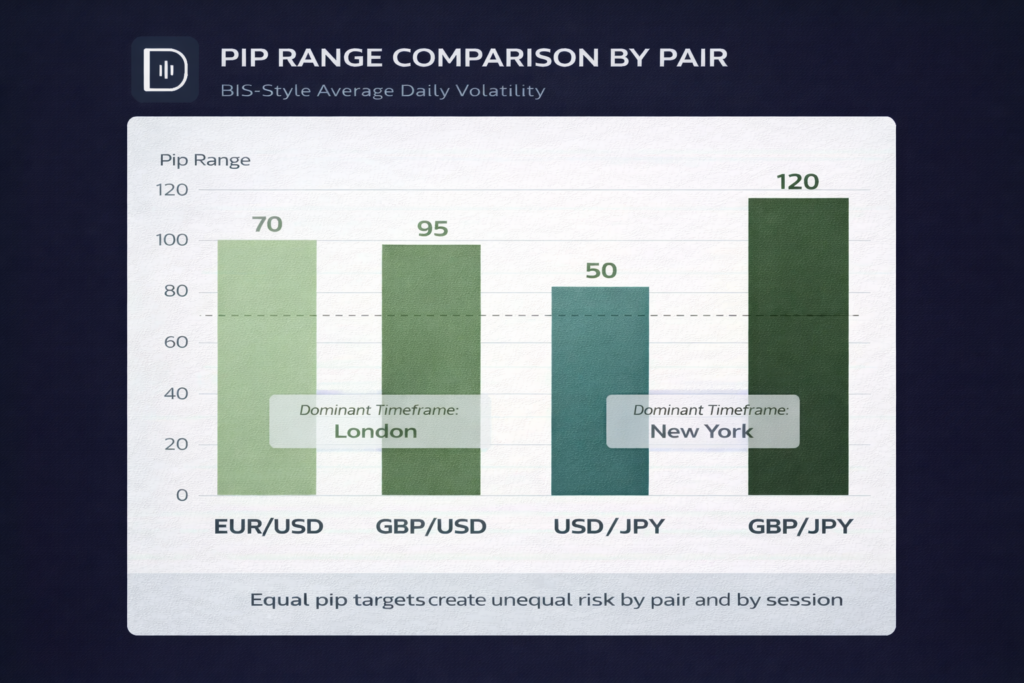
Forex pips are the fourth decimal position for most currency pairs. The second decimal point for JPY pairs. That’s the textbook definition. But research and broker data show why this definition alone is useless for active traders.
According to BIS Triennial FX Survey data, average daily volatility varies significantly between major pairs. EUR/USD may move 60 to 80 pips in a normal session, while GBP/JPY can exceed 150 pips under the same conditions. The pip itself is the same, but its significance in context is not.
DailyFX and Forex.com broker analytics demonstrate that traders who just look at pip count to standardize performance are wrong about the return on risk. A 20-pip win on EUR/USD when the London market opens is not the same as a 20-pip win on GBP/JPY when the New York session opens.
Investopedia explains pip value mathematically, but the real takeaway for day traders is this: pip value only becomes meaningful when paired with lot size, pair structure, and volatility regime.
What this means in practice is simple. If you track pips without understanding pip value, you’re measuring noise, not performance.
Practical Trading Framework: How Professional Traders Think About Pips
Step 1: Separate Pip Movement From Pip Value
A pip is a movement in price. The worth of a pip is money.
This is what pip value usually looks like for standard lot sizes:
EUR/USD: around $10 per pip for a normal lot
Mini lot: about $1 per pip
Micro lot: about $0.10 for each pip
However this is not the case when USD is not the quote currency. The currency rates for EUR/GBP and GBP/JPY affect pip values. Instead of doing math in their minds, smart traders employ a pips calculator.
Keep checking at pip value—you’re behind.
Step 2: Use Pips to Define Structure, Not Ego
Good traders don’t ask, “How many pips can I make today?”
They ask, “How many pips does this setup require to be wrong?”
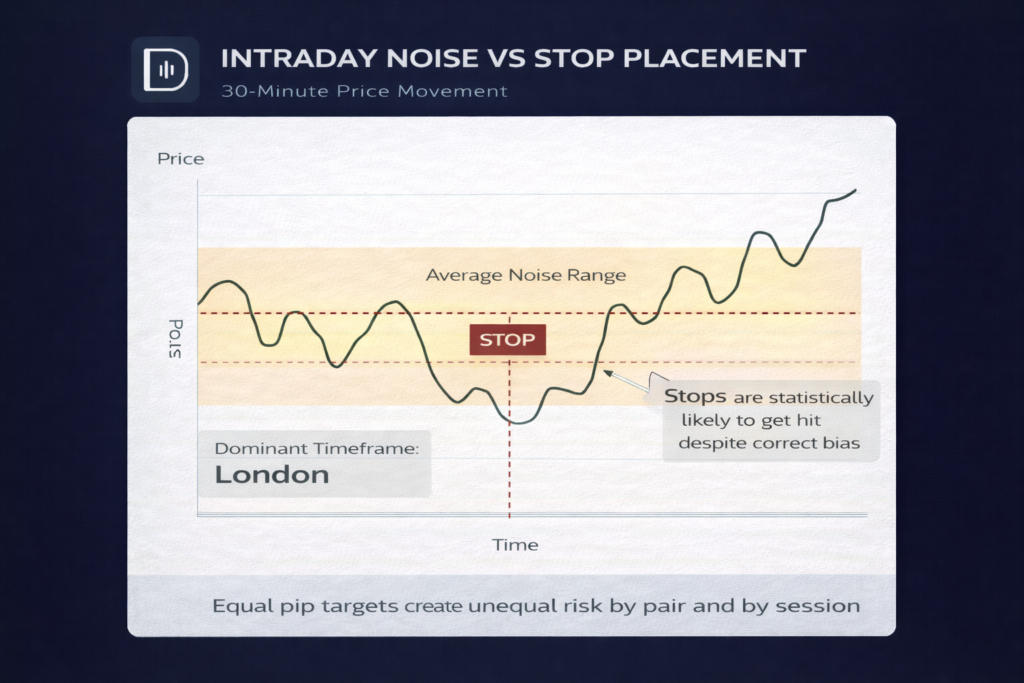
If your stop is 8 pips but the pair’s average 5-minute noise is 10 pips, you’re not tight. You’re fragile.
This is where pips intersect with market structure. In our breakdown on how intraday support and resistance actually forms, we explain why stops placed inside structural noise zones get clipped regardless of bias.
A pip stop must survive normal rotation. Otherwise, it’s not a stop. It’s a hope.
Step 3: Translate Pips Into Position Size, Not the Other Way Around
Most traders pick the lot size initially and then change the stops. Professionals do the opposite.
This is how the process goes:
Find the invalidation level in pips
Find the pip value for the pair
Change the amount of your position so that the total dollar risk remains the same.
This is where most traders get their risk wrong. Using a position size calculator removes guesswork and eliminates emotional sizing. When pip value changes, position size adapts automatically.
Internal Perspective: Where Traders Misread “Good” Pip Performance
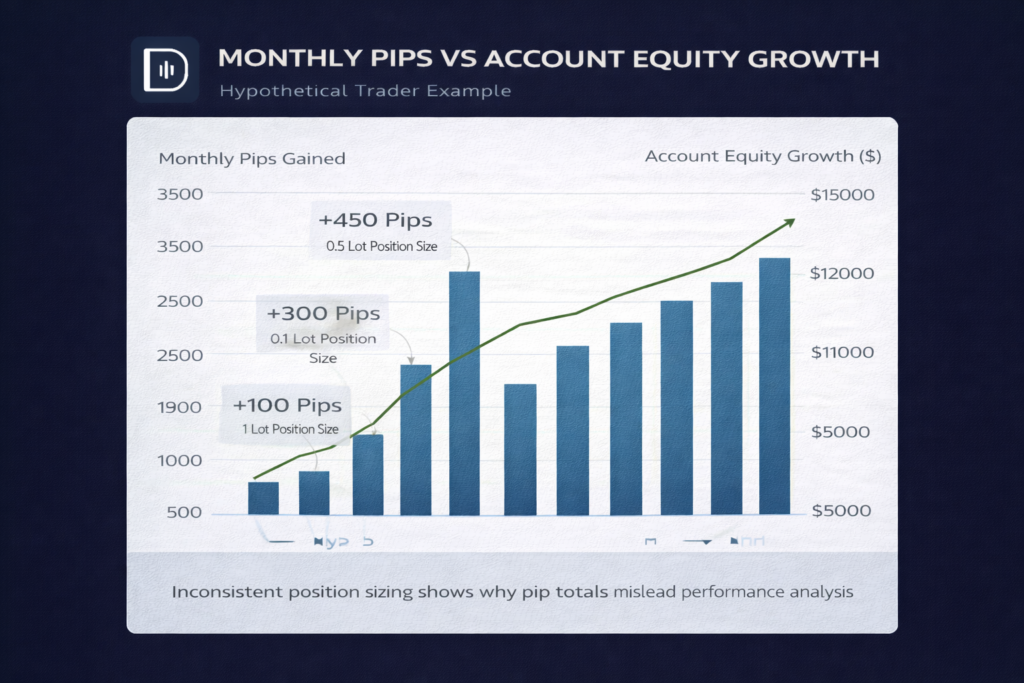
One of the biggest performance illusions in forex is high pip totals with poor equity growth.
Traders could make more than 300 pips in a month without their accounts growing much. Why? Because the value of a pip and the risk were very different from trade to trade.
In our post about why win rate lies to most day traders, we stress that raw numbers without normalizing them could make you too sure of yourself.
It is important to think about pips in context:
Pips for each unit of risk
Pips and the volatility of the session
Pips caught vs. what was expected
lacking that, tracking pips turns into telling stories instead of analyzing them.
Risk and Execution: Where Pip Math Meets Reality
Most traders don’t realize how much execution mistakes throw off pip math.
If news volatility averages 1.5 pips, a 12-pip stop is no longer 12. At least fifteen. For fast growth, this disparity matters.
Calculations for pip must include:
Enter spreading out.
Daytime and nighttime money availability
A pair-only mode
Let numbers rule and take risks. Along with, a position size calculator improves pip-based risk judgement.
Journaling and Performance Optimization: Make Pips Work for You
Simply recording your pips won or lost isn’t a thorough journal.
Effective traders track: – Planned stop in pips
Actual slippage stop
Best pips movement
Volatility throughout sessions
Using a systematic trade journal template, you can spot patterns like tight stops in New York open or large pip goals during slow Asia sessions.
Time will reveal your core assumptions are wrong. That’s the limit.
Scaling and Capital Growth: When Pip Mastery Meets Capital Constraints
This is unsettling. Many traders have an edge in pip extraction but lack funds.
Sometimes, increasing your skills is more important than establishing new settings. This is why qualified traders evaluate funding methods.
The5ers and other well-known prop firms provide disciplined traders with capital and structured risk. There are no quick fixes here. They sort.
An assessment account is a professional path, not a gamble, because it reduces pip risk, adheres to drawdown rules, and trades elegantly.
If you’re thinking about scaling, it’s a good idea to check if a The5ers assessment account fits with how you trade and how you handle risk.
FAQs: Forex Pips Traders Actually Ask About
What is the value of a forex pip, and why does it change?
The size of the lot and the structure of the currency pair affect the value of a pip. When the quote currency isn’t USD, the value of a pip changes with the exchange rate.
Are pips still important for traders who use algorithms or scalping?
Yes, but only when it’s typical. High-frequency traders don’t care about raw movement; they care about pips in relation to spread and execution cost.
If I trade the same pair every day, do I need a pips calculator?
Yes, even for the same pair, a pip’s value depends on account currency, leverage, and position size.
Why do some traders quit keeping track of pips?
Still using pips. They stopped obsessing. The most essential indications are dollar threat and expectation.
Closing: The One Change That Improves Pip Accuracy Immediately
This is the problem.
Stop writing “risked 10 pips” for the next 20 trades. Put in “risked 10 pips at $X per pip with Y volatility.”
That kind of behavior will show you sloppy sizing, weak stops, and performance blind spots more rapidly than any indicator.
Master pips are for decision-making, not movement.
Next read: revisit our deep dive on position sizing mistakes that quietly destroy profitable strategies and tighten the one variable most traders ignore.