
One of the quiet mistakes many traders make early in their career has nothing to do with strategy.
It has to do with timing.
They take the exact same setup on EURUSD at 2 AM and again during the London open. One trade moves instantly in their favour. The other sits stagnant for an hour and eventually reverses.
The difference is not the setup. It is the market session.
Forex trading hours shape liquidity, volatility, spreads, and momentum. Yet most traders treat the 24-hour forex market as if every hour behaves the same.
It does not.
Understanding forex trading hours around the world is not just basic knowledge. It is one of the simplest ways to improve execution quality and eliminate low probability trades.
This guide explains how professional traders think about global forex sessions and how those sessions influence trade selection, volatility, and risk management.
What Research Reveals About Forex Market Activity
The foreign exchange market is the most liquid financial market in the world, with average daily turnover exceeding $7 trillion according to the Bank for International Settlements.
But that liquidity isn’t spread out equally throughout the day.
The CME Group cites research that demonstrates that when institutional traders are active, trading activity tends to be concentrated around major financial centers.
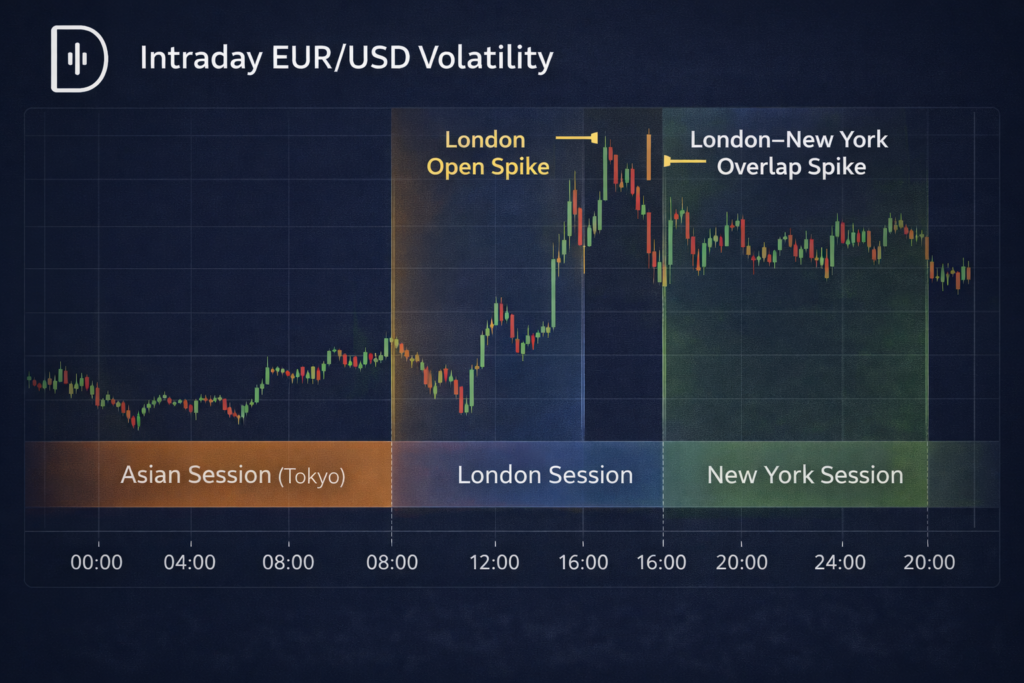
Educational sites like Investopedia point out that volatility is highest when major trading sessions coincide. During these periods both liquidity and order flow increase dramatically.
For day traders, this has practical implications.
More liquidity means tighter spreads, smoother execution, and stronger price movement. Less liquidity often means slower markets, wider spreads, and unreliable technical signals.
Recognizing these patterns allows traders to align their strategies with the natural rhythm of global markets.
Understanding the Four Major Forex Trading Sessions
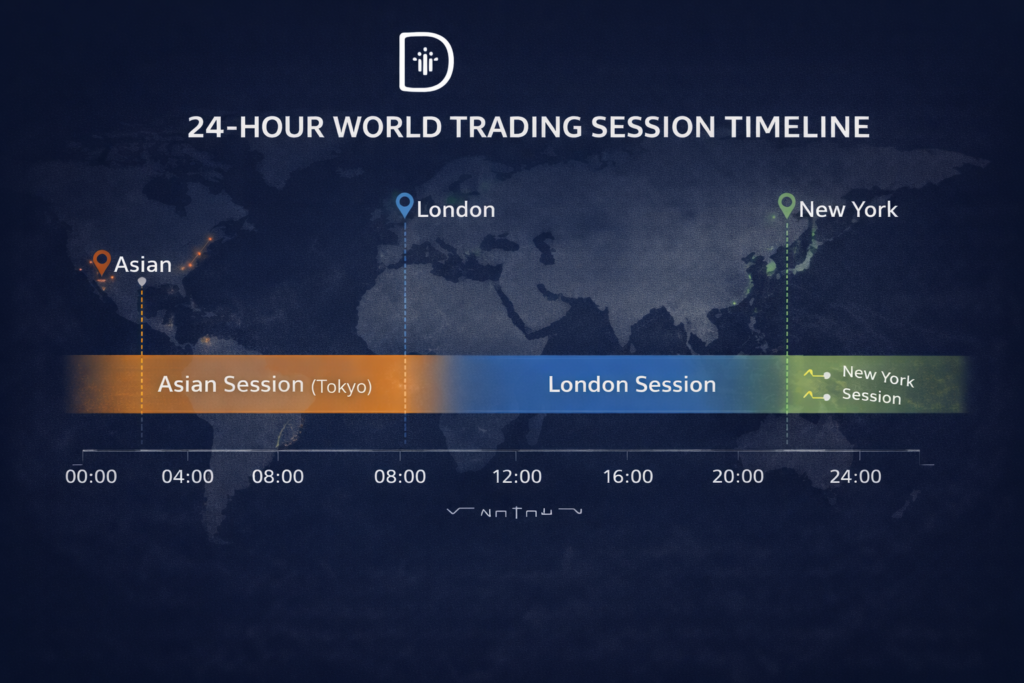
The forex market operates continuously from Monday to Friday because financial centers around the world open and close at different times.
Each major session reflects the economic activity of a specific region.
The Asian session begins when markets open in Tokyo. Liquidity is moderate and price movements are often slower. Currency pairs involving the Japanese yen tend to see the most activity during this period.
The London session introduces significantly more volatility. Europe hosts some of the largest global financial institutions, and the increase in participation often drives strong directional movement.
The New York session overlaps with London for several hours, creating the most active period of the trading day. Many major economic announcements are released during this window, which can accelerate momentum.
Finally, the late New York session transitions back into quieter conditions as liquidity declines.
Understanding these session characteristics helps traders decide when their strategies are most effective.
Why the London and New York Overlap Matters
If there is a single time window that defines global forex trading activity, it is the overlap between the London and New York sessions.
During this period both European and American institutions are active simultaneously. Liquidity reaches its peak and price movement becomes more dynamic.
For many day traders this is the most reliable time to find momentum setups.
Breakouts tend to follow through more consistently. Trend continuation trades often have stronger participation from institutional order flow.
If you trade major pairs such as EURUSD or GBPUSD, this overlap frequently produces the cleanest intraday moves.
Our DayTradersDiary.com article on identifying high probability breakout conditions discusses how this session overlap often triggers major market moves.
Timing trades within this window can significantly improve strategy performance.
When Forex Trading Hours Work Against You
Some sessions can help you, while others can hurt your performance without you knowing it.
In markets with low liquidity, misleading signals are common.
For instance, during the late Asian session, the price may move within a small range. Technical indicators might create signals that look good but don’t have the institutional participation needed to keep the momentum going. Another common mistake happens when sessions change.
A breakout in the last hour of the New York session may look good, but it could fail quickly since there isn’t enough liquidity.
A lot of traders say their strategies are bad when the true problem is that they trade at the incorrect times.
Professional traders sometimes only trade during certain times when they have the most advantage.
A Practical Framework for Choosing When to Trade
Instead of trading all day and night, professional traders only trade during the sessions that fit their style best.
Scalpers like the London open because the market becomes more volatile fast and spreads stay tight. Momentum traders frequently focus on the London and New York overlap when directional moves become strongest.
Range traders sometimes favor quieter periods such as the Asian session where price oscillates within defined boundaries.
The key is consistency.
Trading randomly throughout the day introduces unnecessary variability into performance.
Choosing specific forex trading hours allows traders to specialize in certain market behaviors.
This specialization frequently leads to better execution and clearer plan refinement.
How Forex Sessions Affect Spreads and Execution
During the trading day, forex spreads change.
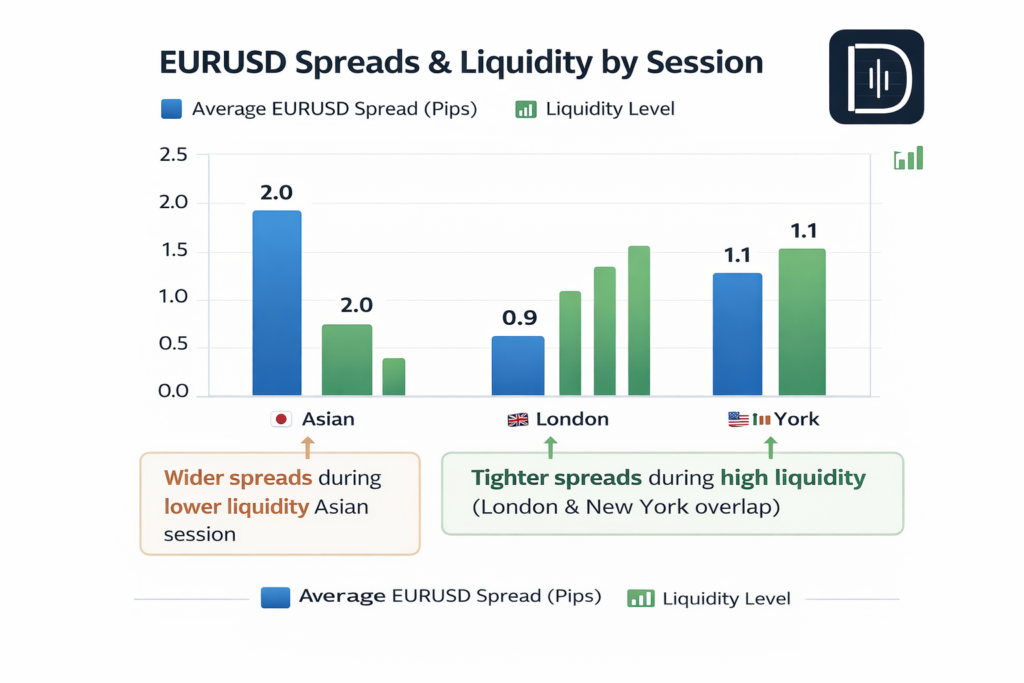
When there is a lot of liquidity, market makers compete with each other to lower spreads. Spreads get wider when liquidity goes down.
This has a direct effect on the costs of trading. For example, a trader entering EURUSD during the London session may face a spread of less than one pip. The same trade during a low liquidity period might experience a spread two or three times larger.
This difference may seem small but it compounds across many trades.
Understanding session based spread behavior can improve execution efficiency.
If you want to explore this topic further, our guide on how spreads impact forex profitability on DayTradersDiary.com explains how execution costs influence strategy performance.
Risk Management and Time Based Volatility
Volatility changes throughout the trading day.
During the London and New York sessions price movement expands. Stop losses must often be wider to accommodate this volatility.
During quieter periods smaller stops may be appropriate but trade opportunities become less frequent.
Many traders overlook this relationship between time and volatility.
They use identical position sizes regardless of session conditions.
This is where most traders miscalculate risk. Using a position size calculator removes guesswork and ensures that position size adjusts appropriately when stop distances change.
Maintaining consistent risk exposure requires adapting to session specific volatility.
Execution discipline matters more than the strategy itself.
Using a Journal to Identify Your Best Trading Hours
One of the fastest ways to improve trading performance is identifying when your strategy performs best.
Many traders track entry signals but ignore the time dimension of their results.
Your trade journal should record the session in which each trade occurs.
Over time patterns emerge.
You may discover that your win rate is significantly higher during the London session. Or perhaps your strategy performs best during the early New York hours.
These insights help eliminate unnecessary trades.
Using the Trade Journal Template available on DayTradersDiary.com allows traders to track session performance and refine their trading schedule.
Professional trading improvement often comes from removing low quality trades rather than adding new ones.
Scaling a Session Based Trading Strategy
Once a trader develops consistency within specific forex trading hours, another limitation appears.
Capital size.
A well structured strategy may generate steady returns but progress can feel slow when applied to a small account.
This is why many disciplined traders explore evaluation programs offered by proprietary trading firms.
Companies such as The5ers, FTMO, and Topstep provide opportunities for traders to access larger capital once they demonstrate consistent risk management.
Session based trading strategies often translate well into these environments because they focus on specific, repeatable time windows.
The5ers in particular emphasizes gradual scaling and disciplined risk control, which aligns well with traders who rely on structured trading schedules.
If your strategy consistently performs during certain forex trading hours, testing it within a The5ers evaluation account can be a logical next step.
Serious traders eventually learn that skill combined with access to capital creates the real growth potential.
Frequently Asked Questions
What are the main forex trading sessions?
The four main sessions are the Asian session, London session, New York session, and the overlapping periods between them.
When is the best time to trade forex?
The London and New York overlap typically provides the highest liquidity and strongest price movement for major currency pairs.
Can forex be traded 24 hours a day?
Yes. The forex market operates continuously from Monday to Friday due to global financial centers opening in sequence.
Why does volatility change during forex sessions?
Volatility changes because different regions of the world participate in the market at different times, affecting liquidity and order flow.
Final Thoughts
Forex trading hours are one of the simplest variables traders can control.
You cannot control the market. You cannot control global news. But you can control when you choose to participate.
Many struggling traders improve dramatically simply by narrowing their trading window to the sessions where liquidity and momentum are strongest.
For the next month, track your trades based on session timing.
You may discover that eliminating just a few low liquidity hours improves your results more than changing any indicator.
If you want to refine your market timing further, the next article worth reading on DayTradersDiary.com is our guide on identifying the most volatile forex pairs for day trading.