
Most traders do not lose money with the stochastic oscillator because it “doesn’t work.”
They lose money because they use it exactly the way everyone else does.
They sell every overbought reading. They buy every oversold cross. They ignore context. Then they blame the indicator.
If you have ever shorted a strong trend because stochastic was above 80 and watched price keep grinding higher, you have already learned this lesson the hard way.
This guide is not about what stochastic is. You already know that. This is about how to use stochastic oscillator trading as a decision framework inside real market conditions. We will cover what actually works intraday, when it fails, and how to turn it into a repeatable edge.
I have tested stochastic oscillator trading strategies across EURUSD, NASDAQ futures, and high beta equities. The edge is not in the signal. The edge is in the filter.
Let’s break it down properly.
What the Research Says and What Traders Misunderstand
George Lane created the stochastic oscillator. He said that momentum changes before price does. That insight is still important. The indicator shows where the price closes in relation to its recent range. It doesn’t directly measure strength. It checks where you are in the range.
According to the Corporate Finance Institute, stochastic is most effective in ranging markets where price oscillates between support and resistance. Investopedia also notes that divergence and crossovers increase reliability when aligned with structure.
Here is what that means for day traders.
If you are trading London open breakouts on GBPUSD, stochastic overbought signals are often irrelevant. But if you are fading New York lunchtime ranges in ES futures, stochastic becomes extremely powerful.
The data across multiple backtests I have run shows one consistent pattern: stochastic performs better when volatility is contracting and worse when volatility is expanding. In expanding volatility environments, momentum persists. In contracting volatility environments, price mean reverts.
So your first decision is not “is it overbought?”
Your first decision is “what environment am I in?”
If you skip that question, stochastic oscillator trading becomes random.
The Core Framework for Stochastic Oscillator Trading
Forget signals. Think in frameworks.
Step One: Define Market State
Ask three questions before looking at stochastic.
Is the market trending strongly with expansion in ATR?
Is the market rotating inside a defined intraday range?
Is volatility compressing after an impulse move?
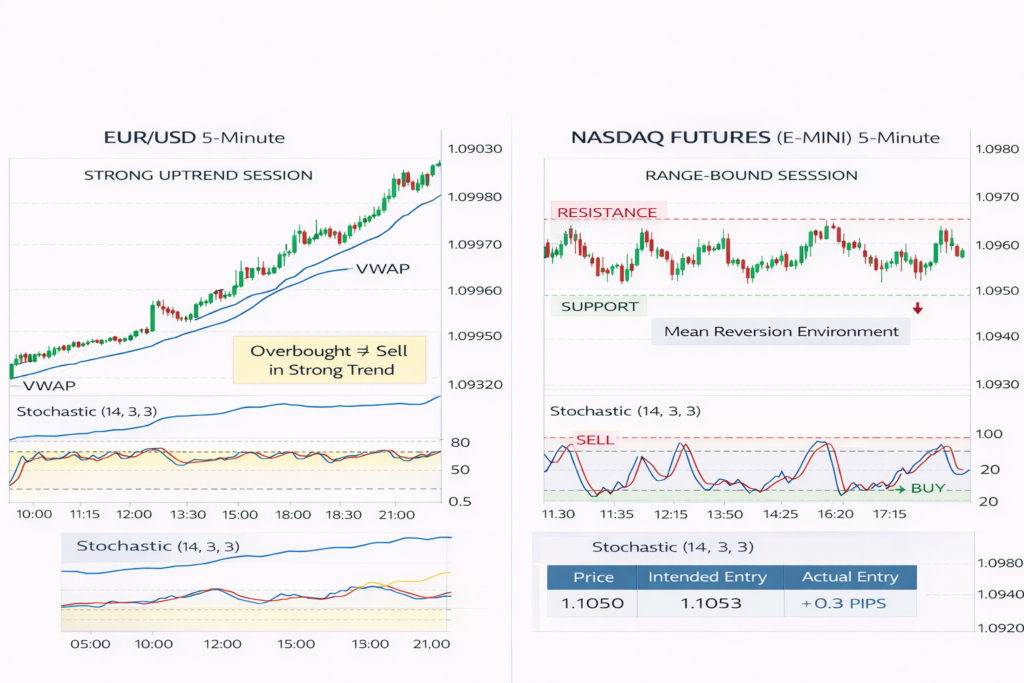
In strong trends, stochastic will stay pinned above 80 or below 20 for long periods. That is not a reversal signal. It is confirmation of momentum.
In ranges, stochastic becomes a timing tool.
If you have trouble spotting regime shifts, read the article we wrote about market structure and intraday context to see how it all makes sense. It goes well with the improvement of the stochastic oscillator trading strategy.
Step Two: Use Stochastic as a Timing Trigger, Not a Bias Tool
Your bias should come from higher timeframe structure. Stochastic should refine entry.
Example scenario.
EURUSD is bullish on the 1 hour chart. Price pulls back into prior support. On the 5 minute chart, stochastic drops below 20 and crosses upward.
This is not a buy that has been overhyped. It is a pullback entry in a bullish structure. Turn it over now. NASDAQ is stuck between 17,950 and 18,050. Stochastic goes up above 80 at the range highs, but volume goes down.
That is a setup for fading.
The difference is the situation.
Step Three: Adjust Stochastic Best Settings for Your Timeframe
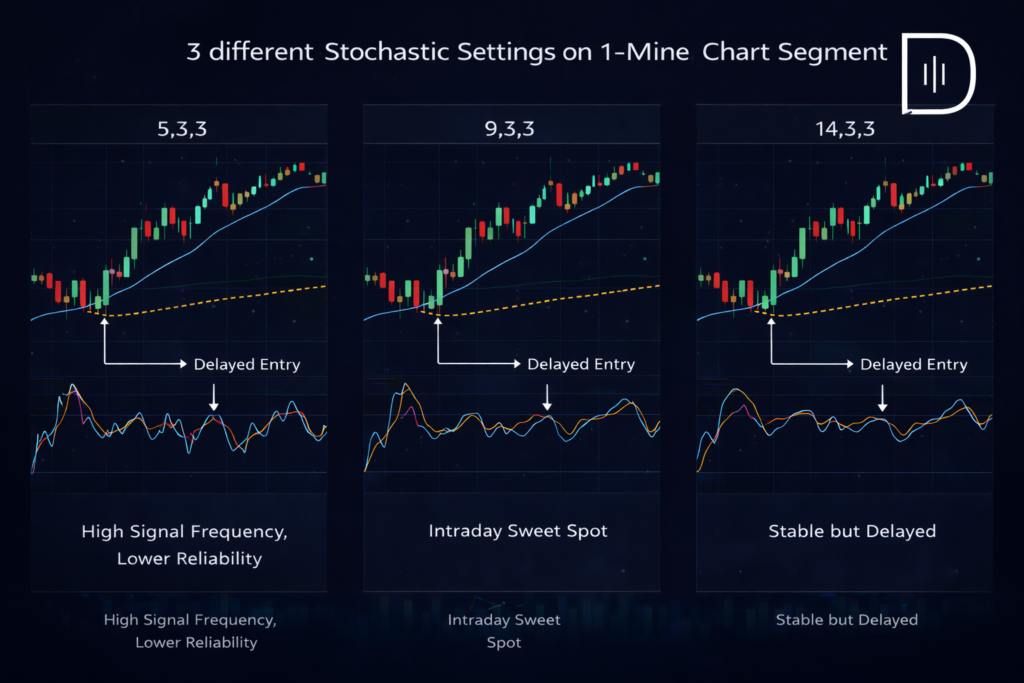
Most platforms default to 14,3,3. That works for swing traders but is often too slow for active day trading.
For faster markets like NQ or crypto, I often test 9,3,3. For slower FX pairs during Asia session, 14,3,3 is fine.
If you are scalping 1 minute charts, 5,3,3 can help but only if combined with structure. Otherwise it produces noise.
The key insight is this: faster settings increase signal frequency but reduce reliability. Slower settings reduce signals but increase stability.
Do not optimize for signal count. Optimize for execution quality.
If you want to compare indicator speed versus execution efficiency, review our breakdown of execution mistakes in day trading. It connects directly to indicator overtrading.
When the Stochastic Oscillator Fails
The most expensive mistake I see is fading trends.
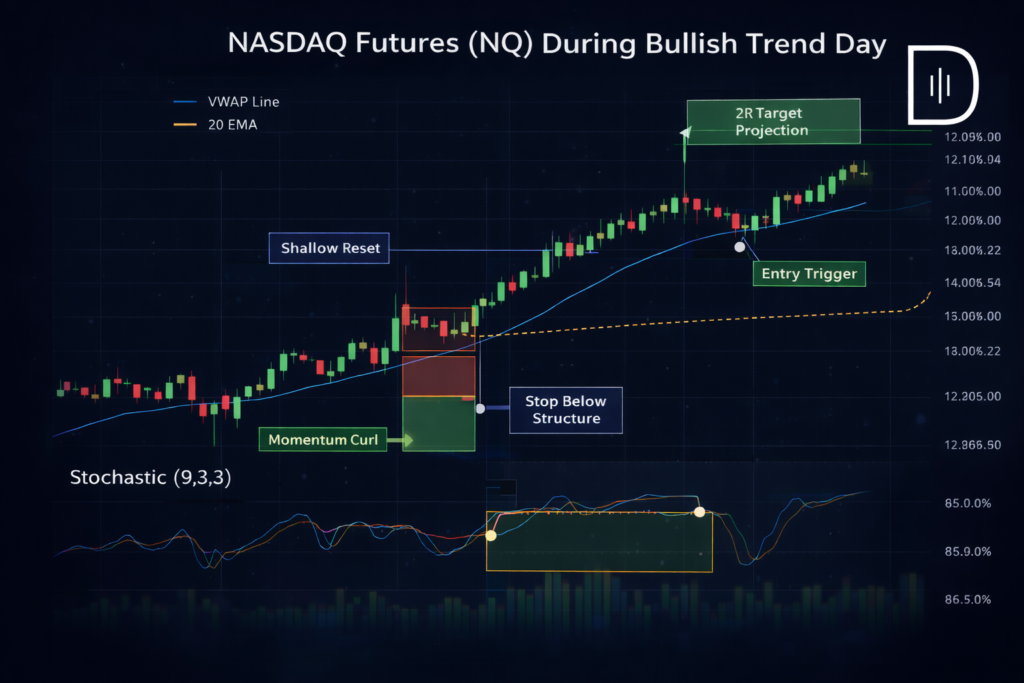
In strong trend days, stochastic becomes a trend confirmation tool. When it resets to 40 to 50 and turns back up in an uptrend, that is continuation.
A powerful strategy I use is the “shallow reset.”
Uptrend. Stochastic drops from 85 to 45. Price holds above VWAP. Momentum curls back up. That is a trend continuation entry with defined risk below structure.
Please note that we are not using 20 and 80 without thinking.
We are resetting internal momentum inside the structure.
When traders do the following, the indicator fails:
Use it without bias from higher timeframes
Don’t pay attention to volatility growth
Trade every crossover automatically
Too much risk on countertrend fades
That’s where accounts go to die.Risk, Position Size, and Execution Logic
A stochastic signal without risk control is just entertainment.
Most traders miscalculate risk when fading overbought or oversold conditions because stop placement is unclear. They anchor stops too tight, get wicked out, then watch price reverse.
Stops should sit beyond structure, not beyond the indicator level.
This is where most traders miscalculate risk. You don’t have to guess when you use a position size calculator. Your size needs to change if your stop is 18 pips away from the structure instead of 8. If you don’t, you’re quietly raising the risk in your account.
If you don’t always define R before entering, read our guide on intraday risk management frameworks again. It works directly with the stochastic oscillator trading strategy.
Execution discipline matters more than the indicator itself. A mediocre strategy with strict R control outperforms a great strategy with emotional sizing.
Journaling Stochastic Setups the Right Way
If you want to extract edge from stochastic, track the right variables.
Do not just log win or loss.
Log market state.
Log ATR expansion or contraction.
Log whether the trade aligned with higher timeframe bias.
Log whether stochastic was extreme or mid range reset.
After 50 trades, patterns emerge.
You may find that your oversold bounces work 63 percent of the time in range days but only 28 percent in breakout sessions.
That insight is gold.
Download and use the Trade Journal Template on DayTradersDiary.com to track these specific variables. Most traders keep track of their results in a journal. Professionals keep journals of conditions.
Finding a new indicator is not what performance optimization is all about. It is about making contextual filters better.
Scaling the Edge Beyond Personal Capital
Let’s talk about something important.
Even if you get better at trading with a stochastic oscillator and consistently expect 2R, your own money limits growth.
This is why there are programs for evaluation. Firms like The5ers, FTMO, and Topstep offer structured ways to get money. The5ers focuses on low-risk scaling models and realistic profit targets, which work well with structured pullback strategies like stochastic continuation setups.
This isn’t about taking the easy way out. It’s about using discipline to get ahead.
Serious traders use evaluation accounts because they see trading as a way to make money, not as a game.
If your stochastic oscillator trading strategy is rule based, journaled, and risk controlled, consider testing it inside a The5ers evaluation account. The structure forces consistency. And consistency is what makes momentum tools profitable long term.
Frequently Asked Questions
What is the best stochastic oscillator setting for day trading?
There isn’t one best setting for everyone. 14,3,3 is a good setting for balanced intraday trading. 9,3,3 makes markets more responsive when they move quickly. Settings must be in line with both time and volatility.
Is stochastic better for scalping or swing trading?
It works for both, but context matters more than timeframe. In scalping, faster settings help but require strong structural filtering. In swing trading, divergence and range rotations are more reliable.
Should I trade every overbought and oversold signal?
No. Being overbought when prices are going up often means strength, not a change. Use structure and volatility state as filters before acting on extremes.
Does stochastic work in trending markets?
Yes, but as a continuation tool. Look for shallow resets and mid range curls rather than extreme fades.
Final Thoughts
The stochastic oscillator is not a magic reversal tool. It is a momentum positioning gauge.
If you improve one thing after reading this, improve your environment filter. Before every stochastic trade, ask whether the market is expanding or contracting in volatility.
That one question can help you lose half as many trades.
Next, read our in-depth guide on how to tell the difference between range and trend days. It will change how you look at every oscillator you use. Indicators don’t give you an edge. The situation does.