
War headlines hit the news and markets react instantly.
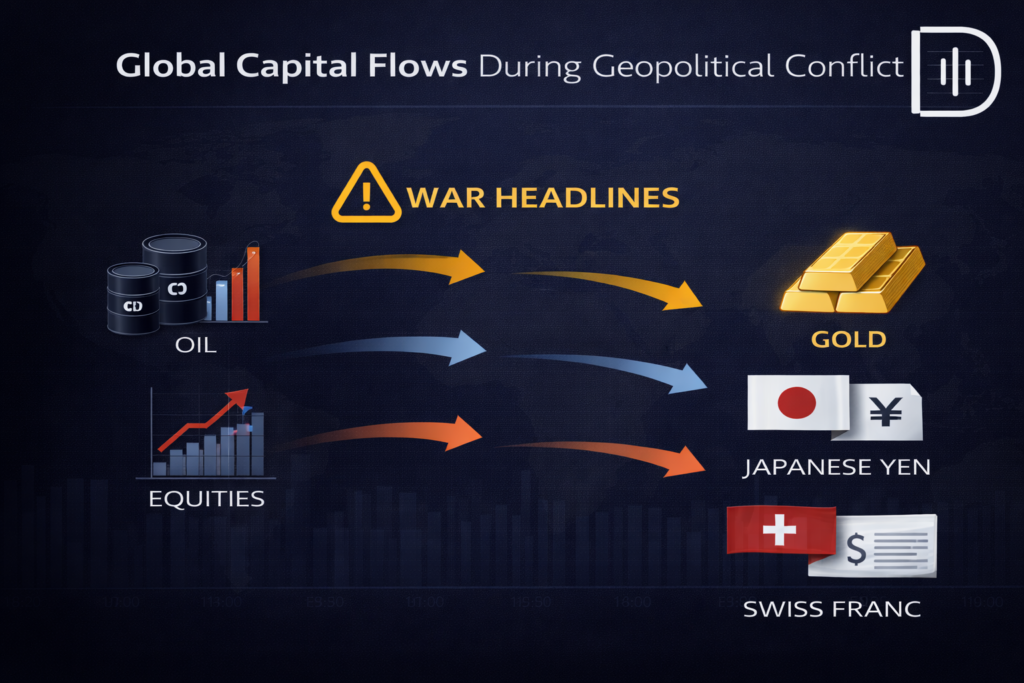
Equity futures drop. Oil spikes. Gold surges. Currency markets start rotating into defensive flows. Traders who were focused only on technical setups suddenly face violent volatility that ignores clean chart patterns.
Most retail traders react emotionally during these periods. They either stop trading completely or chase panic moves after they have already happened.
Experienced traders do something different. They prepare for geopolitical risk by understanding safe haven assets and how capital flows behave when uncertainty explodes.
This article is not about the basic definition of a safe haven asset. It is about how active traders actually use them to hedge exposure and stabilize performance during war driven volatility.
If you trade currencies, indices, commodities, or even crypto, understanding safe haven flows can dramatically improve both risk management and opportunity recognition.
What Research Says About Safe Haven Assets
The concept of a safe haven asset is well documented in financial research. A safe haven asset tends to retain or increase value during periods of extreme uncertainty, financial stress, or geopolitical conflict.
Studies published by the International Monetary Fund show that during major crises investors often rotate capital into assets perceived as stable stores of value. In the past, this has included gold, some government bonds, and a small number of currencies.
The Bank for International Settlements often cites research that shows that currencies like the Japanese yen and Swiss franc tend to get stronger during times of global risk because of capital repatriation and conservative monetary policies.
Meanwhile commodity research discussed by World Gold Council confirms that gold has historically performed well during periods of war, financial crisis, and inflation uncertainty.
What matters for day traders is not the academic definition. What matters is how these flows behave in real time.
When geopolitical risk spikes, liquidity moves fast. Equity markets may sell off while capital flows into gold, the yen, or the Swiss franc. Understanding this rotation gives traders context that pure chart analysis often misses.
Why Safe Haven Flows Matter for Active Traders
Most traders focus on price patterns inside a single market.
But during geopolitical stress, markets move as interconnected systems.
For example, a sudden military escalation may trigger:
A spike in oil prices
A rally in gold
A selloff in global equities
Strength in defensive currencies
If you only watch one chart, the move may appear random. When you watch cross market flows, the logic becomes clear.
This is where many traders lose their edge during high volatility periods.
They continue trading their normal setups without adjusting for the shift in global risk sentiment.
Safe haven awareness allows traders to anticipate the direction of capital rather than reacting after the move begins.
If you want to deepen this cross market perspective, the DayTradersDiary.com article on intermarket analysis explains how macro flows influence intraday price behavior.
Identifying the Core Safe Haven Assets
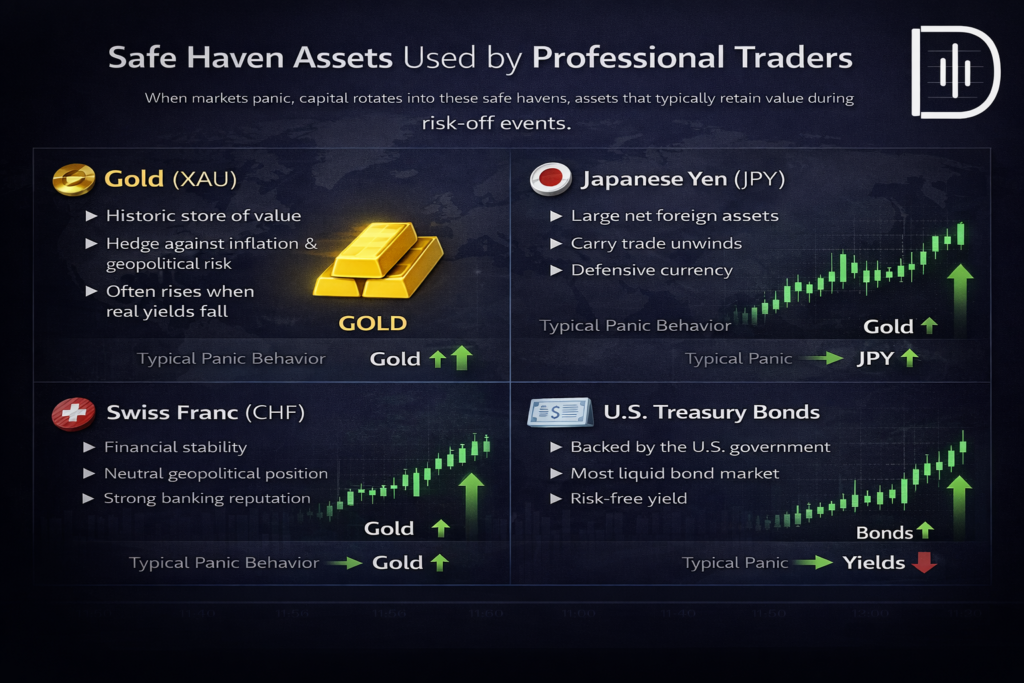
In today’s financial markets, some assets act as safe havens during times of geopolitical conflict. Gold is still the most popular safe haven asset. When things are uncertain, investors often look for physical assets that have a long history of keeping their value. Gold markets also do better when there is a lot of money available around the world and big companies are involved.
Another defensive asset is the Japanese yen. During global stress events, Japanese investors often repatriate overseas capital, strengthening the currency.
The Swiss franc functions similarly due to Switzerland’s political neutrality and historically stable financial system.
U.S. Treasury bonds also protect investors because they are backed by the world’s largest market for government debt.
For day traders, these assets show how people feel about risk around the world.
When gold prices go up quickly while stock prices go down, the market is showing that people are afraid of risk.
Knowing that signal can help you choose better trades across a wide range of instruments.
A Practical Framework for Trading Safe Haven Flows
Professional traders rarely treat safe haven assets as isolated trades. Instead they use them as context tools.
The first step is identifying a geopolitical catalyst. War escalation, sanctions, military conflicts, or energy supply disruptions often trigger safe haven flows.
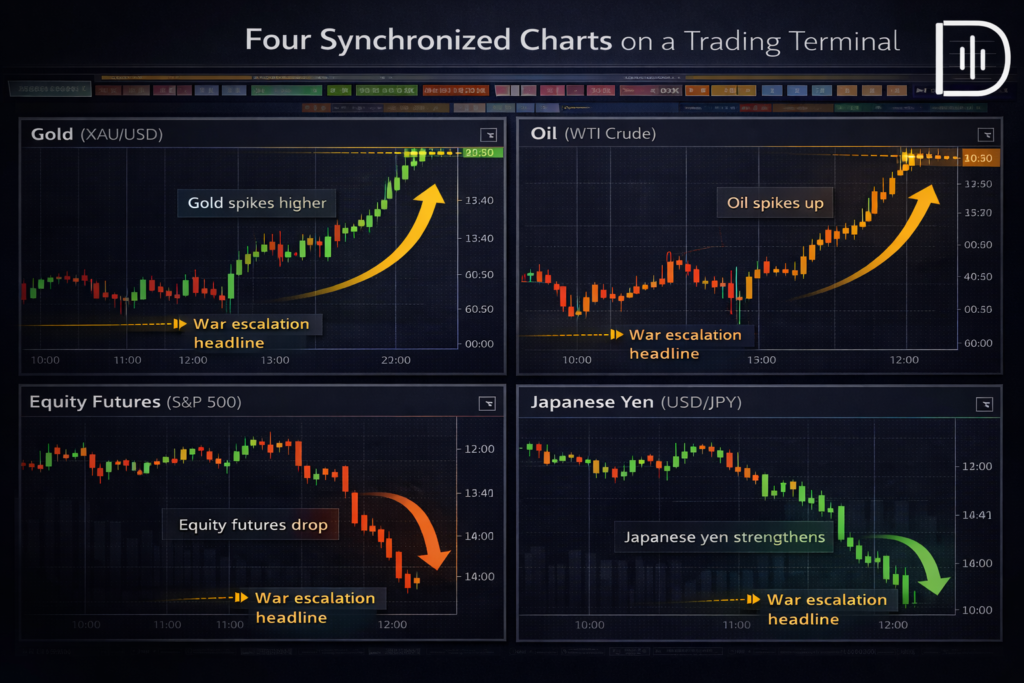
The second step is observing cross market confirmation. If gold, oil, and defensive currencies move simultaneously, the market is entering a risk off environment.
The third step is adjusting strategy accordingly.
Trend continuation trades often become more reliable because panic flows create momentum. Countertrend strategies become riskier because volatility expands rapidly.
For example, imagine global headlines escalate tensions in a major energy producing region.
Oil spikes sharply. Gold breaks above resistance. Equity futures decline.
A trader watching these signals may avoid long equity positions and instead look for momentum opportunities in gold or energy markets.
This type of situational awareness separates reactive traders from prepared ones.
When Safe Haven Trades Fail
Safe haven flows are strong, but they don’t last forever.
Markets eventually adjust to shocks in world politics. After the first panic, money often goes back into risky assets.
This change can happen very quickly.
If a trader gets in on a gold rally late in the move, they may see sharp reversals when institutions start to make money.
Another common failure point occurs when traders assume every geopolitical headline will produce the same market reaction.
Sometimes markets ignore geopolitical news if it does not materially impact economic growth or energy supply.
The key insight is that safe haven behavior depends on perceived systemic risk.
Not every conflict triggers a global capital rotation.
Risk Management During War Driven Volatility
Geopolitical events often produce sudden volatility spikes.
Price movements become faster. Liquidity can disappear temporarily. Slippage increases.
This is where many traders miscalculate risk.
They trade the same position size they use during normal market conditions even though volatility has doubled.
A smarter approach is adjusting risk exposure based on volatility conditions.
This is where most traders miscalculate risk. Using a position size calculator removes guesswork and ensures that larger stop distances do not accidentally increase overall account exposure.
When markets become unstable, capital preservation becomes the priority.
Smaller size often leads to better long term survival during unpredictable conditions.
If you want to strengthen your execution discipline, the DayTradersDiary.com guide on volatility adjusted position sizing expands on this concept.
Journaling Safe Haven Market Conditions
Many traders journal their trades but fail to track macro conditions.
During geopolitical events, this is a missed opportunity.
Tracking safe haven flows inside your journal can reveal patterns that improve future decision making.
Log whether gold, yen, or oil were trending strongly during your trades. Record whether equity markets were rising or falling.
Over time you may notice that your strategies perform differently depending on whether the market environment is risk on or risk off.
The Trade Journal Template available on DayTradersDiary.com helps organize this information systematically.
Professional traders constantly refine their awareness of macro context.
Markets are rarely random. They often respond to identifiable global drivers.
Scaling a Safe Haven Strategy With Larger Capital
The next thing that limits a trader is capital, after they learn how to read macro flows and manage risk well.
When you use a strategy on a small account, it can still feel slow.
This is why a lot of disciplined traders look into evaluation programs offered by private Firms.
Firms such as The5ers, FTMO, and Topstep allow traders to access larger capital allocations once they demonstrate consistency.
Safe haven trading strategies often perform well inside these environments because geopolitical volatility can produce large directional moves.
The5ers in particular focuses on risk controlled scaling models that align well with traders who prioritize discipline and macro awareness.
If you have developed a repeatable strategy around safe haven assets and volatility shifts, testing it through a The5ers evaluation account can be a logical next step.
Professional traders understand that skill must eventually connect with capital efficiency.
Frequently Asked Questions
What is a safe haven asset in trading?
A safe haven asset is an investment that tends to keep or grow in value when the market is stressed, there is geopolitical conflict, or there is financial uncertainty.
Which assets are considered safe havens during war?
Some of the most well-known safe haven assets are gold, the Japanese yen, the Swiss franc, and U.S. Treasury bonds.
Why does gold rise during geopolitical crises?
Investors often move capital into gold during uncertainty because it has historically maintained value during financial and political instability.
Do safe haven assets always rise during wars?
Not always. Market reactions depend on how severely the conflict threatens global economic stability or energy supply.
Final Thoughts
War and geopolitical crises create some of the most volatile market environments traders will ever face.
They can also create powerful opportunities for traders who understand how capital flows react to uncertainty.
The key is preparation.
For the next major geopolitical headline, do one simple exercise. Watch how gold, oil, equities, and defensive currencies move relative to each other.
That observation alone will reveal more about market psychology than any single indicator. If you want to deepen your understanding of global market behavior, the next article worth reading on DayTradersDiary.com is our guide on how macroeconomic events drive intraday volatility.