
Most traders believe that MACD delivers signals.
That belief is what makes them fail.
They wait for a crossover, enter late, see the price stall, and then get stopped out just as the impetus starts to wane.
They decide that the indication is lagging after a few losses.
The truth is more straightforward.
MACD is not a tool for signals.
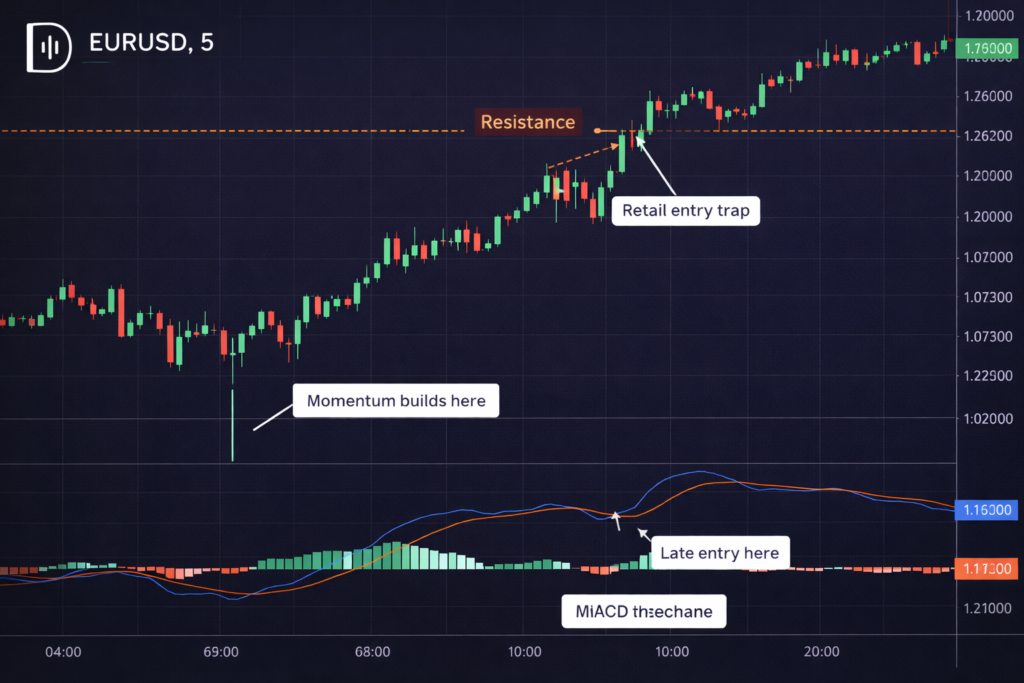
It is a translator for momentum. If you treat it like an entry trigger, you will always be late. If you use it to read momentum shifts in context, it becomes one of the most practical tools for day trading.
This guide is built around that shift in thinking.
What Research and Market Data Reveal About MACD
MACD is derived from moving averages, which makes it a trend following and momentum based indicator.
Research published through institutions like the CME Group shows that short term momentum plays a key role in intraday price movement, especially during high liquidity sessions.
Educational breakdowns from Investopedia explain that MACD measures the relationship between two exponential moving averages, effectively capturing momentum acceleration and deceleration.
The Bank for International Settlements talks about data insights that show how liquidity and capital flows cause bursts of momentum, especially when sessions overlap.
This gives traders something useful to take away.
MACD doesn’t tell you when things will change.
It tells you when momentum is growing or decreasing.
That difference influences how you use it in every way.
What MACD Is Actually Showing You
Most traders focus on the crossover.
Professionals focus on the story behind the lines.
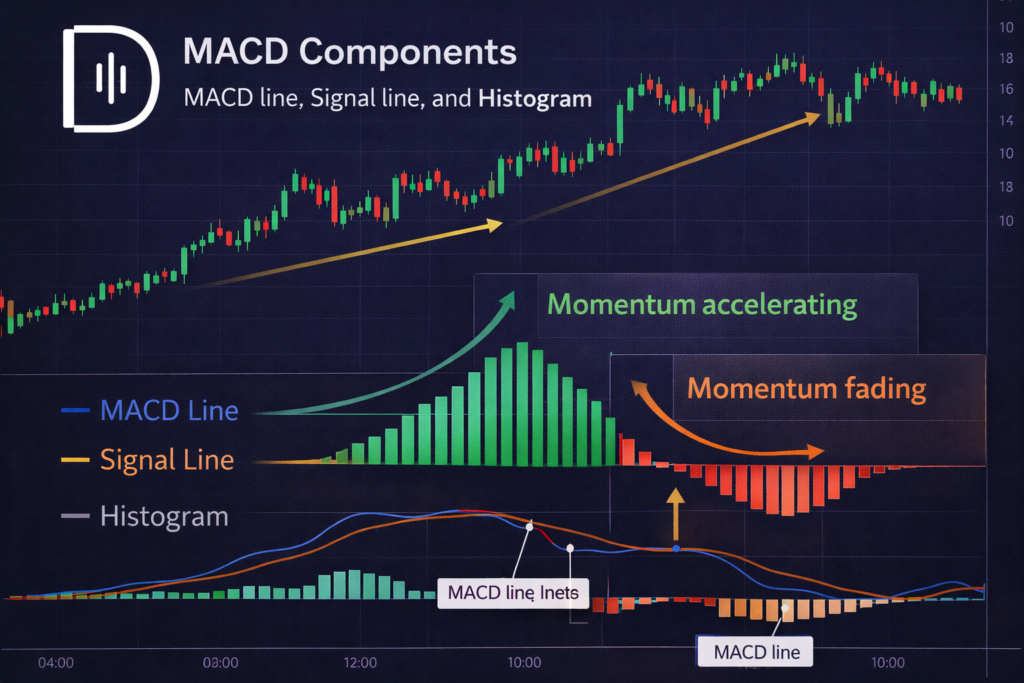
The MACD line reflects the distance between short term and longer term momentum.
The signal line smooths that movement.
The histogram shows how fast momentum is changing.
That last part is where the edge is.
When the histogram expands, momentum is accelerating.
When it contracts, momentum is slowing.
By the time a crossover happens, the move is already underway.
This is why waiting for a clean crossover often leads to late entries.
The Three Ways MACD Should Be Used in Day Trading
There are three practical ways to use MACD effectively.
Momentum confirmation, momentum shift, and divergence.
Momentum confirmation is the simplest.
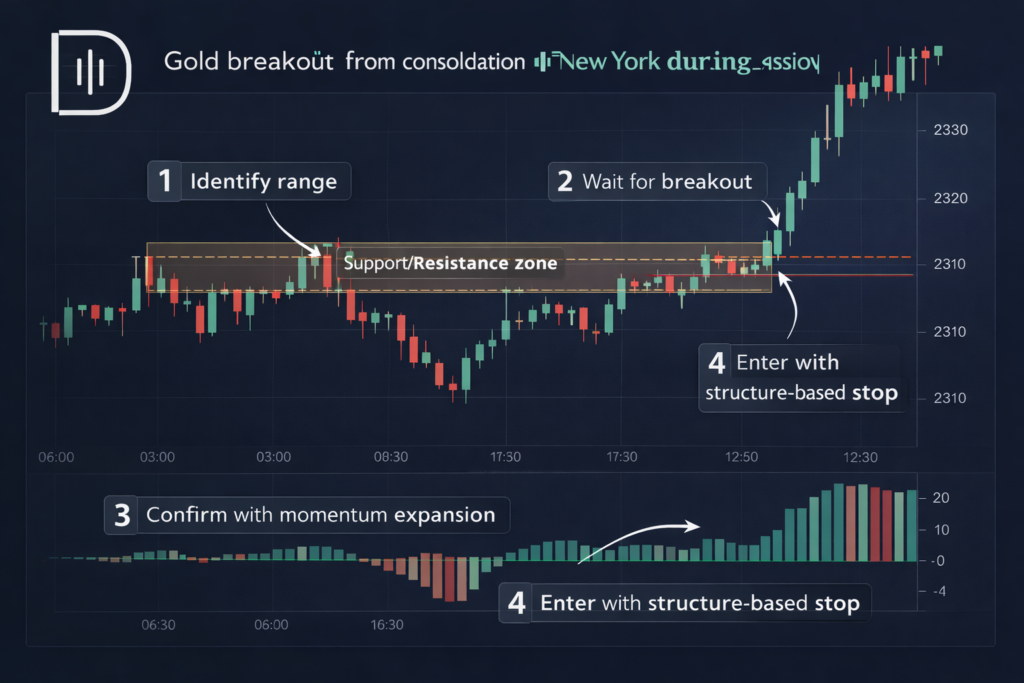
If price is breaking a key level and MACD is expanding in the same direction, the move has strength.
For example, if EURUSD breaks resistance during the London session and the histogram expands upward, that is alignment.
Momentum shift is more subtle.
When the histogram starts shrinking after expansion, it signals that the current move is losing strength.
This doesn’t mean that things will turn around right away, but it does mean you should lower your risk or get ready for a retreat.
Many traders seek for reversals at divergence points.
When price makes greater highs but MACD makes lower highs, it means that momentum is slowing down.
But divergence by itself is not enough.
Things only matter if they happen at the right level.
If you already use structure, the DayTradersDiary.com article on support and resistance trading demonstrates why placement is more essential than the signal itself.
A Practical MACD Trading Framework
You need a procedure to use MACD well.
Don’t look at the indication first; look at the price first.
Find out the important levels, the direction of the trend, and the background of the session.
Then utilise MACD to check what you see or challenge it. For example, during the New York session, if price breaks above a consolidation range, check MACD.
If momentum is expanding, you have confirmation.
If momentum is flat or diverging, the breakout may fail.
Another example.
If price is trending upward and pulls back to a support level, watch MACD.
If the histogram contracts during the pullback and then starts expanding again, it often signals continuation.
MACD is not telling you what to do.
It is helping you understand what the market is doing.
Best MACD Settings for Day Trading and Scalping
The default MACD settings are 12, 26, and 9.
These work well for most intraday strategies.
For faster trading styles like scalping, some traders adjust settings to 8, 21, and 5 to make the indicator more responsive.
But here is the important point.
Changing settings does not create an edge.
It changes sensitivity.
More sensitive settings give earlier signals but increase noise.
Less sensitive settings reduce noise but delay signals.
The goal is not to find perfect settings.
The goal is to align the indicator with your trading speed.
When MACD Fails Most Traders
MACD struggles in choppy markets.
When price is ranging without clear direction, the indicator produces frequent crossovers with little follow through.
This leads to overtrading.
Another common mistake is using MACD in isolation.
Without context, every signal looks valid.
With context, most signals can be ignored.
If you understand session behavior, the DayTradersDiary.com guide on forex trading hours explains why MACD performs better during high volume periods and poorly during low liquidity conditions.
Knowing when not to trust the indicator is part of the edge.
Risk Management With MACD Based Trades
MACD can improve timing, but it does not manage risk.
That is still your responsibility.
The advantage of using MACD is clarity in momentum.
If you enter a trade based on momentum expansion and the histogram immediately contracts, that is information.
It suggests your timing may be off.
Stops should still be based on structure, not the indicator.
If you are trading a breakout, your stop belongs below the breakout level, not based on MACD crossing back.
This is where most traders miscalculate risk. Using a position size calculator ensures that your trade size aligns with your stop distance and keeps risk consistent.
Execution matters more than the signal.
Journaling MACD Performance
Most traders use MACD but never evaluate how it actually impacts their results.
Your journal should track when MACD confirmed trades, when it diverged, and how those trades performed.
Over time, you may notice patterns.
Maybe your best trades occur when MACD aligns with breakouts.
Or maybe divergence works better in ranging markets.
Using the Trade Journal Template on DayTradersDiary.com helps you capture these insights and refine your strategy.
Indicators become powerful when they are tested, not assumed.
Scaling a MACD Based Strategy
A structured MACD approach can create consistency.
But consistency without capital has limits.
This is where proprietary trading firms come into play.
Firms like The5ers, FTMO, and Topstep provide traders with access to larger capital if they can demonstrate discipline.
MACD based strategies often perform well in these environments because they are rule based and focused on momentum.
The5ers, in particular, emphasizes controlled growth and risk management, which aligns with traders who use structured confirmation tools like MACD.
If your strategy becomes consistent, exploring a The5ers evaluation account is a logical next step.
Scaling is about applying your edge to more capital, not changing your strategy.
Frequently Asked Questions
Is MACD good for day trading?
Yes, when used as a momentum tool rather than a signal generator.
What is the best MACD setting for scalping?
Faster settings like 8, 21, and 5 can work, but they make more noise. Most traders still find the default settings useful.
Should I trade MACD crossovers?
Not by themselves. Crossovers are behind and should be used with price action and context.
What is MACD divergence?
Price and momentum moving oppositely generally indicate weakening trends.
Final Thoughts
MACD is simple.
That simplicity is why it is often misunderstood.
It does not tell you when to enter.
It tells you whether the move you are seeing has strength behind it.
If you shift from using it as a trigger to using it as confirmation, your trading changes.
For the next two weeks, ignore MACD crossovers.
Focus only on the histogram.
Watch how momentum expands and contracts around key levels.
That single adjustment can improve your timing more than any new strategy.
If you want to go deeper, the next article to read on DayTradersDiary.com is our guide on combining indicators without overcomplicating your trading.