
Many traders think that the New York session is just a continuation of what happened in London.
That idea quietly ends accounts.
You see London push a strong trend, so you jump in expecting it to keep going. But within an hour, the market snaps back, removes your stop, and then either stays the same or goes in the opposite direction.
There is no technical error. It depends on the situation.
The New York session is not just another active period. It is where liquidity peaks, narratives get confirmed or rejected, and institutions either commit to the trend or unwind it.
If you learn how to read that shift, the New York session becomes one of the most precise trading windows in the forex market.
This is not about trading more. It is about trading at the moment when the market reveals intent.
What the Data Says About the New York Session
The global forex market sees its highest participation during the overlap between London and New York, according to the Bank for International Settlements.
This overlap window accounts for a significant portion of daily trading volume.
The CME Group highlights that U.S. economic releases often drive sharp intraday volatility, especially in currency pairs tied to the dollar.
Meanwhile, educational analysis from Investopedia emphasizes that the New York session introduces a different type of order flow compared to London.
Here is what that means in practical terms.
London is often about initiating moves.
New York is about validating or fading them.
That distinction is where most day traders either find consistency or continue struggling.
Understanding the Three Phases of the New York Session
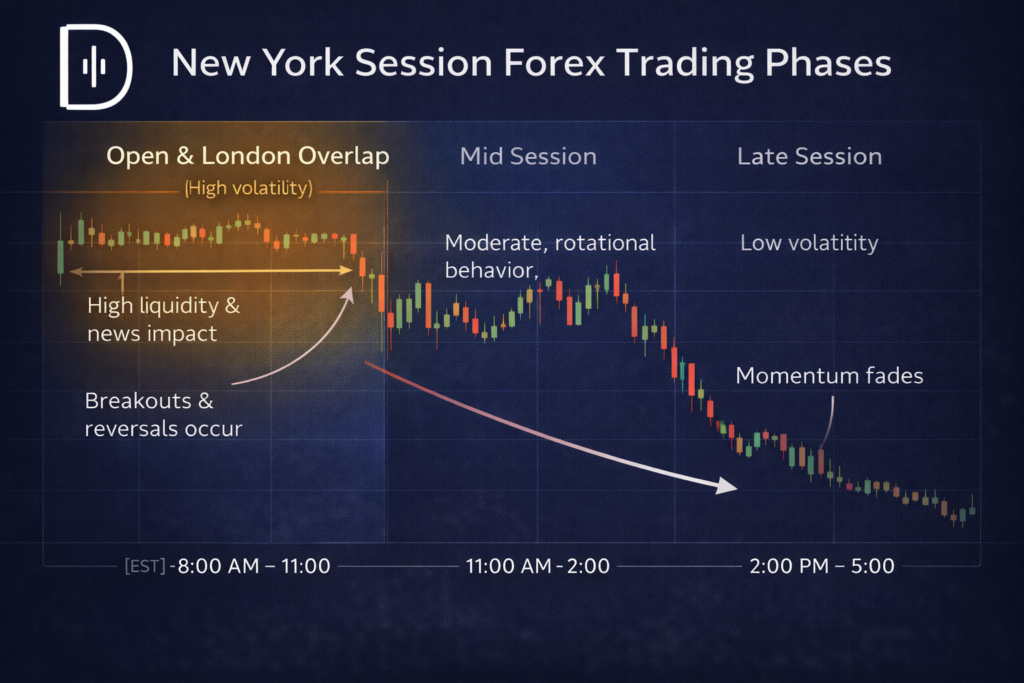
Most traders treat the New York session as one block of time. In reality, it behaves like three different markets.
The open and London overlap phase is the most volatile. This is when U.S. traders react to European positioning and major economic data releases hit the market.
If London created a clean trend, this is where continuation either accelerates or fails.
The mid session phase slows down. Liquidity is still present, but directional conviction often fades. This is where many breakouts stall and price starts rotating.
The late session phase is considerably quieter. The number of institutions that participate goes down, spreads might get bigger, and price action becomes less predictable for day trading.
Most serious traders pay a lot of attention to the initial phase and either quit trading or cut back on their size as the session goes on.
The Continuation vs Reversal Framework
This is where the true edge is.
There is one important question that starts every New York session.
Is the market going along with the migration to London or not?
You are not guessing where to go. You are reading behavior.
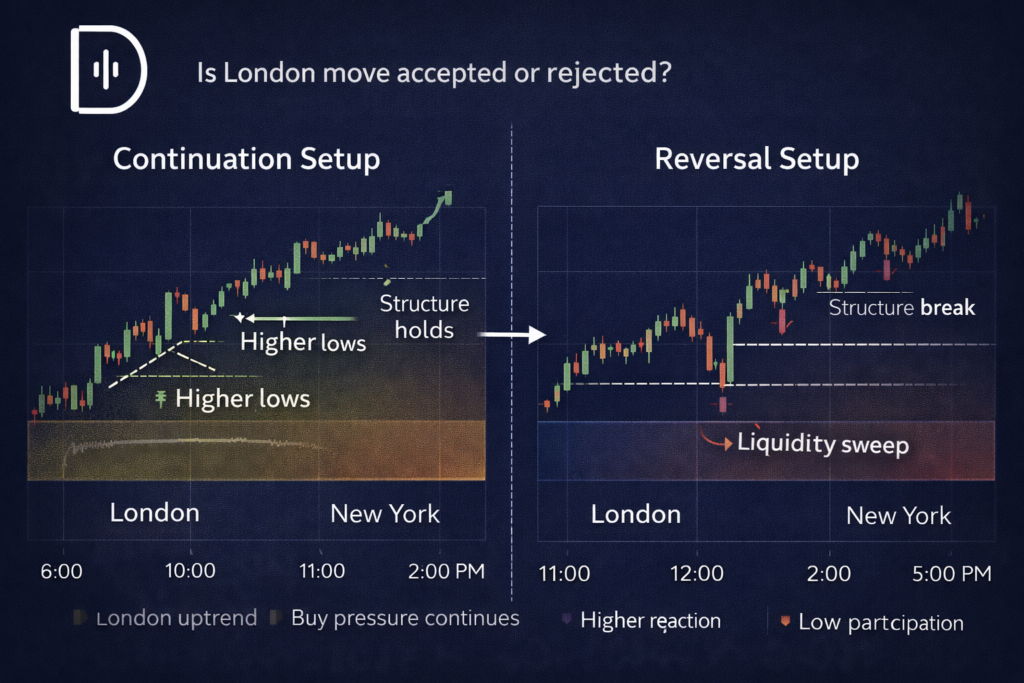
If London makes a strong positive trend and New York opens with shallow pullbacks, higher lows, and active buying after U.S. data, the market is okay with higher prices. That is the same thing.
But if New York opens and immediately pushes below London support levels, absorbs buying pressure, and fails to hold structure, that is rejection.
That is where reversals begin.
A simple way to think about it is this.
London creates the story. New York decides whether the story holds.
If you have already read the DayTradersDiary.com guide on how to trade the London session, you know that session transitions are where the highest quality setups form.
The New York session is the confirmation layer.
Trading Around U.S. Economic Releases
One of the defining features of the New York session is the frequency of high impact economic data.
Reports like the Non-Farm Payrolls, the Consumer Price Index (CPI), and decisions about interest rates can change the structure of the day completely.
Most traders make the mistake of approaching these events as routine setups. No, they aren’t. Before a big release, prices generally go down and liquidity dries up. After the announcement, spreads get bigger, volatility goes up, and the direction can change several times in a matter of minutes. Professional traders do not rush into the first move.
They wait.
They let the initial volatility settle and then look for structure to form. Often the best trade comes after the first fake move when the real direction becomes clearer. The DayTradersDiary.com post about forex trading hours shows why volatility tends to happen at certain times. This can let you see how timing affects settings in different sessions.
A Practical Routine for the New York Session
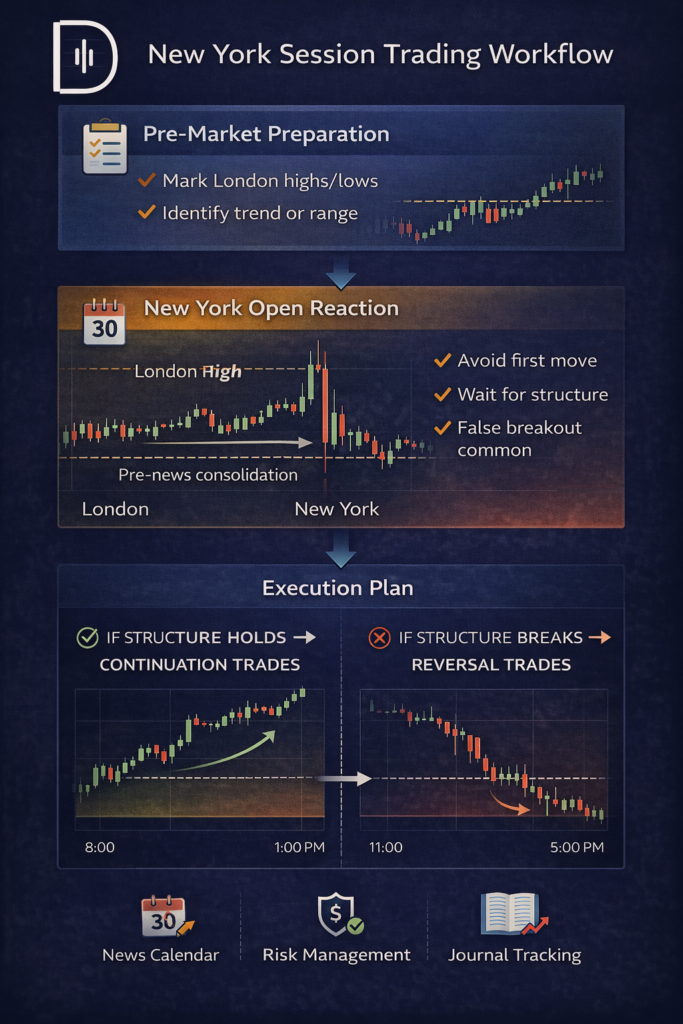
Consistency in this session comes from routine, not reaction.
Before New York opens, review what London did.
Did it trend cleanly or chop within a range?
Mark key highs and lows from the London session. These levels often act as decision points once New York participants enter.
When the session begins, observe the reaction rather than jumping into trades.
If price respects London structure and continues in the same direction, look for pullbacks into key levels.
If price breaks and holds beyond London extremes, start looking for reversal setups.
This process sounds simple, but most traders skip it.
They trade the chart in isolation without understanding how the session context shapes probability.
Where Most Traders Lose During New York
The biggest losses do not come from bad strategies.
They come from impatience.
Traders overtrade the mid session when volatility drops. They chase late moves after the main opportunity has passed. They force setups that only exist during high liquidity windows.
Another common issue is bias.
Traders become attached to the London direction and ignore clear signs of reversal during New York.
The market does not care about your earlier analysis.
It responds to new information, especially during U.S. hours.
Learning to adapt quickly is a core skill for this session.
Risk Management in a High Volatility Window
The New York open can produce some of the fastest moves of the trading day.
That creates opportunity but also increases execution risk.
Slippage, spread expansion, and sudden reversals are common, especially around news events.
This is where most traders get the risk wrong. A position size calculator takes the guesswork out of the equation and keeps your exposure steady even when the market becomes more volatile. You are not merely taking care of the risk for each deal. You are taking care of risk for each session. If the market gets shaky after a big release, it’s usually preferable to stay out of the way instead of forcing deals.
At times like this, following through is more important than analyzing.
Journaling New York Session Performance
If you are serious about improving, you need to separate your performance by session.
The New York session exposes different strengths and weaknesses compared to London.
Track whether your trades were continuation or reversal setups.
Track how they performed after major news releases.
Track whether you traded during the high probability overlap or during slower mid session conditions.
Using the Trade Journal Template on DayTradersDiary.com makes it easier to identify patterns that are not visible in isolated trades.
Over time, you will see which types of setups actually produce results for you during this session.
Scaling Your Edge Beyond a Retail Account
At some point, consistency becomes limited by capital.
A strategy that works during the New York session can produce reliable returns, but scaling that edge requires more than just discipline.
This is where proprietary trading firms come into the picture.
Firms like The5ers, FTMO, and Topstep offer traders the ability to access larger capital pools after proving risk management skills.
The New York session is a good fit for assessment models because it has controlled, repeatable volatility windows. For instance, The5ers emphasizes on consistency and limited drawdown, which is in line with traders that create session-based strategies.
If your data shows that your method performs successfully during New York hours, the next step might be to try it out using a The5ers assessment account. Serious traders eventually realize that edge without capital slows long term growth.
Frequently Asked Questions
What time does the New York forex session start?
The New York session typically begins at 8:00 AM Eastern Time, with the most active period occurring during the overlap with London.
Is the New York session good for day trading?
Yes. It offers high liquidity, strong volatility, and frequent economic catalysts, making it one of the best sessions for active traders.
Should you trade the entire New York session?
Not necessarily. Most high probability setups occur during the first few hours. Later periods often have lower volatility and less reliable movement.
Which pairs are best during the New York session?
USD pairs such as EURUSD, GBPUSD, and USDJPY tend to show strong movement, especially during economic releases.
Final Thoughts
The New York session is not about chasing movement.
It is about reading confirmation.
Every day, the market gives you a clear signal. It either accepts what London started or rejects it completely.
Your job is not to predict that outcome.
Your job is to recognize it early and act with discipline.
For the next two weeks, focus on one thing.
Stop trading the entire session. Trade only the first two hours and track whether you are trading continuation or reversal setups.
That single adjustment can dramatically improve your consistency.
If you want to refine your timing even further, the next article to read on DayTradersDiary.com is our breakdown of the best time of day to trade forex.