
Most traders draw too many lines.
They mark every swing high and low, convince themselves price “has to react,” then get chopped up when the market slices straight through their level like it never existed.
Support resistance intraday trading is not about lines. It is about liquidity.
If you have been trading for a while, you already know how to identify basic support and resistance. The real question is this: why does price sometimes react perfectly and other times ignore the level completely?
This guide is built from live trading experience, data review, and years of watching levels hold, fail, fake out, and flip. If you want a support resistance intraday strategy that actually survives real execution, you need context, order flow logic, and strict risk alignment.
Let’s go deeper than textbook definitions.
Let’s go deeper than textbook definitions.What Research Tells Us About Intraday Levels
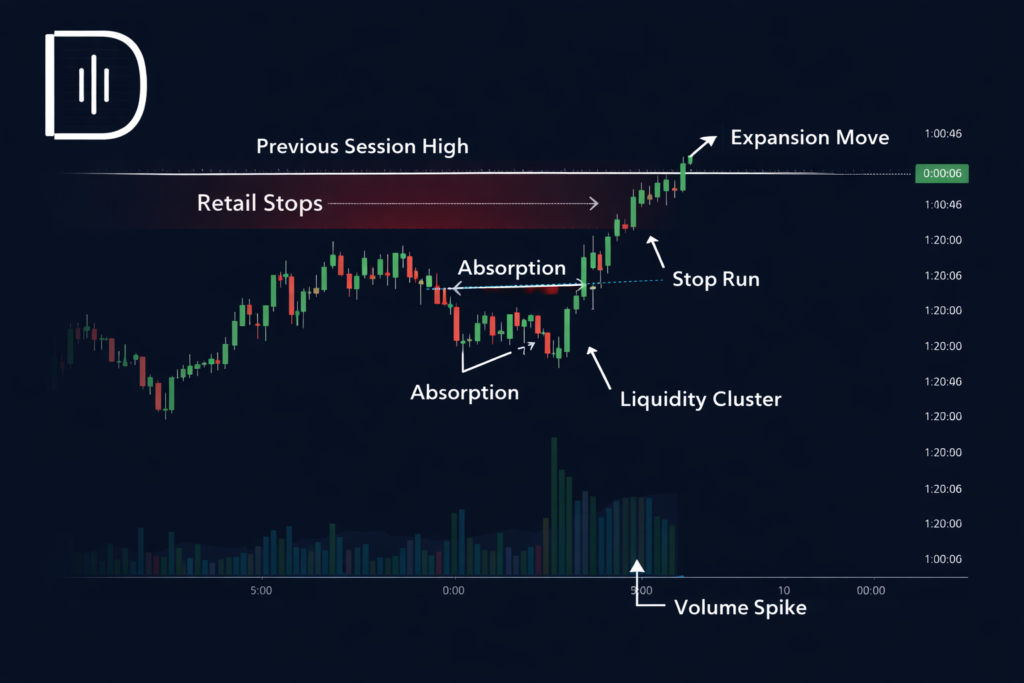
Support and resistance are not mystical barriers. They reflect areas where liquidity clusters.
The Bank for International Settlements often cites research demonstrating that institutional FX flow tends to cluster around previous highs, lows, and option-related strike levels. That means that these levels draw in orders because people use them as a point of reference for execution.
The CFA Institute has put out studies that show how the price impact gets bigger when there isn’t much liquidity around important levels. This is why traders who trade during the day can see big price swings when prices get close to well-known areas.
The National Bureau of Economic Research often publishes academic research that says that order flow imbalance is a major cause of short-term momentum. When stops happen above resistance or below support, momentum often grows for a short time.
What does this mean in practice?
Support and resistance levels work not because they are drawn on charts, but because traders place orders around them. The level is simply a visual representation of collective positioning.
Your job intraday is to determine whether price is approaching a level to reverse, to accumulate, or to break and expand.
The Three Types of Intraday Levels That Matter
Not every level is the same.
The first thing to look at are the highs and lows of the session. High for the London session. The range for New York before the market opens. Low for the Asian session. These levels are used as reference points for liquidity sweeps.
Second are higher timeframe levels that match the structure of the day. A 5-minute swing high that happens randomly is not as important as a 4-hour resistance that was tested during a 5-minute consolidation.
Third are volume-based levels, especially when using volume profile. High volume nodes often act as magnets. Low volume areas tend to accelerate price once broken.
If you are already using volume concepts, revisit our in-depth guide on mastering volume in day trading. Combining volume with support resistance intraday strategy increases precision dramatically.
A Practical Intraday Framework for Trading Levels
Let me simplify how I approach this in real time.
Step one is context.
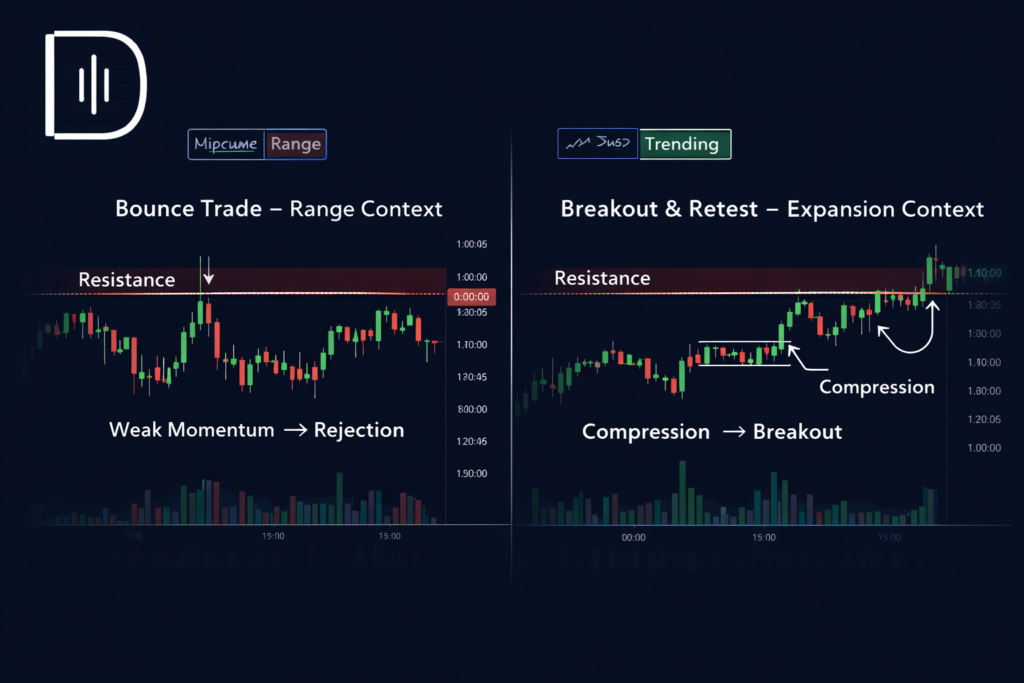
Before the session opens, identify higher timeframe bias. Are we trending or ranging on the 4-hour and daily chart? If higher timeframe structure shows expansion potential, breakout trades at resistance are more viable. If we are range-bound, mean reversion at extremes becomes more attractive.
Step two is reaction quality.
When price first touches a level, observe candle structure and momentum. A strong counter impulse after a sharp rejection suggests active defence. Slow grind into the level with candles that overlap could mean absorption or a breakout.
The third step is to confirm the follow-through.
If I’m going to trade a bounce, I want to see a clear change in the short-term structure. For instance, a break of a minor lower high after support holds. When I trade a breakout, I want the price to go up past the level with as few immediate rejections as possible.This is a story that isn’t very long.
When London opens, the price gets close to yesterday’s high. There is a lot of energy going into the level. The sound gets louder. The price doesn’t go down; instead, it stays just below resistance. A lot of the time, this means absorption. A breakout with continuation is more likely to happen than a fade.
Now imagine price spikes above yesterday’s high during New York lunch with long upper wicks and low follow-through. That looks more like a liquidity grab than true expansion.
Same level. Different context. Different trade.
This is the difference between drawing lines and trading liquidity.
The Two Core Intraday Plays at Support and Resistance
Every support resistance intraday strategy boils down to two primary plays.
The bounce trade.
You trade rejection from the level, aiming for a move back toward range mid or opposite extreme. This works best in range conditions or when higher timeframe structure suggests exhaustion.
The breakout and retest trade.
You trade continuation after the level fails and price retests from the other side. This works best during session opens or macro catalysts when volatility expands.
Most traders fail because they mix these two approaches randomly.
You cannot short every resistance and buy every breakout. You must decide which environment you are in before choosing the play.
If you struggle with breakout logic, our detailed guide on trading intraday breakouts on DayTradersDiary.com connects directly to this framework.
Why Intraday Levels Fail
Levels fail when the market is imbalanced.
If a strong macro catalyst hits, such as a central bank surprise, prior intraday levels may become irrelevant within minutes.
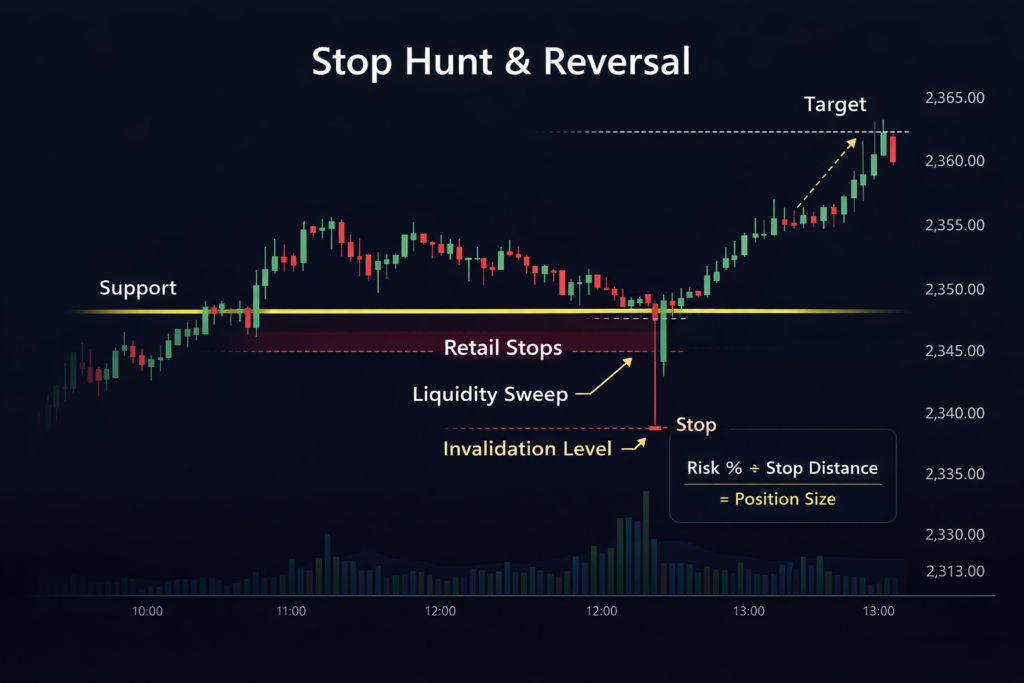
Levels also fail when too obvious. Retail halts are grouped just outside of the highest and lowest points that can be seen. Institutions often push prices a little past these levels to get people to buy before they go back down.
That’s why you need to think logically, not emotionally, when you place a stop.
You are liquidity if you put stops exactly at the level. You are managing risk well if you put them just outside of the structure where the trade thesis is no longer valid.
Risk Management Around Intraday Levels
Support resistance intraday trading creates a false sense of certainty. A clean level looks safe.
It is not.
Your risk per trade must remain constant regardless of how “strong” the level appears.
This is where most traders miscalculate risk. A position size calculator takes the guesswork out of the equation and makes sure your lot size changes to the structure’s actual stop distance.
Your stop must be 15 pips past a liquidity sweep instead of 5 pips at the line. This means that your position size must also go down.
Execution discipline also means being okay with the fact that some levels will break cleanly against you. Statistically, one loss at a level doesn’t mean anything. When accounts blow up, they do it by doubling their size on the next level.
If you haven’t already set up a consistent sizing framework, go back to our risk-to-reward and position-sizing guide and use the Position Size Calculator before every session.
Journaling Level-Based Trades
Most traders mark charts. Few measure performance by level type.
If you want to refine your support resistance intraday strategy, track:
Level type
Session
Bounce or breakout
Higher timeframe bias
Outcome in R
After 50 trades, you will likely discover that certain combinations outperform others. For example, London session breakouts above Asian range high may show strong expectancy, while New York lunch fades underperform.
Our Trade Journal Template is built specifically to track these contextual variables. Without structured journaling, you will misattribute results to randomness or luck.
Data exposes whether your edge is real or imagined.
Scaling a Proven Intraday Edge
Once you demonstrate consistent performance trading intraday levels, capital becomes the limiting factor.
It takes a long time to compound a small account. Raising the risk of each trade to speed up growth usually leads to inconsistency.
This is where evaluation models start to make sense.
Companies like The5ers, FTMO, and Topstep give people structured access to more money with clear rules about risk.
The5ers‘ scaling model is perfect for disciplined intraday traders. You get more money to work with as you show that you can stick to your controlled drawdown limits.
An evaluation account isn’t a way to bet on a challenge. It is about seeing if your support and resistance levels hold up under institutional-style rules.
If you have backtested your strategy, forward tested it, and validated it through journaling, consider stepping into a The5ers evaluation environment as a professional progression.
Frequently Asked Questions
What is the best timeframe for support resistance intraday trading?
Most intraday traders mark levels on 1-hour or 4-hour charts and execute on 5-minute or 15-minute charts. Aligning with a higher time frame increases the chance.
Should I trade every time I touch support or resistance?
No, it depends on the situation. Whether to trade a bounce or a breakout depends on the time of day, the momentum into the level, and the structure of the higher time frame.
How can I stay away from fake breakouts?
Above the level, look for compression and follow-through. Weak momentum and immediate rejection are two common signs of liquidity grabs.
Is support resistance intraday better than systems that use indicators?
Levels show liquidity and structure directly. Indicators can help, but the price structure is still the most important thing for intraday accuracy.
Final Thoughts
It’s not about drawing perfect lines when it comes to support and resistance. They are about figuring out what people want to do with money.
This week’s challenge is easy.
Cut your levels in half. Only pay attention to the highs and lows of the session and one higher timeframe zone. Only trade when the situation fits with your chosen bounce, play, or breakout.
Accuracy is better than mess.
For your next read, check out our full guide on how to make a rule-based intraday trading plan again. Levels are only useful when they are part of a structured process.