
Most traders don’t lose money because they trade pullbacks.
They lose money because they trade every pullback.
You have seen it. Price trends strongly, stalls, dips a little, and you jump in thinking you are buying value. Seconds later, the pullback becomes a reversal and you are stopped out at the exact low before trend continuation.
The real problem isn’t how fast the execution is or which indicators are used. You don’t understand the context.
I made this guide based on the amount of time I spend on screens, the data I have, and the psychological patterns I have seen repeat in hundreds of day traders. You need a decision framework that separates noise from opportunity and continuation setups from distribution traps if you want to trade pullbacks in forex all the time.
Let’s build that framework properly.
What Is a Pullback in Trading, Really?
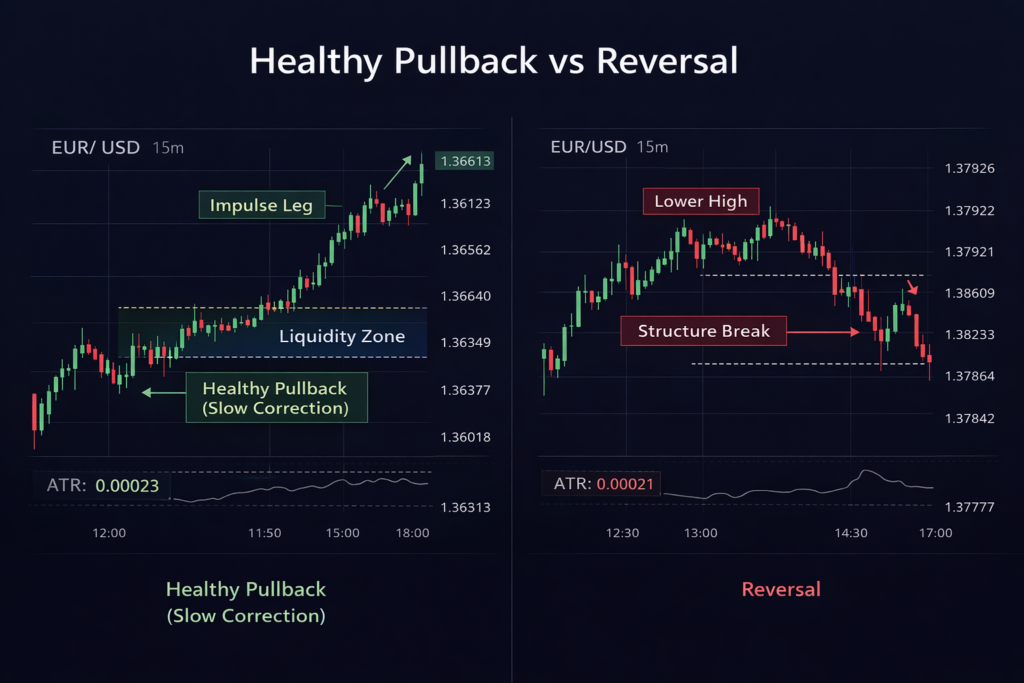
Technically, a pullback is a temporary counter-trend move within a larger trend. But that definition does not help you trade it.
A pullback in trading is an event that affects liquidity. The market is going against the current momentum to balance out the flow of orders before it goes back to going in the dominant direction.
In the EURUSD and GBPUSD intraday forex markets, most pullbacks are caused by three things:
Taking profits in the short term
Scalpers who go against the trend are fading extremes
Institutional reloading at lower prices
The mistake retail traders make is assuming every retracement is a discount. In reality, some pullbacks are absorption before continuation. Others are early signs of structural change.
Your job is to tell the difference.
What the Research Actually Says About Trend Continuation
The idea of trend persistence is not just folklore among traders. Academic research supports it.
A study by National Bureau of Economic Research on momentum effects in financial markets showed that assets that outperform over intermediate horizons tend to continue outperforming. While much of that research focuses on equities, the behavioral logic applies to currencies as well.
In the same way, research from the Bank for International Settlements shows that FX markets have short-term momentum characteristics, especially in liquid pairs during sessions with a lot of participation.
The Federal Reserve has even written about how prices in currency markets tend to move in response to order flow. This supports the idea that price trends often last longer because of how institutions position themselves, not because of random movement.
What does this mean for someone who trades every day?
It means that continuation is statistically possible. But that doesn’t mean you can buy every dip.
There is momentum. Structure determines its integrity.
The Pullback Decision Framework Most Traders Never Build
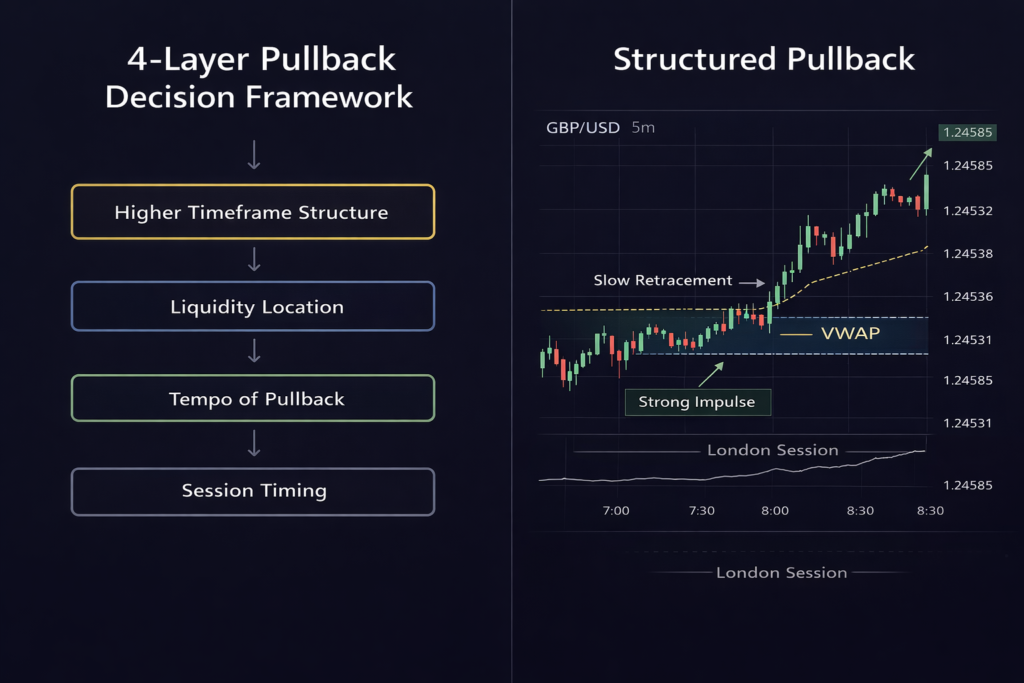
To trade pullbacks in forex consistently, you need to think in layers instead of signals.
Layer One: The Bigger Picture in Time
Before you pull back, ask yourself a question about the structure. Are the higher timeframes making higher highs and lower lows, or lower highs and lower lows?
Your 5-minute pullback isn’t a good deal because the 4H or 1H structure is breaking. It could be the beginning of a time of distribution.
Many traders skip this step. Then they wonder why their “pullback entry” isn’t working.Layer Two: Where You Are Matters More Than What You See. It is unlikely that the price will go back to a random mid-range area.Layer Two: Where you are is more important than what you see
A pullback into random mid-range territory is not very likely.
A pullback to the previous breakout level, the session VWAP, or a clear liquidity pocket is a signal to act.For example, imagine London session breaks above Asian range with strong impulsive candles. Price pulls back 40 percent into the breakout zone during low volatility. That is a structured pullback.
Now compare that to a late New York drift with no momentum context. Same retracement size. Completely different probability.
If you have read our article on support resistance intraday strategy, you already know that levels only matter when liquidity aligns with them. Pullbacks are no different.
Layer Three: Tempo of the Pullback
Strong trends correct slowly. Weak trends correct aggressively.
If the retracement candles are sharp, impulsive, and erase the entire prior move quickly, you are not looking at a healthy pullback. You may be looking at a reversal.
One of the simplest filters I teach traders is this: the correction should be slower than the impulse. If it is not, stand down.
Layer Four: Session Timing
Pullbacks act differently in different sessions.
Pullbacks that happen during the London session are often cleaner because the volume goes up. Pullbacks during lunch in New York are messy and often break fake.
If you don’t pay attention to session structure, you’ll misclassify setups. Our breakdown of the best time to trade forex shows why volatility clustering is more important than indicator settings.
Entry Logic That Reduces Emotional Mistakes
Most traders enter pullbacks in one of two flawed ways.
They enter too early, trying to catch the exact bottom.
Or they enter too late, chasing confirmation after risk to reward collapses.
Instead, think in conditional logic.
If the structure on higher time frames is still there
And the price goes back into a well-defined liquidity zone.
And the lower time frame shows absorption instead of aggressive selling.
Then I make a partial position with a set risk.
This takes away any desire to act on impulse.
Sometimes I start with a smaller size and then add to it after I’ve confirmed the structure. This lowers mental stress and stops people from making trades they regret later.
Remember that this doesn’t depend on signs. It all depends on the situation.
When Pullbacks Fail and Why
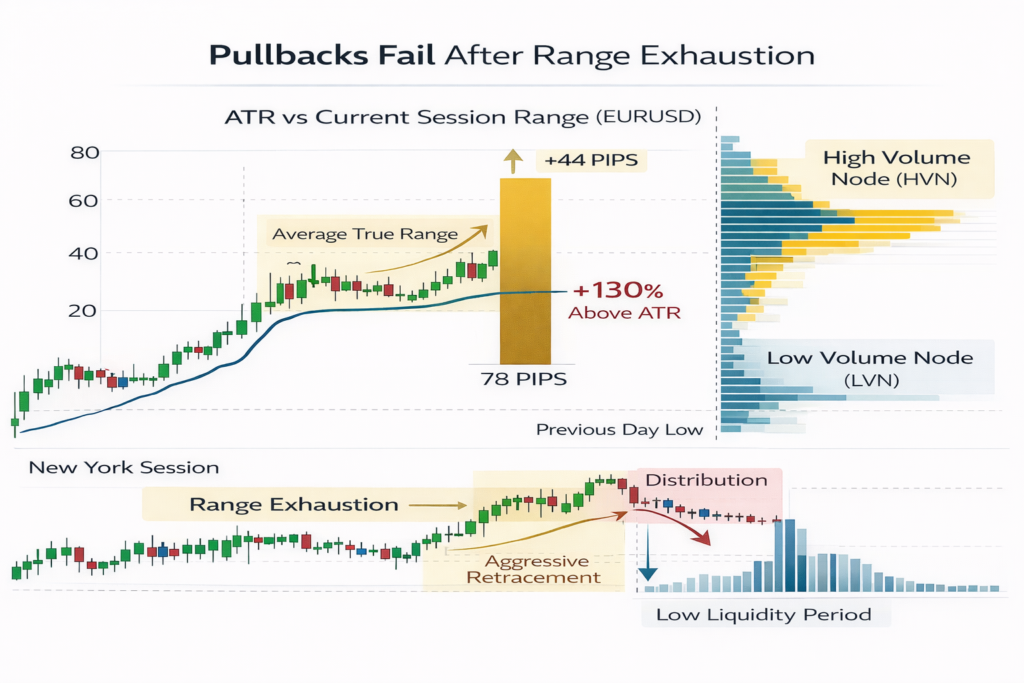
Pullbacks fail most often at structural transition points.
If a trend has already extended far beyond average session range, continuation probability drops. This is where knowing how to use ATR for day trading really helps. If the price has already gone beyond the normal range expansion, the next pullback could be distribution instead of continuation.
During macro news windows, another failure condition shows up. When liquidity dries up and spreads widen, what looks like a pullback turns into a spike in volatility.
You don’t have to guess. You need to filter.
Risk and Execution Discipline
Pullbacks feel safe. That is the psychological trap.
Because you are entering at a better price than breakout traders, you subconsciously loosen risk control.
This is where most traders miscalculate risk. Using a position size calculator removes guesswork. It makes you match your stop distance with a fixed percentage risk instead of your feelings.
Your stop should be set at a distance that is beyond structural invalidation, not at random pip distances. The premise is wrong if the structure breaks. Quickly accept it.
Execution discipline also means being okay with missing trades. Not every pullback confirms what it says in the book.
Journaling Pullback Performance Properly
If you are serious about improving how you trade pullbacks in forex, your journal must track more than win rate.
You should record:
Session timing
Depth of retracement relative to impulse
Higher timeframe alignment
Outcome relative to ATR
When traders use our Trade Journal Template, I encourage them to tag trades by setup type. After 30 to 50 trades, patterns emerge. You may discover your London continuation pullbacks perform far better than late New York fades.
That data becomes your edge refinement tool.
Scaling the Edge Beyond Personal Capital
Here is a hard truth.
Even if you master pullback trading, your growth will stall if capital is limited. A five percent monthly return on a small account does not change your trajectory meaningfully.
Because of this, a lot of serious traders look into evaluation programs like The5ers, FTMO, or Trade The Pool.
It’s easy to see why. If your pullback strategy has a statistical edge and you are disciplined about how much risk you take, you can scale through evaluation accounts to improve your performance without putting too much of your own money at risk.
For example, The5ers has funding models that reward consistency with capital scaling, which helps businesses grow. It’s not a quick way. It is a professional structure that makes people follow clear rules when they take risks.
If you think your pullback strategy is ready, you might want to try it out in a structured evaluation setting. It quickly shows flaws and rewards stable processes.
Frequently Asked Questions
In simple terms, what is a pullback in trading?
A pullback is a short-term move in the opposite direction of the main trend before it continues. Short-term profit taking and liquidity rebalancing are two things that often drive forex day trading.
How far back should a forex pullback go?
There isn’t a set amount. When there are strong trends, shallow pullbacks that happen near previous breakout levels tend to do better than deep ones. You should compare depth, volatility, and session range to each other.
Are pullbacks better than breakout entries?
Neither is better for everyone. If the structure stays the same, pullbacks give you a better risk-to-reward ratio. Breakouts show that something is strong, but the prices are usually worse. Your personality and how you do things are important.
Can beginners make money trading pullbacks?
Only if they put structure first and entries second. Most beginners look at candle patterns without thinking about the bigger picture.
Final Thoughts
Pullbacks are not sales. They are tests.
Every retracement poses the same inquiry. Is the trend still structurally sound, or are people changing their minds?
It’s not your job to guess. It is to make sure that everything fits together, handle risk carefully, and look at performance without bias.
This week, make one thing better. Before you enter pullbacks, either tighten your structural filter or get better at sizing your positions based on how volatile the market is.
If you want to deepen your framework, your next read should be our guide on support resistance intraday strategy. Pullbacks and liquidity levels are inseparable. Master both, and your entries will feel less reactive and far more deliberate.