
Most traders avoid losing money on breakouts because the strategy doesn’t work. They lose because they trade at every level that seems significant.
You have seen it. The price of EUR/USD breaks through resistance, you buy the breakout, and then it quickly goes back into the range. Stop hit. Then you set up forms, but you don’t do it right away, and that one goes 40 pips without you.
The question isn’t whether or not to trade breakouts in Forex. The problem is figuring out which breakout is worth your money.
This guide doesn’t just repeat what you learned in a textbook about support and resistance. It is a way to make decisions based on screen time, trade data, and the mental patterns that keep active traders from succeeding.
You need more than just levels to get the best trade breakouts Forex strategy.
The Reality of Forex Breakouts Backed by Data
We want to clear up a common myth before we talk about tactics.
Retail traders often think that once the price breaks a level, it will probably keep going. The data tells a more complex story.
The Bank for International Settlements’ research shows that institutional flows, hedging activity, and macro positioning are the main things that move the FX market. That means that many breakouts are just liquidity events and not promises to go in a certain direction.
In the same way, the Federal Reserve has put out studies that show how macroeconomic releases make liquidity tighter and volatility higher for short periods of time. This is why breakout strategies tend to do better during scheduled high-impact events and worse during low-liquidity sessions.
The National Bureau of Economic Research often cites academic research that says there are accelerating effects in currency markets, but they are not always present. When flows fit with macro narratives, momentum stays strong. It doesn’t work when moves are based only on technical or liquidity factors.
As a day trader, this is what it means for you. Breakouts work best when people are involved and there is a story behind them. They don’t work when they’re just stop hunts in a calm market.
So the question shifts from how to trade breakouts Forex to when is this breakout statistically aligned with participation.
The Breakout Decision Framework
I cut down on breakout trading to three filters over time. I usually skip a setup if it fails one.
Compression comes first. A valid breakout often happens after the market stops moving around so much. When you see tight consolidation, a smaller average true range, and a clear buildup of liquidity around a level, you are looking at stored energy. If the price moves slowly into resistance without compressing, the chances of failure go up.
The second thing is where it is in the higher timeframe structure. A breakout at the top of a daily range has a different chance of happening than a breakout that follows a weekly trend. You can follow through if the higher timeframe shows that there is room for growth. If it looks tired, you are probably buying into supply.
Third is catalyst. This can be a macro release, session open, or correlated market movement. A breakout during the London open in GBP pairs behaves differently from one in the middle of the Asian session. When I trade breakouts in Forex, I want time-of-day logic on my side.
Let me give you a scenario.
EUR/USD is consolidating below a well-defined intraday high for three hours during the London session. Volatility is compressing. The euro zone PMI release is scheduled in ten minutes. If data surprises to the upside and price breaks with aggressive volume expansion, that breakout is supported by both compression and catalyst.
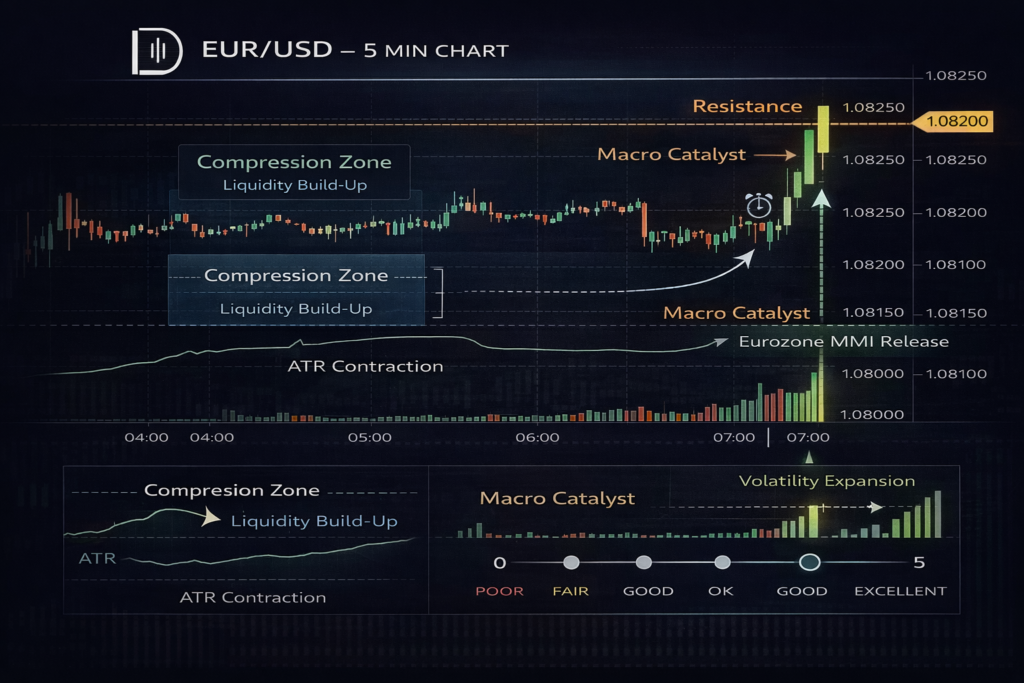
Now compare that with a slow drift above resistance during low volume New York lunch hours. Same chart pattern. Completely different probabilities.
The best trade breakouts Forex setups are contextual, not cosmetic.
Entry Models That Actually Survive
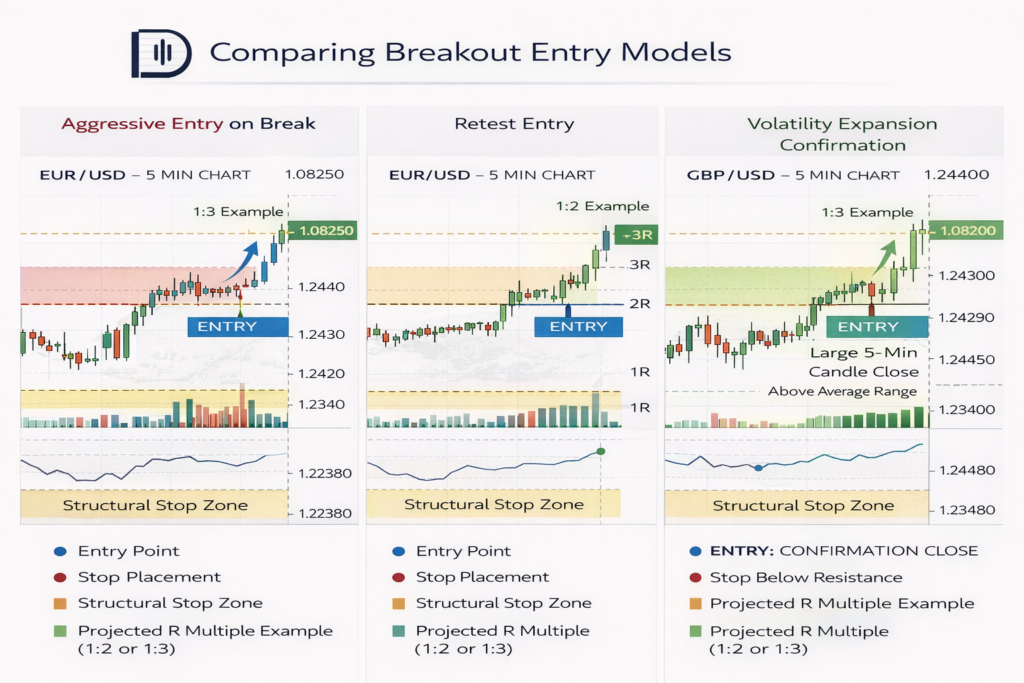
There are three practical ways to execute breakouts, and each has a psychological cost.
The first is aggressive entry on the break. This captures maximum R multiple but increases exposure to false breaks. It works best when you have strong catalyst alignment.
The second is the entry for retesting. You wait for the price to break, pull back to the level, and then demonstrate continuing structure on a shorter time frame. You give up some profit to get confirmation. For most traders, this is better for the long term.
The third is confirming momentum by expanding volatility. For instance, waiting for a 5-minute close with a range that is much higher than the average range from the last five minutes. This cuts down on noise but also on the number of trades.
Most traders mix these up at random. Professionals decide ahead of time which model they will use and when.
Check out our guide on ATR-based trade management on DayTradersDiary.com if you want a more organized way to filter out volatility. It links directly to the logic of breakout growth.
Why Breakouts Fail and How to Avoid Being Liquidity
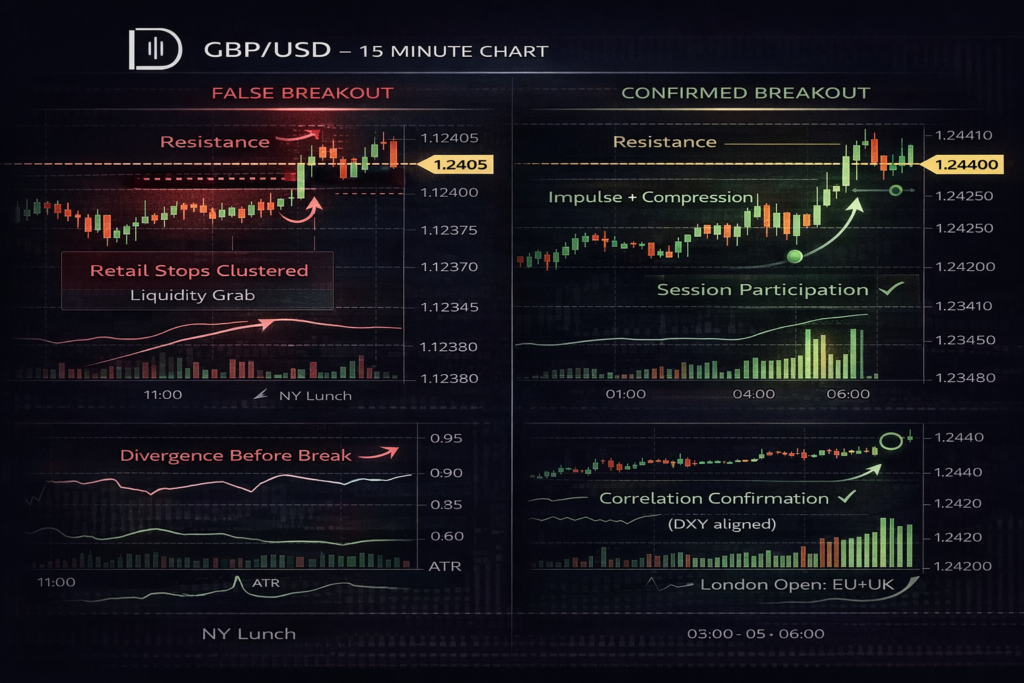
There is a pattern to false breakouts. They happen a lot at clear retail levels where stops group together.
You should assume that liquidity is beyond a level if it is clearly visible on all timeframes and people are talking about it on social media. Institutions might push the price through, set off stops, and then go back.
One useful filter is to look at the momentum before a break. If the price gets close to resistance with a weakening impulse and divergence, the chances of a fake break go up. A strong impulse into a level followed by tight compression is better.
Another is correlation awareness. If you are trading GBP/USD but the Dollar Index is not confirming the move, continuation probability drops.
These are the nuances missing from most generic trade breakouts Forex strategy discussions.
Risk and Execution Discipline
Breakouts make traders want to oversize because they feel like the move is going to explode.
This is where most traders get risk wrong. A failed breakout can quickly turn around and slip stops. A position size calculator takes the guesswork out of the equation and makes sure that the same thing happens at different stop distances.
Your stop placement should be based on structure, not fear. If you’re trading a retest entry, the stop should usually be beyond the structure that makes continuation impossible, not just five pips below entry.
Execution discipline also means being okay with the fact that many breakouts won’t retest. You need to decide ahead of time if it’s better to miss the trade than to chase it.
If you struggle with inconsistent sizing, revisit our position sizing guide and use the Position Size Calculator before every breakout trade.
Journaling Breakout Performance
Most traders journal wins and losses. Few journal breakout type, session, volatility regime, and catalyst presence.
If you want to master how to trade breakouts in Forex, tag every trade by:
Session
Catalyst or no catalyst
Compression duration
Entry model used
Over 50 to 100 trades, patterns will emerge. You may discover your edge only exists during London session continuation setups, not New York reversals.
Use our Trade Journal Template to track these variables systematically. Data removes ego from the equation.
Breakout trading is especially vulnerable to emotional overtrading because of the fear of missing out. Journaling exposes when you are trading boredom instead of edge.
Scaling the Edge Beyond Personal Capital
Even with a good breakout plan, your own money can slow down growth.
This is the limit that serious traders will eventually reach. You get better at executing trades and managing risk, but your account size limits your returns.
This is where evaluation programs come in, not with emotions but with reason.
Firms like The5ers, FTMO, and MyForexFunds offer structured evaluation models. It’s a simple idea. Prove that you can be consistent even when there are risks, and then you can get to bigger pools of capital.
The5ers in particular stresses low drawdown tolerance and realistic scaling plans, which are great for breakout traders who use irregular R multiples instead of high win rates.
An evaluation account is not a shortcut. It is a professional filter. If your breakout framework cannot survive fixed risk parameters, it is not scalable.
If you are consistently profitable on a small account, consider testing your process within a The5ers evaluation environment. It forces discipline and rewards structure.
Frequently Asked Questions
Is breakout trading a good idea for people who are new to Forex?
Yes, but only if beginners stick to structured entry models and strict position sizing. Breakouts that don’t have any context often cause people to stop out again and again.
What time frame is best for trading breakouts?
Forex Intraday traders often use 5- to 15-minute charts for entries, which are in line with 1-hour or 4-hour structure for context. When higher timeframes line up, the chances of continuation go up.
How can I stay away from fake breakouts?
Pay attention to compression, the presence of a catalyst, and confirmation of correlation. Stay away from obvious retail levels when the market is not very liquid.
Do breakout strategies work when the market is moving sideways?
Without catalysts for growth, they don’t do well in broad ranges. In these kinds of situations, mean reversion strategies usually work better.
Final Thoughts
Breakout trading is not about catching every move. It is about waiting for alignment between structure, volatility, and participation.
Your challenge this week is simple. Do not change your strategy. Improve your filter. Trade only breakout setups that meet all three conditions of compression, location, and catalyst.
Then review your last 20 breakout trades. Identify how many met those criteria.
Edge is rarely found in new indicators. It is found in stricter selection.
For your next read, revisit our in-depth guide on building a balanced intraday trading portfolio. It will help you decide how breakout strategies fit within your broader trading approach.