
Most traders say they want volatility.
But when it actually shows up, they are not prepared for it.
They enter trades with tight stops during high volatility and get stopped out instantly. Or they trade quiet markets expecting momentum that never comes.
The problem is not volatility itself.
The problem is not measuring it correctly.
Volatility is not just how fast price moves. It is how much opportunity the market is offering relative to your strategy.
If you learn how to measure volatility in forex properly, you stop forcing trades and start aligning with conditions that actually support your edge.
This guide is built around how experienced traders read volatility in real time and adjust execution accordingly.
What Research Reveals About Forex Volatility
The global forex market processes over $7 trillion in daily volume according to the Bank for International Settlements.
However, that volume does not translate into consistent volatility.
Research and data from the CME Group show that volatility clusters around specific time windows, particularly when major financial centers overlap or when economic data is released.
Educational insights from Investopedia confirm that volatility is influenced by liquidity, news events, and market participation.
For traders, this leads to an important realization.
Volatility is not random.
It is cyclical, predictable in timing, and heavily influenced by session behavior and macro catalysts.
Understanding that cycle is far more useful than relying on indicators alone.
The Three Types of Volatility Every Trader Should Recognize
Not all volatility is equal.
Trending volatility occurs when price moves directionally with momentum. Most traders earn money here because the fluctuations last longer and are easier to handle.
When prices move aggressively yet stay within a range, this is called rotational volatility. This makes fake breakouts and turbulent conditions that keep trend traders from making money.
There is event-driven volatility when big news comes out. Prices go up quickly, spreads get bigger, and the structure breaks down for a short time. Most traders treat all volatility the same.
Experienced traders identify which type they are dealing with before entering a trade.
That decision alone can filter out a large number of low quality setups.
Measuring Volatility Without Overcomplicating It
A lot of traders use indicators but don’t pay attention to what the price is already saying. Start with the easiest way to measure.
Range. How many pips does a pair move in an hour or a session?
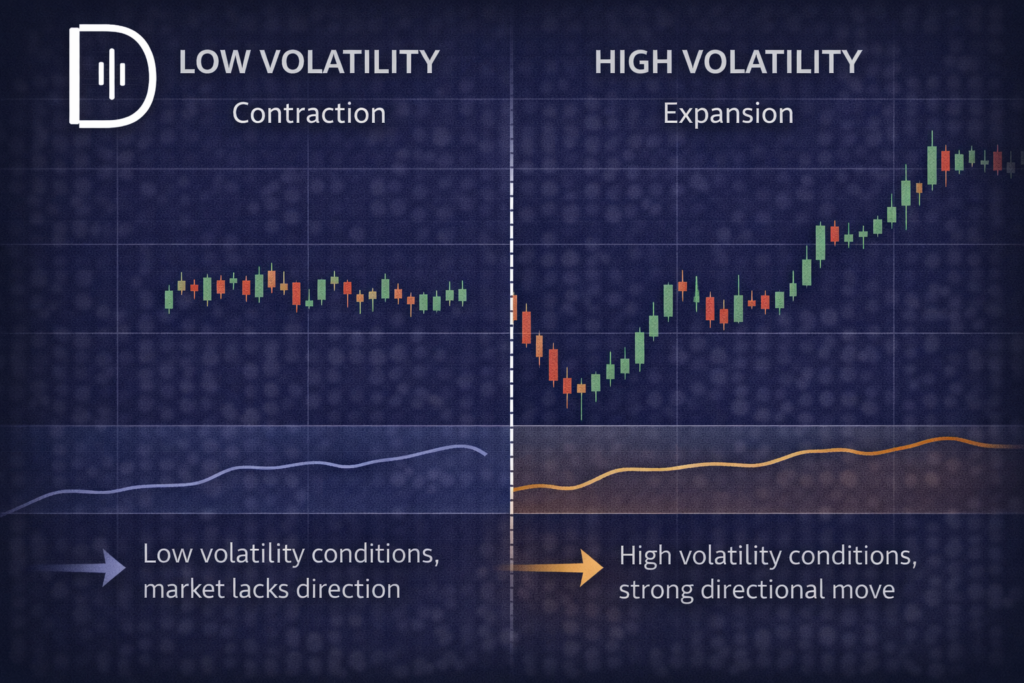
That difference is important for both entry and objectives if EURUSD is averaging 20 pips during the Asian session and 60 pips during the London session. The next thing is growth and contraction. When candles start getting larger, volatility is increasing. When candles compress, volatility is decreasing.
This shift often happens before major moves.
Indicators like Average True Range can help quantify this, but they should confirm what you already see, not replace it.
Volatility is visible on the chart if you train yourself to recognize it.
The Session Based Volatility Framework
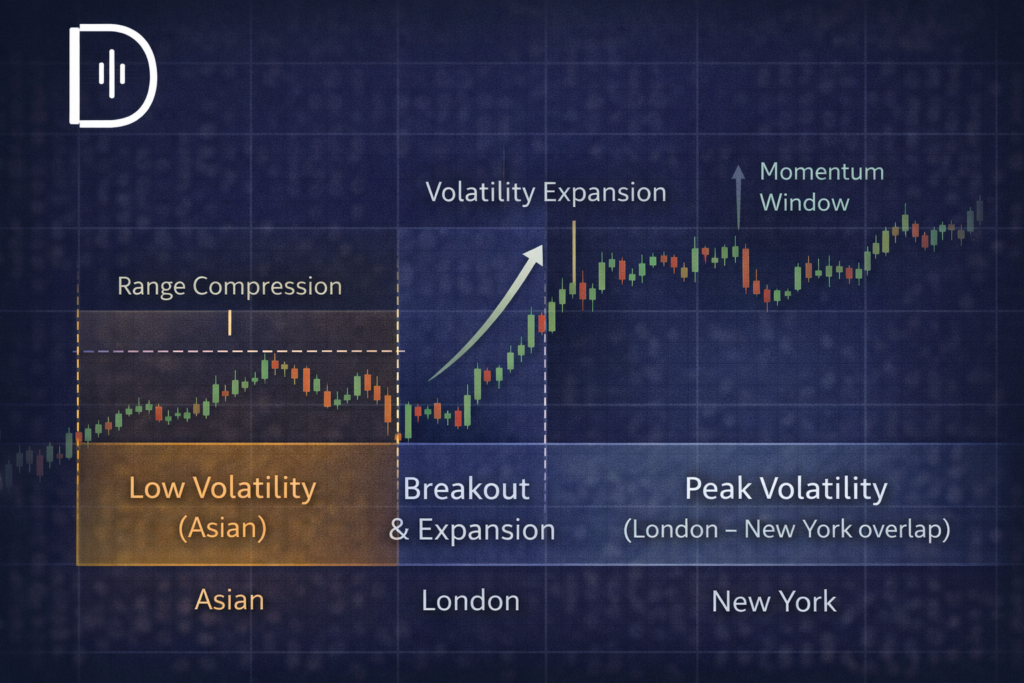
Session behaviour is one of the most reliable ways to measure how volatile the forex market is. The Asian session usually has less volatility and smaller ranges. The London session starts the expansion. This is where trends and breakouts often start. The New York session delivers a second wave of volatility, especially when it overlaps with London. If you have already read the DayTradersDiary.com guide on forex trading hours, you know that timing is not optional in trading. It defines opportunity.
For example, if you are trading a breakout strategy during the Asian session, you are likely operating in the wrong environment.
But the same setup during the London open may produce a clean, sustained move.
Volatility is not just about how much price moves.
It is about when it moves.
A Practical Framework for Trading Volatility
To make this actionable, think in terms of alignment.
Before entering a trade, ask three questions.
Is volatility expanding or contracting?
Is the current session known for momentum or consolidation?
Is the pair moving within its normal range or exceeding it?
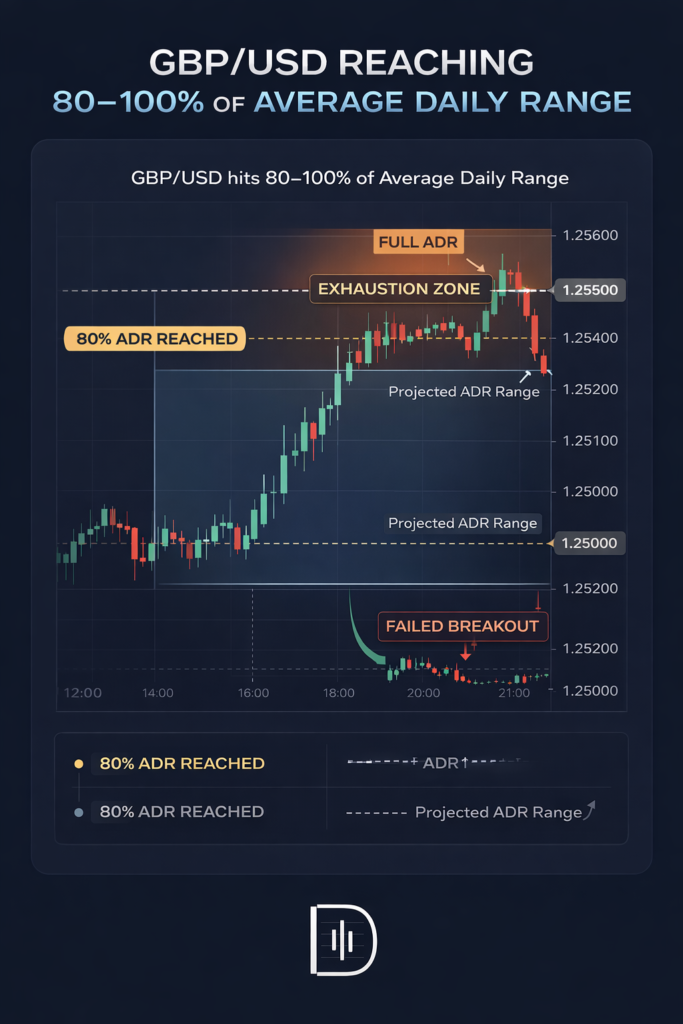
For example, if GBPUSD has already moved 80 percent of its average daily range before New York opens, expecting a strong continuation becomes less probable.
On the other hand, if volatility is just beginning to expand during the London open, momentum setups become more attractive.
This type of thinking shifts you from reactive trading to structured decision making.
If you want to refine how you combine volatility with entries, the DayTradersDiary.com article on candlestick patterns for day trading explains how price behavior changes under different volatility conditions.
When Volatility Becomes a Trap
More volatility does not always mean better trading conditions.
Excessive volatility often creates poor execution environments.
During major news events, spreads widen, slippage increases, and price can move unpredictably.
Many traders get caught chasing these moves.
They enter after a large candle, only to see price reverse immediately.
This is not lack of skill.
It is misunderstanding the type of volatility in play.
Event driven volatility requires patience. The best trades often come after the initial reaction, not during it.
Risk Management in Different Volatility Conditions
Volatility directly impacts risk.
Higher volatility requires wider stop losses. Lower volatility allows tighter stops but often produces smaller moves.
The mistake most traders make is using fixed stop distances regardless of market conditions.
This leads to inconsistent risk exposure.
This is where most traders miscalculate risk. Using a position size calculator removes guesswork and ensures that your position size adjusts when stop distances change.
You are not just trading setups.
You are trading conditions.
Managing risk based on volatility is one of the biggest differences between amateur and professional traders.
Journaling Volatility to Build an Edge
Most traders do not track volatility in their journal.
They track wins and losses but ignore the conditions in which those results occurred.
This is a missed opportunity.
Your journal should include notes on volatility.
Was the market trending or ranging? Was it a high volatility session or a quiet period? Did the trade occur before or after a major news event?
Over time, patterns emerge.
You may find that your strategy performs best during moderate volatility but struggles during extreme conditions.
Using the Trade Journal Template on DayTradersDiary.com allows you to track these variables and refine your approach.
Edge often comes from understanding when not to trade.
Scaling a Volatility Based Strategy
Once you understand how to measure and trade volatility, consistency improves.
But scaling that consistency requires capital.
A well executed strategy in the right volatility conditions can produce steady returns, but growth is limited by account size.
This is why many traders move toward proprietary trading firms.
Traders that show that they can manage risk well can get more money from Firms like The5ers, FTMO, and Topstep. These programs are a good fit for volatility-based strategies since they focus on regulated execution and being able to adjust. The5ers, in particular, focuses on steady growth and risk consistency, which suits traders who base decisions on market conditions rather than fixed rules.
If your trading improves when you align with volatility, testing your approach within a The5ers evaluation account can be a logical next step.
Consistency plus capital is where trading becomes scalable.
Frequently Asked Questions
What is volatility in forex trading?
Volatility refers to the rate and magnitude of price movement in the market over a specific period.
How do traders measure volatility in forex?
Traders use tools like price range, session analysis, and indicators such as Average True Range, along with observing price behavior directly.
Which session has the highest volatility?
The London and New York overlap usually has the most volatility because more people are trading.
Is high volatility good for trading?
It can be, but only if managed properly. High volatility increases opportunity but also increases risk and execution challenges.
Final Thoughts
You don’t want to chase volatility. You agree with it. Most traders fail not because their approach is terrible, but because they use it in the wrong situations. For the next two weeks, keep an eye on volatility before each trade. Ask yourself whether the market is expanding, contracting, or reacting to news.
That one habit will change how you see the market.
If you want to take this further, the next article to read on DayTradersDiary.com is our guide on how to identify the best forex pairs for day trading based on volatility.