
How to Diversify Trading Capital and Protect Your Trading Account
Most traders believe they are diversified because they trade five pairs.
Forex, GBP, XAU, NASDAQ, and possibly BTC. Multifaceted. Expert-like.
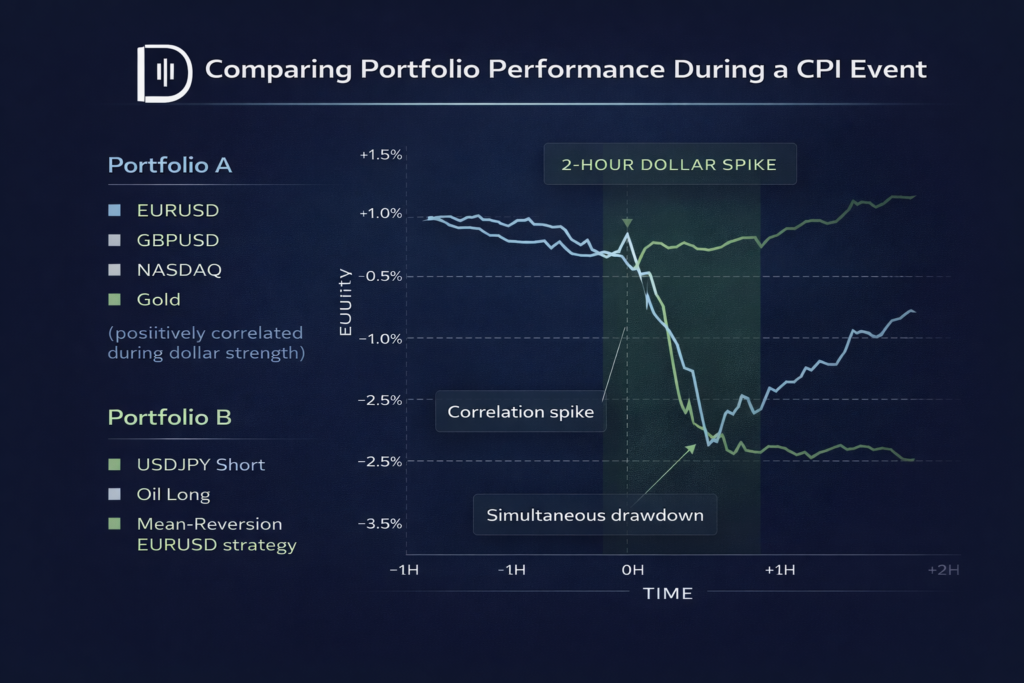
A CPI-driven dollar rise follows. They face simultaneous opposition.
Two-hour account down 3%.
Problem was never lacking enough configurations. Too little actual capital diversification.
One thing keeps happening after years of trading and looking at funded trader and private account performance analytics. Though they use different instruments, traders don’t change their risk, capital, or attitude.
This guide doesn’t cover investment diversification textbook tips. It involves spreading your trading capital to protect your account and gain money.
Know trading risk? This is the next stage.
What the Research Says About Diversification and Why Traders Misapply It
Diversification in investing has deep academic roots. Harry Markowitz’s Modern Portfolio Theory showed mathematically that combining uncorrelated assets reduces portfolio volatility for a given expected return. The original framework is still widely referenced in institutional portfolio construction.
The CFA Institute regularly publishes research showing that cross-asset diversification reduces drawdowns more effectively than simply increasing the number of positions within the same asset class.
Morningstar’s portfolio studies also confirm a key point that active traders often ignore. Correlation spikes during market stress. Assets that appear diversified in calm markets often move together in risk-off environments.
Here is what that means for active day traders.
If you are long NASDAQ, long S&P 500, and long high beta tech stocks, you are not diversified. You are concentrated in one macro factor. If you are trading multiple USD pairs, you are concentrated in dollar exposure.
Diversification that ignores correlation is cosmetic.
The best diversification strategy for traders is not about adding more trades. It is about reducing dependency on one driver of returns.
A Practical Framework for Diversifying Trading Capital
Let’s move from theory to execution.
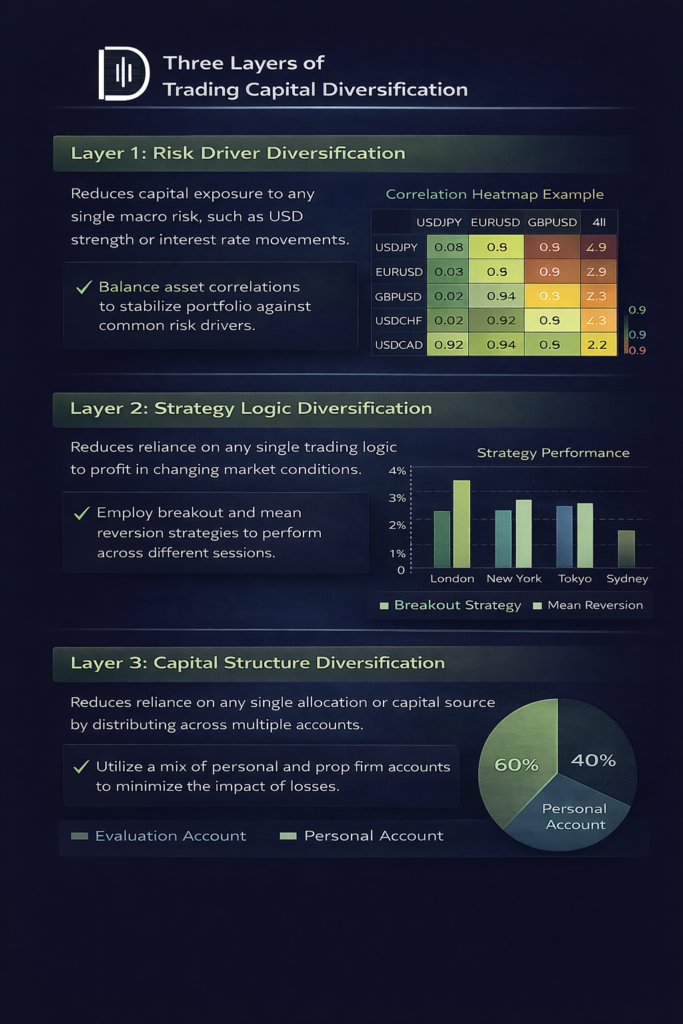
Layer One: Diversify by Risk Driver, Not by Symbol
One question before adding instruments.
What is the big picture or structure behind this exchange?
One example:
When the dollar is weak, long EURUSD and GBPUSD has been said twice.Long gold and long USDJPY during low risk may cancel each other out or increase exposure, depending on the structure. During high liquidity, long NASDAQ and BTC are similar macrobets.
An exercise I give to traders.
Make a list of your open positions. Write the primary driver next to each one. The dollar is strong, there is a lot of risk, rates are high, commodities are high, and there is a lot of tension in the world.
If three trades have the same driver, your money isn’t spread out.
If you mostly trade Forex, read the article on DayTradersDiary.com about how to identify currency correlations and use that information to help you choose positions.
Layer Two: Diversify by Strategy Logic
This is where most retail traders fail. Despite using different tools, they trade globally. EURUSD breakout trader. Gold trader escapes. NASDAQ breakout trader. As the market moves from trend to range, everything worsens. Diversification is the best method to safeguard real capital.
For instance:
• Tracking London session patterns
• Mean reversion during less volatile Asian sessions
• Major event news impact strategy
Each cycle works differently.
Mean reversion may work when trends fail. Breakout systems return when ranges fail.
Repeat the risk management article for the day across sessions to improve this layer. The importance of session structure is unknown to most traders.
Layer Three: Diversify by Capital Structure
Probably the most underestimated diversification method.
Think about it.
Shared broker, liquidity, leverage, and regulatory risk for all your trading capital?
Veteran traders purposefully separate capital.
Simple structure:
Personal account for cautious growth
Divide aggressive settings into more unstable accounts.
Risk-controlled evaluation or financed account
This structure does two things.
First, it prevents one emotional cycle from contaminating all capital. Second, it forces you to adapt to different risk constraints, which strengthens discipline.
If your entire net trading worth sits in one account, one bad month can distort your behavior dramatically.
When Diversification Fails
Diversification fails when traders use it to justify overtrading.
Taking five correlated trades because you want to “spread risk” usually increases it.
Another failure point is over-hedging.
Some traders long EURUSD and short GBPUSD believing they are neutral. In reality, they are paying spreads and commissions to create complexity without real edge.
Diversification should simplify risk, not complicate it.
If you cannot clearly explain why adding a trade reduces net portfolio risk, it probably does not.
Risk and Execution: Precision Still Matters
Even with varying trading capital, you must size positions correctly.
It increases the desire. When trading multiple assets or strategies, volatility profiles fluctuate. 20 pip stops on EURUSD are different from 20 point stops on NASDAQ.
This is where most traders misjudge risk. A position size calculator eliminates guesswork and ensures that your varied positions don’t discreetly exceed your daily risk limit.
You must do more than diversify to protect your capital. Correcting numbers is key.
Reread DayTradersDiary.com’s guide on controlling daily loss limits to discover how to control drawdown pace. Diversification causes account loss despite daily risk limitations.
Journaling Diversification Performance
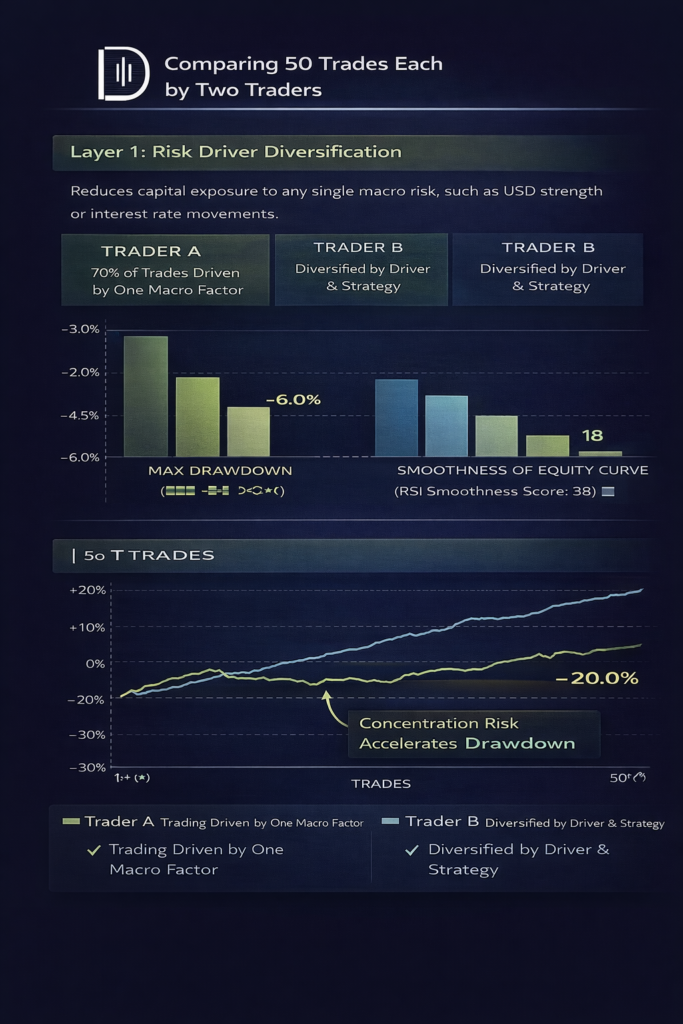
Most trade publications track victory rate and multiple. Few people monitor strategy or asset class performance. Works your diversification plan? Refer to your journal.
Which strategy generates greatest revenue?
Most declines which asset?
Volatility increases collective losses.
DayTradersDiary.com’s Trade Journal Template ranks trades by session and setup. Deal names depend on the driver and strategy.
After 30–50 trades, patterns emerge. But “diversified” investments complicate things when 70% of your earnings come from one location. Diversification only serves if it stabilizes the equity curve.
Scaling Smart: Capital Growth Without Concentration Risk
Sometimes skill is more important than money. After you have an edge and a plan for diversifying, the next thing to think about is the size of your account. Professional evaluation programs are helpful.
Firms like The5ers, FTMO, and Topstep have severe constraints on how much they can lose and how much they can grow each day. Disciplined traders get beyond these problems. They make people richer.
The5ers looks at low-risk growth strategies with clear goals. Traders that know how to keep their money secure and manage their accounts do well in these situations since they don’t utilize just one aggressive method.
A lot of expert traders set aside portion of their activity for an evaluation account, which keeps their money safe and spread out.
If you have a good way to do things but don’t have enough money to grow, think about getting a The5ers assessment account as a way to grow without taking on more risk.
Frequently Asked Questions
Should active traders invest widely?
Diversification in three layers works best. Risk, approach rationale, and capital structure should be varied. Tool overload isn’t enough.
Are trading and investing diversification the same?
No, long-term investing requires asset diversification. Active trading needs shorter cycle diversity to account for correlation spikes and session behavior variations.
Diversify losses?
As long as assets and methods aren’t connected. Not enough diversity can worsen drawdowns when exposures coincide.
Do I need to trade many markets?
Only if you can measure the link and danger. Without knowing it, you might be three times more harmful.
Final Takeaway
Many traders try to grow by making additional trades. Capital structuring improves professionals. Short audit this week. List your latest 20 trades. Determine how many used the same macro element or method. That metric will reveal your danger more than your victory rate.
DayTradersDiary.com discusses professional risk management plans. Read it to learn more. Without risk management, diversifying your portfolio is insufficient.