
Most traders believe they are testing their strategies.
They look at a chart and say, “That would have worked,” when they see a clean setup. They think they have the best backtest day trading strategy after seeing twenty examples. Then they go live, and the truth hits them.
Slipping. News spikes. Hesitation because of feelings. Changes in the regime.
Most strategies fail in the space between theoretical edge and tradable edge.
I’ve seen traders spend months perfecting their entries while completely ignoring the size of their samples, their assumptions about how to execute trades, and the state of the market. Backtesting isn’t about showing that your plan works. It’s about attempting to prove it wrong under realistic conditions.
You need structure, statistical honesty, and a way to tell the difference between pattern recognition and confirmation bias if you want to backtest a day trading strategy correctly.
This guide is based on real trading experience, quantitative research, and what really works when you have a lot of money in your account.
What Research Actually Says About Backtesting
Retail traders rarely look at academic evidence on performance persistence and survivorship bias. They should.
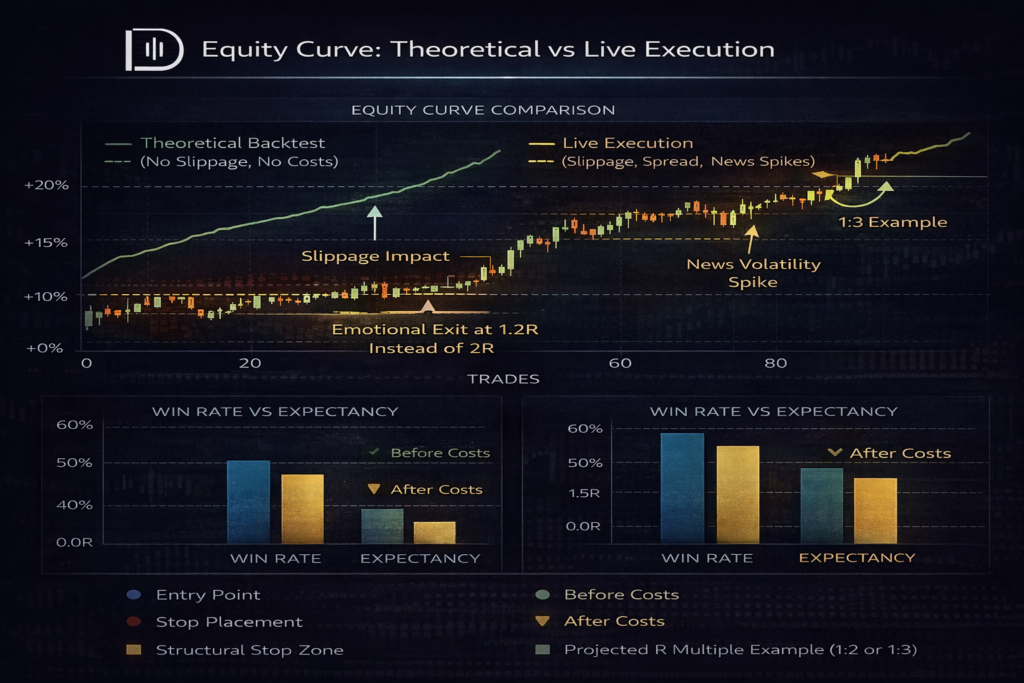
Research frequently published through the National Bureau of Economic Research highlights how many investment strategies lose effectiveness after publication due to crowding and data mining. In trading, that means that strategies that are too good at what they do often fail when they are put into practice with real money.
The Bank for International Settlements has shown that the amount of money available in intraday FX markets changes a lot when macro releases come out and sessions overlap. Your results are not complete if your backtest doesn’t take into account the liquidity at different times of the day.Meanwhile, transaction cost analysis studies from the CFA Institute repeatedly show that slippage and commissions materially reduce short-term strategy performance. For day traders, this is not a footnote. It is often the difference between positive and negative expectancy.
Here is what this means for you.
If your backtest does not include realistic spread assumptions, session filters, and out-of-sample testing, you are not measuring edge. You are measuring chart aesthetics.
The Professional Backtesting Framework
When traders ask how to backtest a trading strategy automatically or manually, I give them the same core framework.
Before you touch any data, be clear about the rules.
Your entry must not be biased. Not “strong momentum,” but something you can measure, like “5-minute close above previous 30-minute high with ATR above 20-period average.” It is not testable if two traders can’t follow the rule on their own.
Define exit logic with the same level of detail.
Fixed R targets, exits based on structure, trailing stops, or exits based on time. Each produces different distribution curves. You cannot compare results across changing exit logic.
Define market conditions.
Session. Instrument. Volatility regime. Trend filter or range filter. A breakout system during London open behaves differently from the same system during New York lunch.
Pick your testing method after the rules are set in stone.
Discretionary traders can use manual backtesting very well. It makes you think about structure and context. But it needs to be written down in a systematic way.
Automated backtesting is very useful for systems that follow rules. You can do batch testing on years of tick data with platforms like MetaTrader, TradingView, or custom Python scripts. The risk is too much optimisation.If you tweak parameters until equity curves look smooth, you are curve fitting.
The best backtest day trading strategy approach uses both. Start broad with automation to test viability. Then manually review trades to understand behavioral patterns and edge sustainability.
Sample Size and Statistical Reality
This is where most traders fail.
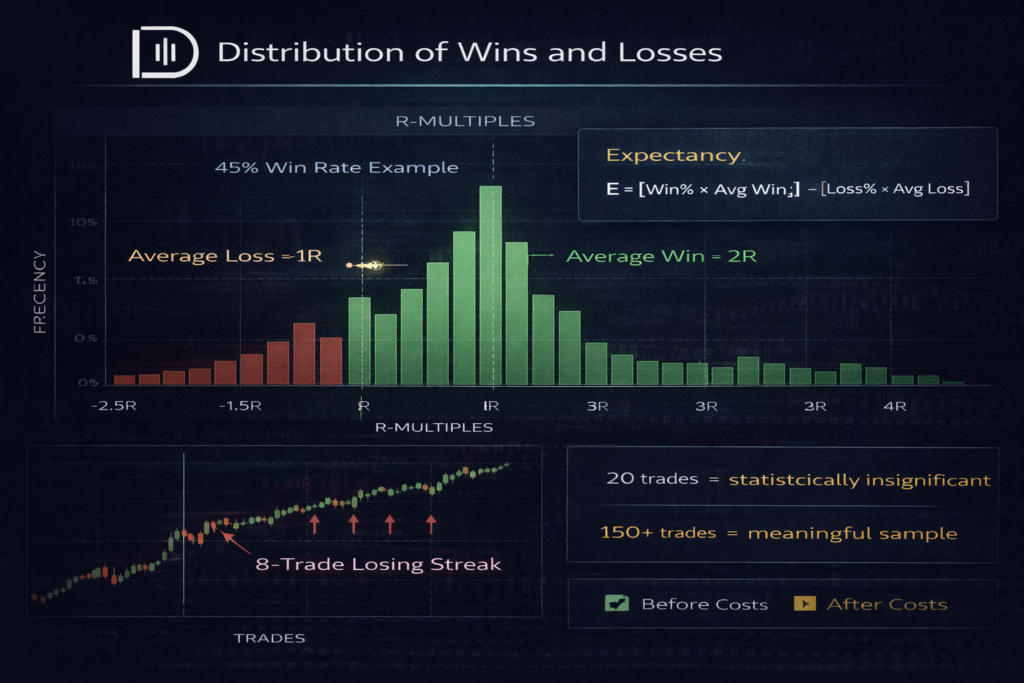
Twenty trades mean nothing. Even fifty trades tell you very little about long-term expectancy.
For intraday systems, I recommend at least 100 to 200 trades before drawing conclusions. More is better.
But quantity alone is not enough. You need distribution analysis.
What is your average win versus average loss
What is the longest losing streak
What is the maximum drawdown
How does performance change across sessions
If your system has a 45 percent win rate with 2R average reward, it can be highly profitable. But if it also produces eight consecutive losses under certain volatility conditions, you must know that before risking real capital.
This is why our article on understanding risk to reward ratios connects directly with backtesting. Expectancy is math. Confidence comes from knowing the math survives stress.
How to Backtest a Trading Strategy Automatically Without Fooling Yourself
Automation speeds up learning but makes mistakes worse.
This is how I think when I make or judge algorithmic tests.
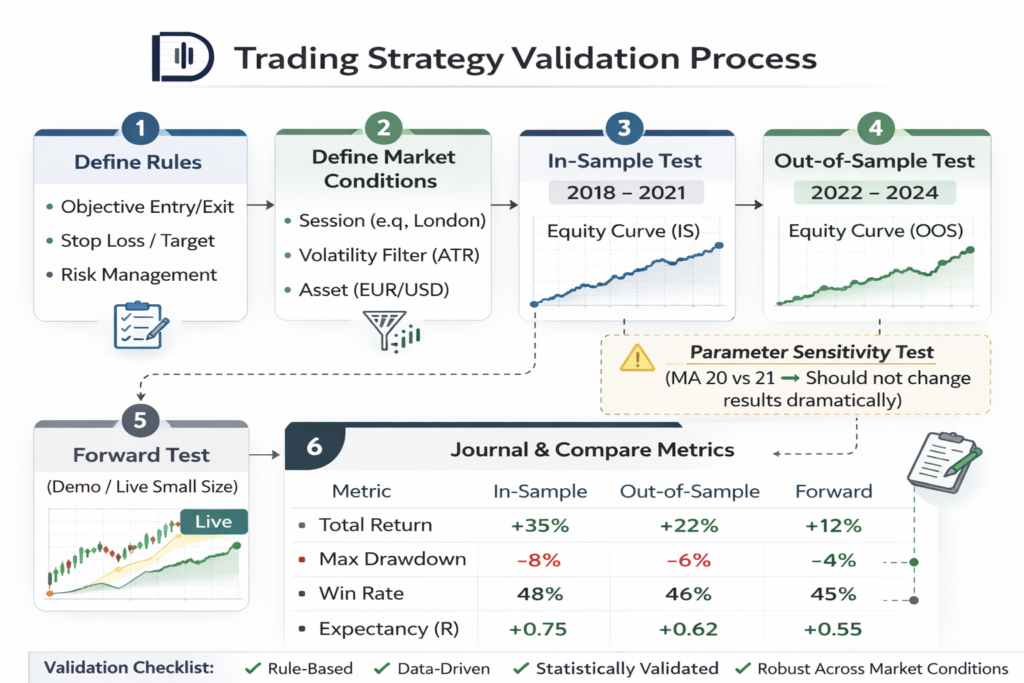
First, split the data into two groups: those that are in the sample and those that are not. Make the plan for one time period. Check it on a completely different time period without changing any parameters.
Second, don’t try to make small changes to parameters. Your strategy is weak if changing a moving average from 20 to 21 makes a big difference in the results.
Third, make sure to include realistic spreads and slippage. If you trade EUR/USD, use conservative spread assumptions when the market is unstable.
Fourth, test it over a number of years and with different levels of volatility. A strategy that only works in years with a lot of volatility is not universal.
Automation answers whether something works statistically. It does not answer whether you can execute it emotionally.
For that, you need forward testing in a demo or small live environment.
Risk and Execution Discipline
Backtesting creates confidence. Overconfidence destroys accounts.
If you double the risk per trade during drawdowns, a backtested system that shows a 20% annual return means nothing.
Most traders make mistakes about risk here. A position size calculator takes the guesswork out of the equation and makes sure that you always match lot size to stop distance.
Execution discipline means making sure that what you do in real life matches what you thought would happen when you tested it.
If your backtest exits at 2R but you consistently close at 1.2R due to fear, your real expectancy is different.
This is why our Position Size Calculator and risk management guides are not optional add-ons. They are part of the backtesting ecosystem. Without consistent sizing, your test results are irrelevant.
Journaling to Validate the Backtest
Backtesting is hypothesis. Journaling is validation.
Once you go live or demo, every trade should be tagged according to the same criteria used in your test.
Setup type
Market condition
Session
Execution quality
Emotional state
Compare live metrics with backtested metrics after 30 to 50 forward trades.
Is the win rate the same?
Is the average R the same?
Is the profile of the drawdown the same?
If the live performance is very different, find out why.
The gap is often in the mind. Not acting on valid signals. Leaving early. Not making trades after losing.
Our Trade Journal Template, which you can download, helps you organise this process so you can compare backtest expectancy with real-world execution.
Without journaling, you are guessing whether your strategy works. With journaling, you know.
Scaling an Edge Beyond Personal Capital
At some point, serious traders face a ceiling.
Your backtest shows that the expectancy is always the same. Your test in the future proves it. But the size of your account limits how much money you can make.
This is where evaluation models logically fit.
Companies like The5ers, FTMO, and Topstep offer structured challenges that are similar to the risk controls used by institutions.
For example, The5ers stresses realistic drawdown limits and scaling plans that are based on performance goals. For traders with strategies that have been proven to work, this environment can help their capital grow faster without putting their own money at risk.
An evaluation account won’t help you make money faster. It tests your backtested edge under real-life conditions.
If your system can’t meet certain risk levels, the problem isn’t money. It is strong.
If you’ve already made and tested a strategy that works over and over again, you might want to try it out in a The5ers evaluation framework. It makes you stick to your plans and rewards you for doing so.
Frequently Asked Questions
How long should I test a day trading strategy?
Test over a number of years and in different levels of volatility. For statistical relevance, you should aim for at least 100 to 200 trades.
Is it possible to trust manual backtesting?
Yes, as long as the rules are clear and every trade is recorded in a systematic way. Manual review often gives discretionary traders a better understanding.
How can I tell if my plan is strong?
It works well in all kinds of market conditions, keeps a positive expectancy after accounting for realistic costs, and shows the same metrics in forward testing.
Final Thoughts
Backtesting is not about finding a perfect system. It is about building statistical confidence that survives execution friction and market variability.
Your challenge is simple.
Take one strategy you believe in. Write down the exact rules. Backtest at least 100 trades with realistic spreads and fixed risk. Then compare the equity curve to your emotional tolerance for drawdowns.
Most traders don’t do this step because it takes away the fantasy.
Experts like it because it gives them confidence.
You should read our in-depth guide on how to make a rule-based intraday trading plan again for your next read. It will help you turn backtested data into a structure that works.