
Most Forex traders don’t blow accounts because their strategy is bad. They blow accounts because they trade too much.
Overtrading rarely feels reckless in the moment. It usually feels productive. More charts open. More pairs watched. More trades taken “just to stay engaged.” I’ve seen skilled traders lose money over time due to a thousand tiny mistakes.
Thinking more transactions improve odds is a massive mistake. Trading often entails fewer possibilities, poor execution, and emotional decisions.
This tutorial uses real trading logs, behavioral data, and years of observing traders make the same mistake in different markets. PnL suffers from tougher rules. Determine risk and profit, then achieve these objectives.
What the Data Actually Says About Overtrading
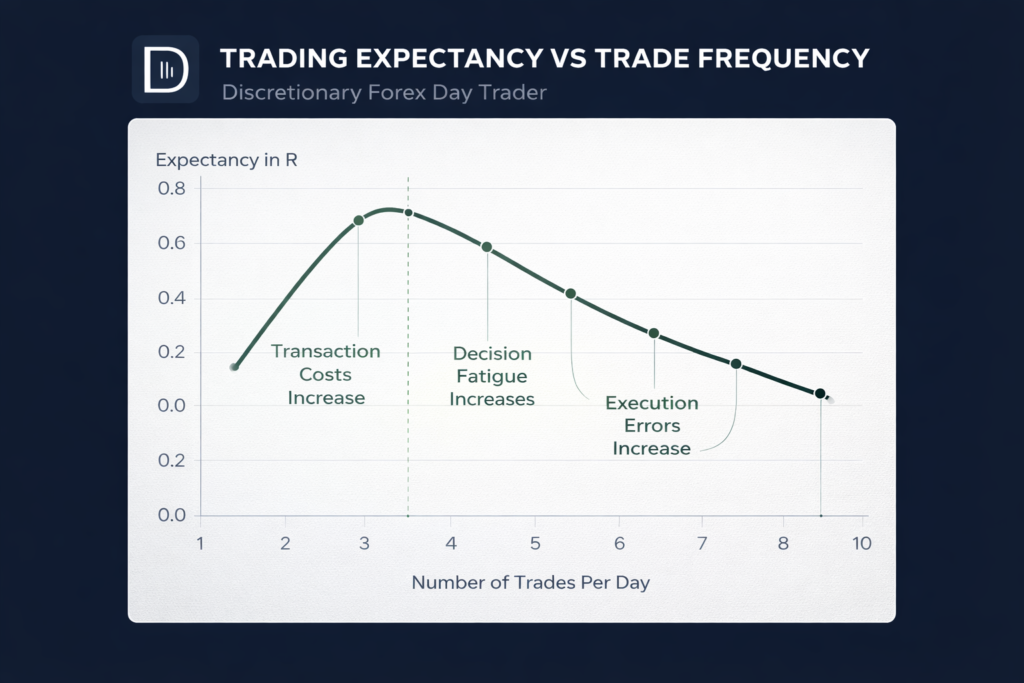
Several high-quality data sets consistently show that activity hurts performance beyond a certain point.
A well-known study by Barber and Odean analyzed tens of thousands of retail trading accounts and discovered that after costs, the most active traders did much worse than the market. Their conclusion was blunt: excessive trading is hazardous to wealth. You can review the study summary via the University of California database.
The CFA Institute has also published behavioral research showing that overconfidence and action bias lead traders to trade more frequently during uncertain conditions, exactly when edge is lowest.
More recently, broker-level analytics shared by firms like IG Group and OANDA show a similar pattern in Forex specifically: traders with fewer, higher-quality trades tend to have higher expectancy than high-frequency discretionary traders.
What this means for a day trader is not “trade less” in a motivational sense. It means understand that every additional trade has a declining marginal edge. After your A+ setups are taken, what’s left is usually noise.
Overtrading is not a volume problem. It’s a selectivity problem.
A Practical Framework to Avoid Overtrading in Forex
Framework 1: Trade Opportunity vs Trade Permission
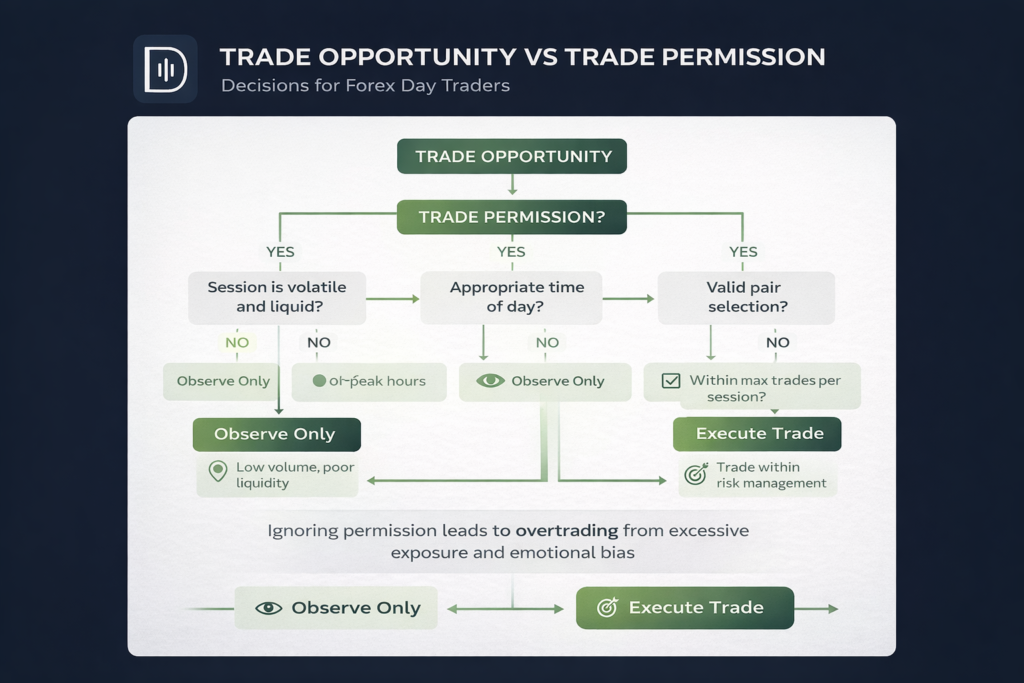
One of the most useful mental shifts is separating opportunity from permission.
The market offers endless opportunities. Your trading plan offers limited permission.
ahead of the session starts, make sure you know what the exact market circumstances are that you can trade in.
The most trades you can make
The time frame when your edge has been there in the past
For example, “If the London session is less volatile and the New York session is more volatile, I can make up to two trades on EUR/USD or GBP/USD.” I only watch other than that.
This prevents “permission creep,” where one trade protects another until the session blurs.
Framework 2: The Decision Fatigue Curve
Trades become more aggressive later.
Why? Sick of choosing.
Every business decision is thought-out. Risk assessment is tough in many deals, even winning ones. Knowing marginalized places follows.
Stop trading at your daily profit objective or max fall. Simple yet effective. Behavior, not market decline.
A lot of traders connect this idea to established rules, but it makes more sense to think of it as defending the quality of execution rather than implementing discipline for the sake of discipline.
Framework 3: If-Then Scenarios Instead of Signals
Reactive thinking facilitates overtrading.
Add “I’ll trade if I see a setup” – “If price breaks X level with volume during Y session, then I execute.”
I do nothing when prices fluctuate between levels.
Conditional thinking greatly reduces impulse trades. You can also see where logic went wrong, making it easier to overlook errors.
This plan works well with the analysis frameworks we talked about in our DayTradersDiary.com piece about rule-based intraday trading strategies.
This approach pairs well with the decision frameworks discussed in our article on building rule-based intraday trading plans on DayTradersDiary.com.
Where Overtrading Connects Directly to Risk and Execution
It’s not simply a mental thing to overtrade. It’s math.
Every trade that is added makes:
Costs of transactions
Exposure to change
Mistakes in execution while tired
This is where most traders get their risk wrong, not for each trade, but for each day. They size each deal accurately, but they don’t think about how much risk they are taking on overall.
Using a position size calculator removes guesswork here. When you know exactly how much capital is at risk per trade and per session, it becomes much harder to justify “just one more trade.”
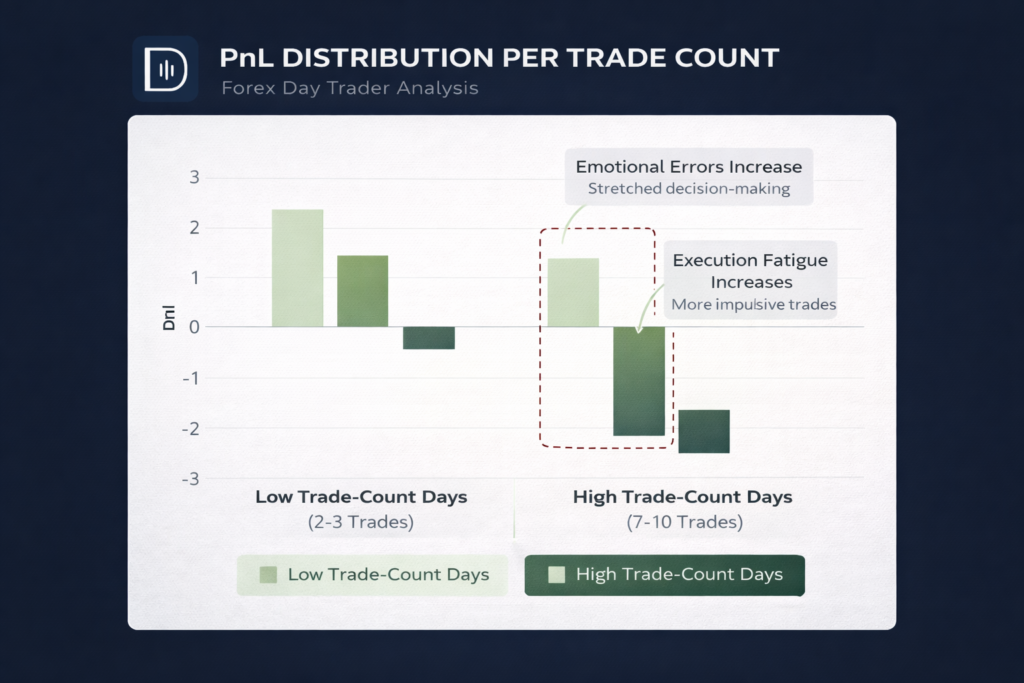
If your plan risks 0.5 percent per trade and you take eight trades instead of three, your real daily risk profile has doubled, even if each trade looks conservative in isolation.
This execution mistake is closely related to the issues discussed in our risk management breakdown on intraday drawdown control.
Journaling: Turning Overtrading Into a Measurable Variable
Most traders journal outcomes. Very few journal behavior.
If you want to avoid overtrading, track:
- Number of trades per session
- Reason for each trade
- Emotional state before and after execution
- Whether the trade was planned or reactive
Patterns appear quickly.
You’ll often find that your worst days are not your biggest losers per trade, but your highest trade count days.
Using a structured trade journal template makes this process objective instead of emotional. Overtrading creates a performance issue that can be rectified when it is obvious.
One question per week in your journal:
“If I didn’t have enough money, which trades would I not do again?”
The one inquiry eliminates much noise.
Scaling Without Falling Back Into Overtrading
Many traders seeking improvement fall into this trap.
They cease overtrading, gain self-control, and become consistent, but their account size limits them. Higher frequency accelerates development.
Indeed, expert traders differ.
Capital efficiency, not trades, increases.
Because professional traders seek to scale up their proven execution without changing their behavior, evaluation-based prop businesses like The5ers, FTMO, and Topstep exist. The structure requires selection. Trading too much has consequences.
The5ers focuses on low leverage, downside risk limitations, and long-term expansion, which is great for traders who have already fixed their overtrading problem and want to keep it that way.
If you are routinely making money but feel limited by the size of your account, getting a The5ers evaluation account is a smart move, not a quick fix. It rewards being disciplined, not doing things.
FAQs: How Traders Search This Topic
Why do I overtrade even with a solid strategy?
Because overtrading is rarely a strategy issue. It’s usually boredom, fear of missing out, or lack of predefined permission rules.
How many trades per day is too many in Forex?
There is no universal number, but for most discretionary day traders, performance drops sharply after three to five trades per session.
Is overtrading the same thing as trading for revenge?
Not all the time. Revenge trading is when you trade because you’re angry about losing. People can overtrade even on days when they win because they are too sure of themselves.
Can automation assist stop people from trading too much?
Yes, but only if the rules are clear. Poor automation just makes bad behavior worse.
Final Thoughts and a Challenge
Not overtrading in Forex isn’t about willpower. It’s all about structure.
Here’s your challenge for the next five trading days:
Limit yourself to your best two setups per session. Journal every trade you don’t take. Review which non-trades saved you money.
Most traders focus on entries. Professionals focus on restraint.