
Most day traders trade price, not news. After the CPI spreads expand, a nice setup fails, and the post-mortem is bad luck or manipulation. The real issue is less complicated and easier. Trade was always noteworthy. Few got it.
Daily forex isn’t driven by headlines. Evolving expectations, risk pricing adjustments, and positioning moves in minutes rather than days impact it. Short-term traders that ignore news mechanics miss critical information.
Not anticipating news with this guide. It’s understanding how daily forex news affects prices, when it presents opportunities, and when it silently ruins technical trades.
Everything here comes from a mix of market data, execution experience, and watching traders repeat the same mistakes across different news cycles.
What the research really tells us about news and intraday FX moves
High-quality research on news impact in FX is consistent on one thing. Prices move most when data surprises expectations, not when data is simply good or bad.
The Bank for International Settlements has shown time and time again that currency rates change a lot when unanticipated macroeconomic data comes out, especially inflation, employment, and central bank communication. Based on their study of FX microstructure, traders change quotes and keep track of inventories within minutes.
When trading is one-sided before the release, volatility spikes are short-lived but directional, according to Federal Reserve Bank of New York research. Because of this, some news trends rise for hours and then fall.
Even if they happen briefly, scheduled high-impact releases generate more intraday range rise than they should, according to DailyForex and other institutional studies.
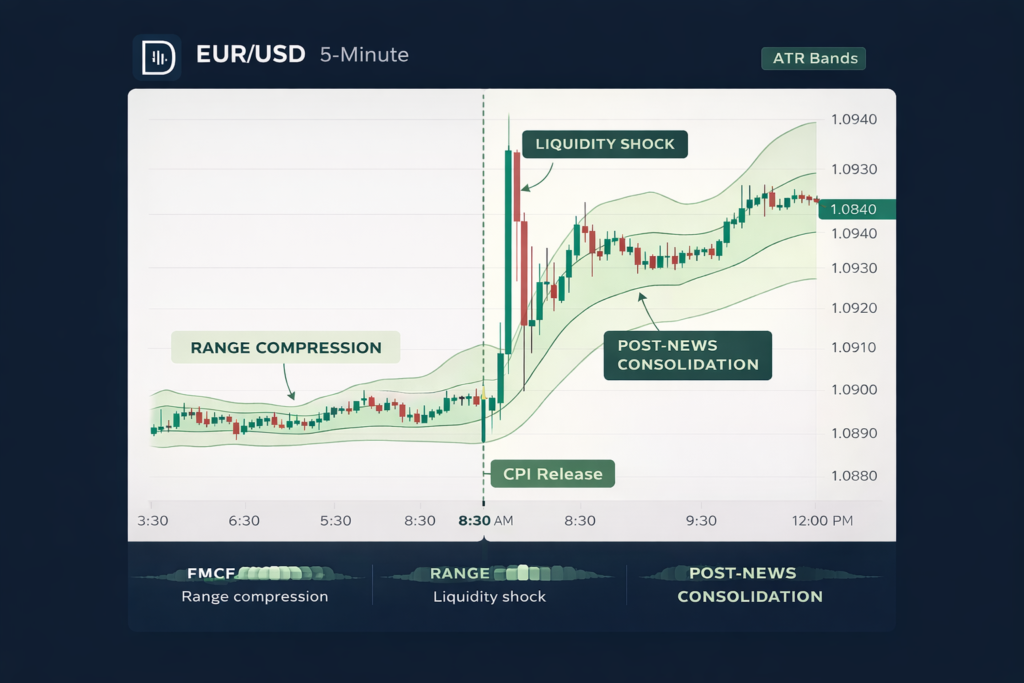
This is very important for day traders. News is not just erratic noise. It is a catalyst for volatility and a path that works with the current order flow. If you know what people expect, where they are, and how much money is available, news becomes a tradeable structure instead of chaos.
A practical framework for trading news-driven intraday moves
Experienced day traders ask three questions instead of if the news is good or poor.
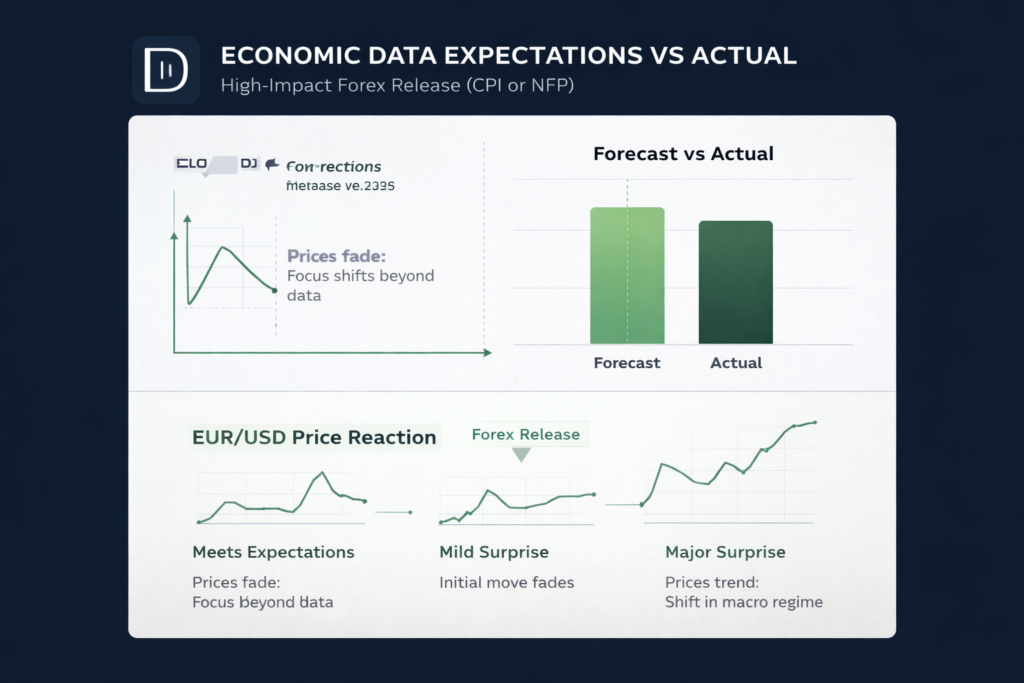
First, was the result surprising or just news? A data point that meets expectations generally rises and falls quickly. An unexpected turn of events keeps things going.
Second, how does price fit into the structure throughout time? What happens when news breaks a price out of a multi-session range is different than when it reaches in the middle. Breakouts that satisfy the greater time period bias tend to last.
Third, what was the pre-release market like? Market movement comes from tight ranges, low volatility, and little liquidity. Long moves and crowded trading are risky.
Many skilled intraday traders use this simple assessment procedure.
Price is expected to rise before a significant announcement with clear support and resistance. Don’t disregard intuition. Let the market demonstrate it accepts structure above or below.
If the price has been rising before the release, set lower targets. Profit-taking halts or reverses many strong pre-news moves.
Data is when the first reaction is violent but subsequently returns to pre-announcement levels. The unanticipated outcome upset the market. Wait for mean reversion or stand back till volatility subsides.
This framework pairs well with structured intraday approaches discussed in our article on session-based forex volatility and why London and New York behave differently.
Why some news trades work and others fail
Lack of attention is the biggest mistake. Execution timing and context.
Retail traders participate when the spread is greatest and liquidity providers are protecting themselves. Bad fill, tight stop, and even a great idea fails to make money.
A typical mistake is treating all news the same. CPI, NFP, and central bank rate decisions change the prices of currencies. Unless it changes anticipations about policy, mid-tier data usually only makes noise for a short time.
Experienced traders also respect when not to trade. If you rely on limited stops and a clean structure, high-impact releases can make your plan useless for 15 to 30 minutes. Waiting is not a bad thing.
For a more detailed look at execution faults that happen during volatility spikes, check out our tutorial on frequent intraday execution errors that hurt efficiency without anybody noticing.
Risk, position sizing, and execution during news
News makes both chances and mistakes bigger. This is where most traders get the risk wrong, especially when the market is more volatile.
Having a set lot size during news is a secret bet. Stops need to breathe, so the size of the position has to go down. A position size calculator takes the uncertainty out of the equation and keeps risk the same even when things change.
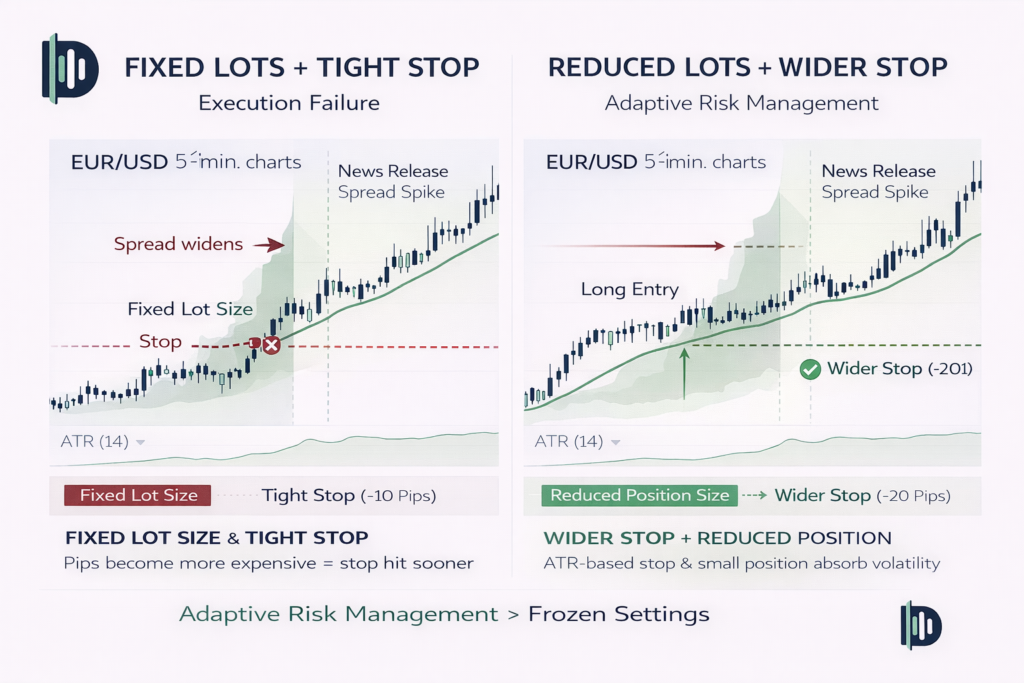
Professionals also select maximum slippage tolerance. If you can’t manage entrance quality, control size. Avoid trading at your highest risk during news.
Daily news traders lack courage. They consider execution more carefully.
Journaling news trades to sharpen your edge
Most traders keep track of their results. Low journal context. When trading news, context is important.
Put a tag on each trade that says “release,” “anticipation vs. outcome,” “continuation,” “reversal,” or “fade.” Patterns start to form. You may discover that you perform best trading post-news pullbacks, not initial spikes.
Review not just winners and losers, but also missed trades. Examine both good and terrible bargains. Many traders know their edge is waiting for the after-news calm.
Structural trade diary templates accelerate up and clarify this procedure. News goes from emotional to quantifiable.
Scaling an edge beyond personal capital
A refined news framework without sufficient capital caps upside. This is where many disciplined traders hit a ceiling.
This can be fixed by professional evaluation programs. The5ers, FTMO, and others offer organised environments that prioritise risk management above aggression. Not easy ways to get things done. They filter.
Successful traders in such strategies know how to control decreases in size positions, and stick to their plan when the market is uncertain, such when news breaks.
If you can show that you can consistently manage risk around large announcements and do process-driven trading, it could make sense to think about getting a The5ers evaluation account. It lets traders change their exposure without changing their actions, which is where many people give up.
Closing: one improvement that pays off immediately
Avoid asking what the news will do when you schedule a trading day. Consider its effects on strategy volatility, liquidity, and structure.
Your task is simple. This week, there is only one big release in trade, and it’s smaller, slower, and more apparent than normal. Both the result and the background.
As your next read, revisit our analysis of how skilled day traders adapt to the market. News is simple but reveals weaknesses immediately.
FAQs
Does daily forex news always move the market intraday?
No. Only news that meaningfully shifts expectations or positioning tends to create sustained intraday moves.
Is it better to trade during news or after?
It all relies on how well you do it. Many day traders do better with trading after the news than with the first reaction.
Which news events matter most for day trading?
Inflation data, assessments on the job situation, and decisions made by central banks always have the biggest effect on the market during the day.
Can technical analysis still work during news?
Yes, but only when combined with volatility awareness and adaptive risk management.