
Most forex day traders do not lose money because they trade the wrong pairs or use the wrong indicators. They lose because they show up at the wrong time.
I have reviewed thousands of trade journals over the years. A repeating pattern always stands out. The strategy looks fine. Risk is reasonable. Execution obvious. However, traders make trades at dull hours, when money is scarce, or when they don’t understand session overlaps.
This causes entries to be chopped off, unexpected halts, and that irritating feeling when nothing is wrong but nothing works.
This tutorial uses real session data, institutional market structure, and real traders. Non-theory. Not general “trade London session.” advice. Helping you decide when to trade, when to quit, and why timing is advantageous.
What the Data Actually Says About Forex Trading Hours
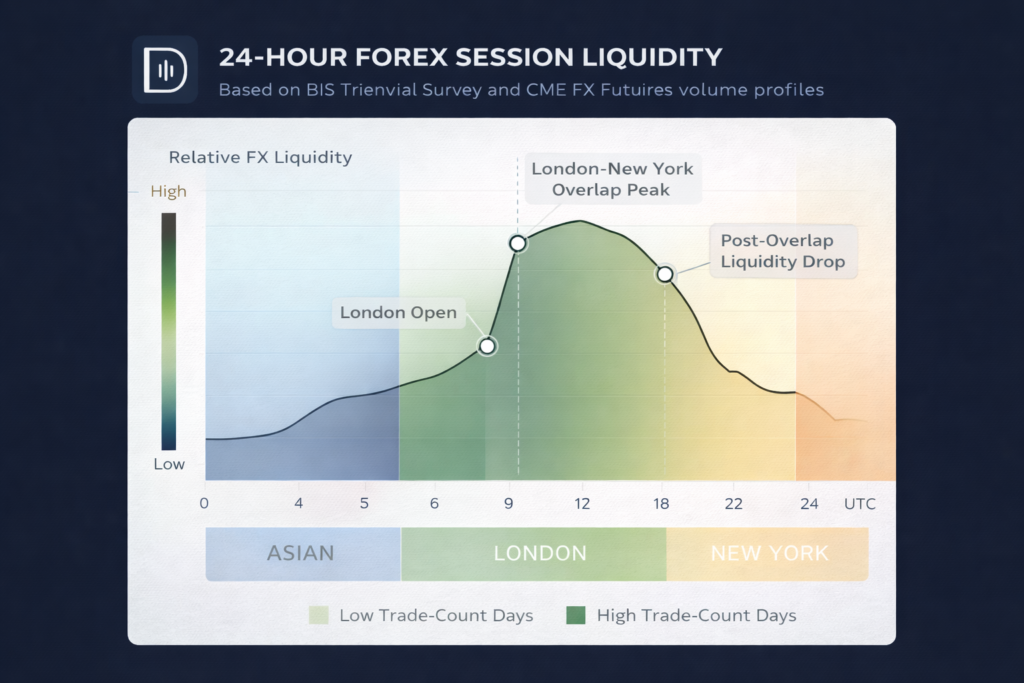
Let’s ground this in facts before moving into frameworks.
The Bank for International Settlements Triennial Survey says that more than 70% of all FX trading happens during the hours when London and New York are open. Forex markets are open 24/7, and liquidity varies. It gathers in bustling institutions.
CME FX futures volume profiles and Forex.com liquidity figures always show three things:
- As banks and funds operate, spreads are narrow and order flow is clean.
- Low liquidity increases volatility and false breakouts.
- Retail drops most when institutions are inactive.
You can explore this further in BIS FX market research and CME FX session volume data, both publicly available and widely referenced by professional desks.
What this means for day traders is simple. The market is most tradable when large players are present and least forgiving when they are not.
Understanding Forex Sessions Beyond the Textbook
Most traders know the session names. A lot fewer people comprehend how they act.
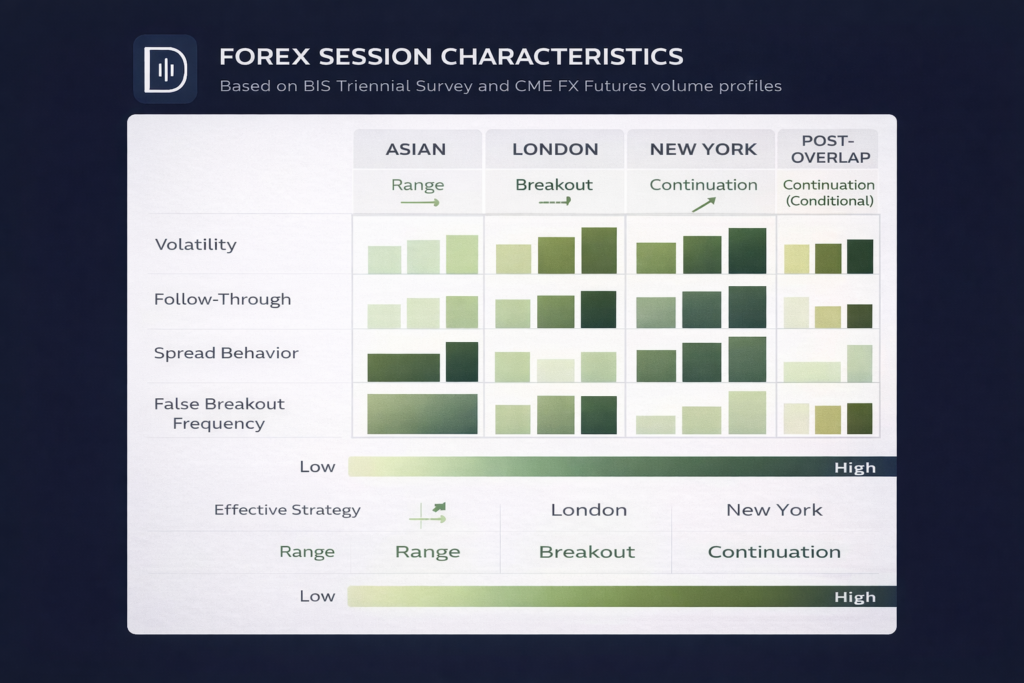
Asian Session: Structure Without Follow-Through
Asian session expands range, not expands. Trading yen pairings and AUD-related items, however price discovery is limited for most large pairs.
Best for this session:
Range-fading strategies
Pre-London liquidity
Effective mean reversion traders
Thinking breakouts will last doesn’t work.
London Session: Real Price Discovery Begins
The London FX market awakens.
Overnight range attacks occur.
Removed Asian high-low stops.
Days usually have a directional tilt.
Traders who organize well, not quickly, win this session. Chase the initial breakout frequently fails. After the funds is taken, consistency comes from waiting for the drop.
New York Session: Continuation or Distribution
New York doesn’t usually start new trends. It often builds on or diminishes what London started.
The London-New York overlap is the most active time of the day for trading. This is when: Growths are narrow
Execution gets better
Institutions change their exposure levels
Behavior changes after the overlap ends. The volume goes away. There are more fake motions.
You need a new plan if you trade late in New York.
A Practical Decision Framework for Day Traders
Instead of asking “What is the best time to trade forex,” ask this instead:
“What market behavior am I trying to trade, and when does that behavior actually occur?”
Here is a framework I use with traders.
Step 1: Define Your Trade Type
Breakout traders need patience and liquidity.
Traders who retreat must be patient and planned.
Range traders need low volatility and clear limits.
They each work effectively in different windows.
Step 2: Match Strategy to Session
If you trade breakouts, watch the London open or London-New York overlap.
After London, trade New York retracements and declines.
Asian sessions benefit range traders.
Overtrading is applying the same approach every session.
Step 3: Set a Hard Trading Window
Professional traders stop trading when conditions degrade. Most retail traders do the opposite.
Pick a fixed daily window and treat everything outside it as off-limits.
If you struggle with this, revisit the article on avoiding overtrading in forex on DayTradersDiary.com. It connects directly to session discipline.
Why Most “Best Time to Trade” Advice Fails
This is the hard truth.
Most traders don’t fail because they trade at unfavorable times. They lose because they trade for too long.
Just because something is available all the time doesn’t mean it can be traded at all times.
Markets reward being picky.
If your diary shows trades spread out over several sessions, it is not diversification. That is not making up your mind.
Risk and Execution Are Session-Dependent
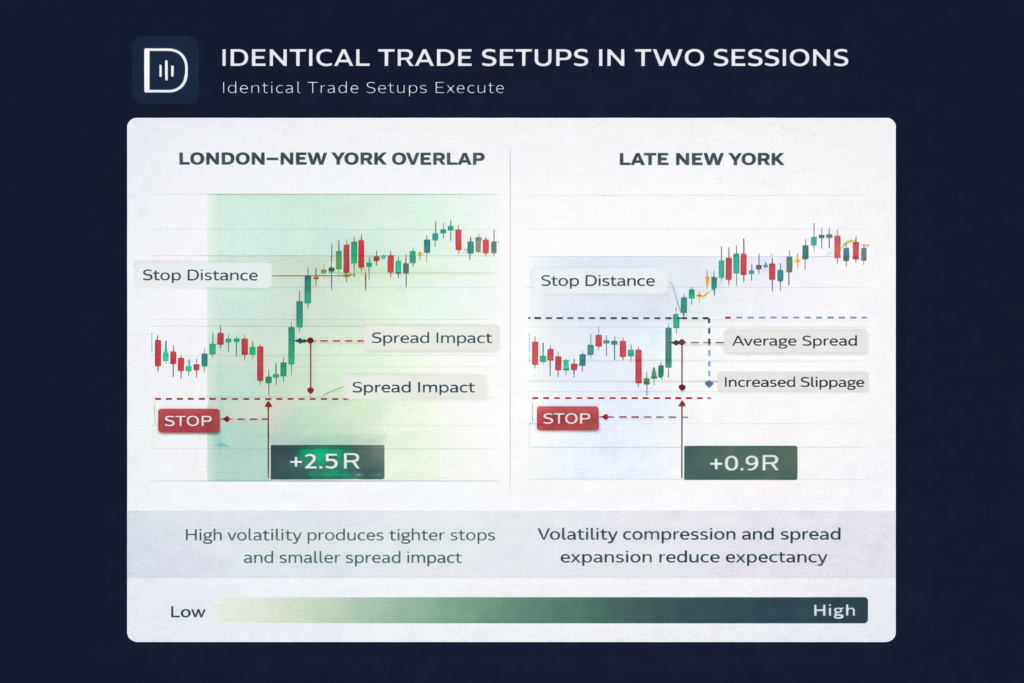
This is where most traders miscalculate risk.
Stops behave differently in thin markets. Slippage behaves differently during news windows. Spread expansion changes R-multiples without you realizing it.
Position sizing must adapt to session volatility.
This is why using a position size calculator removes guesswork. It forces you to quantify risk based on current conditions, not assumptions carried over from another session.
Same setup. Same risk percentage. Very different outcome depending on timing.
Journaling What Time Actually Pays You
Most traders write down when they enter and exit trades. Few people write down how they do at different times of the day.
That’s wrong.
Your strategy might not be what gives you an edge. It may be when you sell it.
Use the Trade Journal Template on DayTradersDiary.com and add:
Session
Time frame
Bias before the session
Quality of execution
Patterns start to show up quickly after 30 to 50 trades. You will be able to observe which hours slowly take money out of your account and which hours add to it.
Scaling the Edge Without Capital Constraints
Professional traders must face this truth.
Without money, growth slows even with an edge.
This is why many disciplined day traders use evaluation-based prop firms. Less easy. Tools for scaling.
Traders can use timing-based tactics on bigger amounts of money using The5ers, FTMO, and Topstep without changing the regulations.
Simple to understand.
For sessions where your edge does well, increase its visibility.
The5ers has long-term growth methods and swing trading regulations that don’t overuse leverage. Traders that emphasize timing and patience above frequency benefit.
Consider whether an assessment account meets your consistency if you wish to progress.
FAQs: What Traders Commonly Ask
Forex beginners should trade what timeframe?
High liquidity narrows time frames for structure. Ignore narrow markets in London and New York when beginners start. Consider smaller discussions.
Should you day trade FX in London or New York?
Direction is London-based. New York confirms or denies. Understanding two is better than one.
Trading forex in Asia?
Only with range-based techniques. It’s frustrating to expect Asian trends.
Is announcement timing more important than session?
News increases session activity. High-impact publications take precedence over separate events.
Closing: One Actionable Challenge
For the next two weeks, do one thing.
Trade only one session.
Same window. Same pairs. Same rules.
Then review results.
Most traders discover their edge was never missing. It was just buried under bad timing.
If you want to deepen this process, the next read I recommend is how to build a consistent day trading routine on DayTradersDiary.com.